Worth the segment alone dealing with the Nobles Trail.Frederick Lander was part of several expeditions of the 1850s to locate a route for a Pacific Railroad. There would be many turn of events during this time period, among them the nation’s civil war. When Lander arrived in the Smoke Creek/Honey Lake area, it just happened with the outbreak of the Pyramid Lake War of 1860, and there were several contributing events in the Honey Lake Valley that had a bearing. Lander was caught in the middle. He did keep an excellent account of those activities, which were published by the Desert Research Institute in 1993 with Joy Cleland as editor.
On a side note, even though he died in 1862, one hundred and thirty three years his estate funded a re-photographic survey of Eagle Lake; where in using photographs of the early 1900s, Desert Research Institute went back to those sites to photograph and examine the changes.
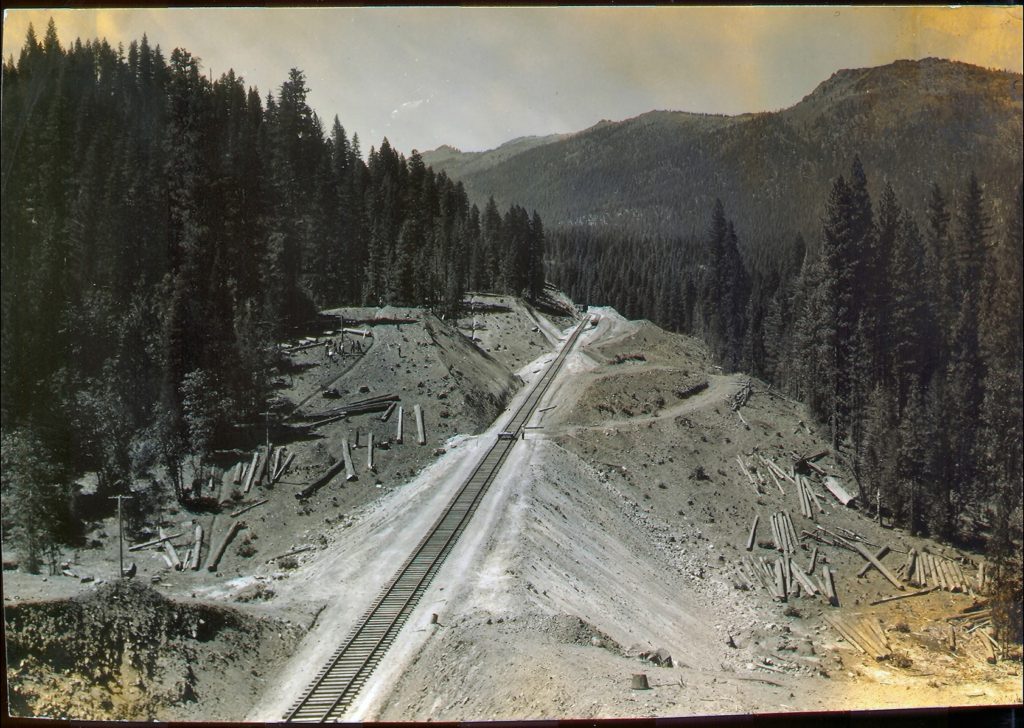
A 1923 view of Papoose Meadows. Courtesy of Lola Murrer TannerOriginally known as Papoose Valley and some time in the 1920s it was changed to Papoose Meadows.
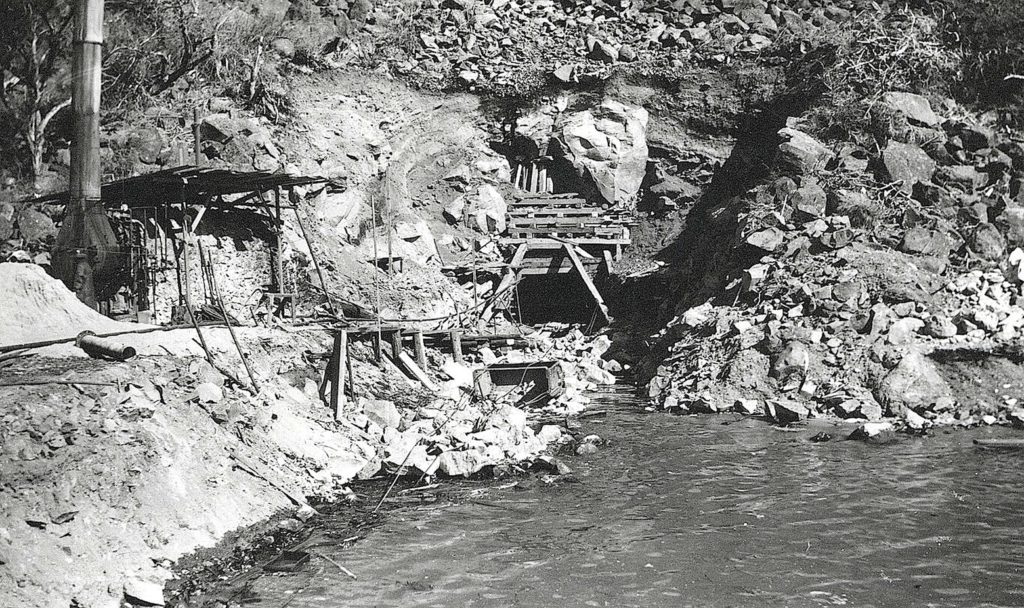
Susan River, 1899. Courtesy of Philip S. HallAs the Bizz Johnson Trail, formerly the Fernley & Lassen Railroad, is popular with locals and out-of-towners, alike, I thought some might enjoy today’s photograph. This was taken below Hobo Camp in 1899 prior to the railroad’s construction through there in 1913. The flume carried water to the Arnold Ditch would power the Arnold Planing Mill at the Richmond Road Bridge.
Courtesy of Louise West CollectionI scanned this and a few others last spring from the Louise West papers who taught Kindergarten and First Grade in Susanville from the 1940s to the early 1970s. At that time, I had mentally prepared a post about this topic, it has since been lost to one of those deep recesses of my mind. Many will find the names quite familiar and these youngsters became a part of Lassen High’s Class of 1959.
October 9, 1977Located on the 900 block of North Street once stood the residence of Thomas N. Long. It was built in the mid-1870s and demolished a century later. The residence had two owners, Long and Bundy & Winifred French. It was torn down in October 1977 and plans were for an apartment complex on the site that that never materialized.October 20, 1977
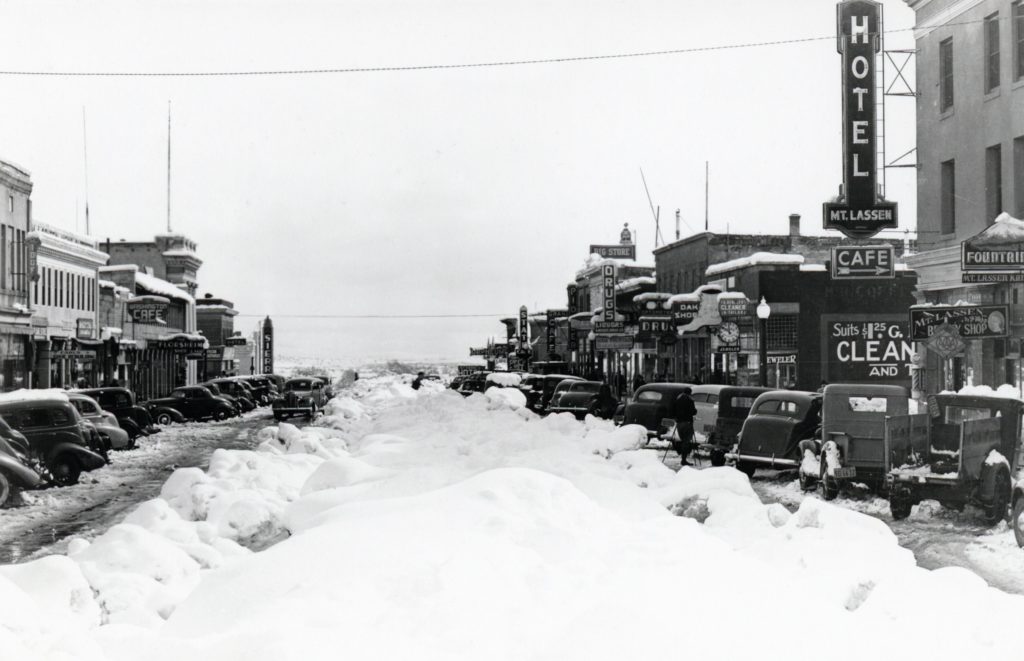
The Emerson Hotel located at Main & Lassen Streets, the current site of the Hotel Mt. Lassen.In 1900-01, Reno building contractor, C.E. Clough kept busy in Susanville with the construction of four major brick buildings—Emerson Hotel, Methodist Church, Oakes & Philbrook and the Susanville Grammar School. Only two remain, the Methodist Church and Oakes & Philbrook, though the Susanville Grammar School was reincarnated, more about that later.
The brick was produced locally, though I am not sure where. In 1878, Robert M. Bean had a brick kiln along Piute Creek, a quarter mile north of town. That would place it around Marmo meadows.
Pine Grove School, 1916. D.m. Durst CollectionIn the 1880s, Big Valley saw a major increase in population, thus more schools were needed. It did not take much to create a school district then. The residents needed to be more than five miles from the nearest school house and have ten school age children in a proposed district. The Pine Grove School was established in February 1888, from sections of the Cedar Run and Pioneer School Districts. On March 17, 1888, an election was held at the residence of J.M. Bassett to approve both a bond measure for $500 and a site for a new school. The voters, all eight, approved the bond measure, though the records do not indicate anything about the school site proposal. On August 3, 1925, the Board of Supervisors approved Pine Grove’s petition to consolidate with Bieber. The residents requested that the abandoned school not be sold, torn down or removed from its site. What became of it, I do not know.
Entrance to Ramhorn CampgroundRamhorn Springs and Campground is located a sort distance east of Highway 395 between Secret Valley and the Madeline Plains. I was told recently, and I do not know if it is a fact, that the springs dried up in the recent drought. Anyhow, bighorn sheep once roamed much of eastern Lassen County. In 1881, Lum Roberts killed one on Skedaddle Mountain that weighed 200 pounds! In the early 1920s, only one band of sheep, consisting of about forty head, remained on Observation Mountain, not that far from Ramhorn Springs. The majority of that herd perished in the winter of 1922. Lassen County Game Warden, C.O. Fisher, noted that only six sheep were still alive at Observation in 1927 and by 1931 it was deemed that the sheep were extinct in the region.
A view from the southern end of Grasshopper Valley, August 4, 2016.The following is a brief account compiled years ago by Lina Goumaz Brownell Barclay (1883-1972) when her father Philip Goumaz operated a ranch at Grasshopper Valley.
The Philip Goumaz ranch was located five miles north of the J.C. York place in Grasshopper Valley. He bought it from Charles McClelland and moved his family from Susanville to here in the spring of 1888.
At the foot of the hill, in back of the house was a fine cold spring. The mail and passenger stage went from Susanville to Bieber in one day and back the next. In later years the change of stage horses were kept at the Goumaz ranch and the driver and passengers ate the noon meal there.
One year the grasshoppers were so thick, a person would kill several taking one step. They ate the leaves off the willows along the creek. When they began eating the standing hay, my father cut it earlier than usual. They ate quite a lot of the hay, so we found out why the valley was named Grasshopper.
There were several other ranches located in the valley. About one mile north from us was the Shanklin ranch. In later years, it was sold to Antone Gerig. Adjoining the Shanklin ranch was the Frank Loveland place. Philip Goumaz sold his place to Bailey, DeWitt and Theodore of the Honey Lake Valley in 1905 and returned to Susanville.