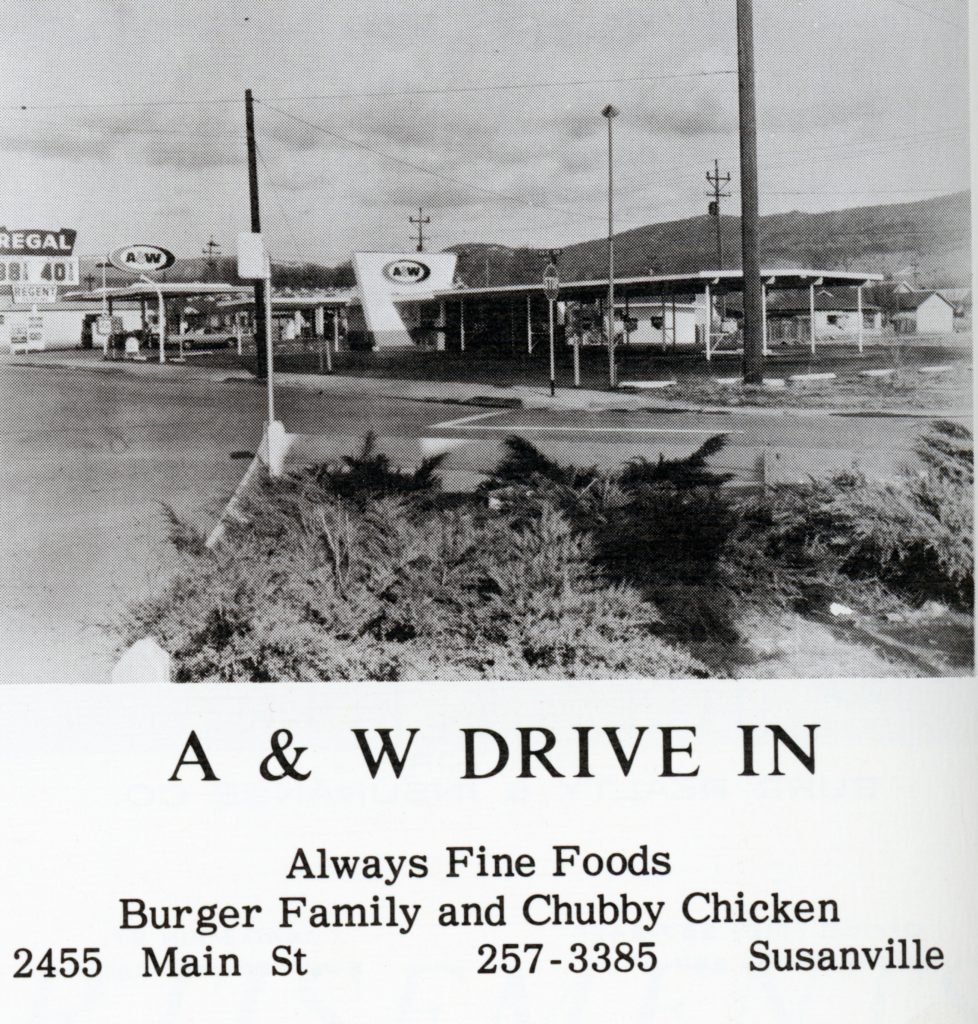
1971 Advertisement in the Lassen Cougar Yearbook. Courtesy of Jim Chapman
Seasoned residents will remember this establishment located at the bend in Main Street. It opened for business on May 22, 1961. It was established by John Gilliam and Leonard Porritt who invested $40,000 in this new enterprise. Decades later it shut down. It was first reincarnated as Chinese Kitchen and today it is the home of the Courthouse Cafe.
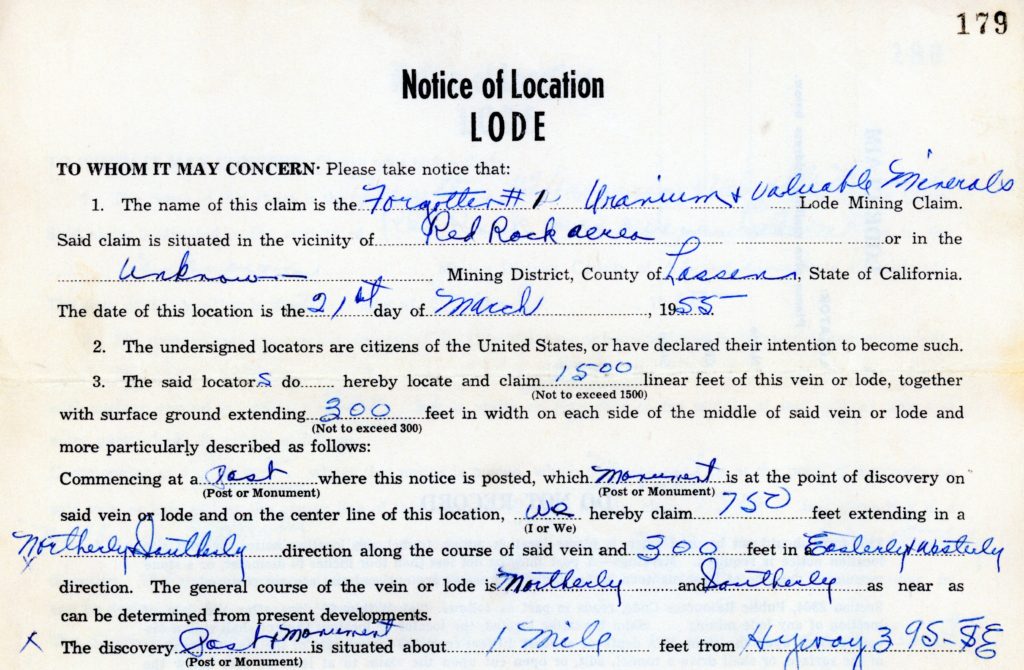
This was one of those events that seemed to happen with a blink of eye and then it was gone. In March 1955 the California Mining Journal featured three articles on the uranium discoveries in Lassen County, or more specifically about four miles north of Hallelujah Junction in the neighborhood of Red Rock. The initial discovery was credited to Carlton A. Brown of Reno in the fall of 1953. What caused tremendous speculation was in 1954 a similar discovery had occurred in Inyo County and those initial prospectors sold their claims for $2 million. As word spread, there was the proverbial land rush to file claims, my family included. By the fall of 1955, it was determined the uranium was of low grade and possessed little value. Interest quickly waned.
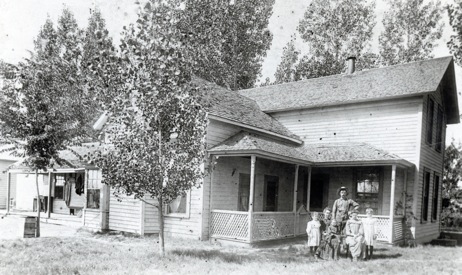
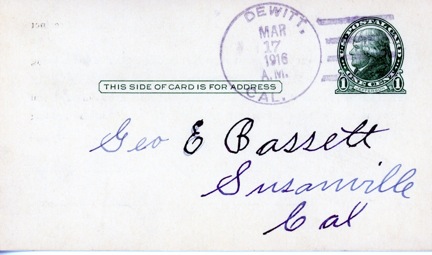
There was a time when the DeWitt family was well known throughout the Honey Lake Valley. However, with time comes many changes and many old time families slowly fade away. DeWitt is one such family.
Franklin and Mary DeWitt settled in the Tule District of the Honey Lake Valley. A portion of their ranch is now known as the Fleming State Wildife Refuge Unit. Their son, Walter B. DeWitt (1863-1948) was a life-long resident of the Tule District. His 1906 biography stated: “The farm which he now occupies is situated on the Spoonville and Hot Springs stage line, about four miles west of the last named place. On his homestead, July 1, 1903, through his earnest and energetic efforts, a post office was established named in his honor, and he was chosen the first postmaster, a position which he still occupies, with his wife as assistant.” The post office closed on November 30, 1927 as part of implementation of the Rural Free Delivery system.
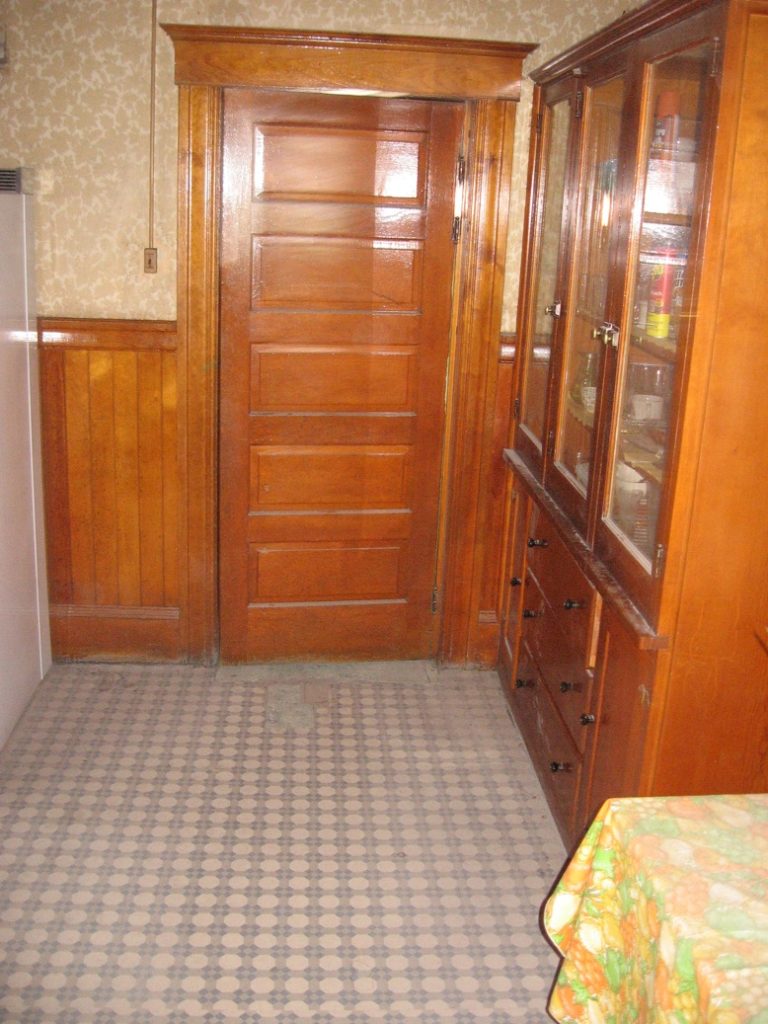
The doorway between the kitchen and dining room, April 13, 2019
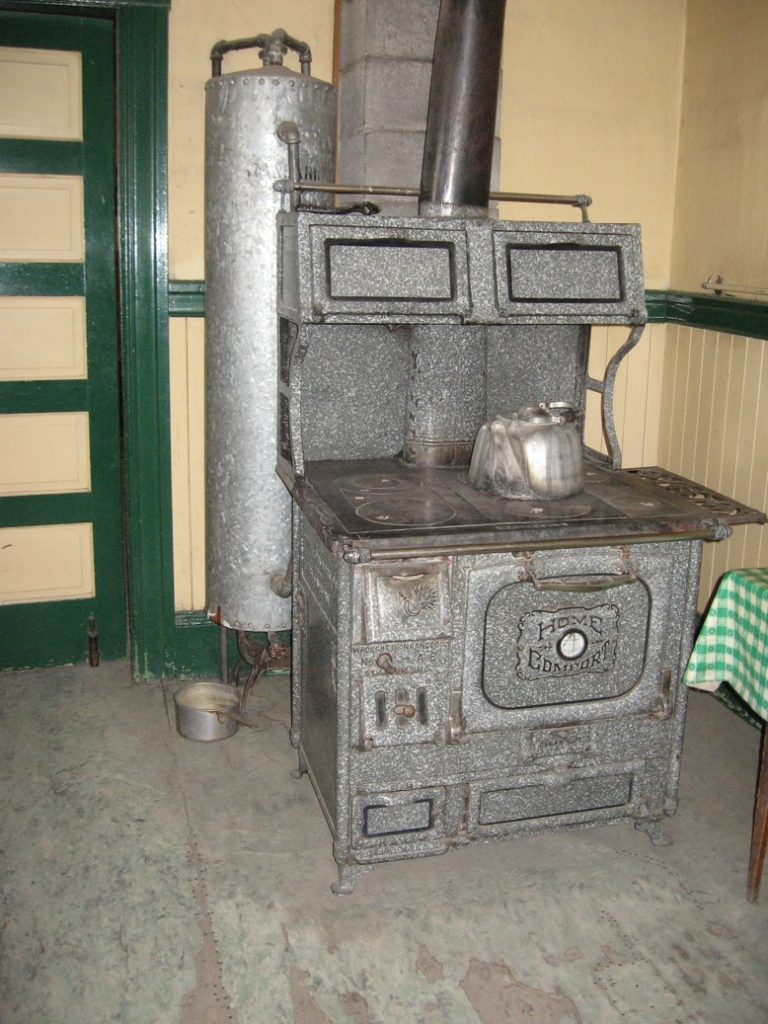
A week ago, I featured an article on historical home interior in Susanville. This Sunday, I decided to do another “light” piece. In 1928, my grandparents John & Lola (Murrer) Tanner traded ranches with the Capezolli family. My grandparents new home was two-story, seven bedroom ranch house built in 1911. Many of the original features remain intact, even the lineloleum. One of the other striking features is the kitchen stove—a Home Comfort Range. My grandmother was more of a 19th century person, so this the only stove she used in her for the rest of her life. You might notice the water tank attached to the stove, which was her source for hot water.
A view of Diamond Mountain, from Lassen High School’s agriculture fields, 1916. Courtesy of D.M. Durst Collection
Spring in this part of California is an elusive creature. The current state of almost winter like conditions is nothing unusual. Then one day, the weather turns hot, summer is here with no real transition from winter to spring.
The above title was a headline story of the Lassen Mail of March 22, 1935. Some may appreciate the tale:
“Spring is here!
“On Thursday of this week Lassen County threw off its mantle of gloom and welcomed the sweet scented breezes of gentle Spring with a howling blizzard, a wind storm and six inches of fresh snow all combined with a drop in temperature that would make an Eskimo run for the furnace room.
“As befits an integral part of ‘sunny California,’ Lassen hailed the new season as chilly winds howled mournfully through the canyons bringing flurries of snow and rain. Indications at present are that the spring season here will be about the same as usual—which is enough bad news for one week.
Piute Creek, April 9, 1938. Courtesy of Betty Barry Deal
In 1870 the California Legislature passed a law that prohibited hogs from running at large in the village of Susanville. This was serious business, since the problem was so bad, the residents had to petition Sacramento for assistance! Take for example that on May 22, 1864, Isaac Roop, the owner of the town’s water system sued Hiram Teft for allowing his hogs to roam freely. It should be noted the town’s water supply was from Piute Creek, and was distributed through open ditches. In Roop’s court complaint he cited, “ Teft’s hogs has entered and wallowed in my water ditch and has urinated and deposited excrements therein whereby the water running in said ditch has been muddied and rendered filthy and make unfit for use.” Roop sought $50 in damages and loss of water sales. As no judgment was entered into the court, Teft and Roop must have reached an agreement.
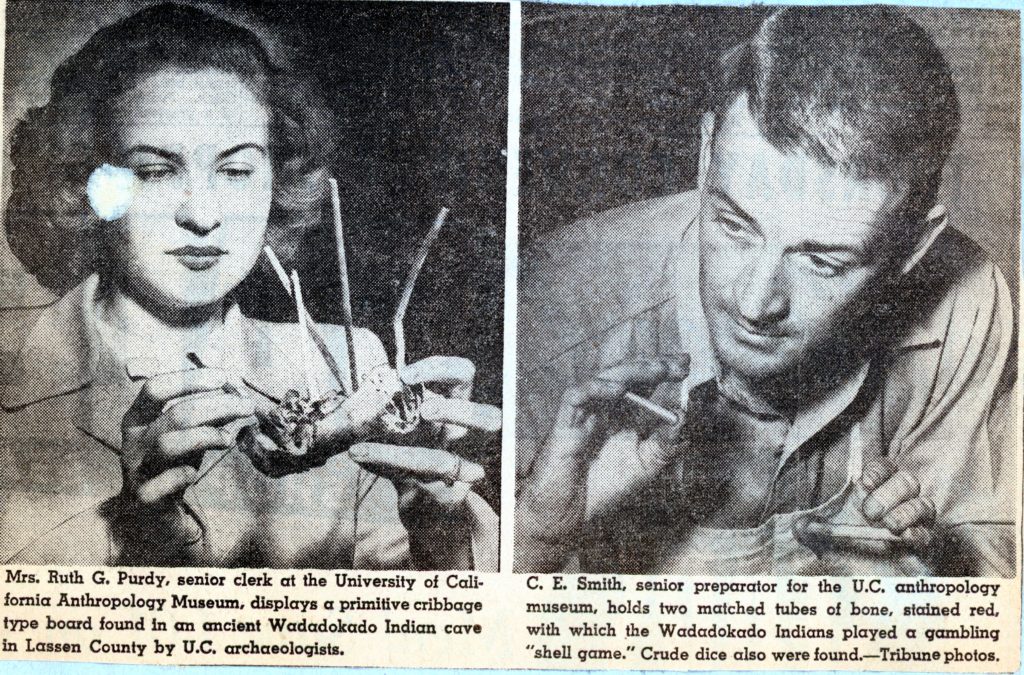
On July 13, 1949, a feature article in the Oakland Tribune wrote: “U.C. Archaeologists Make Scientific Raid on Primitive Gambling Casino. A scienitific raid on a primitive gambling den in Lassen County by a squad of University of California archaeologists has turned up enough evidence to jail a whole tribe of Wadadokado Indians.
“The Wadadokado however, disappeared from the historic California “den” about 100 years ago and so the archaeologists, all members of the California Archaeology Survey have plenty of time to sift the evidence and repare their case.
“Location of the “den,” called Tommy Tucker Cave is in Lassen County, about seven miles from the Nevada line. Entrance to the cave, 200 feet up the side of Honey Lake Valley, is effectively concealed from the Valley floor.”
The article continues about various objects unearthed. In previous post I have wrote about Tommy Tucker Cave, so as a refresher use the search feature on the site. The primary purpose why I selected this item, it is first time I have come across a reference of the Northern Paiute Indians as Wadadokado. Doing these daily posts, I am learning something all the time.
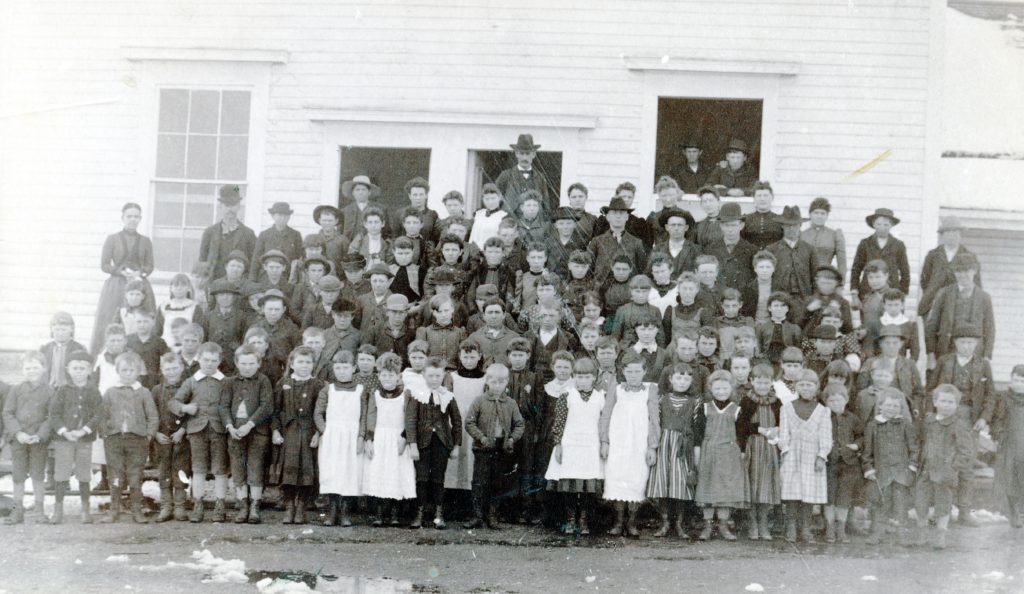
The Susanville Grammar School, early 1890s. Courtesy of Juen Chappuis.
In 1863, the Plumas County Board of Supevisors approved the formation of the Susanville School District—Lassen County was not in existence. A site for the school was selected at Cottage Street, near Weatherlow. All these years later this property has always been used for public educational purposes. The original school structure was a very modest one, and as the community grew, so did the need to expand the school. In 1873, L.J. Abel and George Barley constructed a two-story schoolhouse for $3,025, one the site of the first school. It would meet the community’s need until the arrival of the next century. It was.
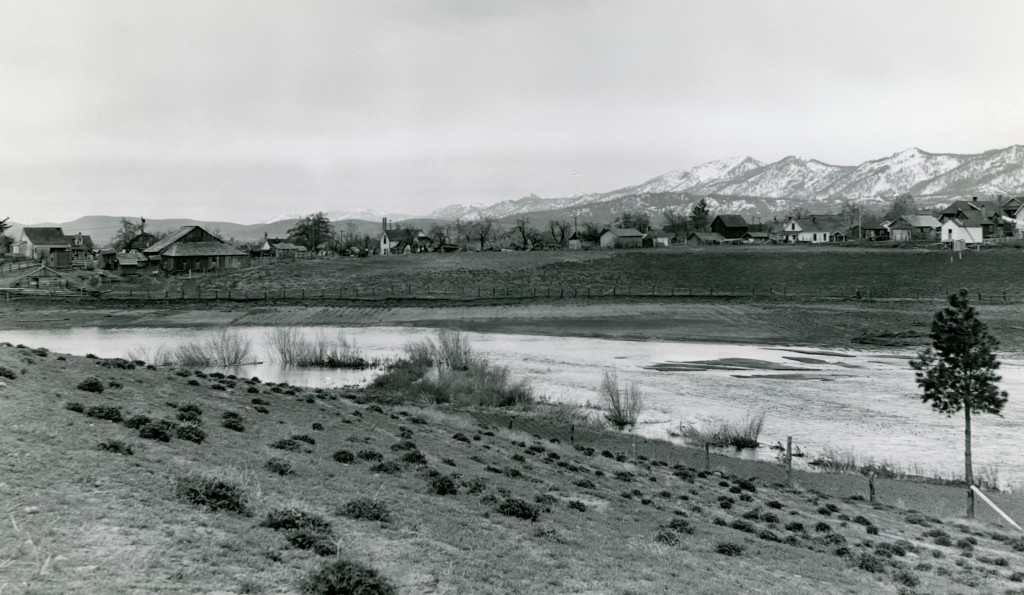
Honey Lake, February 1984. To the right is the Hartson Sand Ridge. Photograph courtesy of Bob Sorvaag
In the summer of 1850, when Peter Lassen and a group of prospectors traveled through there, they named the lake and the valley for a sweet dew type substance found on the wild grains. Lassen returned that fall and was accompanied by J. Goldsborough Bruff and several other men in a search of the fabled Gold Lake. On October 5, 1850, Bruff named it Derby Lake, for his friend George H. Derby, a United States topographical engineer, who at that time was surveying Southern California. In 1943, the Oakland Tribune published an article about Fred Lake’s 1892 dream town of Honey Lake City. That prompted a question from several readers as to how Honey Lake received its name. John S. Thomas of Oakland wrote the newspaper and stated: “They call it Honey Lake on account of the honey dew that fall on the borders of the lake. In haying time, if you lay or stand a pitch fork out all night, the handle in the morning will be as sticky as if it had been rubbed with honey. However, W. E. Booth of Hayward questioned Thomas’ claim in a letter to the Tribune. They published his response: “Booth used to live in the Honey Lake Valley and worked on a dairy ranch. Booth insists that he never saw such phenomenon and never heard the story. It would seem that if such a phenomenon was the source of the name of the lake and region, it would have been a matter of common experience and knowledge. The phenomenon of which Mr. Thomas speaks may have been incidental, the sticky handle may have been caused something other than the dew .”
It should be noted for the record that the Hudson Bay fur trappers of the 1830s and 1840s referred to the area as Hot Springs Valley.
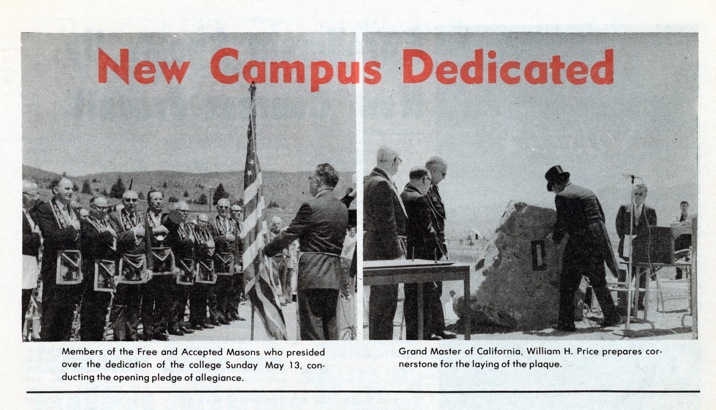
May 13, 1973 was a historic day for Lassen Community College. A formal dedication ceremony was held for the new campus. At 12:30, it began with the Grand Lodge Officers of the California Free and Accepted Masons with the cornerstone laying ceremony. A time capsule was included to mark the event for posterity. It was then followed by a barbecue. At three p.m. the formal dedication program began at the Sports Center with College President Robert Theiler, as the initial speaker. Theiler was followed by an assortment of dignitaries giving their blessings for the monumental occasion.