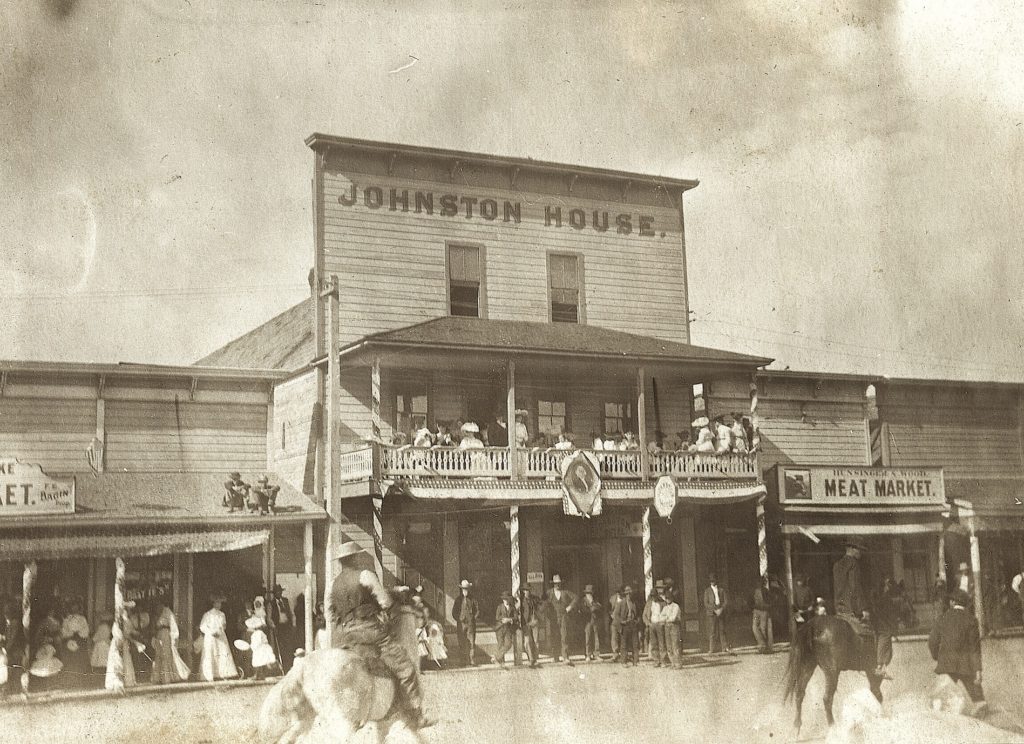
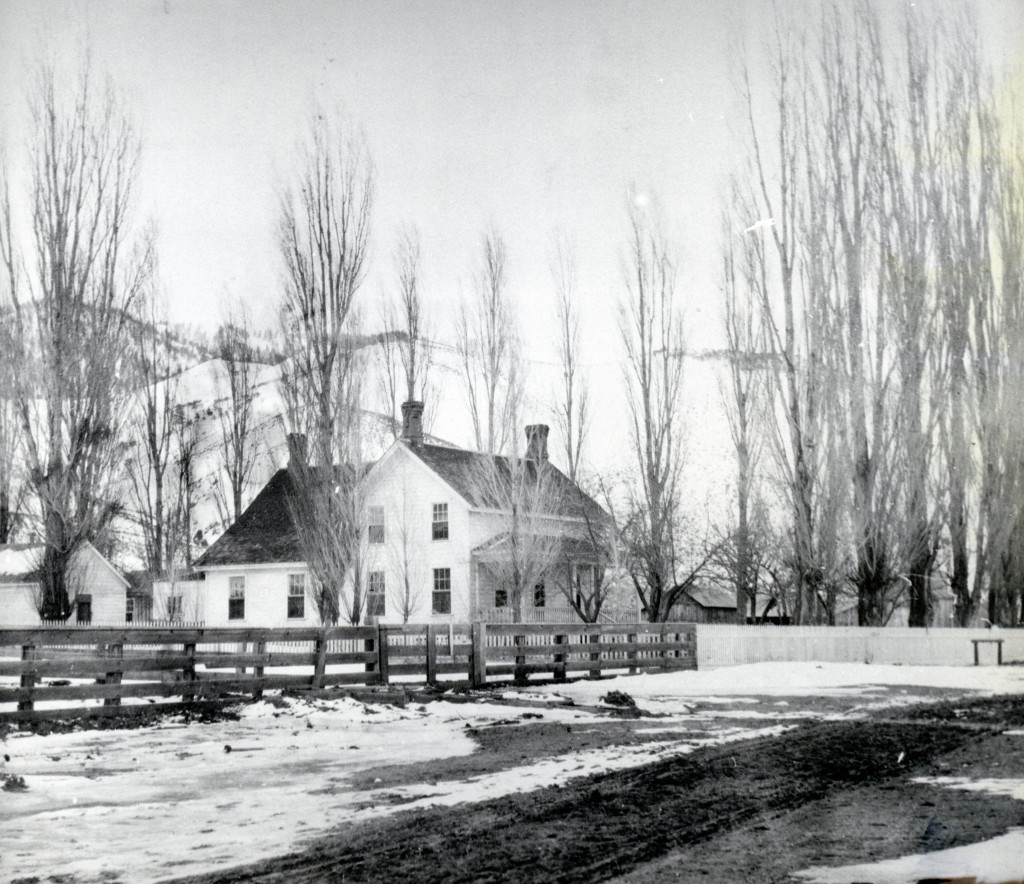
The Johnston House, circa 1909. Courtesy of Betty Barry Deal
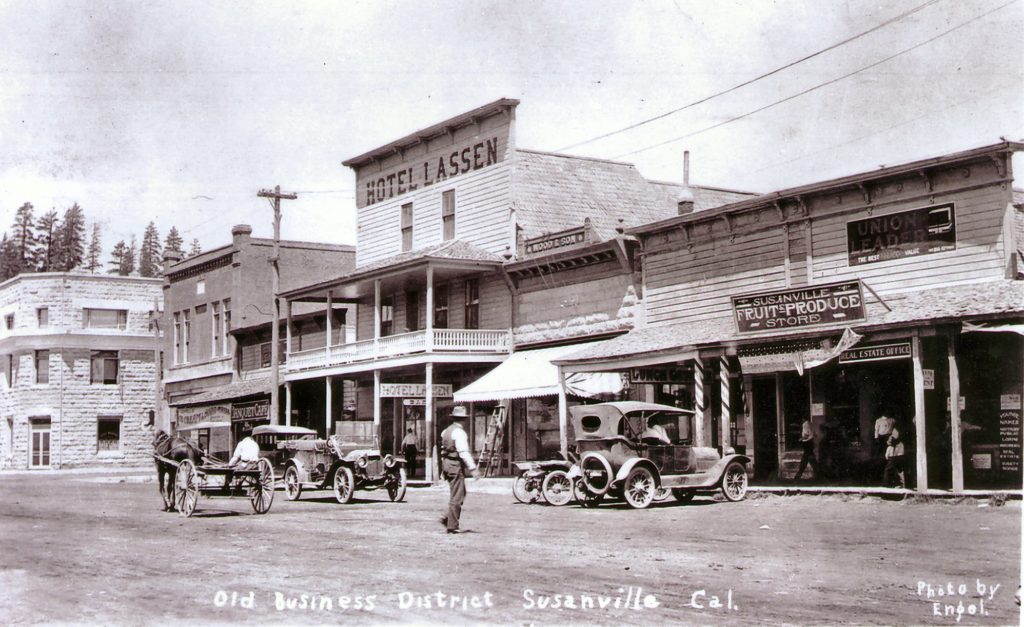
The Johnston House was built in 1893 after a devastating fire that destroyed the north side of Susanville’s Main Street business district. It was so named for its original owner/proprietor Robert Johnston. Until the Emerson Hotel opened in 1901, it was the town’s major hotel. There was the smaller Cottage Street Hotel, which was more like a boarding house. In 1897 Johnston sold the hotel and it changed owners on a frequent basis. In 1916, Henry C. Dobyns purchased and renamed it the Hotel Lassen. It was destroyed by fire in 1919.
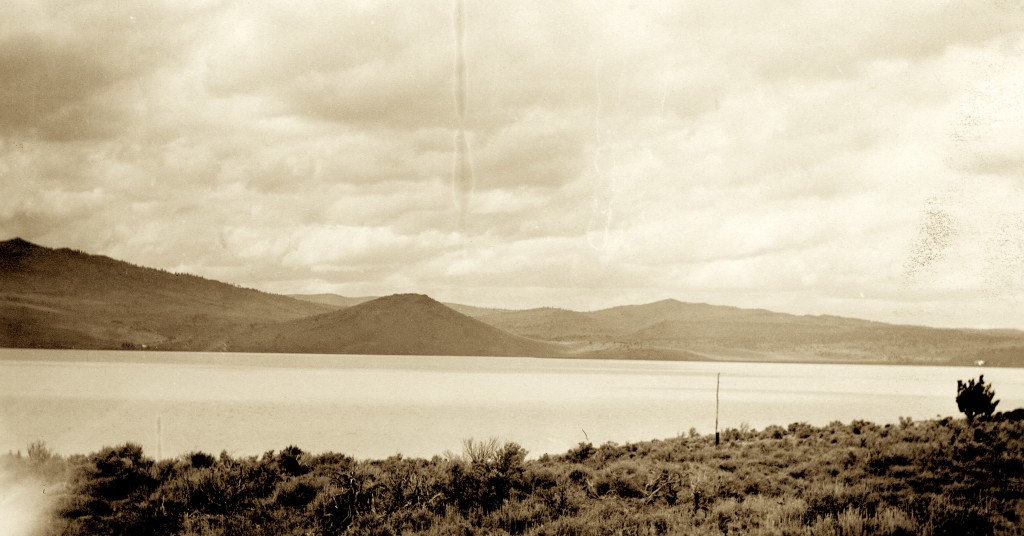
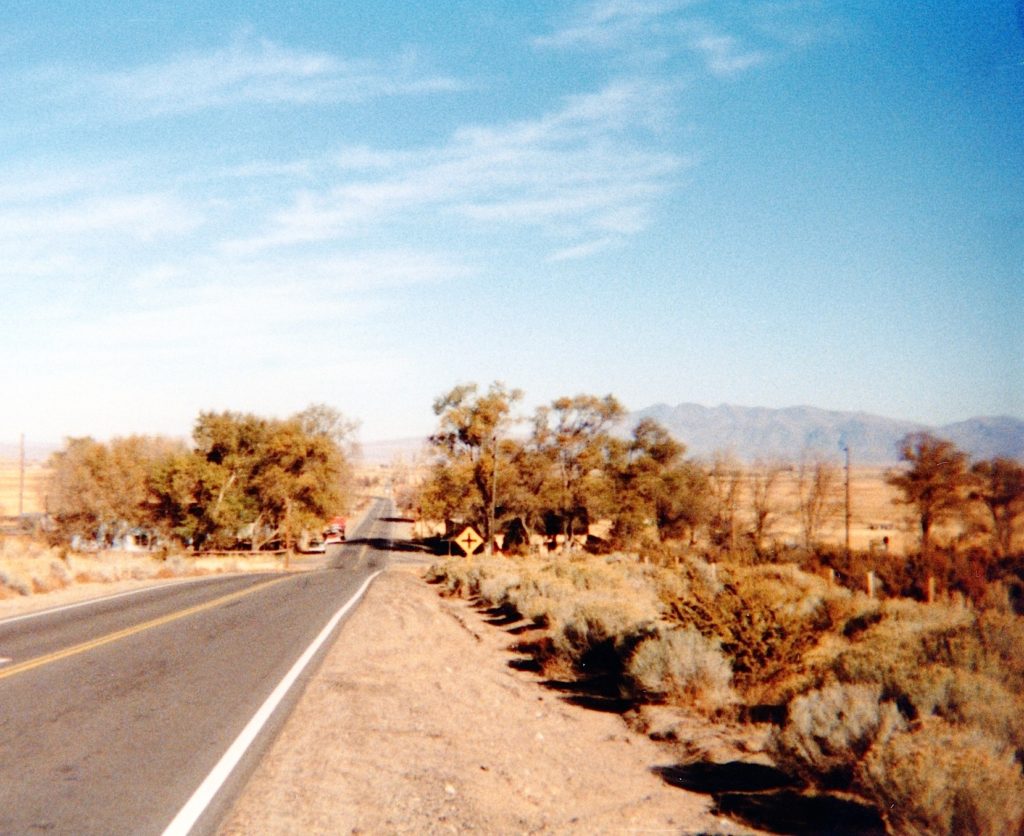
Horse Lake located east of Eagle Lake, is a shallow playa lake covering some 3,500 acres. It is similar in nature to Honey Lake, that both go dry in drought cycles.
Horse Lake was first settled in 1868 by B.E. Shumway. Back then the most direct route from Susanville to Surprise Valley, Modoc County was via Horse Lake. It was at Horse Lake where Lassen County’s first billboard appeared, unlike the ones we know today. Susanville’s pharmacist, Dr.R.F.Moody in the 1870s created his patent medicine Sagebrush Liniment. On a boulder along side the road at Horse Lake he carved into it his famed patent medicine. Decades later when the county widened the road, the boulder was turned over, now face down no longer a billboard.
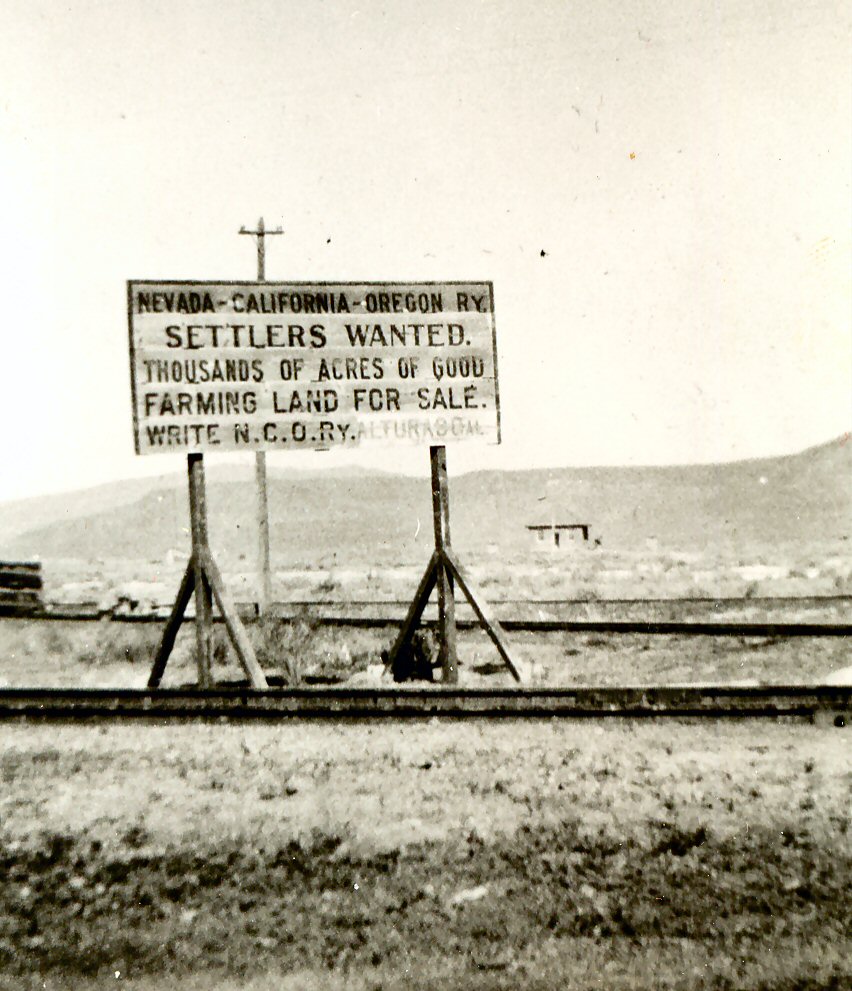
This weathered sign of the NCO at Wendel in 1920, in better days to entice homesteaders. Photograph taken by Lassen County Librarian Lenala Martin.
There is a bit of irony in this tale. In 1923, Merrill’s vision of tapping Eagle Lake for irrigation became a reality. Nobody used his Lassen County Desert Land Act which it was designed for. Of note, it was David Watson of Big Valley who was the first person to use Merrill’s Act in 1887 when he received a federal land patent for 480 acres, located thirty-five miles north of Eagle Lake. At least, in 1891, Merrill did receive title to 160 acres near Belfast, which was to be his dream city of 25,000 inhabitants in the Honey Lake Valley under his Act.
The majority of the federal land patent acts have been revoked, though the Desert Land Act, as far as I know, is still in existence. The last time it was used in this region was in the 1980s. Franklin Jeans wanted to expand his Fish Springs Ranch in eastern Honey Lake Valley on the Nevada side. To meet the reclamation requirement, he had several deep irrigation wells drilled. Jeans had no intention to reclaim the sagebrush land. His goal and it finally became a reality was the water from these wells are now part of Reno’s water supply via a pipeline.
The Belfast District, 1898. It was to be the center piece of Merrill’s reclamation project.
The federal land patent process often referred as homesteads worked fine until the westward expansion. After crossing the Mississippi River there were dramatic changes in geography and climate. It was President Abraham Lincoln who corrected the situation. In 1862 Lincoln was able to pass three important pieces of legislation since his opposition failed to show up in Congress. These were the creation of the Department of Agricultural, the Pacific Railroad Act and the 1862 Homestead Act. While the Homestead Act did improve matters in the west, it was not a one-size cure all fix. The arid intermountain west presented its own challenges. A unique chain of events occurred when Captain Charles A. Merrill announced in 1873 of his reclamation plan for the Honey Lake Valley by tapping Eagle Lake as its water supply. It should be noted that Merrill was not a novice to land issues. He came to California, in 1864, from his native state of Maine. In 1870, Merrill was involved in a title dispute of a Mexican land grant near Santa Barbara. As a result of that involvement he worked ardently as a land agent for individuals who had capital to invest.
For Merrill to move forward on his Eagle Lake project he would need federal legislation for an easier method to homestead arid lands. Merrill recruited California Congressman J.K. Lutrell to craft such legislation. On March 3, 1875 Congress approved Lutrell’s bill, the Lassen County Desert Land Act. In essence, an individual could claim up to 640 acres of government land, versus the standard 160-acre limit. A person then had two years time to reclaim the land by irrigation and they could purchase the land from the government at $1.25 per acre. The last provision was unique in that one did not have to reside on the land as a requirement. The Lassen County Desert Land Act gave birth to the much more famous Desert Land Act of 1877. The two Acts were nearly identical; expect of course the latter applied to all arid regions of the American west. There was one other major change in the fee structure. Under the Desert Land Act, “the settlers pay twenty-five cents per acre at the time of application, to have three years (versus two) for the purpose of irrigation and to pay one dollar per acre upon making the final proof, i.e. being issued a land patent to the property. The Desert Land Act was immensely popular and large swaths of land in the West were obtained under this Act.
It should be noted there was a dark side to it. This was from the Lassen County Desert Land Act’s non-residence provision that was included in the Desert Land Act. In the first decade there was a significant amount of fraud. It enabled land speculation companies to acquire thousands of acres of land by hiring dummy entry men to file on said land. Locally, this was particularly the case in eastern Honey Lake Valley and the Madeline Plains. Later amendments to the Act reduced the fraudulent activity.
Westwood Ballpark. Courtesy of the Westwood Museum
During 1938 and 1939 the Red River Lumber Company experienced a lot of labor strife. Due to a strike in February 1939, Red River closed the mill. A unique thing happened at that time, Westwood would soon have a baseball park.
One of the effects with the mill closure was that residents were now without their regular wood supply for heating, for those who did not have steam heat. The idle strikers volunteered to cut trees on forest service land for firewood. They established a wood lot on the lower end of Birch Street, adjacent to the current VFW Hall.
Jim Travers came up with the idea they could use some recreational outlet to dispense with their extra energy. On the property they were using as the wood lot was a partially destroyed house caused by a fire some time ago. Travers and Earl Yaber came up with the idea to transform the property into a baseball park, and the other strikers were supportive of the project. The AFL union asked Red River if they could lease the property for that, and the company consented. In no time at all, the volunteers quickly cleared the property, removing the old building and hauled in 200 loads of decomposed granite from Fredonyer Summit to spread over the baseball field. In short order the property was transformed into a ballpark that could accommodate 600 people, along with parking, drinking fountains, rest rooms, an enclosed press box and seventeen flood lights. Nearly 500 men and women contributed to the cause.
On Sunday, June 12, the first softball games were held. First up was the Westwood AFL, who lost to Susanville’s Model Laundry by a score of 7 to 8. The next match was between the H.S. Anderson Club and Fruit Growers’ Story Club, which Anderson prevailed in the tight match that went into four extra innings with a score of 14 to 13.
Eagle Lake trout, April 6, 1961. Courtesy of California Department of Fish & Game
During World War I food rationing was on a voluntary basis. The Lassen folks were a very patriotic bunch and a look back at the records one would thought it was mandatory. Since meat and wheat were two items to conserve some looked for alternatives.
Take for instance our neighbors in Washoe County. Arrangements were made to allow fish from the Truckee River and Pyramid Lake be harvested for market. This caught the attention of Susanville resident L.W. Boggs. He proposed that the same thing could be done with Eagle Lake bass and trout. Not only would this conserve beef and pork, but the fish would be good for the local diet. However, state law prohibited commercial fishing in lakes and streams. Boggs proposal never gained traction.
It should be noted that in the late 1800s wagon loads of Eagle Lake trout were caught and sold in Susanville at twenty-five cents a pound.
In the summer of 1964, Robin McVickers and Fred Toler formed the Northlands Holding Company for their newest endeavor. The two men purchased four of the old Fruit Growers Supply Company’s apartments on Alexander Avenue in Susanville from the Eagle Lake Lumber Company. The buildings were completely renovated, became known as the Riverside Apartments when they were opened in September 1965. One building, in particular, was dubbed “The Chateau.” This building was specifically set aside as a dormitory for Lassen College students and could accommodate fifty-six students. This apartment complex still exists and is known as the Parkview Garden Apartments.
Jacob McKissick Ranch, Long Valley, 1903. Courtesy of PhilipS. Hall
The early day argonauts of the 1840s and 1850s were a hardy lot. First you had to be tough both mentally and physically to make the overland journey, or you perished along the way, like some did. When gold was discovered in California that was a very appealing lure to many to make the journey west.
For others, it was opportunity to start a new life, because of past actions haunted a person. There were other indidivuals when they came West became very influential residents, even they had left behind them a shady background. Jacob McKissick, fondly referred to as Uncle Jake settled in Long Valley in 1859. Prior to that he had resided in Iowa. McKissick in time would become one of the largest stockmen in Lassen & Washoe Counties. In 1898, he returned to his old stomping grounds in Iowa. When McKissick lived in Iowa, he was in an altercation that led to a man’s death, but was not charged at the time. In 1898, the dead man’s partner recognized McKissick and had murder charges brought against him. McKissick was acquitted. There are countless tales such as this. For instance, John Sutter, the founder of Sacramento, fled his native Switzerland before criminal charges were filed on him.
The Buntingville Breeze was one of those short-lived parody publications. When it made its debut in May 1899 the editor went by the non-deplume Spot Cash Sockettuem. The following issue revealed the editor’s identity as Mike Phillips, the town’s only merchant. It never survived long enough for a third issue as Phillips closed his Buntingville store and opened a new one in Standish.
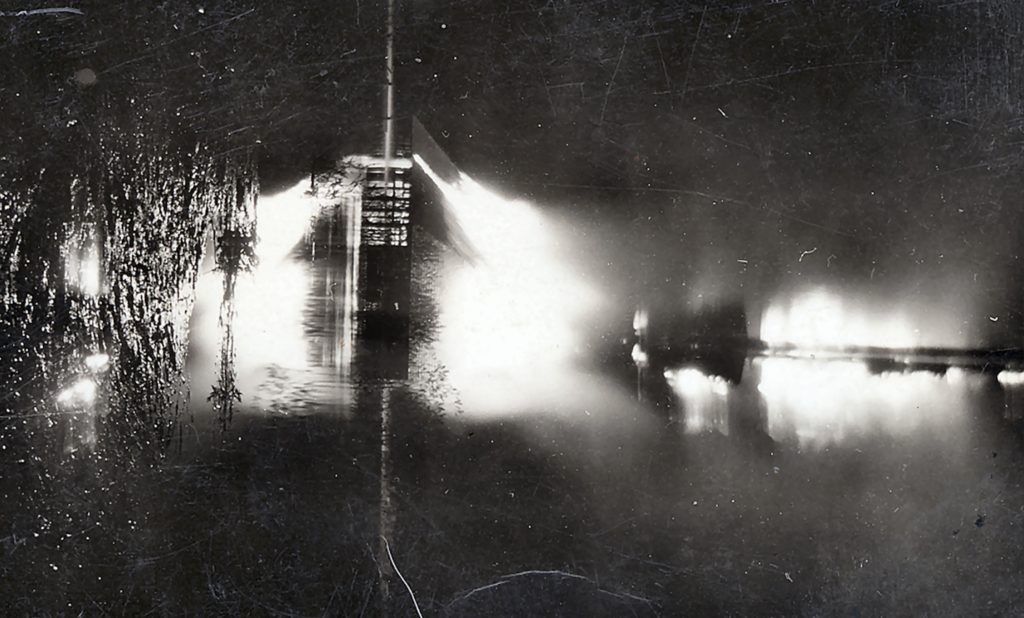
June 6, 1914 burning of Bunnell’s-Courtesy of Holly Blackburn
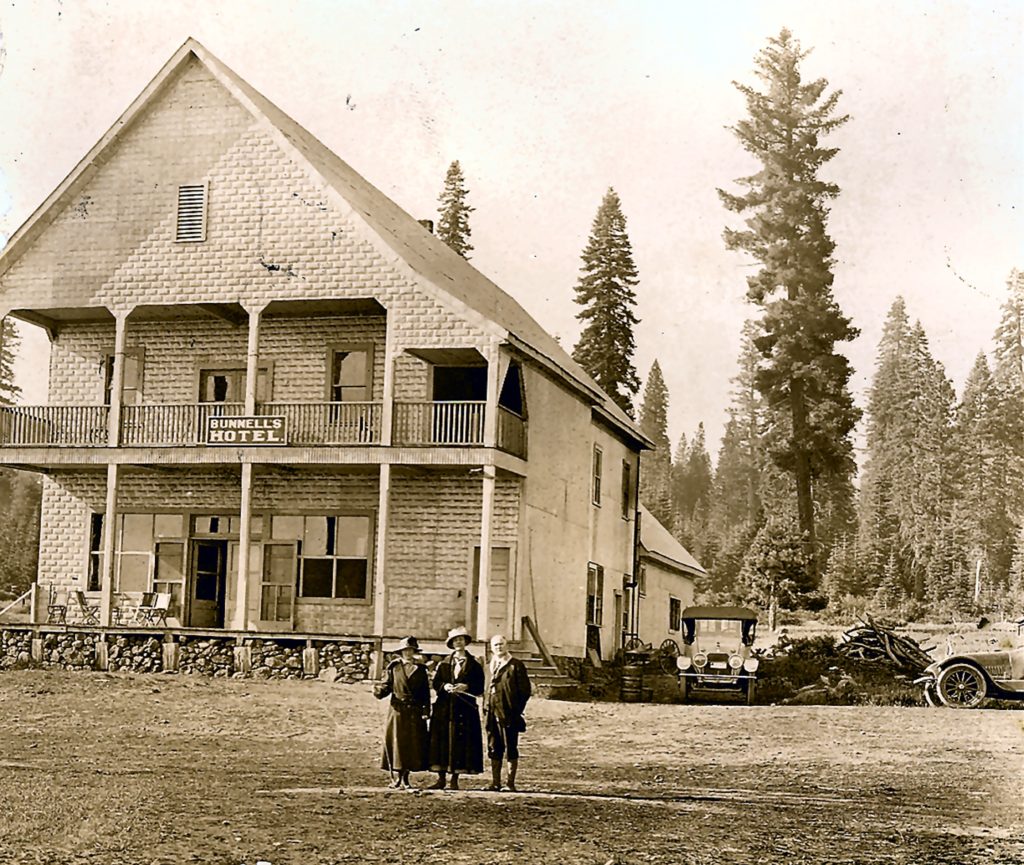
In 1867, Luther Wellington “Wells” Bunnell relocated from Butt Valley in Plumas to nearby Big Meadows, known today as Lake Almanor. One of his distant neighbors was Dr. Willard Pratt, who opened the first hotel in Big Meadows which was met with great success. After all, those who could escape ever so briefly in the summer months from the Sacramento Valley, flocked to places like Big Meadows to escape the heat, after all this pre-air conditioner times.
For thirty-eight years Bunnells became a well known resort. Changes were on the horizon, especially with the Great Western Power Company who had entered the picture in 1901 with plans to transform Big Meadows into a massive reservoir as part of its hydroelectric power system. On April 11, 1906, Bunnell entered into an agreement to sell his place for to Great Western Power for $35,000. He moved to Susanville the following year and for a brief time the power company used the resort, now closed to the public as their headquarters. With the dam nearing completion and the flooding of Big Meadows to become a reality, on the evening of June 6, 1914 all the buildings at Bunnells were set ablaze for demolition.
The ‘annex” at Bunnell’s – Courtesy of Holly Blackburn