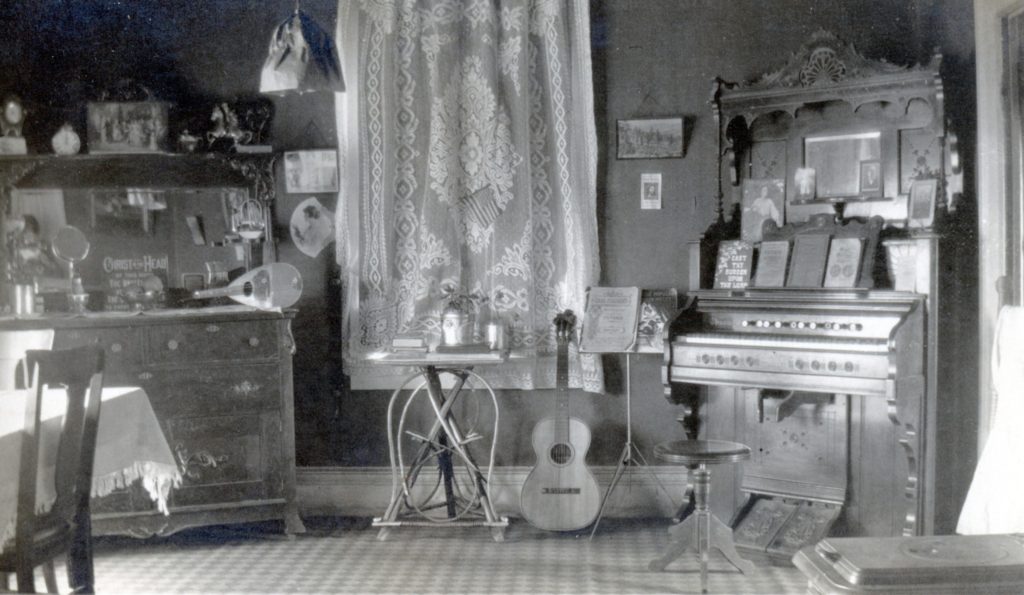
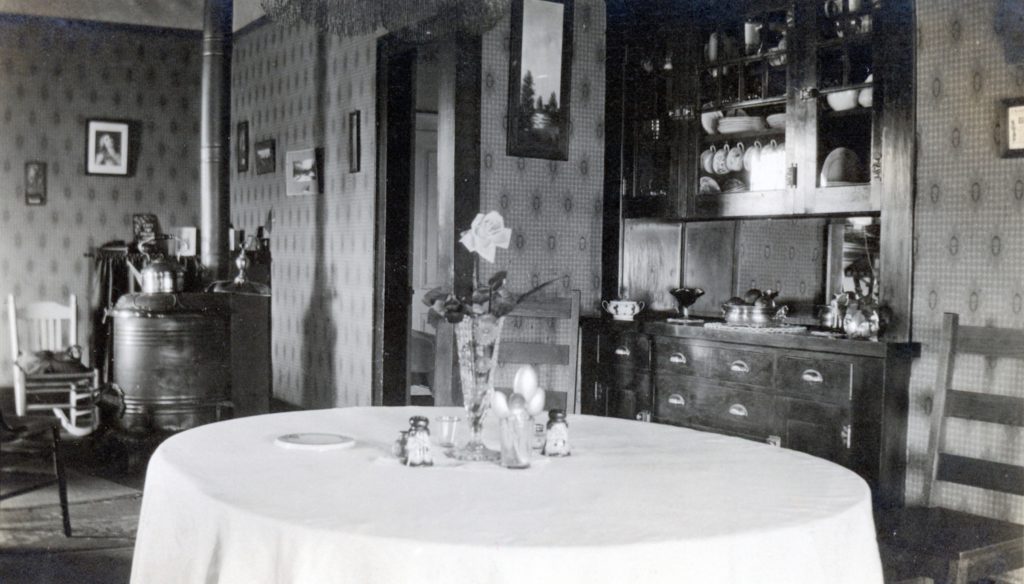
The interior of Edith Young’s home, 1919. Courtesy of Belle Dorsey
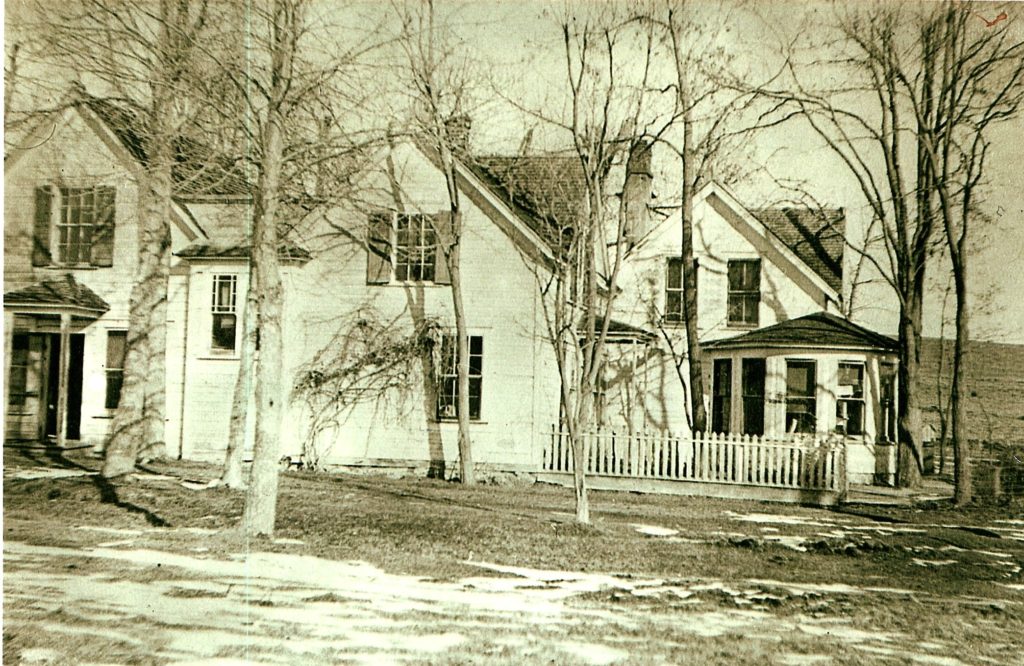
In 1918, Hayden Hill residents Belle and Jud Dorsey moved to Susanville. Jud went to work on the construction of the mill of Lassen Lumber & Box Company and would remain with the company for several years. The Dorsey’s made their home with Miss Edith Young. Young at the time, was the local government agent for the Native American community. Interior photographs for this era, tend to be on the rare side, but I know some might enjoy them. What is perplexing for me, is I do not know where this was located. Belle did take a exterior photograph of house, which is hidden by mature trees and there is not enough peripheal to provide any clues.
The interior of Edith Young’s residence, 1920. Courtesy of Belle Dorsey.
For many, it was a spring to rejoice, the region having endured a twenty-year drought. Water was flowing everywhere. Lakes and reservoirs were being restored to their former glory. This was especially true in the case of Honey Lake that went dry in 1919. It should be noted when the lake is full, it takes about two drought years on the average for the lake to go dry. Of course, all that water in Honey Lake made for an excellent setting to go boating. In April 1938, John Berglund, Howard Thornhill, Kenneth Doyle and Leon Millsap spent the day traversing lake in an outboard motor boat owned by Berglund and Thornhill. However, the former glory days on boating on Honey Lake never returned. With improvements to the automobile and roads, made mountain lakes more accessible, thus more preferable than the shallow Honey Lake.
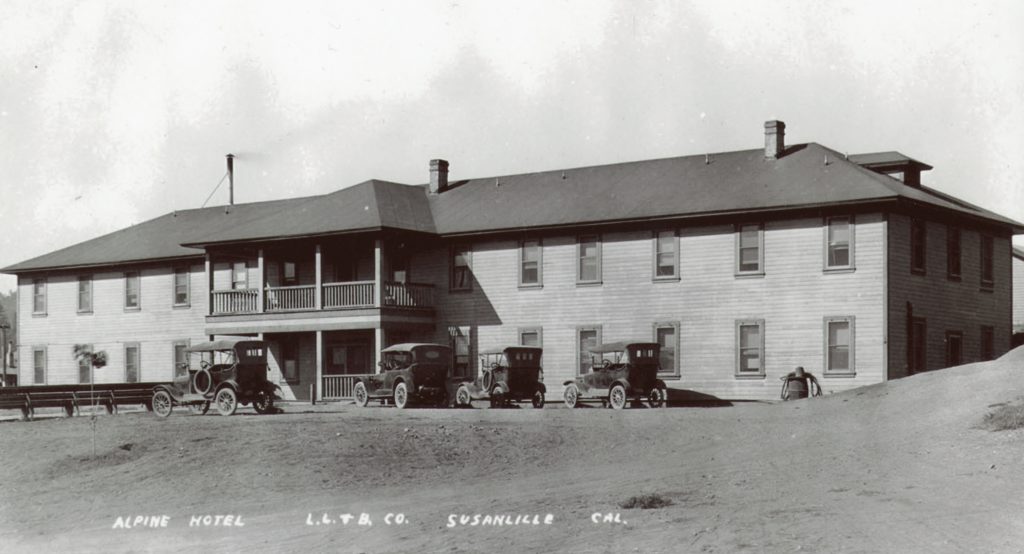
Alpine Hotel, located on Alexander Avenue, was a dormitory for the employees of the Lassen Lumber & Box Company
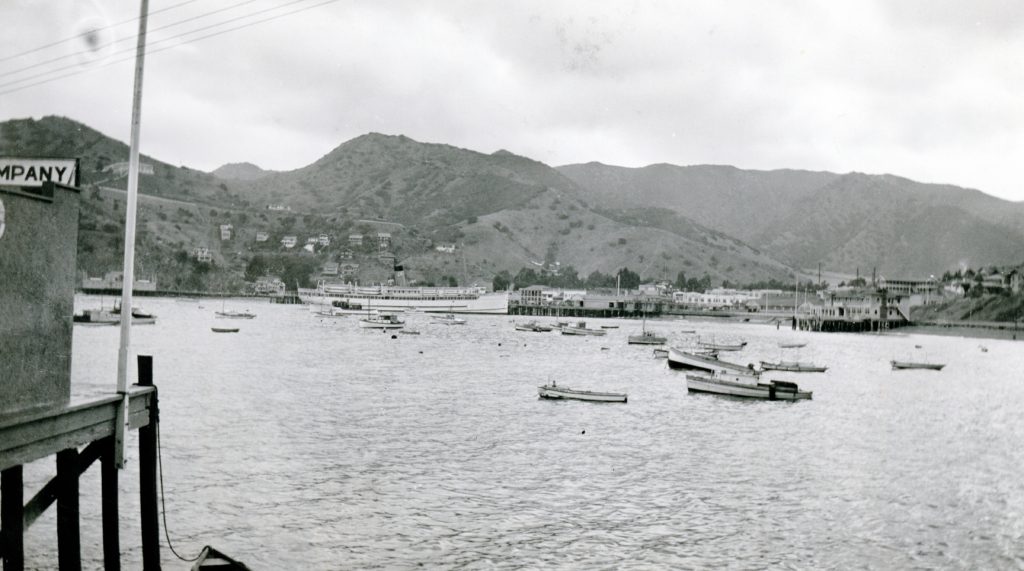
In September 1925, fourteen members of the local American Legion post received a rousing send off from the community on its departure to the State Legion Convention at Avalon on Catalina Island. The group’s spirits were high since earlier in the year San Francisco had withdrawn its bid and supported Susanville for next convention. Among the many items the group left with was a special edition of the Lassen Advocate extolling the many virtues of the commumnity. One feature noted the community had 2,305 rooms available. This was a contentious issue as to whether to hold the convention in Susanville in 1926. The Susanville delegation used all its charm and political savvy to beat out Santa Rosa and Stockton by a huge margin. About all those rooms. All might have went well if there was zero occupancy, but with a critical housing shortage that was not the case. The only way to accommodate all the visitors was for residents to open their homes and many did. The Red River Lumber Company provided 325 cots and Fruit Growers 150.
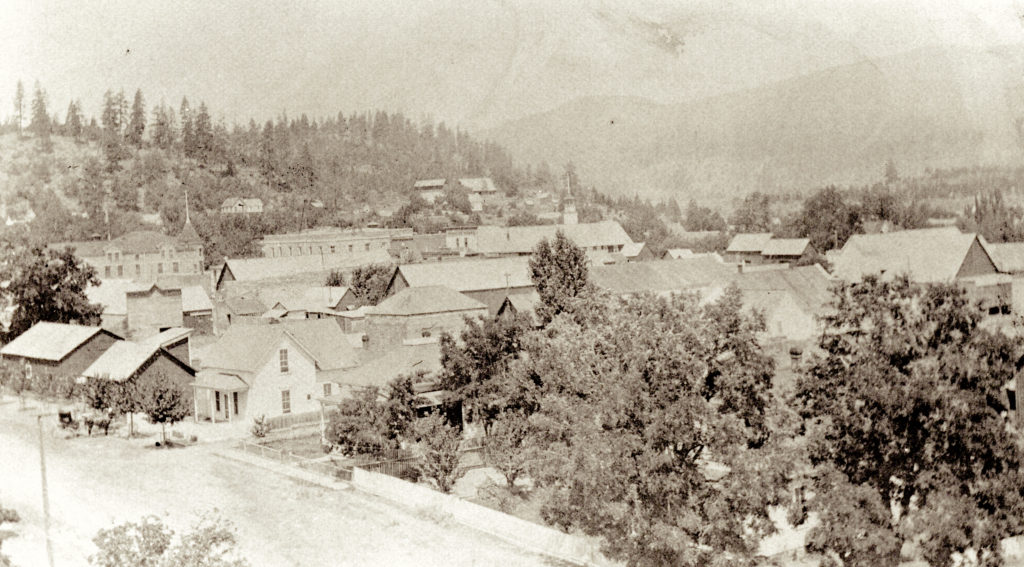
A unique view of Susanville, 1905. Courtesy of Mary Dale Folsom
This was a very short-lived organization that existed during the month of January 1899. The lead instigator, was well known Susanville attorney, E.V. Spencer. At this time, The Nevada-California-Oregon Railroad (NCO) began work to extend its line north from Amedee to the Madeline Plains, again bypassing Susanville. Spencer and L.C. Stiles were appointed representatives of the Club to meet with NCO officials, in this case E. Gest, the manager. The duo reported the meeting was cordial, the NCO had no intent to construct a feeder line. Gest, is the people wanted to construct it, he estimated the cost at $100,000. The initiative floundered. It is interesting to note that Gest testified that summer to California Board of Equalization that the people of Susanville did not deserve a railroad.
There were some local critics that thought the Susanville Improvement Club could do a lot of other work than trying to be a railroad builder. Whatever the case may be, the improvement club morphed into the Susanville Town Hall Association a month later.
On June 19, 1874, the Lassen Post Office was established in Willow Creek Valley, north of Susanville. Edward Bonyman served as the first and only postmaster. Then, a most peculiar thing happened. On April 1, 1875, the Merrillville Post Office was established by Bonyman’s neighbor, Orman Folsom. Since there was not a need for two post offices in Willow Creek, the Lassen Post Office closed on July 14, 1875. Today, the property is known as the Willow Creek Wildlife Refuge.
The more things change, the more they remain the same, as the old saying goes. The following is a 1927 editorial of the Lassen Advocate, as it was concerned about how mail order business hurt the community. Fast forward today, replace mail order with online shopping.
The Town Grave Digger. In nearly every community may be found quite a number of persons who consider themselves leading citizens, but in truth are helping to dig a grave for their town.
They do it through their failure to support institutions which make the town what it is. They do it by sending away for merchandise which might be brought with equal advantage at home. They do it frequently through thoughtlessness, but often througfh sheer disregard for the welfare of the community of which they are aprt.
The doctrine of buying at home in not advanced solely in the interest of the individual markets. It is advocated because every citizen of a town is to a certain extent dependent upon every other citizen for his own prosperity. Business men are sometimes as greatly at fault as anyone else inthe matters of out-of-town trading.
If the shoe dealer sends away for his automobile tires and the automobile man sends away for his furniture and the furniture man sends away for this clothing and so on, how can they expect to build local prosperity?
All the fine talke about civic pride that one may indulge in will never make a town, so long as the life blood of the community—the cold cash—is spent elsewhere.
A man may make boosting speeches until he is black in the face, but unless he spends his money where he makes it, he is the home town grave-digger.
The county wanted to oblige, but it had no funds. They deferred to take any action and turned the matter over to the federal immigration officials. J.C. Borden of the Immigration Bureau was brought in to investigate the situation. What he found on his arrival was that of the forty-five applicants only a handful were eligible to receive aid to pay for their return to Mexico. Yet, the issue was also moot, as Borden noted, because all the Mexicans had gone back to work. He informed the Board, should the issue arise again, that under a federal ruling any alien who had been in the United States for three years and becomes indigent can be returned to his native land with the cost borne by the federal government. Yet, Red River’s actions caused a lot of anxiety and speculation among its Mexican workforce. In January 1931 rumors circulated that it was going to eliminate all Mexican labor. Red River issued a statement to ease fears among its Mexican employees: “The policy is to employ this [Mexican] labor on certain classes of work as they are very satisfactory in certain moderately well paid positions, do not move around looking for other positions which cuts down the cost of labor turnover. They are considered essential and desirable as part of the plant personnel. It is not the policy to employ outside Mexicans while work is scarce, but it is the policy to take care of those who have been here for some time and have proven to be good workmen and citizens.”
The deportation issue did arise again, as unemployment was persistent with the stagnant economy. In the fall of 1931, Lassen County transported more than one hundred Mexicans to San Francisco, who were then handled over to federal authorities to deport them to Mexico. The county deemed it was cheaper to pay the transportation costs than to provide aid. Many of the Mexicans were willing to leave, and those who had the means left on their accord. The issue was not isolated to Lassen County for 50,000 Mexicans throughout California had been deported that year.
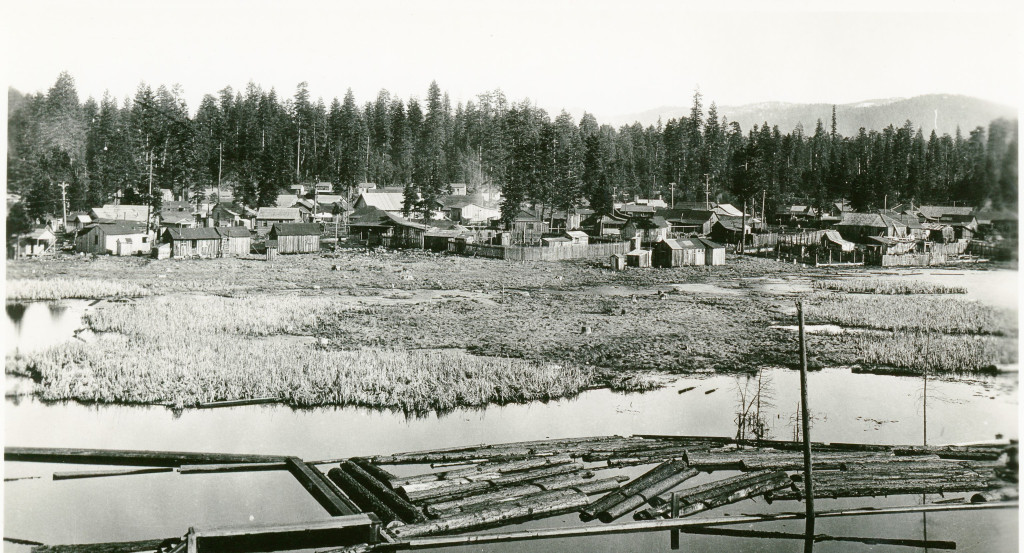
Westwood’s Old Town, home of many of its immigrant workforce. Courtesy of Hank Martinez
Note: This was one of my early posts, that a few people expressed an interest. It should be duly noted that mills of Fruit Growers and Lassen Lumber & Box also hired large contigencies of immigrants.
One of the more unusual annals in Red River’s history was deportation. Red River hired a large percentage of foreigners whether it be Scandinavians, Italians or Mexicans. With the downturn in the lumber market, the company was forced to layoff some of its workers. If they thought that the layoff was temporary, they allowed the affected worker to remain. By 1930, however, Red River sought alternatives, as they could no longer bear the financial burden.
In December 1930 Red River notified the Lassen County Board of Supervisors of the lay offs and sought aid to provide for the unemployed Mexicans in Westwood, with the emphasis to pay the costs for their deportation. This had not been the first case where aid for the indigent and/or deportation had been raised by Red River. In the fall of 1929, the first deportation occurred at Westwood. Six members of the Phil Trudeau family, who were in the country on a visitor’s permit, were returned to Canada and eight Mexicans were deported to their native land.
On January 5-6, 1931, the Board of Supervisors held a two-day hearing concerning the deportation of Mexicans at Westwood. There were forty-five indigent Mexicans at Westwood who had been laid off and Red River took care of their needs. Again, Red River felt that it was either the county or the federal government’s obligation to provide them with food and other basic necessities and not the company. The Mexicans did meet the requirements to receive government aid. Even though they were not citizens, they were legally here and had been previously employed.
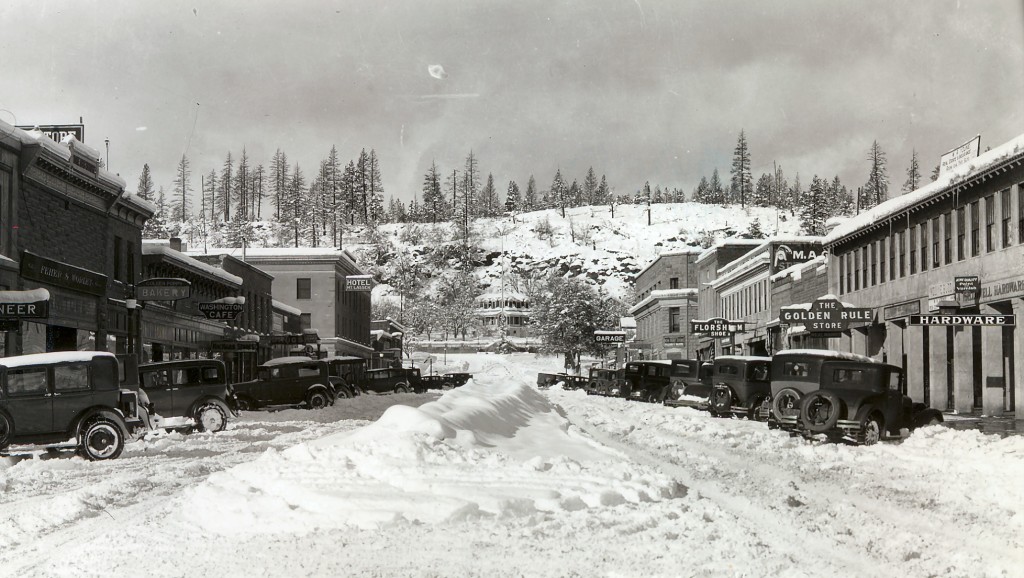
Main Street, Susanville, 1885. Courtesy of Betty Barry Deal
Today’s feature photograph was taken by John Hanson, who operated a photography studio in Lassen County during the early 1880s. An interesting footnote one could purchase this print for $2.00.
Hanson, a native of Denmark, first came to Lassen County in 1881, where he set up shop at Bieber. Previous to that he was in San Francisco. His brother, whose first name remains unknown came to Bieber and set up a photography studio there, while John moved to Susanville. Like so many photographers in the rural west, they rode the circuit to surrounding communities in search of business. Hanson, like his colleagues, never remained in one place long enough, that we know very little personal information about them. Hanson did find romance in Susanville and married Miss Fannie F. Streshly there on October 31, 1883. Thankfully due to newspaper excerpts we know that Hanson took photographs of the Juniper Mine at Hayden Hill, as well as an assorted views of the many other places in the region. Most of that type of work has never surfaced. In 1885, he departed to Inyo County and never returned back to Lassen.
One of the lingering questions is whatever became Hanson’s negatives? This also applies to others in his profession, such as Herman Brince who did exceptional work here in the late 1870s. Brince died in 1882 in New Zealand, and it would have been rather doubtful that he would have hauled his work there, considering it would have been glass plate negatives.
Camp C, no date. Courtesyof Lenala Martin Collection
During the 1920s, Fruit Growers Supply Company operated six railroad logging camps in the vicinity of Martin Springs, located between McCoy Flat Reservoir to the south and Pine Creek Valley to the north.
Camp C had a unique feature not found in other logging camps. It should be duly noted that Fruit Growers valued their employees and took good care of them. In 1923, Fruit Growers built an outdoor boxing/wrestling area that seated 500 at Camp C. On June 23, 1923, the inaugural wrestling match was held between Susanville resident Bill Mohler and Paul Kinney of Omaha, Nebraska. A special train from Susanville was dispatched to Camp C to allow their mill employees to attend.