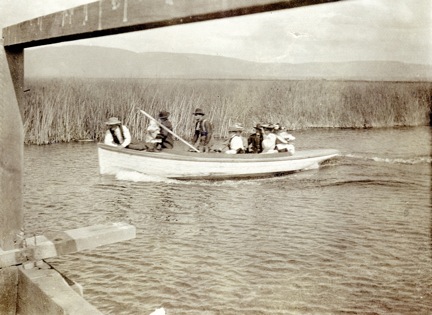
There are many different ways to see the country. These Eagle Lake boaters were checking things out back in 1906. Courtesy of Lola L. Tanner
There are a handful posts that I repeat each year, and for good reason. With summer weather upon us, it is an ideal time to check out the many wonders that surround the residents of the Lassen Region. I hope this editorial from the Lassen Advocate of June 21, 1929 will inspire you to explore the wonderful country around us.
Know Your Country
If you were wondering what to do with your weekends this summer, have you ever given any thought to the fact that you don’t know your own county and the wonderful lake and mountain country immediately contiguous.
Within a few hours of Susanville there are numerous beautiful lakes as well as some beautiful streams and excellent camping spots.
How many have been to Drakesbad and to the top of Mount Lassen? How many have been to the ice caves near Eagle Lake and Wilson Lake?
There are many trips that can be taken from Susanville in the morning returning the same evening and traversing in the meantime a lot of new country that you have never seen before. Beauty spots near a mountain stream with clear sparkling water are numerous where one may have their picnic lunch.
Try and see your own neck of the woods this summer. You will find many a pleasant day in store for you.
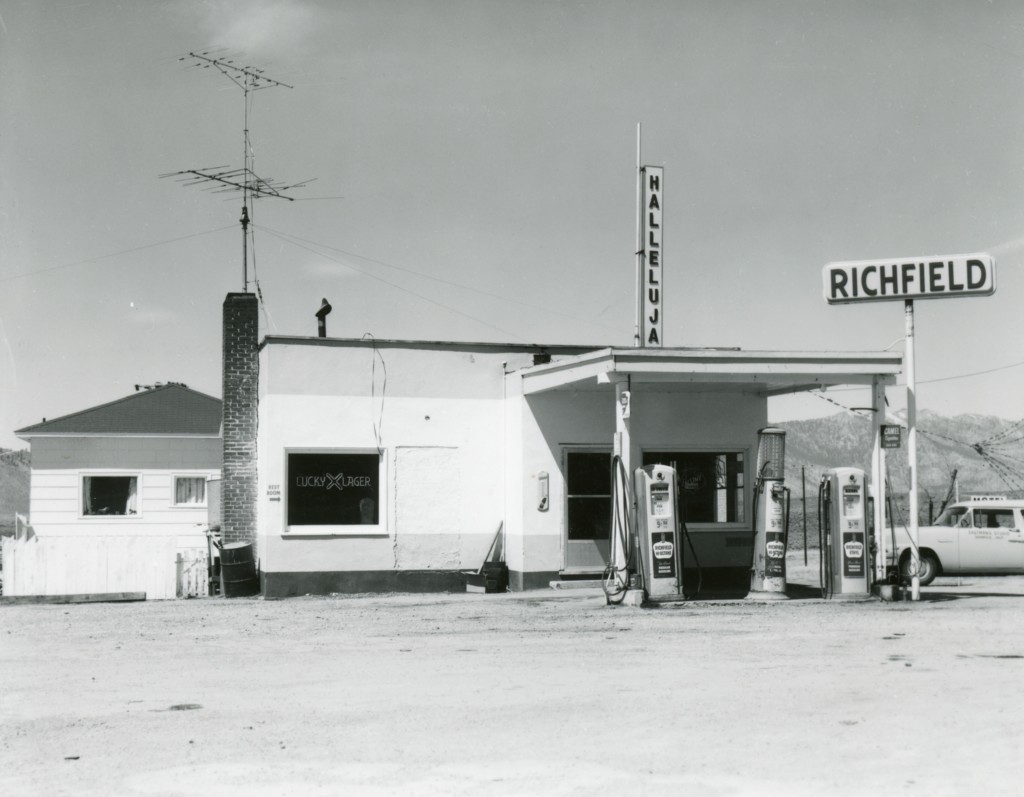
Walt Wiley was a feature writer for the Sacramento Bee and focused interesting stories about Northern California. Some readers may recall I highlighted an article of his last November, Westwood, A Tough Old Town. The following appeared in the Bee on October 13, 1973, when Hallelujah Junction was to no longer be.
“Hallelujah Junction was never much of a town; it never even got its own post office. But it was right there on every road map and aircraft navigation chart. Now Hallelujah Junction is going to be obliterated to make way for a freeway.
“For forty years it was a popular stop some 30 miles north of Reno, Nev at the intersection of Highways 395 and 70. Until last month, Hallelujah Junction was a haphazardly-arranged community of a few houses, a bar, motel, restaurant, service station and even a couple of aircraft hangars and an abandoned stretch of Highway 70 that made up. ‘Hallelujah International Airport.’
“Now the State of California is selling the buildings after having bought the land to build a highway interchange next year when 395 is widened into a four-lane freeway between Hallelujah and the Nevada State Line, some eight miles to the south.
“I’ve still got 12 acres of the land left across the highway. When they’re through I guess I’ll try to build something there,” said Charles Armstrong, Hallelujah Junction’s owner for the last two years.
“They bought the land because they wanted the access to it, and if I build anything new, I’ll have to until they’re through with the new highway so I can find out how much success I have on the land I have left,” said Armstrong. He is living in nearby Graeagle, Plumas County, waiting for the dust to settle from the construction.
“Harold Stoy, who sold the town to Armstrong, now lives some 15 miles north of Hallelujah at Doyle. Stoy’s father, Orville, founded the community in 1932, homesteading 80 acres, 68 of which now have been consumed by the highway builders. “It started out as a tiny gas station, and sort of grew from that as more and more people started traveling through, said Stoy, 58. “The only reason I sold the place is that it just got too busy for me. There was so much business it was wearing me out.”
“The name, he said, attracted all sorts of visitors. Pilots would land on the bumpy airstrip out of curiosity, and after a group from Mexico flew in one day a few years back, he deccided to call the strip ‘Hallelujah International.
“Ministers would occasionally stop to complain that a place with such a scriptual name was a disappointment because it had a bar but no church. Tourists would stop to mail postcards, only to find that there was no post office. “I never did get around to getting a post office there; I was always too busy running the business,” Stoy said.
“He said the place was named Hallelujah 80 years before his father homesteaded there. A group of emigrants shouted the word on the spot after hearing mountain man James P. Beckwourth describe the mountain pass just to the west—5,212-foot—Beckwourth Pass—as the lowest and easiest over the Sierra.”
Isolated settlements in their earliest days had many obstacles to overcome and one item that was hard to come by was cash. This problem was only excabberated during the Civil War years of the 1860s in this region.
The Honey Lakers were a resourceful lot. One crop that grew well was rutabagas. In April 1860 when Honey Lake Valley’s first newspaper, Richmond Times, made its debut they offered a subscription price of 200 pounds of rutabagas. There is one recorded court case in which the lowly rutabaga was accepted as legal tender. In 1866, A. Dillon sued Antone Storff over the payment of labor and sundry supplies. Dillon accepted Storff’s partial payment in the form of rutabagas.
Devil’s Corral Bridge, 1918. Courtesy of Margaret A. Purdy
In 1944, the County of Lassen contracted Engineer, John D. Hubbard to conduct a study of Iron Ore Deposits in Lassen County as well as other minerals. This was done in conjunction with the Western Mining Council and the California Department of Natural Resources.
As a general rule, such reports tend to be dull reading. On the topic of coal deposits, Hubbard did interject a bit of humor. He wrote: “There is a lignite deposit in Sec. 7, T29N R11E one mile south of Devil’s Corral (handy for the Devil). It is owned by Paul Olsen and associates of Susanville.” Lignite is the lowest grade of coal, with little commercial value.
J.E. Lane’s depiction of Main Street, Susanville, 1864
Awhile back I wrote about the B&B a former Susanville business. One of the feature’s in the banquet room was oil canvas mural of the eruption of Lassen Peak. Lane’s main income was as a commercial painter of homes and businesses. Seasoned residents may remember Frank Maurino (1920-2001) who was also a commercial painter, but was also known for his artistic talent.
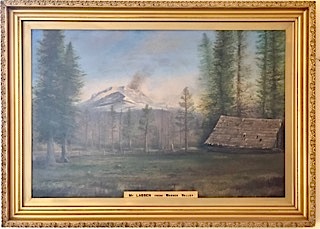
Lane was commissioned by the County of Lassen to do two paintings for the Lassen County Courthouse that was dedicated in 1917. One painting was Susanville in 1864, which is not only the county seat, but it was the same year the county was created. The second painting is that of Warner Valley, looking at Lassen Peak during an eruption. What is peculiar about this, is that Warner Valley is in Plumas County and Lassen Peak is in Shasta County.
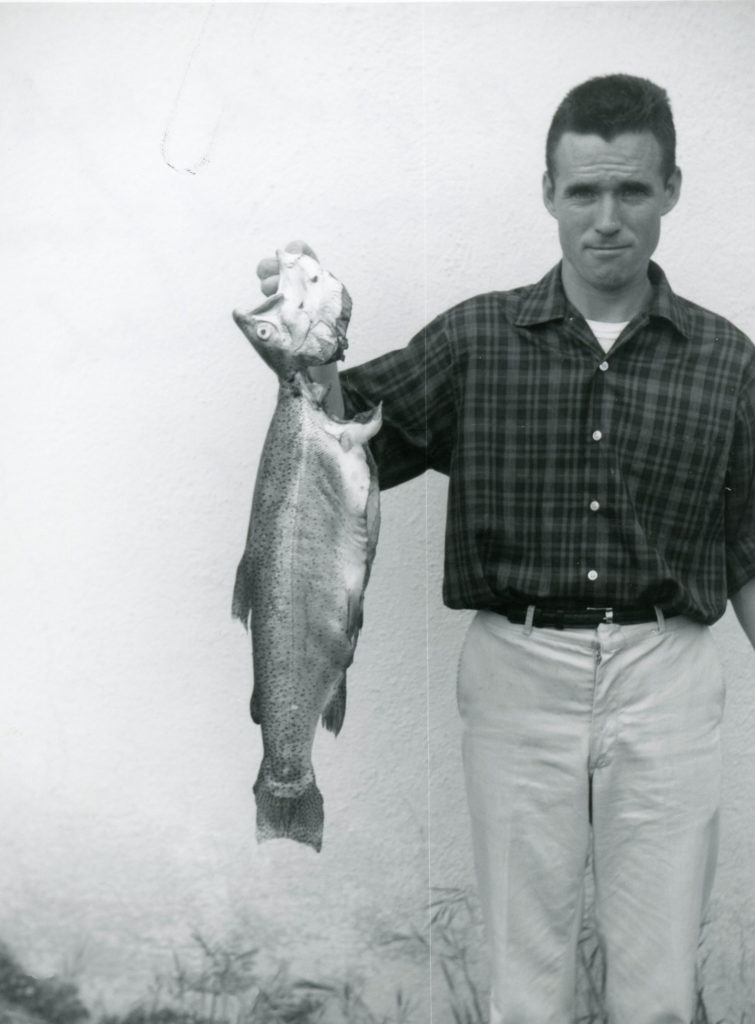
James Stokes holding “Old Lady of the Lake, a 8 pound Eagle Lake Trout caught in 1961.
Since this is opening weekend of fishing at Eagle Lake, it is only fitting that I pass along an article from the Lassen Advocate of September 23, 1927, in regards to a big fish caught there.
“Wright Spalding and Tom Wilson brought one of the nicest fish that has been caught in this section of the county for the season to town yesterday, after having pulled it out of Eagle Lake.
“The fish is thought to be one of the old original Eagle Lake trout, commonly called land-locked salmon and weighs nine and fourth pounds. It is about twenty-six inches in length and is a splendid fish.”
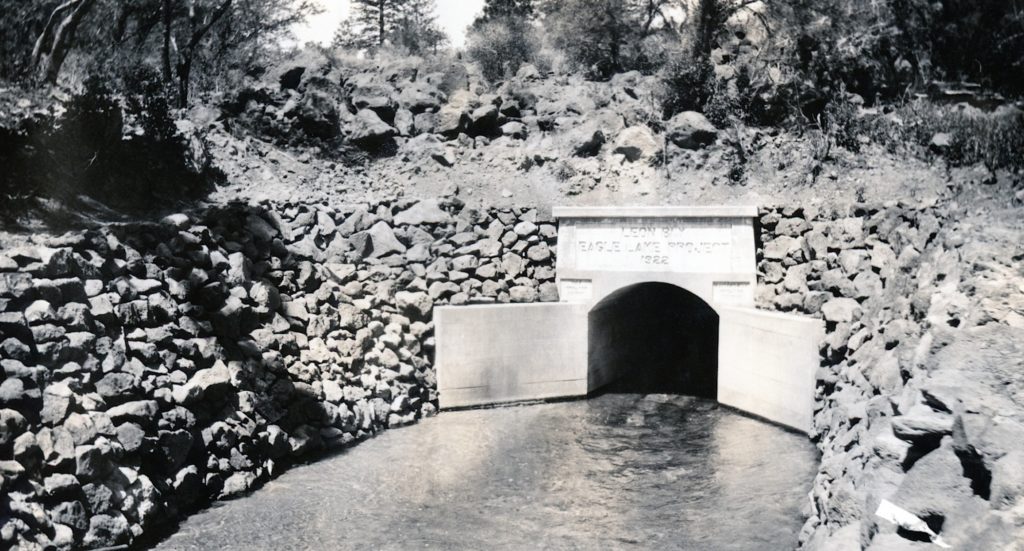
Outlet of the Bly Tunnel, 1924. Courtesy of Lola L. Tanner
Bly was confident of the project, and Gallatin gave him her blessing, in addition she provided him with the necessary funds to launch the enterprise. Bly’s approach was different from the previous attempts. It was a two-prong approach. One was the technical aspect to design the system, obtain permits, etc. The other had to deal with financing. Bly went directly to those who would benefit the most, farmers and ranchers of the Honey Lake Valley. He persuaded one group to form the Tule Irrigation District. Adjoining Tule was a pre-existing district Baxter Creek that was at a standstill as it did not have a sufficient water supply. In a co-operative effort Bly convinced the two districts to pass a 1.25 million dollar bond measure to finance the project. His top selling point was, once the bonds were redeemed, they would own the system.
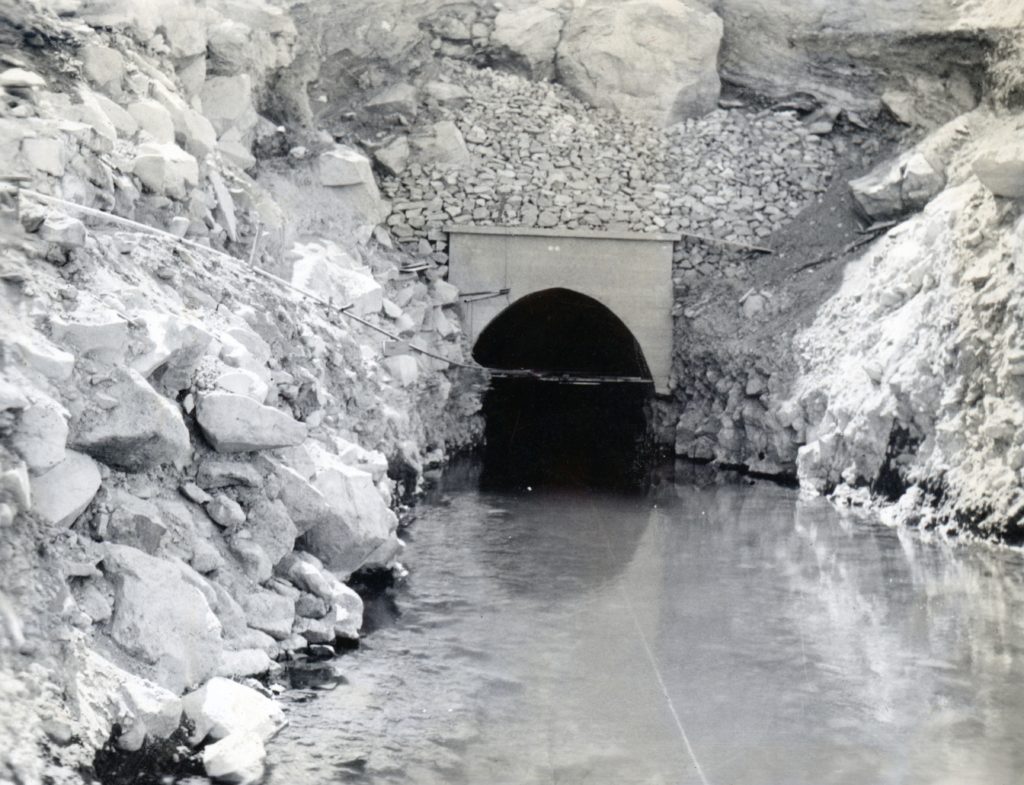
As soon as Bly had everything assembled and approved, no time was wasted to begin the actual implementation. In 1921, Bly contracted with the Grant Smith Company of Seattle to construct the entire system for $950,000. That fall work began on the 7,300 foot long tunnel. In the spring of 1923, the tunnel was completed, a few months behind schedule. It was a daunting task, to say the least, as 180,000 cubic feet of soil and rock was excavated to construct the tunnel.
On May 19, 1923, a grand celebration was held. The joyful times of Bly Tunnel were short lived. In a nutshell, there were two factors that caused the Bly Tunnel project to implode. Grant Smith Company’s contract stipulated the inlet would be eight feet below the lake’s surface, but they only did three feet due to volcanic rock encountered. Litigation ensued. To compound matters, a drought that began in 1917 and one that would last for twenty years, drastically lowered the level of the lake.
In 1935, after a decade to deepen the intake channel, the tunnel was abandoned. Many farmers in the irrigation districts went bankrupt, unable to make their bond payments. In 1961, the State revoked Bly’s original water right permit, thus a final blow. The tunnel has since been sealed and no water flows through it. The odd thing, many still cast the blame on the lake’s fluctuating levels on a sealed tunnel.
Bly tunnel inlet, July 1924. Courtesy of Wyn Wachhorst
This falls under the category, “Well, it seemed like a good idea at the time.” This was the consensus many had about the issue to tap Eagle Lake by means of a tunnel to irrigate the arid sagebrush lands of the Honey Lake Valley. After all, there was a mile distance between the lake and the headwaters of Willow Creek and that creek would provide a natural channel to convey the water to the Honey Lake Valley. After all, it should be noted that Eagle Lake is California’s second largest natural lake, and back in the 1870s, the reservoirs that we have today were non-existent.
The scheme had its humble origins with Augustine W. Blair. In the summer of 1872, Blair secured three investors to finance a mile and a half long tunnel to tap the lake. He estimated the cost at one million dollars. The project went no where. However, word of this enterprise spread and the following year, Captain C.A. Merrill paid the region a visit to inspect the scheme. Merrill was so consumed with the Eagle Lake project that he would spend the rest of his life in pursuing his quest, until his death in 1901.
Merrill was not the only one who saw the lake’s potential. Nine other entities were created over the next four decades with the same intent that originated with Blair, all without success. In 1914, enter Leon Bly, a civil engineer, who was recruited by Eagle Lake property owner, Malvena Gallatin, as to whether the tapping of the lake was feasible. Gallatin’s concern had nothing to do with irrigation. The constant rising level of the lake wreaked havoc to her shoreline property. Bly agreed and was methodical in his approach. It should be noted that prior to Bly, his predecessors were under the impression that the lake had an abundant supply of water, some who went so far to proclaim the lake’s depth at 1,000 feet! In 1915, the first thing Bly did was a sounding of the depth of the lake. His revelation surprised many, when the deepest point in the lake was 105 feet.
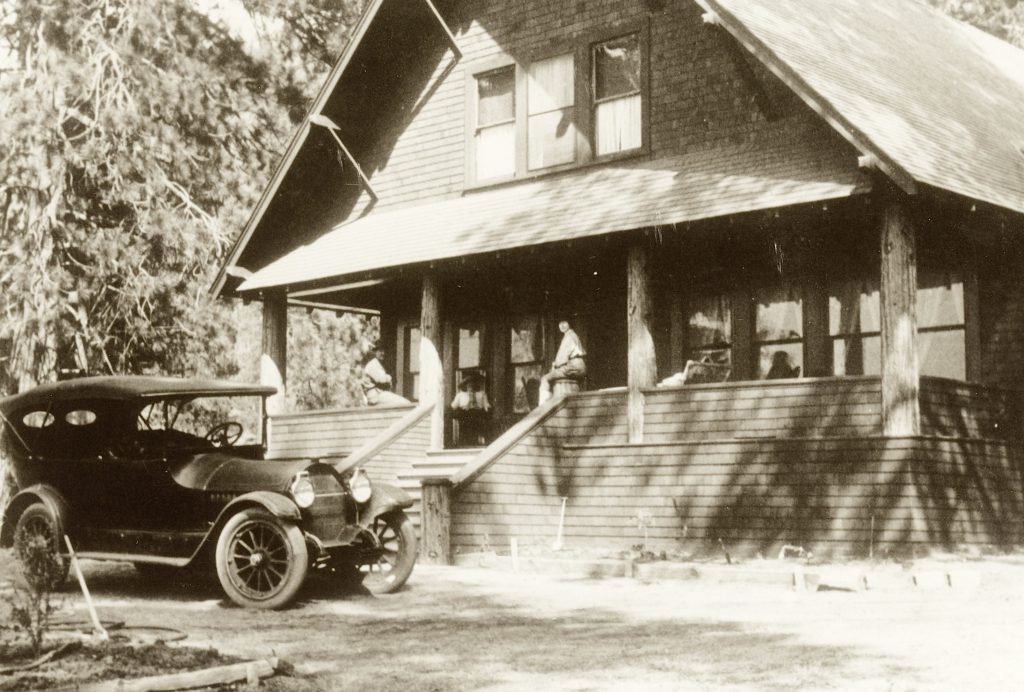
In the 1980s, the forest service considered Gallatin House at Eagle Lake surplus property and wanted to demolish it. More about this later. Anyhow, the property is now part of of Camp Ronald McDonald at Eagle Lake. This Saturday and Sunday they will be holding their 26th Annual Memorial Day Pancake Breakfast from 7 a.m. to 11 a.m. It only cost five dollars for all you can eat breakfast. Proceeds benefit Lassen County Kids Camper Scholarship Fund.
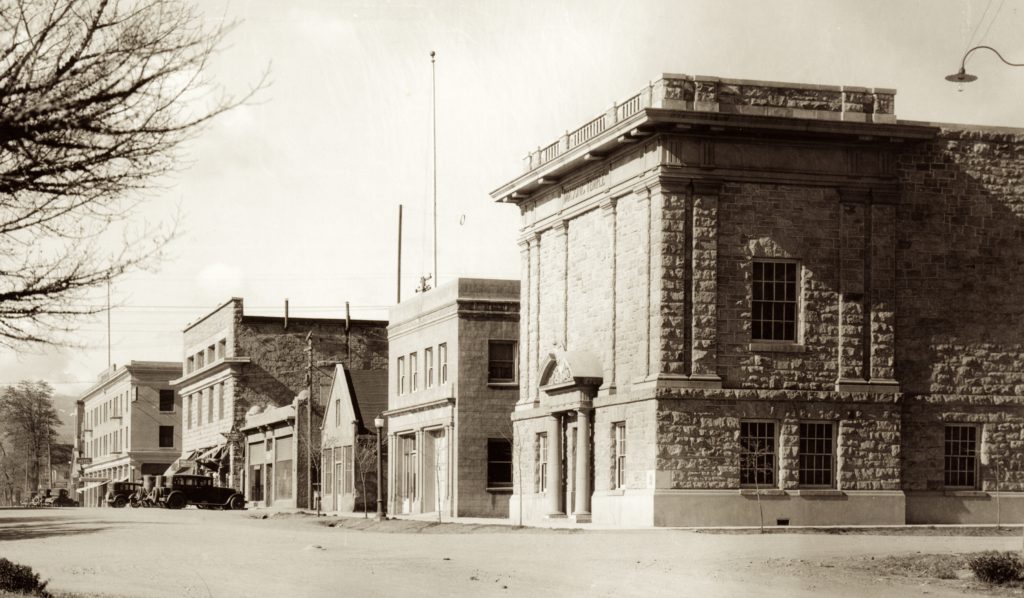
At the July 18, 1927 Susanville City Council meeting, plans were finalized to transform Main Street into a boulevard. The major impact was that all cars entering Main Street from Roop, Lassen, Gay, Union and Weatherlow Streets would be required to make a full stop before proceeding. The matter was thoroughly discussed, it being the only item on the agenda. The ordinance went into effect on August 19.