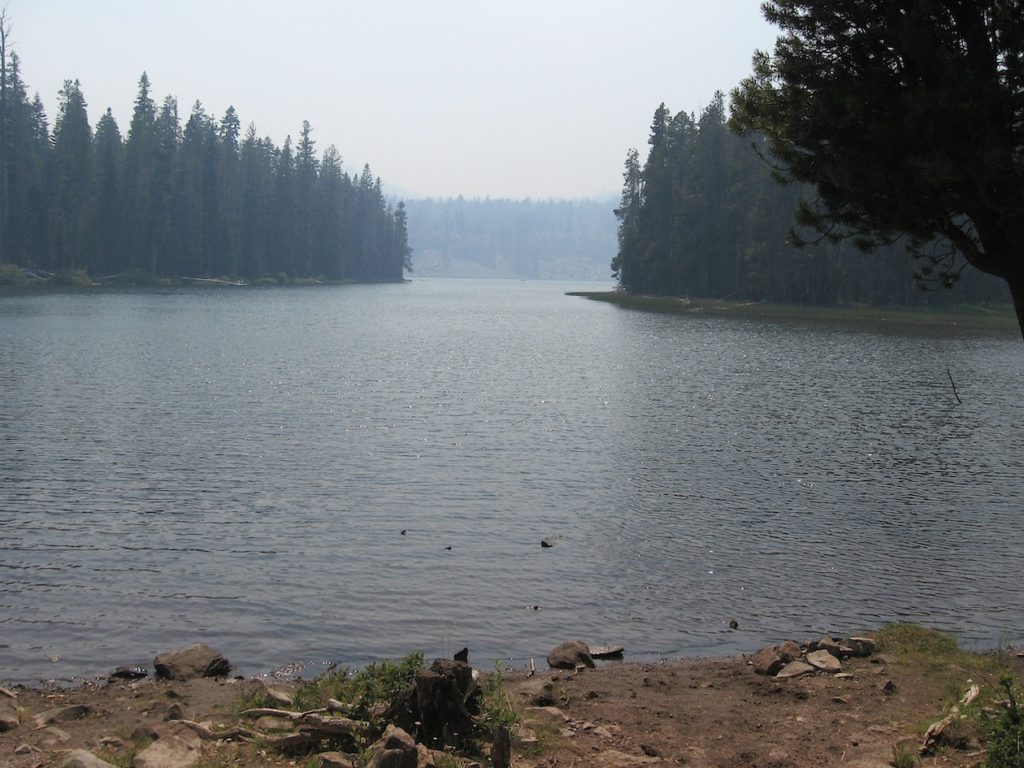
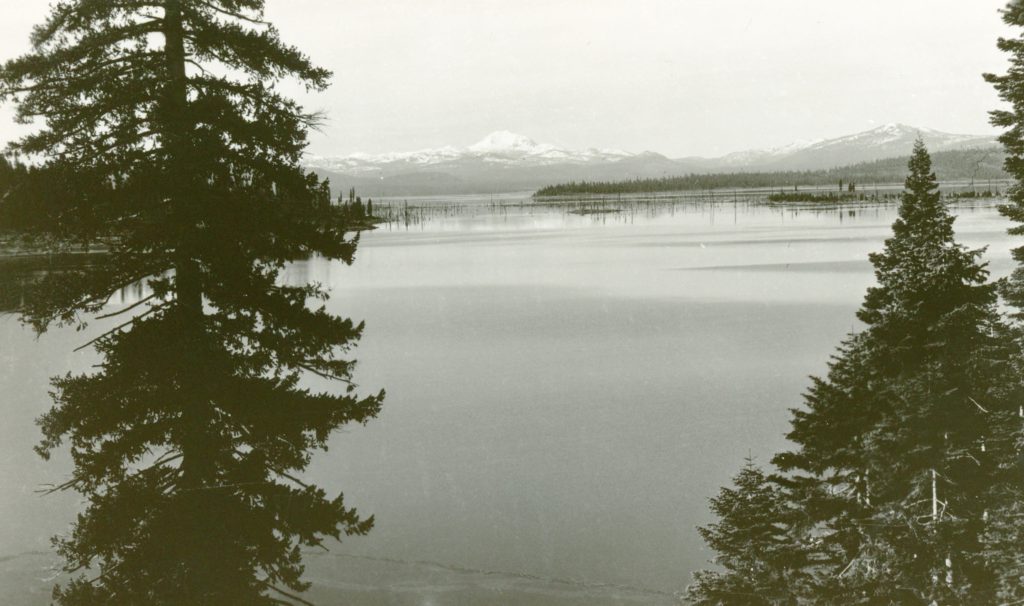
Silver Lake at an elevation of 6,472’ was named sometime in 1870s for the silver like reflections of the water surface when the wind blows. In 1924, the Lassen National Forest Service surveyed summer home lots and offered them to the public on a 99-year lease.
On May 28, 1938, Lurah May Stubblefield was granted to operate a seasonal post office there, that she christened Lake Nokopen. Stubblefield was the only postmaster and the post office closed on June 29, 1940. The name Lake Nokopen may have been attributed to the Boy Scouts organization, that held summer camp there during the late 1920s and 1930s.
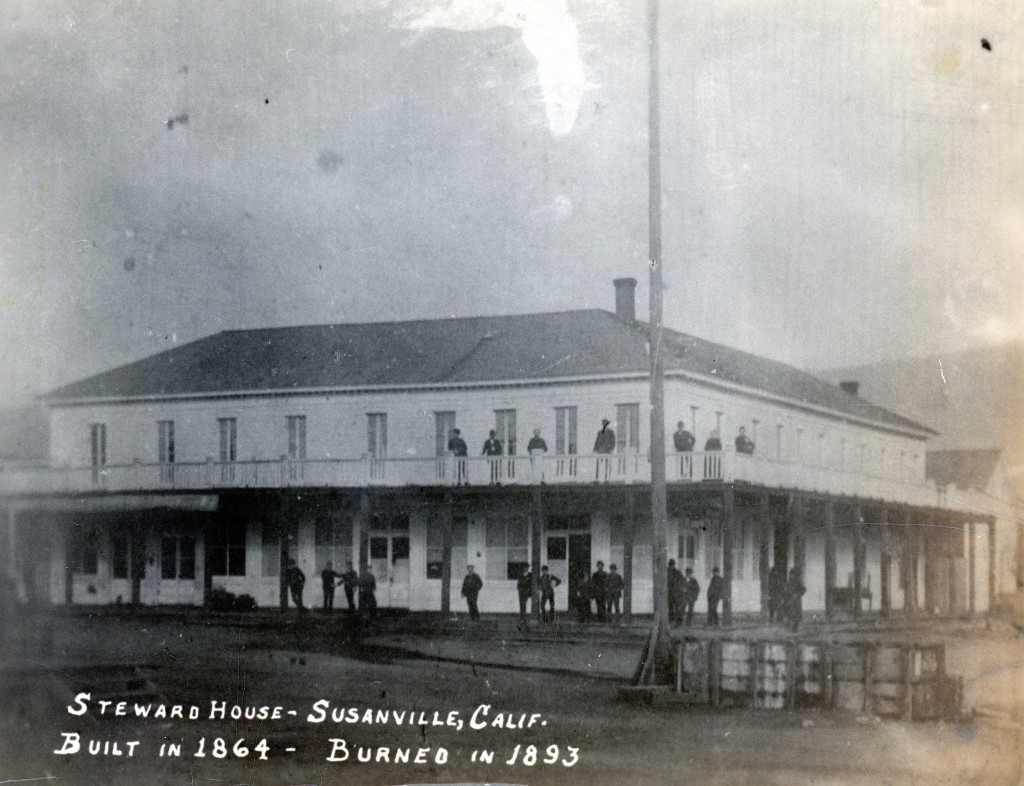
In July 1892 George and Socrates Harrison, Susanville contractors were rebuilding the porch steps of the Steward House Hotel located on the northwest corner of Main and Gay Streets. They discovered the remnants of a historic relic—a small cannon.
According to Adam D. Elledge (1827-1924) the Plumas County officials brought the weapon with them in 1863 during the episode that became known as the Sagebrush War. It was never used. After a truce was held, it appears someone “liberated” the cannon and hid it the corner of the foundation of the Steward House which was under construction. A year later, it was removed, and it was noted it was fully loaded. So it was discharged, but not in a good way. The muzzle was plugged and sent shrapnel of the cannon into the area, a piece that struck and tore a big hole in the Susanville School a few blocks of way. At least no one was injured. The remains of the cannon were put back in its original hiding place, until it was unearthed in 1892 and given to Elledge.
It has been a popular summer destination since the 1870s. Unfortunately, while visiting there last summer, smoke from the Dixie Fire that started two-days earlier some fifty miles away, had already descended on the lake.
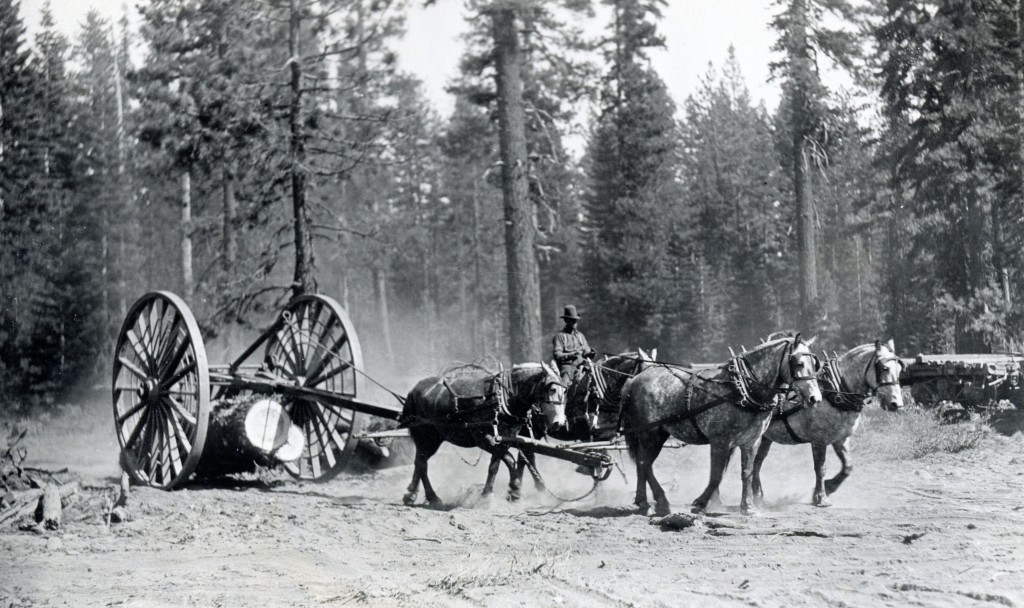
Horse logging with big wheels, at Fruit Growers Camp B, north of McCoy Flat Reservoir.
There were many enjoyable aspects when I researched the logging/sawmill operations of the Fruit Growers Supply Company aka Fruit Growers. For starters they kept well detailed records. Their annual reports are a compelling read, and one just never knows what you can find in them.
Fruit Growers 1947 annual reported highlighted many interesting facts, it being the company’s 40th anniversary. Take for instant, the following:
”The Susanville mill was completed and began cutting timber late in 1921. When cutting started, logging in that area was done with horses. Fifty-two horses were bought locally, 60 in St. Paul and 22 in Iowa. The total of 134 horses had an average cost of $276.67 and the harness for them totaled $13,247.07.
“Four horses would skid with wheels about 2200 feet per load. Modern Diesel D8 tractors bring in about 5,000 feet.”
Note: This originally appeared on January 8, 2018, so it might be familiar to some. For some odd reason in August 2021 it garnered a lot of attention from first an internet search and then spread on social media. While seasoned subscribers may recall it, there are new ones who may find it of interest.
From time to time discussions have been held whether the cloud seeding in the Lake Almanor Basin area by Pacific Gas & Electric Company affects the areas to the east. In 1979, Lassen County officials thought the cloud seeding was part of the drought problem in southern Lassen County. In October 1979, Henry LaPlante of PG&E stated that the company has been treating selected storm systems for more than 25 years. He said the intent of the seeding was to increase the high elevation snowpack. Furthermore, LaPlante wrote, “There is no scientific evidence which indicates that cloud seeding activities in our Almanor area reduces the amount of precipitation in any other area.”
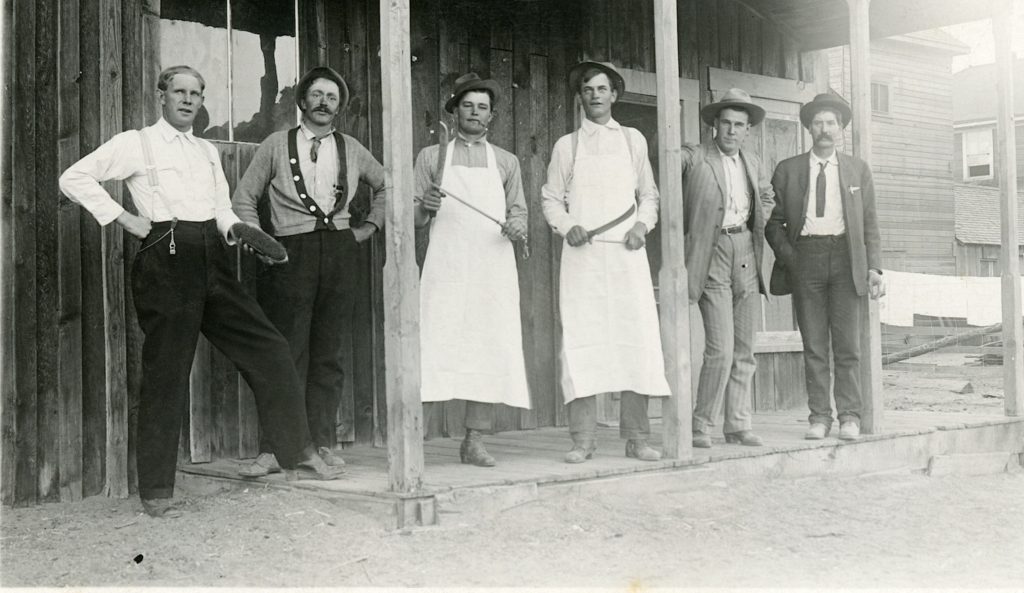
Left to Right: Garfield Vogt, Les Cottingham, Orrin Myers, Fred Hansen, Roy Hopkins, Unknown—Vivian Hansen
The Standish Meat Market was an early day enterprise of Fred Hansen. When it first opened it was located on the north side of Todd Hemler’s Standish Livery Stable. What a peculiar arrangement to the say least. As business increased Hansen moved to a second location and branched out in carrying groceries. One of his newspaper advertisements caught my attention with the statement “Local-killed Meats.”
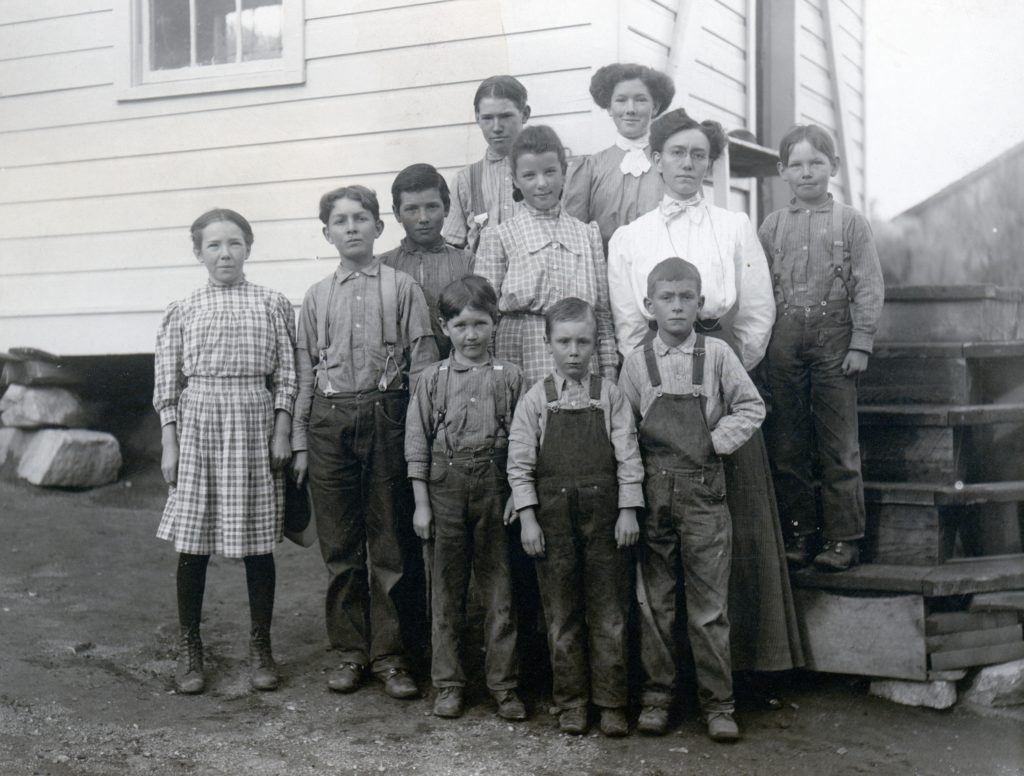
In the fall of 1882, W.H. Sifford led the effort for a new school district on the west side of Honey Lake. The two nearest schools were nearly five miles away in either direction—Milford to the south and Lake to the north. In May 1883, the Oak Grove School District became a reality. The nucleus of the student population came from Clark, Decious and Raker families. It should be noted that the Wales, Wilburs, Lindsay, Fisher and Grass families also contributed to the student population. Like so many rural schools in 1920, the enrollment had declined to such an extent it was closed. In 1922, with no indication that the school would be resurrected, it was annexed to the Lake School District. The school was torn down in February 1926.
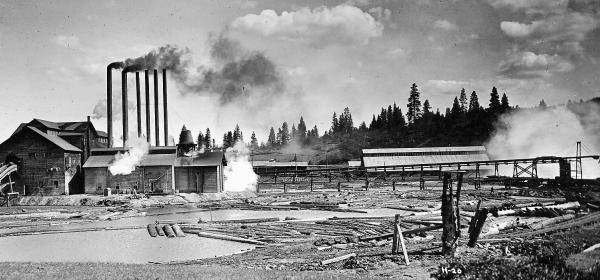
Since 1907, Fruit Growers Supply Company has had a presence in Northern California. It first began at Hilt in Siskiyou County. In 1919, it expanded to Susanville. In 1944, another expansion of the purchase of Westwood and equally important the Burney Tract in Shasta County. After the closure of Hilt in 1972, Fruit Growers was no longer operating any sawmills, the company owned some 400,000 acres of timberland in Northern California. In 2019, Fruit Growers began to liquidate, the first to go was the Burney Tract which was sold to Sierra Pacific Industries.
The water carnival at the Sunkist Lodge, Eagle Lake, 1921. Courtesy of Ed Standard
The next to go was the Lassen Tract. In 2020, it was also sold Sierra Pacific Industries.
Fruit Growers Mill at Hilt, 1919
Hilt, was of course, Fruit Growers first acquisition and it would be the last sold, which occurred in 2021. It was purchased by a firm known as New Forest based out of Sydney, Australia. Fruit Growers has focused on purchasing timberland in Oregon and Washington.
While sifting through some notes, I came across these items from the Quincy Union newspaper of the 1860s. Regional newspapers such as The Territorial Enterprise (Virginia City) to the Marysville Daily Appeal provided coverage of the Honey Lake environs. So here are some tidbits.
January 3, 1864 – They have a rabbit mine at Honey Lake. On one day 400 of those animals were sent to the Virginia City market.
January 30, 1864 – Hay is selling for $80-$100 per ton in Honey Lake. There is no hay in Sierra Valley.
March 5, 1864 – The farmers in Honey Lake are busily at work ploughing, sowing, repairing and improving their ranches.
September 17, 1864 – The new jail in Susanville is in course of erection and when completed will be an ornament to the town and very convenient. It is built of Roop granite found in the quarry near the town.
September 15, 1866 – Post Offices at Black Rock. Post offices have been established at Spring City and Hardin City. W.H. Vanalstine is appointed postmaster at Spring City and Charles Nixon at Hardin City. This will be of a great accommodation for the Black Rockers.
29 September 1866 – On the Way. Alvaro Evans of Long Valley has a quartz mill on the road for Black Rock. They expect to have it put up and running by the first of November. (Note: This mill was moved to Hayden Hill in 1871)
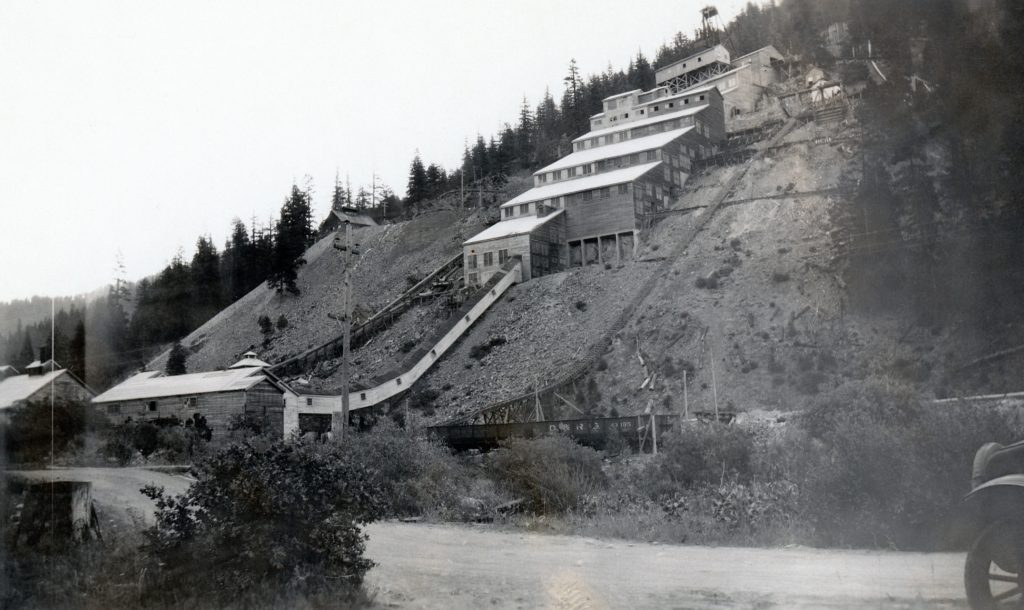
Engels Copper Mine, 1922. Courtesy of Lola L. Tanner
In 2018, US Copper announced preliminary intention to bring the back copper mining in northern Plumas County Copper Belt. They focused on a 13 mile square area that includes Moonlight Valley to the Engel Mine on Lights Creek, just north of Taylorsville. Between 1915-1930 161 million pounds of copper was extracted. It was their intent to begin a drilling program in 2021, but due to last year’s Dixie Fire in the region work was temporarily stalled.