Indian Valley Hot Springs, Plumas County

Lassen Mail, May 21, 1926

Operating a bath house to a full scale resort utilizing hot springs has in my perspective is a risky endeavor. When times are good, they are real good, but same applies to bad times, and in many instances its the low points where the operation shuts down. Some times revived and some times not.

Indian Valley Hot Springs at Greenville is a perfect example. Greenville was a thriving mining community during the late 1800s.  The hot springs became a popular attraction and bathing place. As the mining activity dwindled by 1900, the bath house fell into disrepair and closed.

In the spring of 1926, B.C. Johnson decided to see if he could make a go of it. He spent six weeks in getting the property in shape. Johnson highlighted the fact, that not only could a person have an enjoyable soak, but one could also “soak” in the natural beauty of Indian Valley. How long Johnson operated it I do not know.

A partial view of Indian Valley in the 1960s.

For those interested, awhile back it was on the market with an asking price of $4.95 million. With last year’s devastating Dixie Fire that destroyed a large segment of Greenville, the value might have dropped.

Tim
American Forestry Week

A century ago, usually during the second or third week of April, the President of the United States would proclaim American Forestry Week. It was a venue to bring public awareness for the preservation of forest growth and the prevention of forest fires on public domain. Today, in the month of July is National Forest Week which promotes public awareness of national forest issues.

For instance, in 1924 California experienced a very severe drought and along with its worst forest fire season to date. It was noted that over a million and one-quarter acres were burned over by fires, most of which was caused by careless campers.

Locally, as the timber industry played such an important role in the region’s economy it was observed. It was a topic found at many civic organizations, as well as in the schools.

Tim

Lassen Farm Bureau News

Sunflower demonstration on the A.F. Babcock Ranch, Bieber, 1923

During the 1920s, the Lassen Farm Bureau published weekly all the agricultural news of the county. All the rural communities had their own “Farm Center,” that held regular meetings to discuss a wide variety of topics. M.D. Collins who was the farm advisor then, kept very busy.  Here are two items, that some may find of interest.

May 1926 – J.H. McClure, assistant freight and passenger agent for the Southern Pacific with offices in Reno, spent two days in Lassen County this week. Mr. McClure states they are now giving Lassen County service in freight that has never been excelled. Freight leaving Reno in the evening arrives in Susanville the next morning. Mr. McClure states that an iced car is leaving Susanville twice a week to carry Lassen County products to the lower country markets. The service is being pushed to the highest possible degree of efficiency and the farmers will be able this season to ship out their products under better conditions than of former years. The rate on potatoes was reduced last fall.

May 1926 – Jack Menser, Arthur Kenyon and Peter Gerig, committeemen for the Big Valley flour mill, report that the money is being paid quite satisfactorily and it is hoped the larger portion will be collected in the near future. Alfred Jacks is ready to make the mill purchase as soon as the money is available.

August 1926 – The Big Valley flour committee has collected $2,450 of the $2,500 required to get the mill. The mill is being ordered by Alfred Jacks who is constructing the new building in which to house the machinery. Big Valley will have another flour mill for operation this fall.

September 1926 – The Red River Lumber Company has built a new hay barn near the dairy buildings which has a capacity  of 1000 tons of hay. The barn is practically full of hay at the present time. Other improvements have been made around the dairy barns and the market milk station. New  corrals for the dairy cows and feed racks are being installed.

Tim

Preparing for a new Lassen High School

Lassen Union High School

When the trustees of Lassen Union High School made the decision to a build a new school, time was of the essence. Glenn Wemple, who was on the board, informed me that they did not want to make the same mistake as what happened to the Orland High School. These types of school hold a tremendous amount of emotional attachment in their respective community. Orland moved slow and it created a great deal of anger and resentment.

Akol & Associates of San Francisco were hired as the architects for the new school. The estimated cost to construct a new campus on site of the existing was $2,317,410. It would be done in two phases. For Phase One, bids were required to be submitted no later than April 12, 1967. Five bids were received and initially the trustees took no action. A week later, the trustees rejected all bids. New bids were solicited for no later than May 15.  On May 16, 1967 the trustees accepted the bid of C&J Construction Company of Reno, Nevada. On Friday afternoon, June 23, 1967 a groundbreaking ceremony was held behind the main school building.

Support


Susanville’s First Railroad Depot

Susanville Depot, 1914

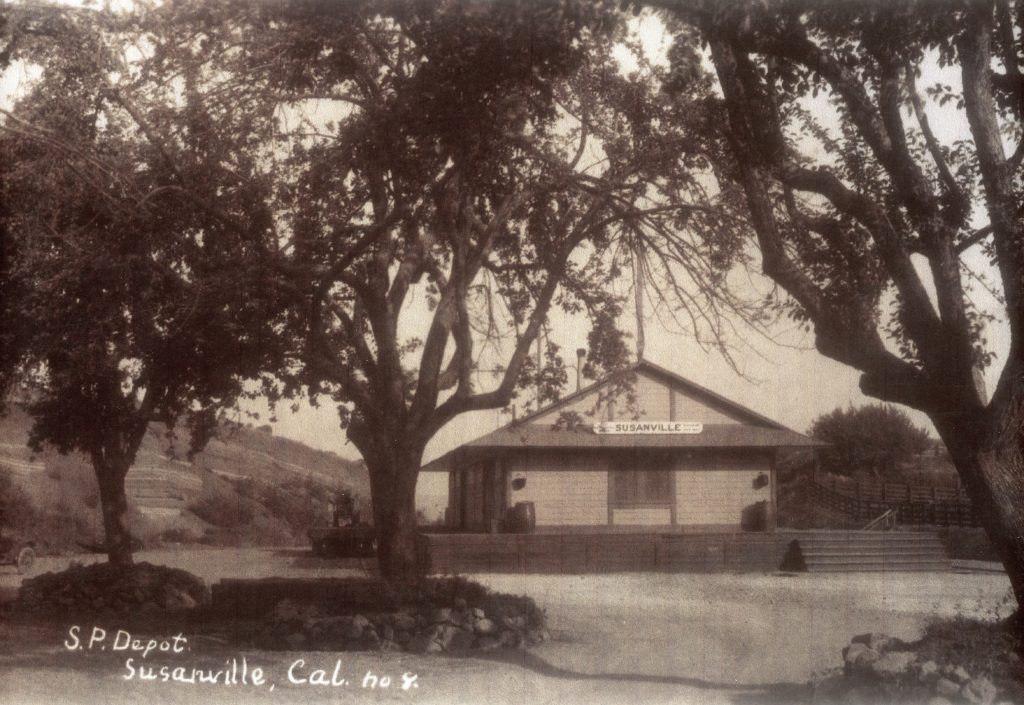
In the spring of 1913, the mighty iron horse finally arrived in Susanville and the community rejoiced. It was a long time coming, ever since the early 1880s they had done all they  could to attract a railroad, citing its untapped timber resources as an incentive. For awhile there was a glimmer of hope that the NCO Railroad would extends its line to Susanville on its journey north to Oregon. That was shattered when the railroad in 1887 decided to bypass Susanville and build its line along the east side of the Honey Lake Valley.

With the arrival of the Fernley & Lassen Railroad, in 1913, the residents wondered what kind of depot they would have. As far as the Southern Pacific, owners of the line,  were concerned it would be a modest structure, since in their opinion, Susanville was a small community that had no industry.  A wooden 26 foot by 62 foot depot was built, being part passenger depot and part frieght shed. It opened to the public on September 14, 1913 with C.B. Morton’s the first depot agent.

Subscribe

P.S. For those who want to know, yesterday the cast came off and pins removed, too. It will take time to fully function again, but its a start in the right direction. Thank you Dr. Mark for everything and for most pleasant and memorable office visit yesterday.


Barbers United!

Pioneer Barber Shop, 1903

In January 1926, the barbers of Susanville, not to be confused with the famed Barber of Seville, had an interesting get together. The barbers consisted on Ray Ashton, E.M. Lamson, Andrews & Thurmond and the Kester Brothers. They agreed to charge a uniform price. As of February 1, 1926, all haircuts would be 65 cents; children under the age of 12, 50 cents and shaves 35 cents.  In 1900, a Susanville barber charged 25 cents for a hair cut and 5 cents for a shave.

Fast forward to 1941 when the barbers of Lassen and Plumas Counties organized a Journeymen Industrial Union of the AFL.  The rates they charged were the same as the ones set by the Susanville barbers in 1926.

Subscribe

A 2023 Calendar Cover Opportunity

Dow Wells, October 8, 2020

First of all, I plan to still issue calendars for the next few years. There are some production issues to be worked out. Anyhow, on two occasions I have used a contemporary color photograph for the cover. The above photograph of Dow Wells, near Eagle Lake, graced the 2021 calendar cover. For those photographers out there, if you happen to see something of interest that may be suitable for a cover, please free to submit. It should be noted that they need to be taken in the portrait mode. One has plenty time during the spring, summer and early fall as I will not need the same until October 1.

Tim

A Big Timber Sale

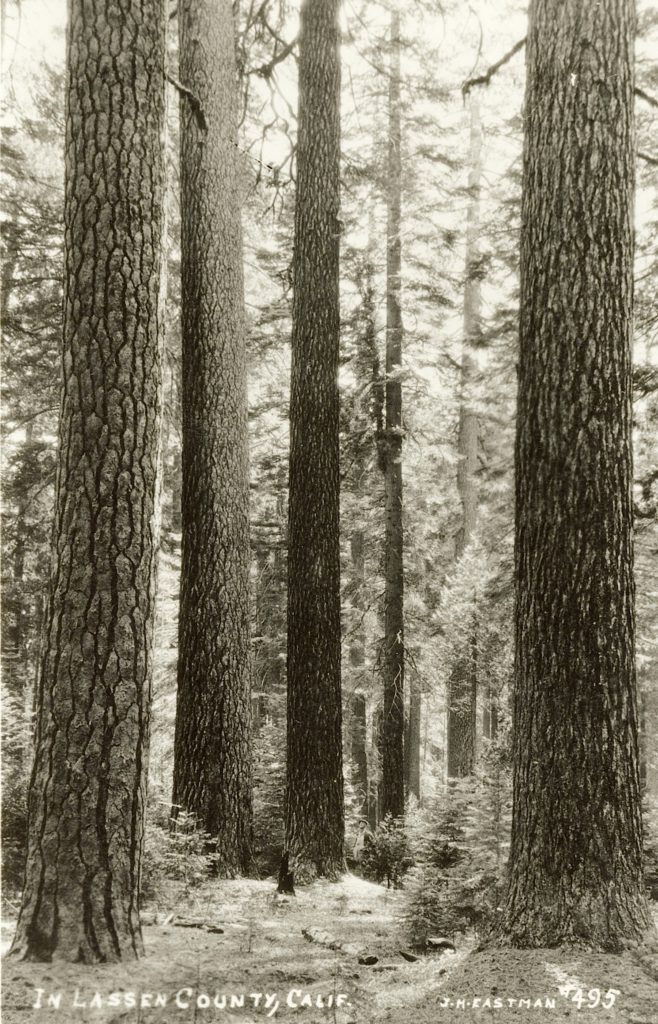
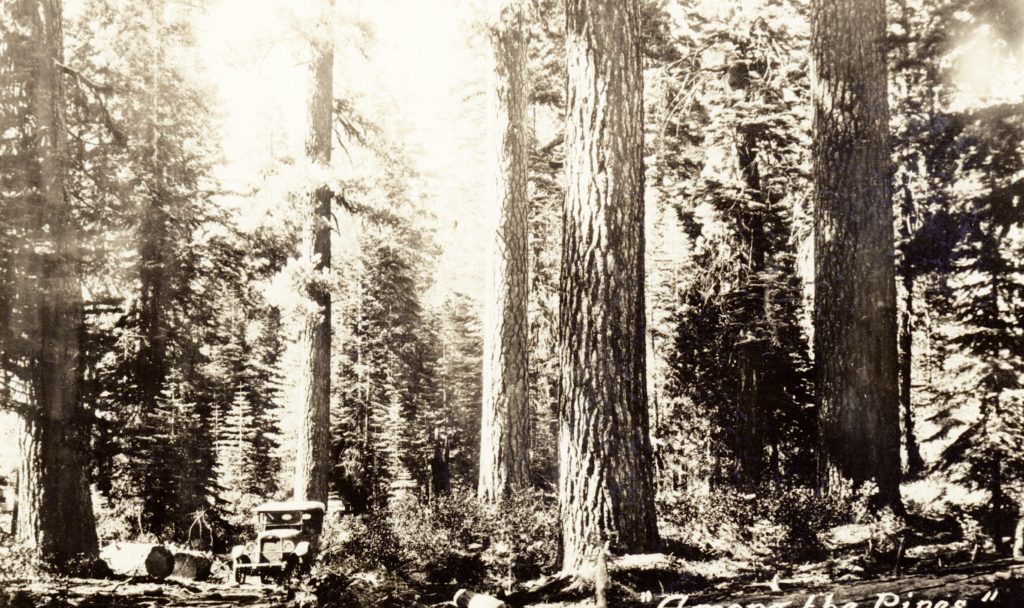
In early 1922, the Lassen National Forest Service advertised it was accepting bids for the Pine Creek Unit timber sale just west of Eagle Lake. This was no ordinary timber sale—it consisted of nearly one billion board feet of merchantable timber! Of course, there were terms and conditions that applied.

The buyer would have twenty to thirty years to harvest the timber. To protect the lands for the future, harvesting was restricted to a maximum of 37 million board feet a year, and only 70 percent of the original timber volume per acre was to be cut. On April 2, 1922, the bids were opened. The following day, Fruit Growers Supply Company bid of $3,314,000 was accepted. The money spent in increments on a pay-as-you-cut basis.

Fruit Growers did have a competitive edge. Their Collins Tract and the Pine Creek Unit were intermingled. Since it was stipulated that only a limited amount of timber could be harvested was not particularly attractive to many lumber companies. Finally, Fruit Growers had already adopted a sustained yield forest management policy, another requirement of the forest service.

As the Lassen National Forest would monitor the sale, it was determined to move its headquarters from Red Bluff to Susanville.

Support

An Active Lake Almanor Volcano

Lake Almanor, 1926.

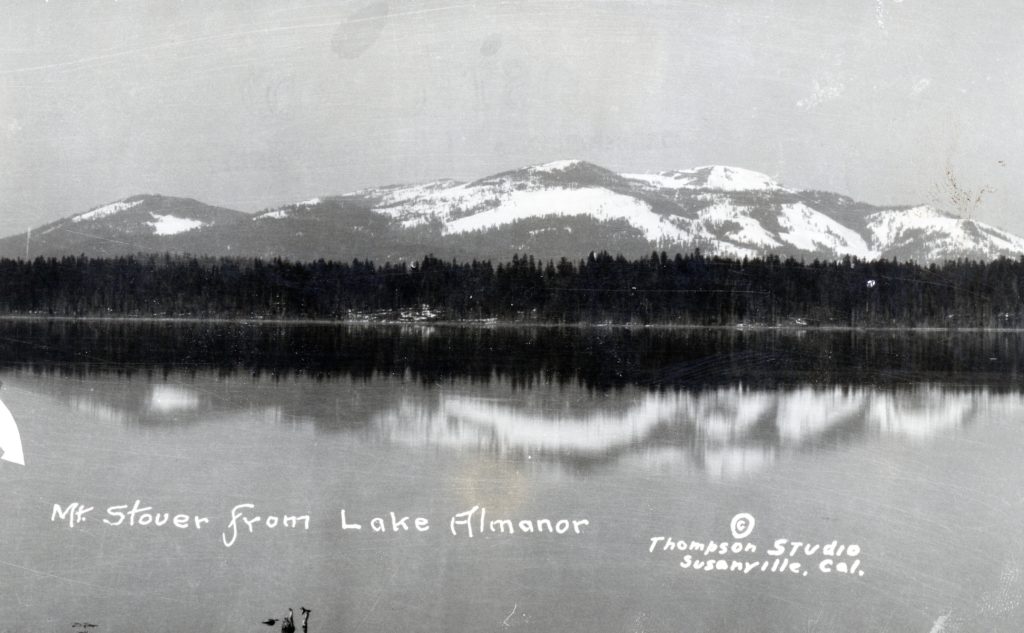
This is not a April Fools prank. On March 15, 1915, the Surprise Valley Record, Cedarville, Modoc County had a small article about “Another Volcano.” Lassen Peak, during the previous year, had become an active volcano. This account of Stover Mountain as an active volcano, I found rather “surprising.”

“Another Volcano-Westwood, Cal. Mar. 7-Another volcano in active eruption in this vicinity, a mate to Mount Lassen was reported today to the officials of the Red River Lumber Company.

It is Mt. Stover, 22 miles west and located 15 miles southeast of Mount Lassen.

On the strength of the reports men were sent to investigate as the country is in the heart of the timber holdings of the company.

”Mt. Stover, it was reported, has been smoking slightly for the past two days but early this morning an active eruption was seen with a column of dense smoke rising far above the lofty peak. No flames were seen or damaged reported. Mt. Stover is said to be in second in height of Mt. Lassen and the outbreak at the distance from the original volcano is regarded as a sign of subterranean disturbances.”

Tim

An Interesting Observation

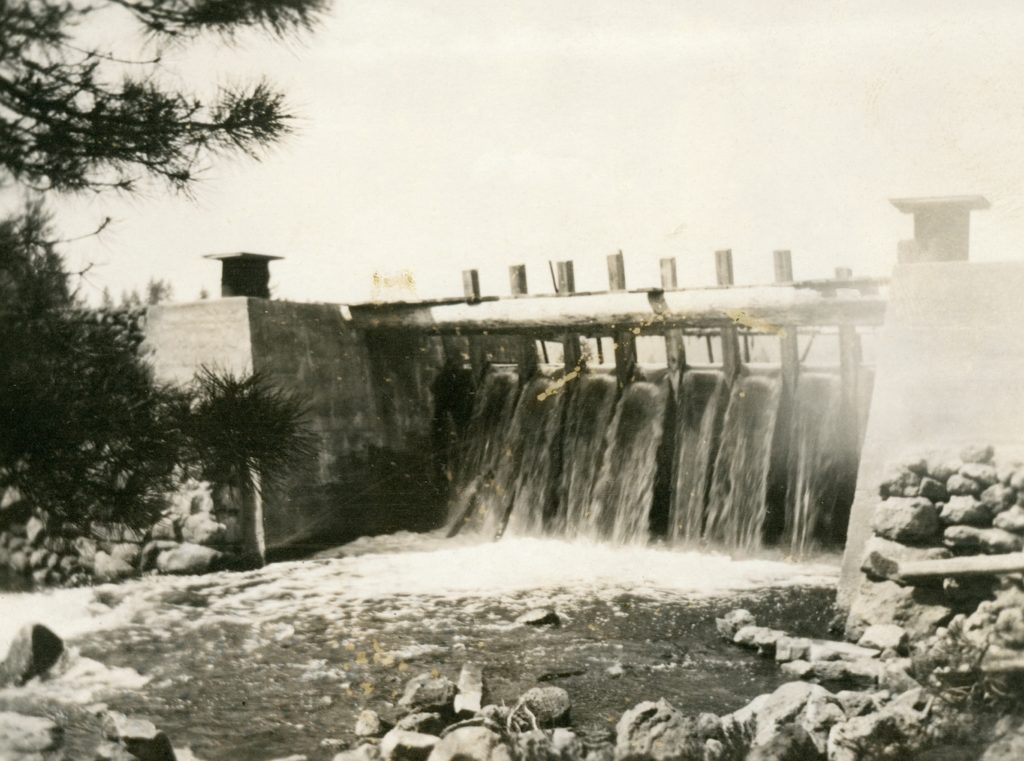
McCoy Flat Reservoir dam, 1915. Courtesy of Alphozene Terrill, granddaughter of Ben H. Leavitt

In 1965, Med Arnold penned an interesting Letter to the Editor of the Lassen Advocate. Arnold (1885-1967) is known for many things, whether a magistrate at Herlong, to high school coach, and also being a grandson of Isaac Roop, the founder of Susanville. The letter’s caption “What Lassen County Needs.” With the steady decline of the lumber industry, it was important in his opinion to focus on the future. While he acknowledged the opening of the prison, the California Correctional Center, that was beneficial, it was not the future.

A pastoral scene near Johnstonville.

Arnold wrote: “It is my opinion that the most important project is the water situation, especially now with a decline in the lumber industry, which is sure to become worse in the not to distant future. If that is the fact, and I believe that it is, then we must look to helping of our farmers. The raising of crops and livestock are sure in time to become the leading industries of the county. So with that in mind we should endeavor to secure for them and adequate water supply, not for their present farms and ranches now under cultivation, but for the hundreds of idle acres now in brush.”

Arnold pressed the need to construct dams on Susan River, Willow Creek and Long Valley Creek. Not only did he stress these newly created reservoirs would furnish badly needed water, but would provide for additional recreation for fishing and such, “adding to our future economy.”

In 1968, Lassen County’s first general plan was released. That document, too, stressed the importance of the dams that Arnold referred to. They never happened and now the California
Correctional Center is on the brink of closure.

Subscribe

Exploring Lassen County's Past