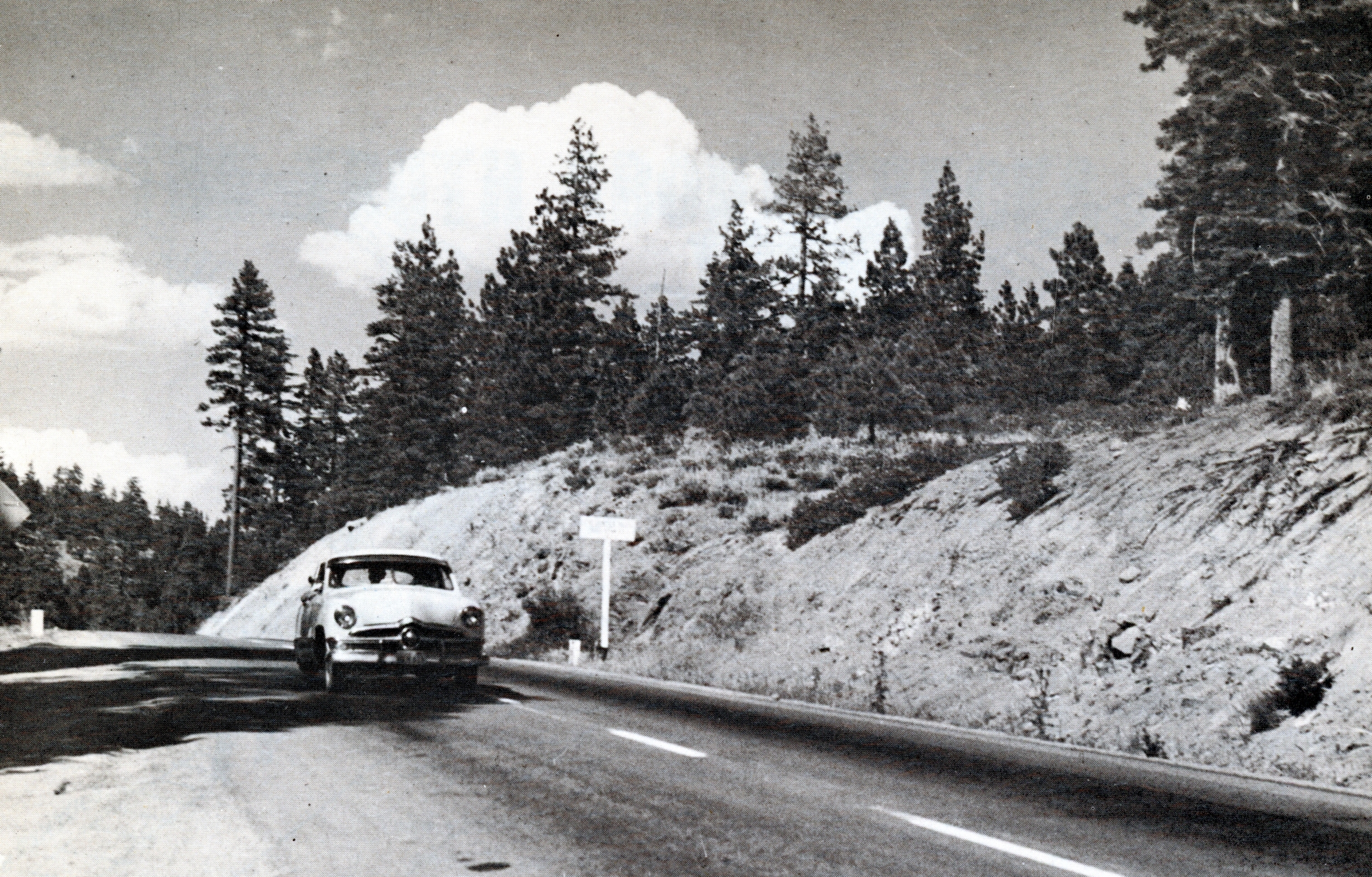
The above photograph appeared in a 1956 Susanville Business Directory. While the quality is not the best, I thought some might appreciate the same. In 2020, work began on what is dubbed the Good Fred Project by Caltrans. It consists of a new bridge over Goodrich Creek and a major highway alignment over Fredonyer. Hopefully, the project will be completed this year.
The region, like most of California is earthquake prone. Actually, on any given week there are small quakes in the region, registering under 3 on the Richter Scale. The tremors are so faint, no one feels them.
However, that was not the case on May 23, 2006, when an earthquake struck the east shore of Lake Almanor at 8:47 p.m. It got everyones attention as it measured 5.7. It was widely felt throughout the region.
In the spring of 1914, a swarm of earthquakes hit the region, a prelude to Lassen Peak’s eruption that May. At the same time, Big Meadows was being flooded to be transformed into Lake Almanor. Many locals believed that was cause of the Lassen Peak eruption.
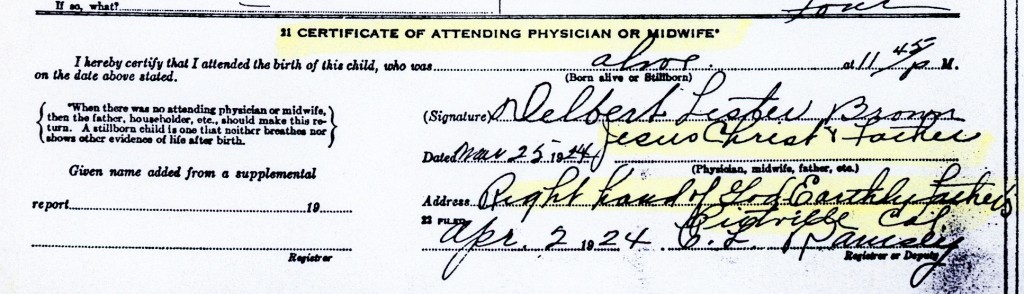
Notice the information Brown provided for his daughter’s birth.
Back in 1997, I was hired to research a parcel near Pittville on the Lassen-Shasta County line. It became a very convulated affair, and not a pleasant one on my part. However, the early history of the property has an unusual tale.
Delbert Lester Brown (1890-1966) gave this most unusual address of the “Right Hand of God Earthly Father” when his daughter was born in 1924. Brown’s homestead was situated on the bench above Pittville. He located there in 1914, after moving from Lakeview, Oregon. When Brown was digging a well by hand, he reached a point when it was necessary to blast out the rocks with dynamite. Brown set his charges into the well hole and tried to detonate them. Nothing happened, so he crawled into the hole to locate the problem. Brown discovered the charges had become damp. Since there was little light, Brown, with the claw end of a hammer, accidentally struck one of the blasting caps. Luckily, it did not go off. At that moment, Brown decided that the hand of the Lord was on his side and that he must change his ways. After that incident Brown began spreading the gospel and he became widely known as Preacher Brown.
Note: For those interested my broken wrist is improving. Progress is slow but sure, but this year I will not able to do as much cemetery work prior to Memorial Day.
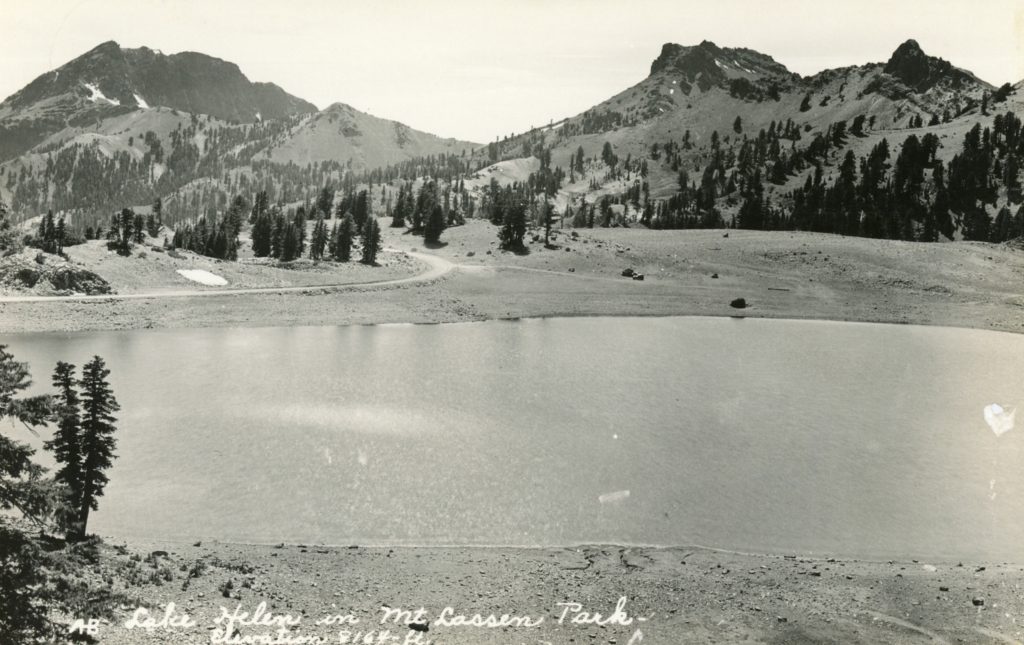
Lake Helen at an elevation of 8,164’ is a popular stopping spot on the loop highway through the park. It was so named for Helen Brodt, the first woman to climb Lassen Peak.
Long before there was any thought given of making Lassen a national park, the area lured summer tourists from the Sacramento Valley to escape that region’s heat. In late August 1864, a camping party consisting of Pierson B. Reading, Kendall Bumpass, S.S. Thomas, and Aurelius and Helen Brodt arrived at Morgan Meadows, to the south of Lassen Peak. On August 28, they made the ascent to the top of the peak. Two weeks later, the Brodts journeyed to Susanville, where Aurelius Brodt wrote to his mother about his journey in the mountains. “Last week Helen and myself climbed and stood upon the very top of Lassen Peak, 11,000 feet above the level of the ocean. It was a thrilling adventure—we walked over ice and snow that had probably been there for centuries—we found a crater in active operation, sending up vast clouds of sulphurous steam making a deafening roar similar to an immense steam engine [Bumpass Hell]. We found a beautiful little lake near the top of the mountain which was named Lake Helen after my wife, she being the first woman that had ever seen it, also her name and date Aug. 28, 1864 is inscribed on the side of a large rock on the very peak, she being the first woman that ever ascended the peak.”
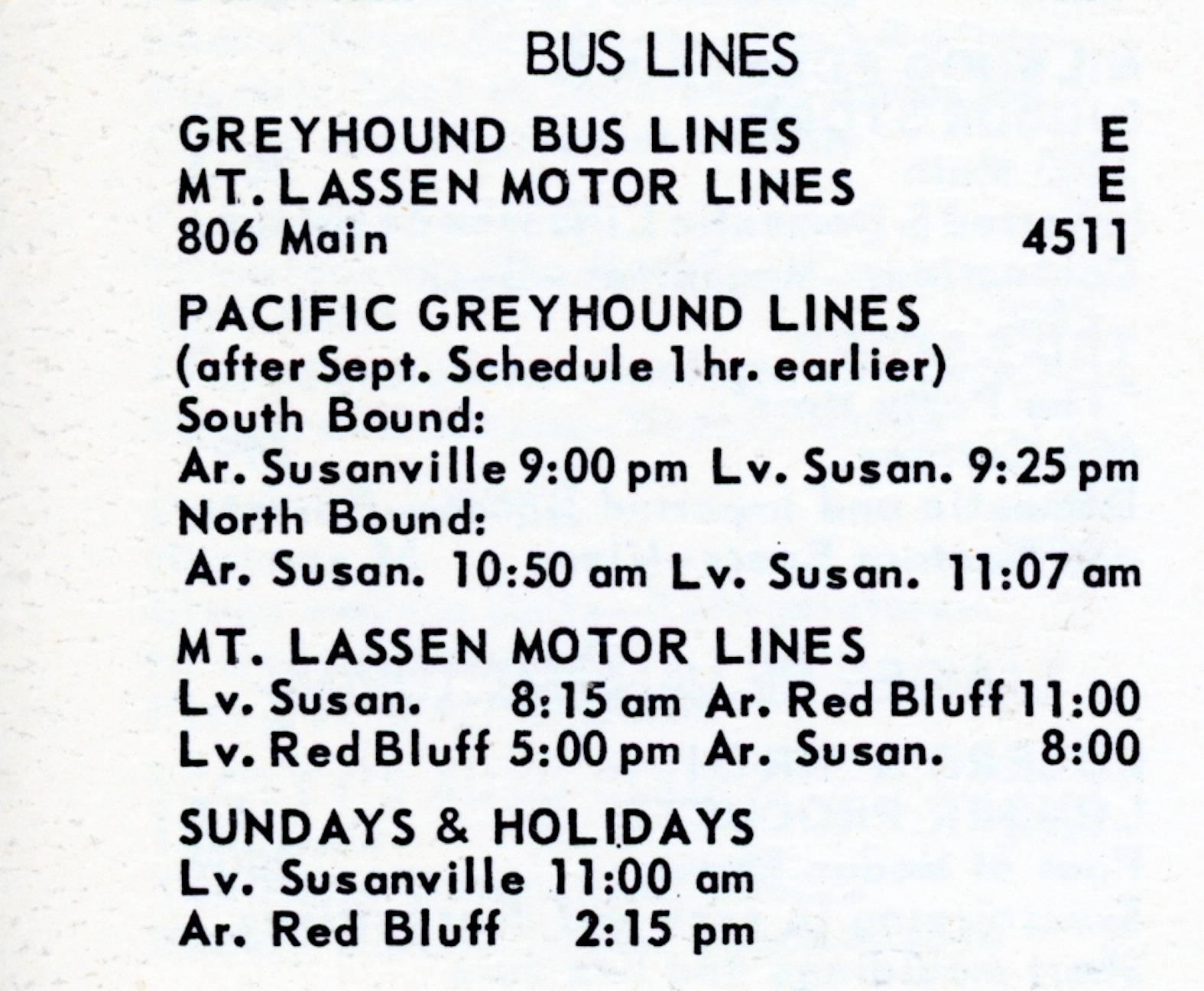
A reader wanted to know if Susanville was ever served by Greyhound Bus Lines. The answer is yes. However, my knowledge of its operations is extremely limited. Greyhound probably began service in the area by the1950s. Some time in the 1980s, it probably ceased. The last location was on North Sacramento Street across from the T&A. The agent then was Nels Wilhelm. If anyone can shed more light on this topic, it would be appreciated.
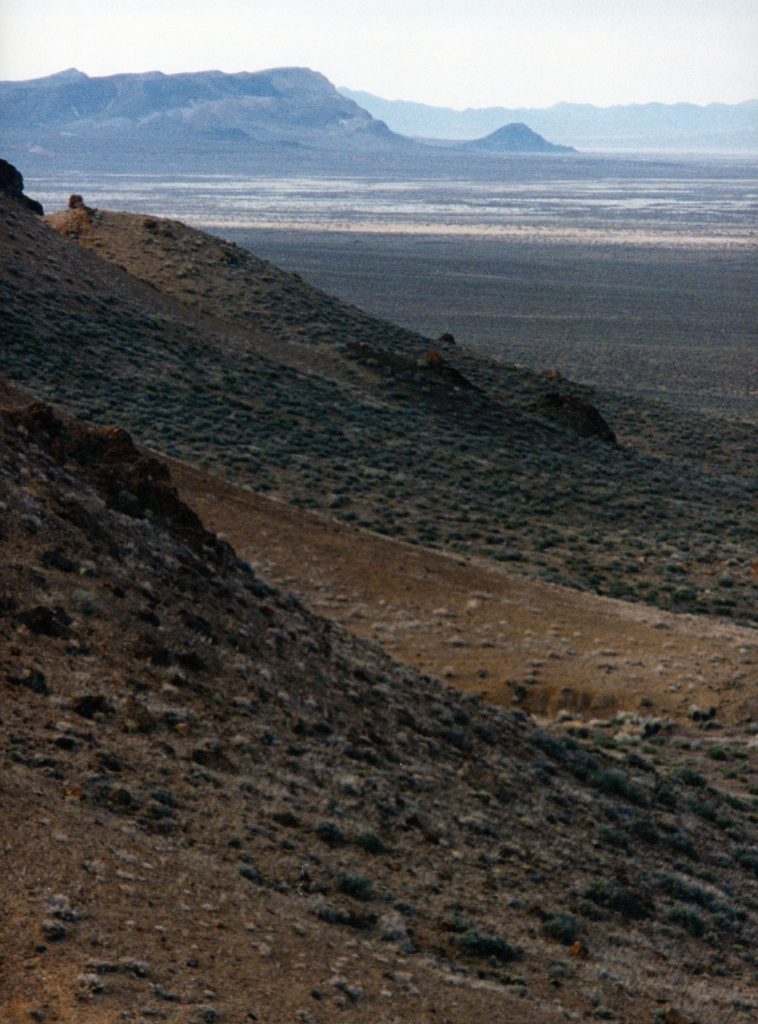
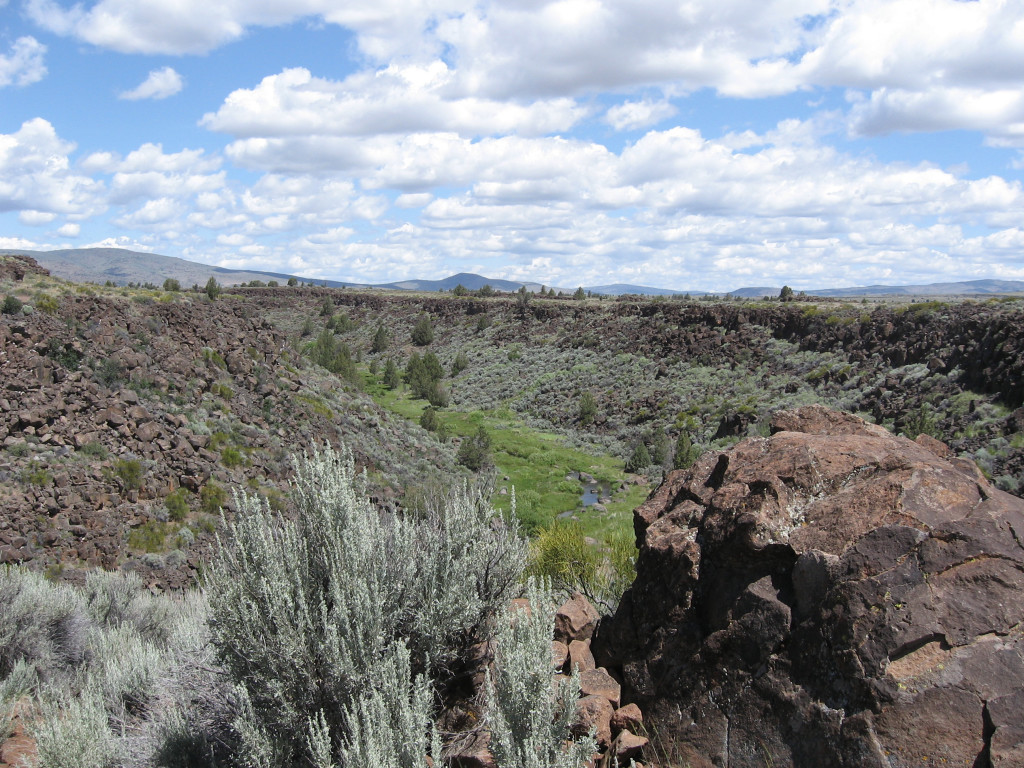
Clapper Canyon/Creek, Black Rock Desert. Courtesy of D. Dickerson
Hardin City was a short lived mining town in the Black Rock Desert during the 1860s. It was named after James Allen Hardin, a member of emigrant party in 1849 who a made an accidental silver discovery in that vicinity by picking up a rock there, but did not realize until later when he resided in Petaluma. Thus, another lost mine story began. In 1859, Peter Lassen and others made an expedition in search of the mineral deposit and it was a fatal mistake for him and his companion, Edward Clapper. Lassen was only several miles from where Hardin City would spring up.
Anyhow, while sorting through my file on Camp McGarry, I came across this article of Modoc Independent of Alturas dated 11 September 1884. Its an account from Alturas resident, H.L. Spargur, who was one of many prospectors in the Black Rock Desert back in the 1860s. I thought some might enjoy it.
”Black Rock — H.L. Spargur who has been on a prospecting trip through a portion of Nevada, relates some stories which cannot fail to be interesting to them who some eighteen years ago believed that the Black Rock mines were the richest in the world, and braved all sorts of dangers and hardships in efforts to develop that section, but at last were forced to abandon the mines and see all their golden dreams fade away. Mr. Spargur was one of the those who, in 1866, went to the Black Rock mines and, with his family, stayed there as long as there was a ghost of a show, and was among the last to pull up camp and seek new fields.
“Many of our readers will remember that a quartz mill was built, and that no less than three towns were laid out, and for a time the Black Rock country was a lively one. Mr. Spargur says that although it has been sixteen years since he left Harden City, (one of the three towns referred to) he found it looking natural as the day he left it. The houses, which the miners built for themselves and families were of adobe, and although for 16 years they have been deserted by human beings, they are now in as perfect a state of preservation as they were when they were abandoned in 1868. Mr. Spargur speaks of the wonderful preservative qualities of the water of that place and the peculiar state of the atmosphere, and gives it as his opinion that “a man would never die at Black Rock.” He says that in the year 1867, when the quartz mill was built a wooden pipe was laid to convey the water from one of the springs to the mill, and that when a year afterwards the mill was torn down and hauled away, this pipe was left undisturbed and that at the time of his visit to Black Rock, some three weeks ago, the water was still running
through the pipe and the material of which it was made was as sound as it was the day the water was turned in. Mr. S. says that while strolling through the streets of Harden City he noticed pieces of boards and even the smallest splinters of wood which has been there exposed to the elements all these years, are still as firm as when they left there by the miners years ago. “[Note: The quartz mill was moved to Hayden Hill]
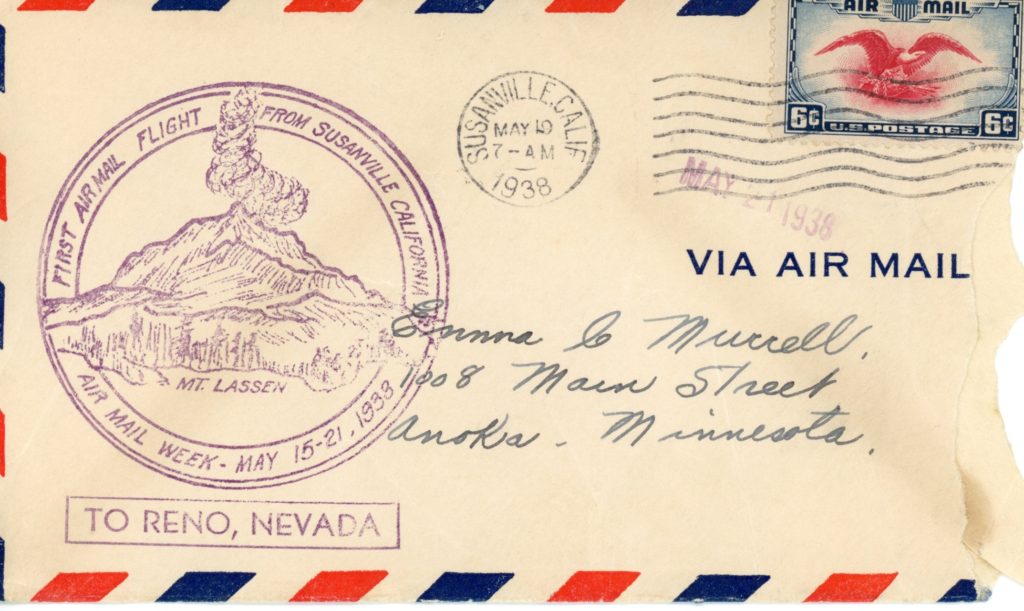
Susanville resident Florence Uptegrove sent this special air mail to Emma Murrell.
One just never knows what can be found on Ebay. Some time ago, I found this Susanville Postal cancel for National Air Mail Week which was held during the week of May 15-21, 1938. It commemorated the twentieth anniversary of the implementation of air mail. Citizens and communities were encouraged to participate.
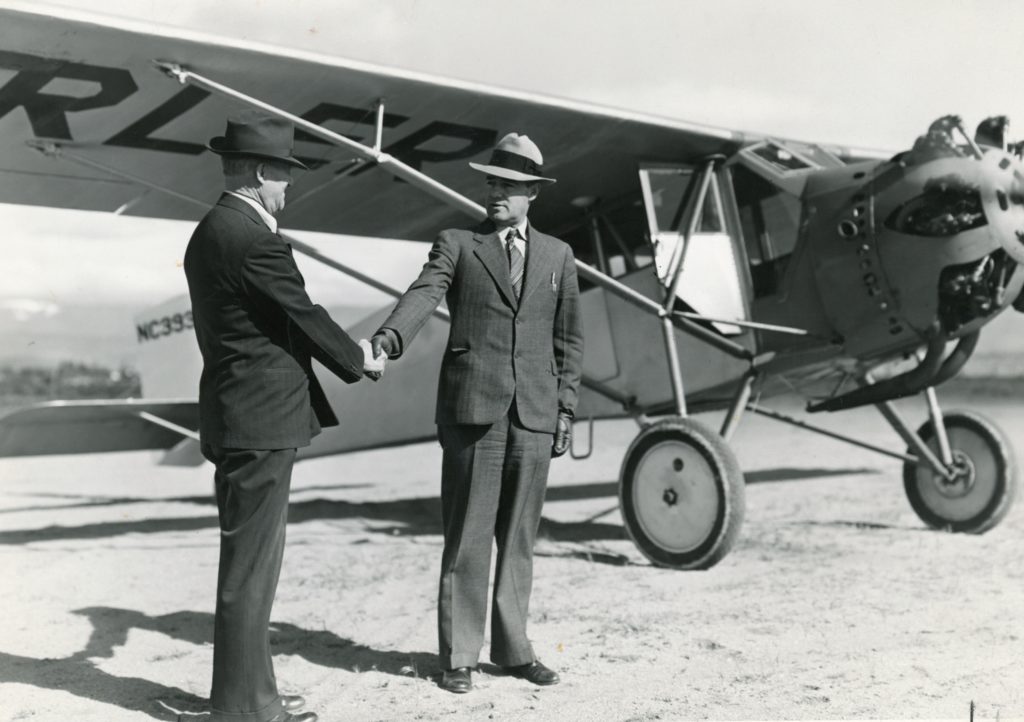
Postmaster Elmer Winchell with Ben Curler at the inagural airmail flight at the Susanville airport on May 19, 1938.
Of course, Lassen County Superior Court Judge Ben F. Curler an avid flier was more than happy to participate in carrying air mail. For a brief time, when Curler served as magistrate for Lassen Volcanic National Park he would fly to Mineral to hold court. Curler’s May 1938 airmail flight went from Susanville to Reno. At Reno, he picked up his father, Washoe County District Court Judge, Ben V. Curler. The elder Curler, was a pilot, too, having obtained his license in 1935 at the age of 70. The two flying judges departed Reno and flew to various Nevada communities as part of the National Air Mail Week campaign.
A view of the Willow Creek Rim from Belfast, June 2, 2015.
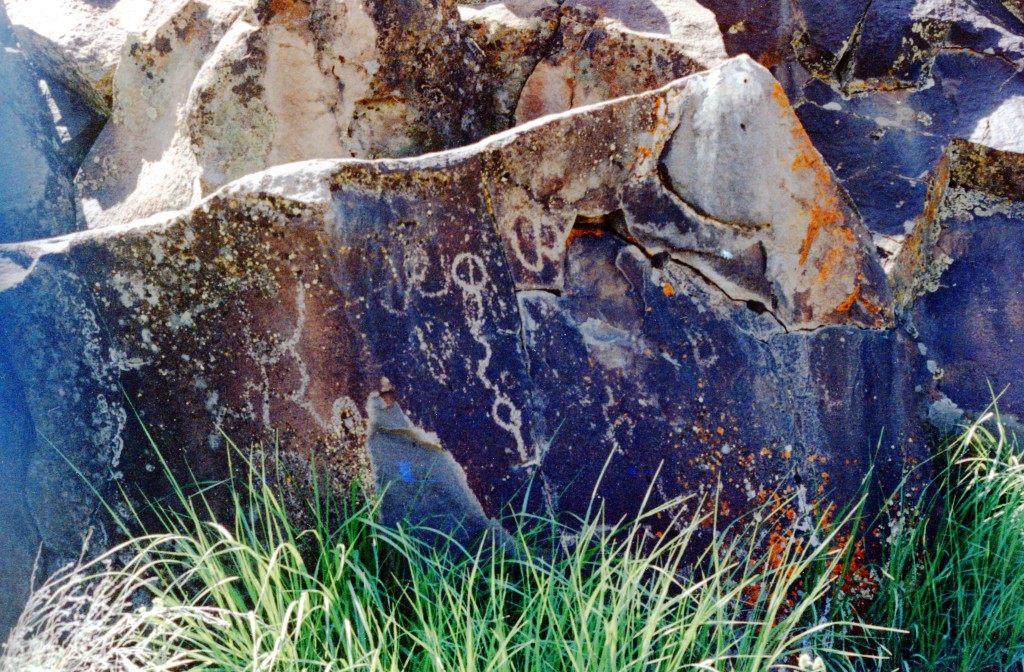
Here are some random notes by the wayside about the local petroglyphs that I thought some might enjoy. Belfast, of course, is the best known site, but many might not be aware that are some surrounding Susanville.
In 1918, Russell Brownell, who dubbed the Belfast petroglyphs Council Crest urged Congressman John Raker to designate it as a park. Nothing happened. However, nearly seventy years later as to what is referred to as the Willow Creek Rim was placed on the National Register of Historic Places.
Sunrise Chamber, Balfast, 2015
In 1949, Francis Riddell while engaged in some major archeological work in the region, spent considerable time collecting information on the Honey Lake Valley Paiute Ethnography. He spent countless hours interviewing members of the Joaquin family. The following is a summation about what he was able to glean about the petroglyphs. “The name for the petroglyphs was tumadai, ‘magic” or ‘trick.’ Only certain people knew what they meant. Kitty Joaquin, however, stated a more common name for the petroglyphs was numutubon ‘Indian writing.’ Susy Buster said that the petroglyphs were only known to those who put them on and the snake elements were put on by those who had an understanding of snakes.”
One of many glyphs to be seen along Upper Smoke Creek.
Finally, back in the late 1960s the Lassen County Historical Society published a bulletin on Petroglyphs by Tom Eilers.
Susanville Rotary Club received its charter on Saturday. May 15, 1926. There were twenty-one charter members: M.D. Collins, Harry S. Coleman, Robert M. Cook, Henry M. Elliott, Dr. Gordon R. Fortson, Thomas E. Hunter, Hans P. Peterson, Arthur J. Mathews, Harry A. McBride, Charles McGowan, James A. Pardee, E.L. Shirley, Ernest W. Smith. John B. Spalding, John J. Woodward, Frank H. Bangham, Thomas W. Blight, Charles H. Bridges, L.R. Cady, B.D. Cardinal and Frank Coffin.
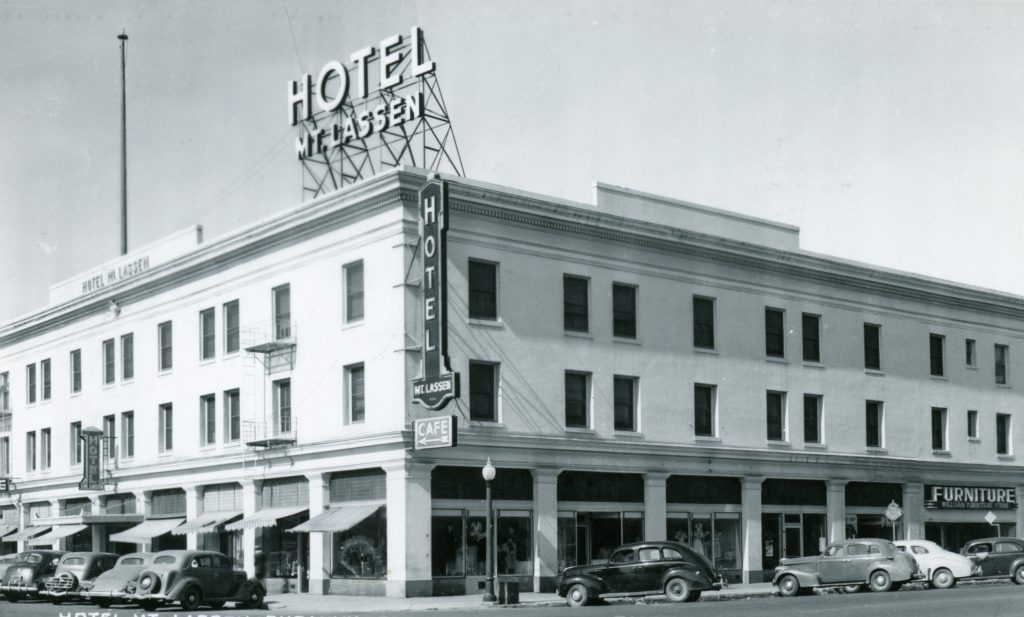
The following Wednesday the Rotary Club held its first luncheon meeting. There were a few kinks. Of the seventeen members present, they gathered at the Republic Grill on South Gay Street for lunch. Afterwards, they proceeded to walk one block up to the Hotel Mt. Lassen for the business portion of the meeting. It was their intention to hold the luncheon meeting at the hotel. However, the hotel was still under construction, and while portions of the building were completed, the kitchen was not. A temporary solution was found were the luncheon meetings were held in the basement of the Methodist Church, with the women of that church doing the cooking and serving. This situation lasted a little bit longer than anticipated, since the Mt. Lassen Coffee Shop did not open for business until July 20, 1926.
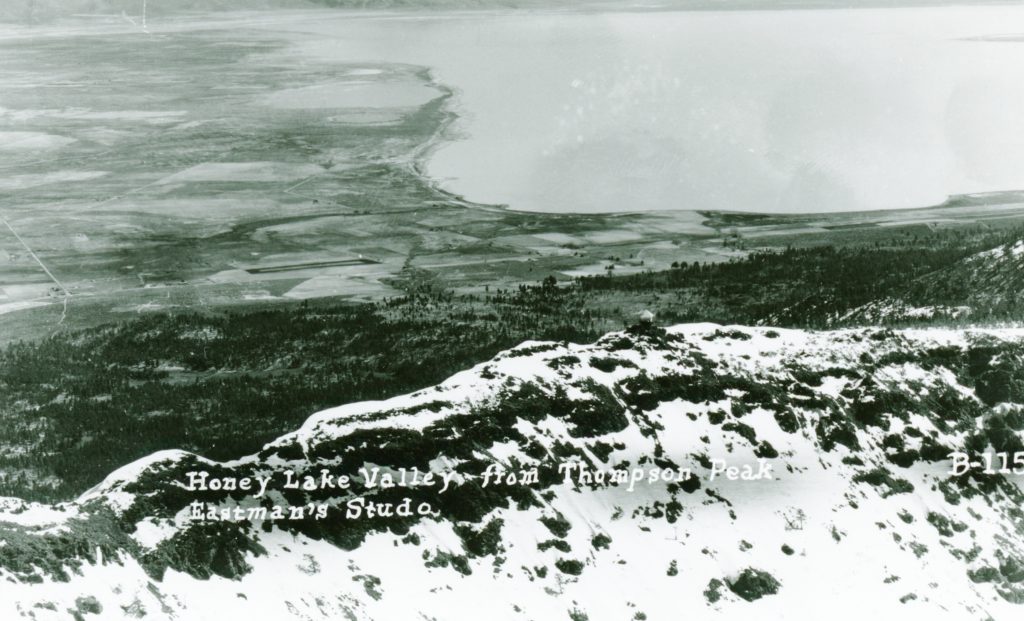
Honey Lake is a multi-purpose land unit in planning commission speak, whether dry or full. When Anglo settlement occurred in 1850s lake was a natural asset, initially for recreation. In 1856, a crude sailboat plied the lake, only to turn into a tragedy when the boat capsized, drowning two of its occupants. The following year, one of the west shore’s first established ranches, Clark’s advertised they had two fine boats for fishing and pleasure. In 1881, they still had the only boats on the lake. Of course, in the 1890s, boating both commercial and recreational took off with the establishment on the lake’s eastern shore. If you use the search feature, you can read previous posts about boating on the lake. The lake went dry for a twenty year period (1917-1937), that with other factors boating went by the wayside.
On the recreation theme, there are those rare occurrences when lake is frozen over, turning it into one huge ice skating rink. Like boating, ice-skating had its hazards too. In 1879, Milford school teacher, Truman Ashbrook drowned while ice-skating when he encountered an air pocket, and fell through the ice. There was the 1914 tragedy of Charlie Wilbur.
Two interesting events occurred when the lake was dry in the early 1930s. In 1931, the dry lake bed was used a summer military camp for training army pilots. More about that in the future. In the fall of 1933, Zeb Johnson and W.H. Tucker were drilling for a water well on the dry lake bed. They struck natural gas. Just like a gold discovery people flocked to file claims. Alas, when analyzed it was low grade, that consisted from decaying vegetable matter.
There is the more recent case of the Honey Lake Conservation Team of the early 2000s that will be explored in the future.