Some people assume that Red River Lumber Company’s operation at Westwood was that of a sawmill. It was more than that, and was a multi-facited lumber plant. On May 2, 1924 work began on a half-million dollar veneer plant just to the north of the sawmill. As what had become customary, it too would be built on a grand scale and when completed would be the second largest veneer plant on the West Coast. The two story structure measured by 100 feet wide and a 1000 feet long, with ample room to make additions should demand warrant. Three hundred men were hired in the spring of 1925 to operate the facility. Continue reading Westwood’s Veneer Plant→
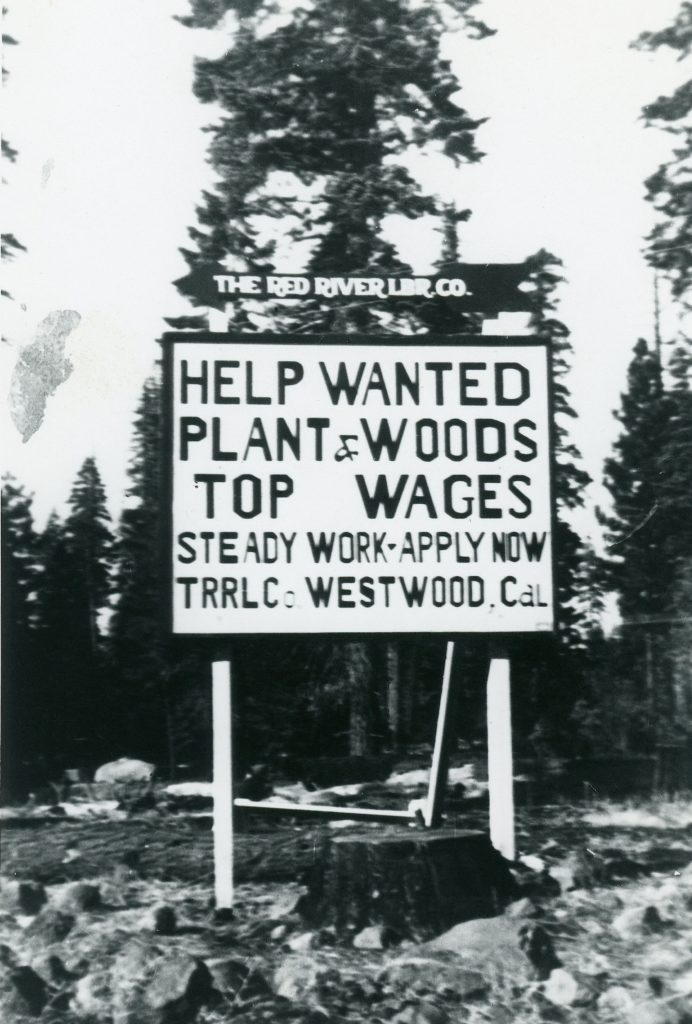
One of the peculiar oddities back in Westwood’s early history there were no accommodations for the traveling public. The Red River Lumber Company who controlled the town wanted it that way. This would hinder any “undesirables” to try infiltrate the town, i.e., such as union organizers. However, Red River needed to provide some sort of accommodations for people visiting on official business with the company. Red River constructed the El Solano at 501 Birch Street to meet those needs.
In the 1930s, during Red River’s financial crisis, the company converted its American Legion Hall into a hotel known as the Blue Ox Inn, and thus the El Solano diminished in status. It would later be converted into apartments. In the fall of 1965 the Assembly of God Church renovated the building, and the second story removed. Today, it is a private residence.
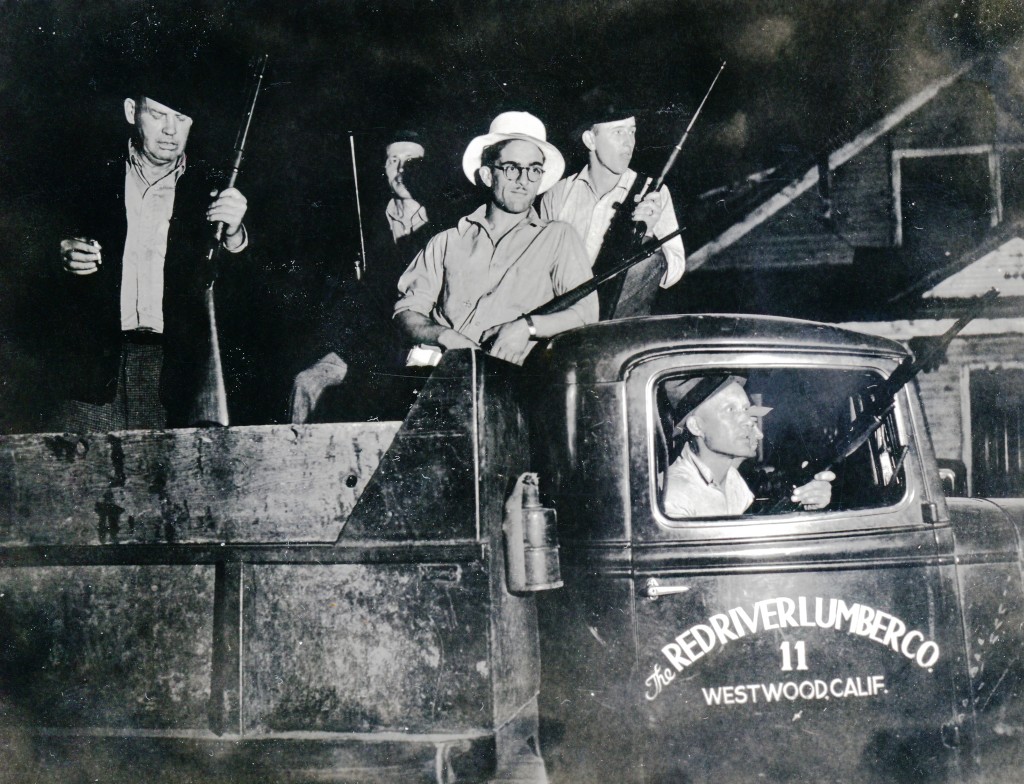
Purge Night, July 13, 1938. Courtesy of Frank Davis
Estate Sale: I need to make room for items from my mother’s estate. This a great bargain 50% off, your cost $12.50 plus shipping. What a deal!
The carefree spending days of the Red River Lumber Company came to an abrupt end. Bonds were used to finance the construction of Westwood came due. On the other hand, Fletcher Walker continued expanding operations, each at an additional cost. The bondholders on the other end were not pleased with the delinquent payment and return. A free for all battle occurred as to whether the banks or the Walkers would control Westwood. The Walkers, made concessions to keep the banks at bay.
Then there were labors problems. It began with the purge of the CIO members and their families who were driven out of Westwood in 1938. That was the tip of the ice-berg. The following year the AFL went on strike over the same issue of wage restoration that the CIO wanted. It was a mess, to say the least, and it would be one of many factors that would seal Red River’s fate. Click here to order.
If there was ever a great misnomer for a building it was one of Red River Lumber Company’s first public buildings in Westwood was dubbed the Opera House. It should be noted that when Westwood was being built in 1912-14, it was remote. There were no highways, and in the winter the only access by train. It was designed this way on purpose to keep undesirable elements, including unions out of the community. However, Red River would need to provide entertainment venues for its employees, if they wanted to recruit and retain. Continue reading Westwood’s Opera House→
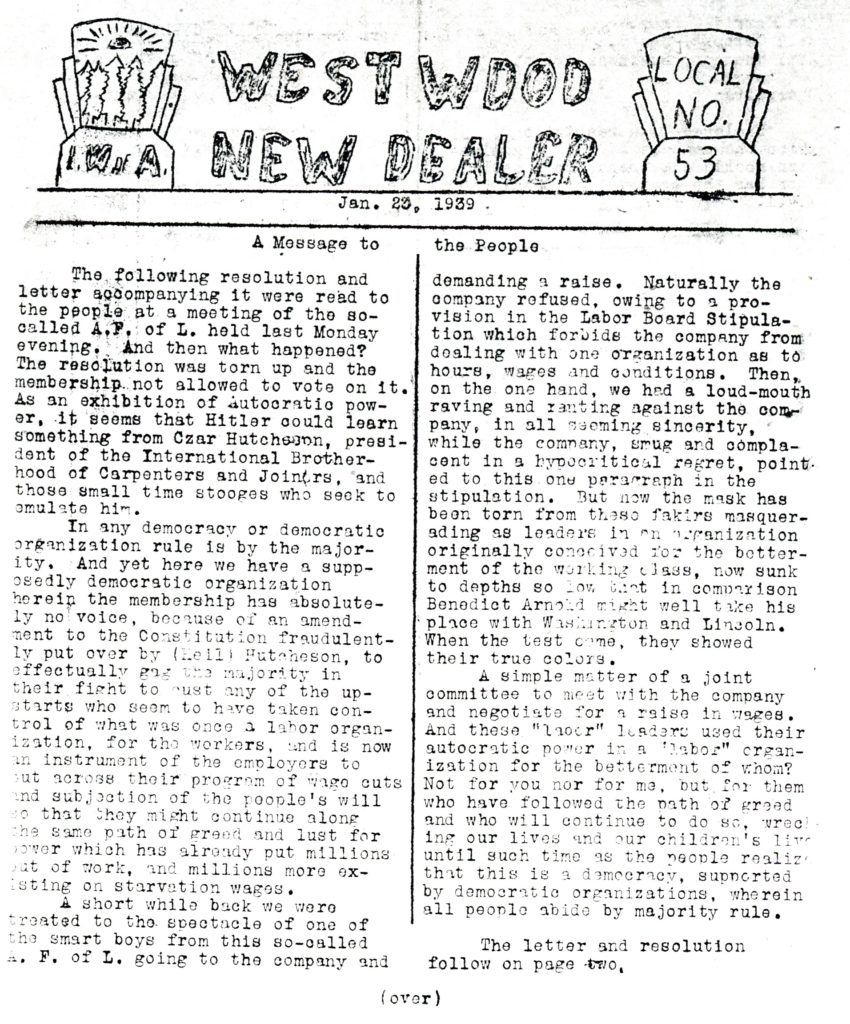
The front page. You can click to enlarge the image.
During the late 1930s, Red River Lumber Company was plagued with labor problems. There were be two major strikes, one in 1938 that caused the “purge” and a second the following year.
On January 23, 1939, the local union published a two-page newsletter called the Westwood New Dealer. In it they cited the January issue of the West Coast Lumbermen. This publication contained an article Best News of the New Year which stated that orders for western pine was up 47% from last year. This is turn meant there would be a substantial increase in logging and manufacturing, which the CIO interpreted as meaning that the lumber industry in general and more particularly Red River would see increased profits. They sent a letter to the local AFL with the following resolution, “That a joint committee of Local 53 and Local 2386 be formed to negotiate wage scale to be effected as soon as possible.”
Red River was not amused when they saw the first issue of the Westwood New Dealer. Clinton Walker thought not only it was imperative that they obtain copies of future editions, but equally important to designate someone to answer the “miserable statements” contained in it. Clinton noted that it was true that there had been an increase in orders, but the price for lumber had not increased.
Thus, the stage now set, and the second strike would shut down the mill for over two months. One can learn more about this and other labor issues in Red River: The Turbulent Thirties.
When Westwood was established, its Catholic community was a part of the Sacred Heart Parish—it had only been created in 1912 and covered the territory of Lassen and Modoc counties. The first pastor was Father P.J. O’Reilly. There seems to be some confusion as to when the first Mass was celebrated in Westwood. On December 12, 1913, it was reported in the Lassen Weekly Mail: “Father P.J. O’Reilly made the trip to Westwood to attend to spiritual wants of the Catholic Church in the new lumber town.” However, under the heading of Remarks in the Parish Death Register, Father O’Reilly wrote, “Mass was celebrated in Westwood for the first time by Rev. P.J. O’Reilly on 19 April 1914 in the school house situated near the present fire department. Mass is now said in the school situated on the hill facing Delwood Street.” Father also wrote, “The first Catholic funeral that was held in Westwood was on July 24, 1914. The internment was made in the new cemetery, portion of which viz the North East section is devoted to the use of the Catholics who die in and around Westwood for Catholics only. This cemetery is 3 1/2 miles from Westwood.” That internment was for Jose Alvarez, a 22 year-old millworker who died from typhoid fever. Continue reading Our Lady of the Snows→
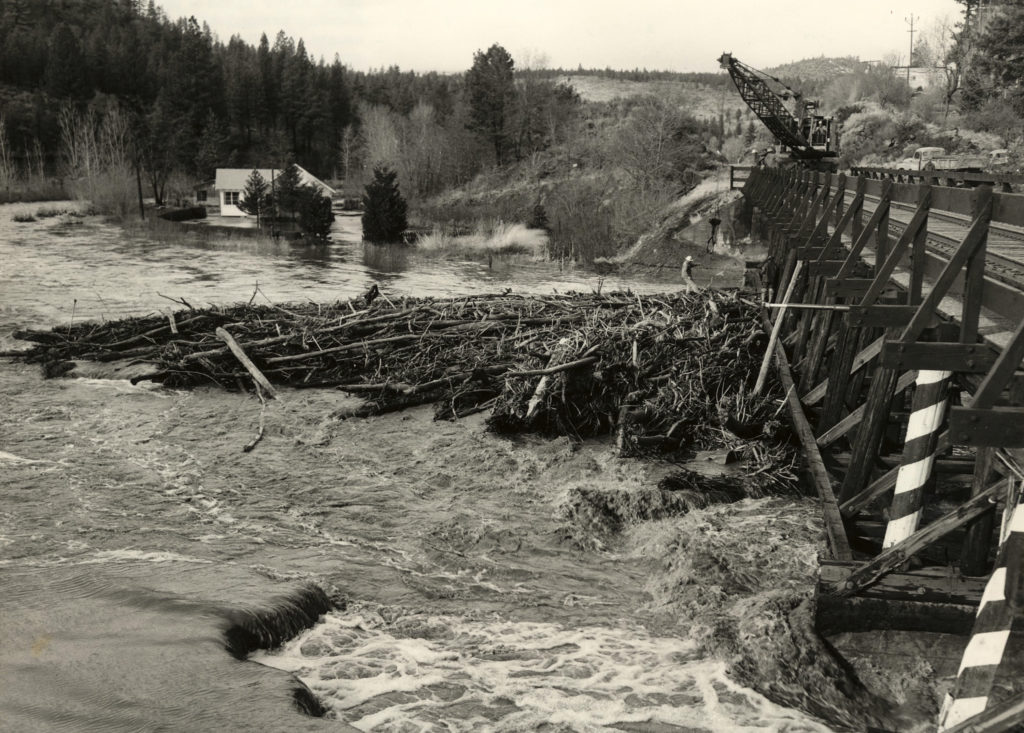
Southern Pacific’s railroad trestle at South Lassen Street, December 1955.
The floods of December 1955, locally and throughout California was a notable event to say the least. It began with warm rains on December 15th and by December 20th, 4.41 inches had fallen in Susanville. The snow elevation remained high, and on December 20th there was 21 inches of snow on Fredonyer summit. The rain continued turning the Susan River into a raging menace. Conditions worsened as the river brought assorted debris with the floodwaters. The debris became a major obstruction when it collided with the Southern Pacific’s railroad trestle at Susanville’s Lassen Street. On December 23rd Marvin D. Coltran, a member of Southern Pacific’s bridge gang fell into the water there. Efforts were made to reach him, but the river’s swift current swept him away. Continue reading The Floods of 1955→
The Westwood Grammer and High Schools. Courtesy of Hank Martinez
For nearly twenty years, the Red River Lumber Company’s town of Westwood operated differently than other communities. Even the public Westwood School District was an unusual creature in the beginning. Under normal circumstances a school district would issue bonds to finance school construction. Not so in Westwood. Red River built the schools, and leased them to the Lassen County Superintendent of Schools at a nominal cost. Continue reading Westwood’s First High School→
The Red River Lumber Company was unusual in that it did not routinely have commercial films made of its operations, as their competitors did. It was deemed a good business practice to show prospective retail buyers, as well as investors, of one’s operation. In the 1930s, Red River officials debated the issue, particularly as it might be beneficial if forced to sell Westwood. On the other hand Red River’s neighbor the Fruit Growers Supply Company routinely had films made. For them it was important for the citrus growers to see what was involved with their investment.
In the summer of 1928 Caterpillar tractors sent a camera man to Westwood to film Red River Lumber Company’s entire operation–from the falling of trees to finished board. Caterpillar was interested in Red River’s operations. Red River’s skilled machinists were constantly making improvements to Caterpillar tractors. Among old time Red River employees there was the folklore that Red River had more patents on Caterpillar tractors than Caterpillar. Whatever the case may be, in November 1928 the film made its debut at the Westwood Theater.
It would be interesting to know if the film exist in Caterpillar archives. After all, Fruit Growers had a 1925 film of their Lassen Operation in their archives.
Pat O’Dea, Courtesy of the University of Wisconsin
In 1919, Charles J. Mitchell arrived in Westwood like so many before and after him seeking employment. The Red River Lumber Company had high turnover in its workforce and always had openings. Little did Red River know their new hire was a famous football player. Then again, Mitchell used an alias. After all this was in an era, where few people carried any type of identification, and Social Security numbers were non-existent. Continue reading Pat O’Dea – The Kangaroo Kicker→