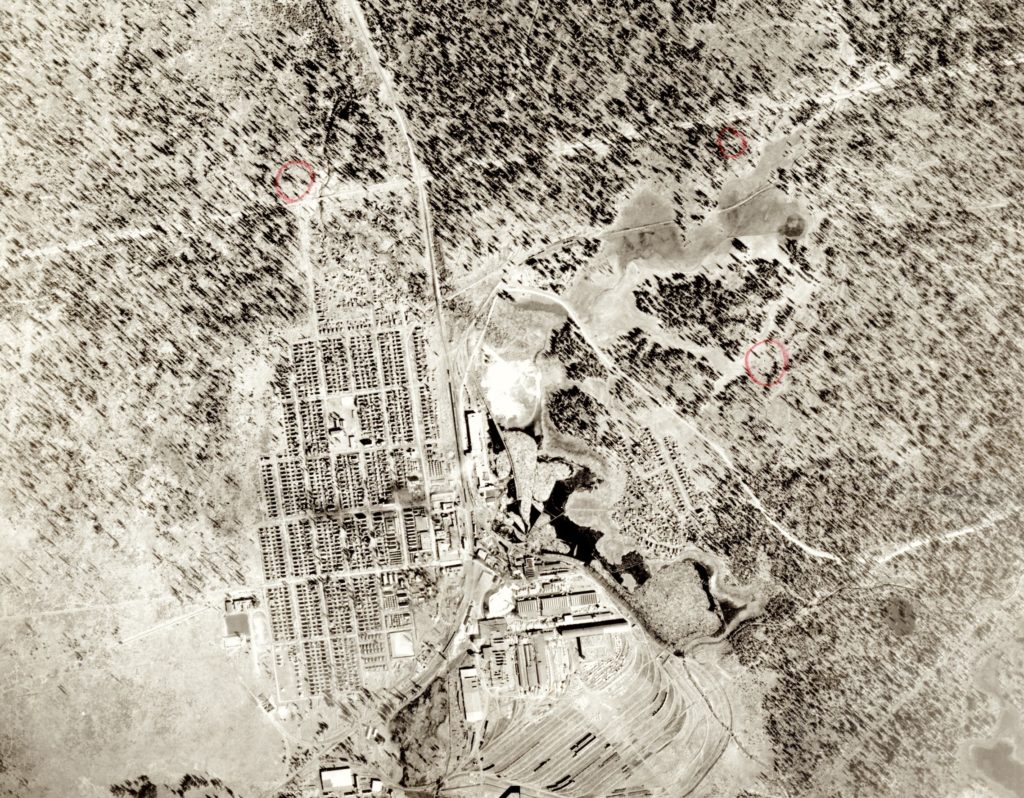
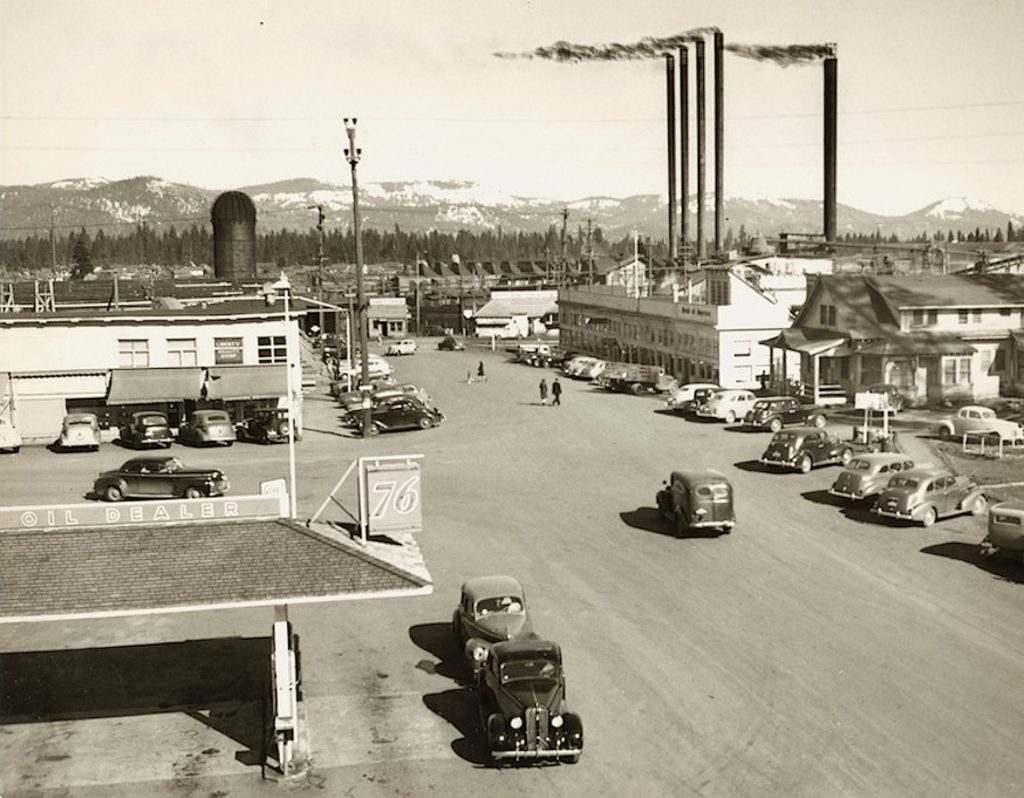
Westwood, October 13, 1941 —Courtesy of Hank Martinez
This was an exciting era for the residents of Westwood. While the United States had not entered into the global conflicts, the nations economy was in high production to meet the nation’s allies. Lumber was a high priority commodity, and Red River Lumber Company’s operation at Westwood was put into high gear.
The installation of the Hammerhead Crane at Westwood, was one of many improvements to entice buyers.
Red River not only went into a full production mode, the first time since World War I, it went on a major modernization campaign. Not only where there substantial upgrades in all the mill equipment, but its logging department saw major changes as well—among other things its own fleet of logging trucks.
While the casual observer or Westwood resident thought all these improvements was just a sign of prosperity from the recovery of the nation’s Great Depression of the 1930s. Behind the scenes, Red River was busy putting its Westwood operation on the market, to sell, nothing different what a current homeowner does prior to listing their house on the market.
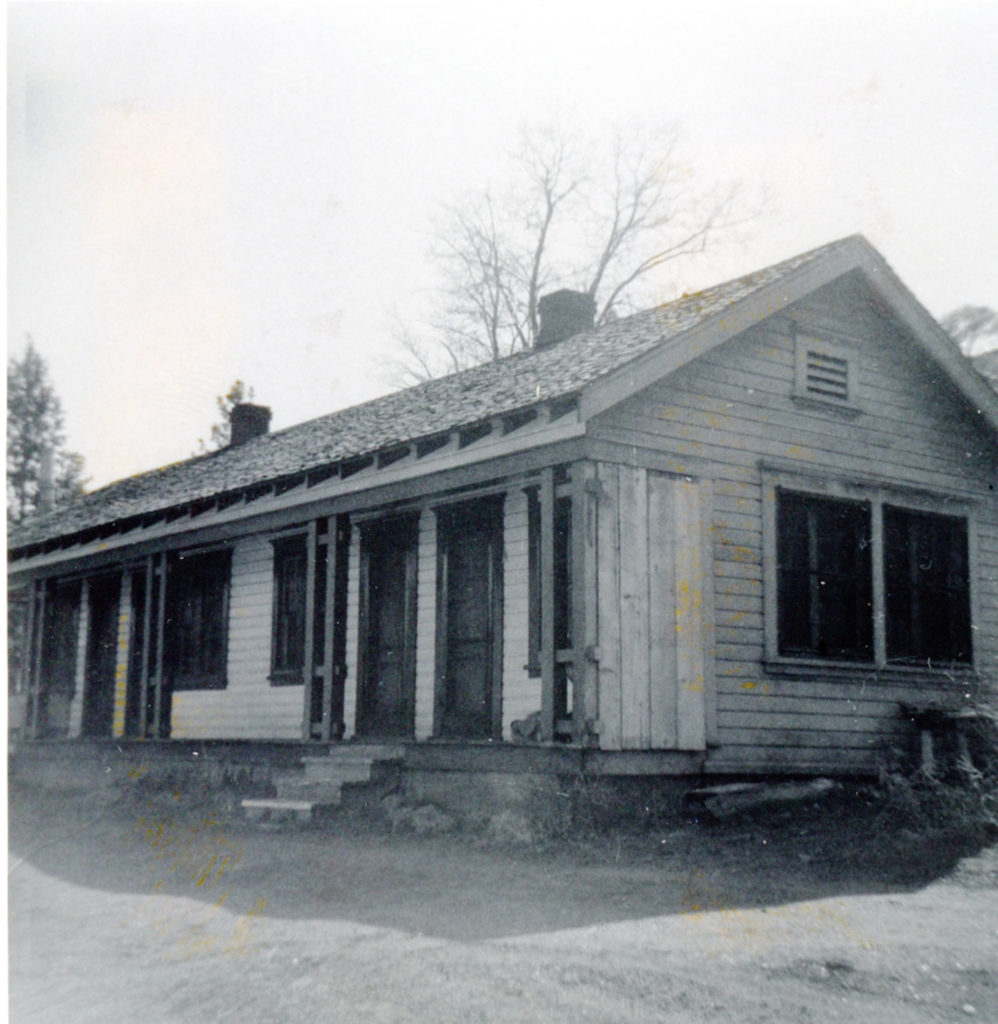
The Westwood Hospital had a small building adjacent to it, that was used to quarantine patients who had highly infectious virus. This was a common practice many years ago to have a small separate facility to quarantine patients. Some of these buildings were a bit sketchy and less than desirable accommodation. This you can easily see with the above illustration of the isolation ward of the Lassen County Hospital in 1947. When the first hospital was built in Lassen County, it was far removed from Susanville proper, so it was not necessary for a separate facility.
Back to the matter at hand. Does any one have, or knows some one who has a photograph of the quarantine building of the Westwood Hospital.
The July 4, 1906 parade with the city/fire hall in the background—Lola L. Tanner
Photographs of certain places and/or events just want to remain hidden. Take for instance Susanville’s combination City/Fire Hall. It was built in 1905 and destroyed by fire in 1921. A photograph of it does appear in the 1965 Lassen Advocate Centennial publication. One would think a public building, adorned with a sixty-foot tall bell tower, would appear in a variety of photographs.
Another example. My good friend, the late Hank Martinez, spent a life-time in search of a photograph of the El Centro, in Old Town, Westwood. It was a combination store and community hall. I had hoped to find one in the Red River Lumber Company’s archives but to no avail.
In May, 1923 one of the largest public events ever held at that time, occurred in Litchfield. It was a grand celebration to celebrate the completion of the Bly Tunnel at Eagle Lake, that would irrigate lands in the Honey Lake Valley. Over 5,000 people were in attendance and yet, to this day, I have never come across a single photograph.
Interesting, however, some times rare photographs do surface on Ebay. Some times I make a purchase, and some times not, depending on price range, etc.
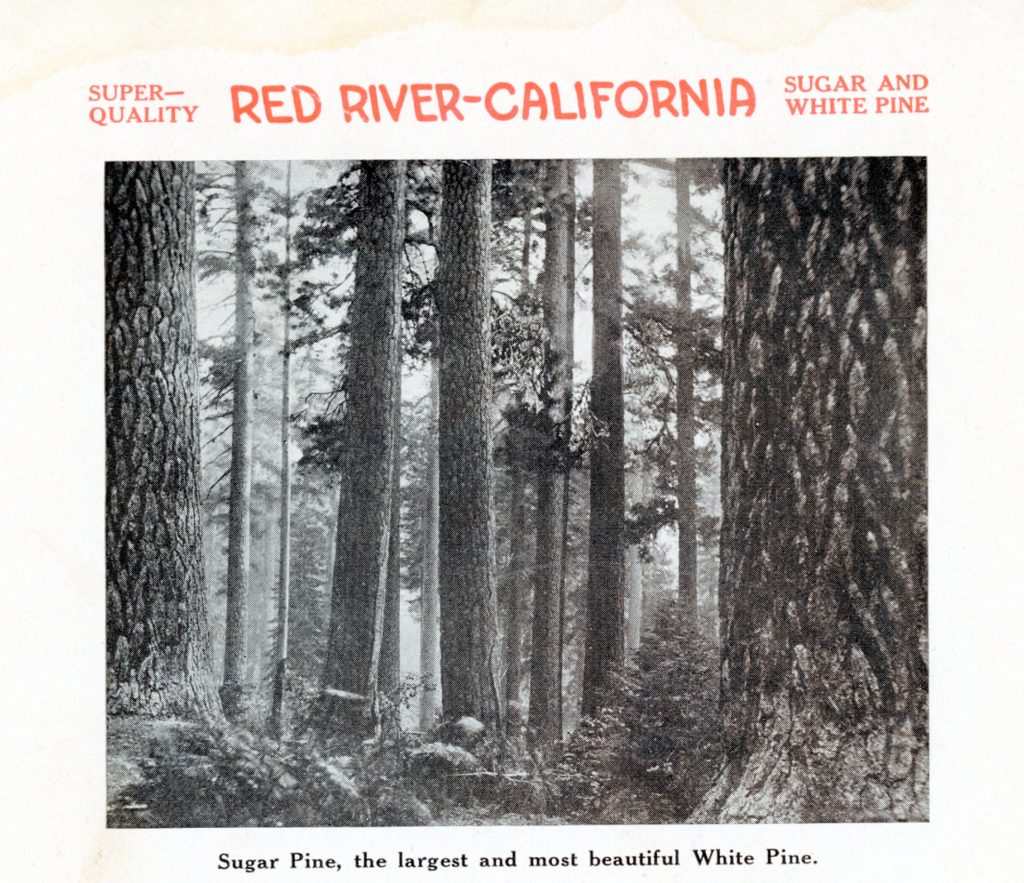
Every pine buyer wants to know , “What do I get for my money?” And “What does Red River-California offer that I can get nowhere else?” We submit herewith a few facts concerning Red River-California Sugar Pine and White Pine and the plant at Westwood, California, that produces it and delivers it to all parts of America. This service, more than any other gives you:
QUALITY: “Old-fashioned White Pine, “scientifically manufactured.
UNIFORMITY: Full specified thickness and width, thoroughly seasoned.
ECONOMY: Reduces your working-up cost. Gives you a superior product.
SECURITY FROM SUBSTITUTION: As manufacturers, we ship nothing but genuine Red River-California. Unlimited forest resources assure this uniform supply of many years to come.
RELIABLE DELIVERY: Plant runs the year ‘round. Westwood lies east of the Sierra Nevada snowsheds, on a direct line to eastern points and near a great transcontinental empty-car center.
A bassinet from the Westwood Hospital—Courtesy of David Zoller.
Awhile back, a visitor to the site came across a post about the Westwood Hospital. It was a topic, near and dear to him, since he was born there. Of course, the Maternity Ward of the Westwood Hospital was a very busy place back in Westwood’s heydays. This created a small chain reaction, wherein someone sent a photograph of one of the bassinets used in the Westwood Hospital where the newborns were placed. Thus, thank you David Zoller for sharing the same. I am sure when others are doing research about the Westwood Hospital where they were born will appreciate this.
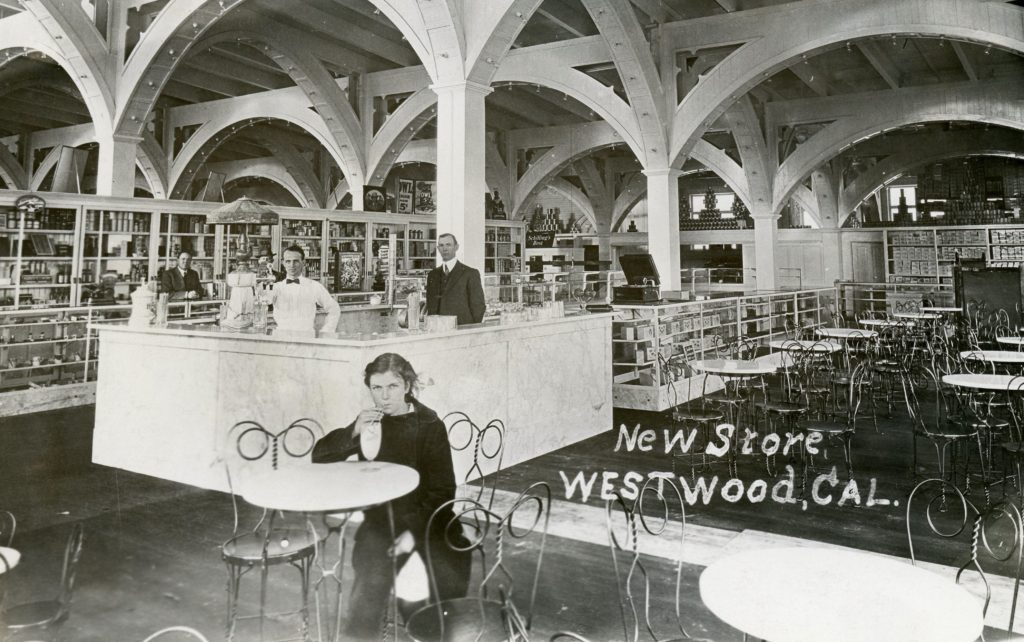
In 1935 Pland-Evans extended the operating hours of the soda fountain in the Big Store to 11:00 p.m.
Pland-Evans was certainly not a household name to many, unless you happen to reside in Westwood during the 1930s and early 1940s. This San Francisco company were “operators of industrial subsistence facilities.” When the Red River Lumber Company during the 1930s went through its re-organization phase they leased their commercial facilities such as the Big Store and the Westwood Club to Pland-Evans. Pland-Evans operated these facilities in Westwood, as well as the Walker Mine in Plumas County until 1942. At that time they were succeeded by H.S. Anderson Company.
Westwood Ballpark. Courtesy of the Westwood Museum
During 1938 and 1939 the Red River Lumber Company experienced a lot of labor strife. Due to a strike in February 1939, Red River closed the mill. A unique thing happened at that time, Westwood would soon have a baseball park.
One of the effects with the mill closure was that residents were now without their regular wood supply for heating, for those who did not have steam heat. The idle strikers volunteered to cut trees on forest service land for firewood. They established a wood lot on the lower end of Birch Street, adjacent to the current VFW Hall.
Jim Travers came up with the idea they could use some recreational outlet to dispense with their extra energy. On the property they were using as the wood lot was a partially destroyed house caused by a fire some time ago. Travers and Earl Yaber came up with the idea to transform the property into a baseball park, and the other strikers were supportive of the project. The AFL union asked Red River if they could lease the property for that, and the company consented. In no time at all, the volunteers quickly cleared the property, removing the old building and hauled in 200 loads of decomposed granite from Fredonyer Summit to spread over the baseball field. In short order the property was transformed into a ballpark that could accommodate 600 people, along with parking, drinking fountains, rest rooms, an enclosed press box and seventeen flood lights. Nearly 500 men and women contributed to the cause.
On Sunday, June 12, the first softball games were held. First up was the Westwood AFL, who lost to Susanville’s Model Laundry by a score of 7 to 8. The next match was between the H.S. Anderson Club and Fruit Growers’ Story Club, which Anderson prevailed in the tight match that went into four extra innings with a score of 14 to 13.
During the reorganization of Red River in the early 1930s, it was only a matter of time that bank issue once again would be scrutinized. On June 6, 1934, Clinton questioned how the bank operated: “As to the Westwood National Bank, I feel that this should be run as a bank and not as a subsidiary financial department of Red River. I think that the Bank board of directors should direct the policy and business of the bank and that the finance committee of the bank should pass on loans and these be on the merits of the loan and not from the standpoints of its convenience of Red River.”
Clinton’s concerns were confirmed when investigations were conducted on the bank’s affairs. It was disclosed that certain family members used the bank to obtain dubious loans, which would not have been approved by a regular bank. For instance, a loan was made to finance a portion of the construction of the Walker-Hovey railroad in Modoc County, which was being bailed out by the same time by the government’s Reconstruction Finance Corporation.
These events allowed Clinton to move forward on his case to dissolve the Westwood National Bank. Clinton cited it was an ill conceived venture as no one in the Walker family had any banking expertise. While it was agreed to dispose of the bank, that was easier said than done. After all bank failures were a common occurrence across the nation, so it was not the best time to put a bank on the market. It was even suggested they could sale it to the residents of Westwood. One of the obstacles to sale the bank was Willis, who also served as the bank’s president. After two years of stalling by Willis, it was decided to put Wellington Henderson (Clinton’s son-in-law) in charge. Wellington, it should be noted had banking experienced as he had worked for Bank of America. On September 18, 1936 Willis made the announcement that the Westwood National Bank reached an agreement with the Bank of America for the sale of the bank. Willis stated “This sale brings an affiliation for our local bank that will enable us to render an even greater service to the local community. Our bank will become a branch of the state-wide institution in the near future. The local officers and staff will remain.” While the bank building has long since been demolished, the concrete vault still remains, a testament to better times.
This was no ordinary bank, but then the Red River Lumber Company was not an ordinary operation either. Red River wanted to capture as much of its employee payroll at Westwood, as possible. This was no small sum, with an average monthly payroll of $350,000. Red River was able to retain a majority of the payroll being returned in the form of rent payments, the costs of necessities of life such groceries and other amenities purchased from its company stores.
The Big Store, noted for have everything under one roof, served as a de-facto bank. It was one of few places were employees could cash their payroll checks. In one instance this seemed like a good business maneuver, with an employee having plenty of cash in his pocket might splurge on something in the Big Store after cashing his check. With 2,000 employees cashing their checks, the Big Store was insufficient to handle the volume. A number of employees found that method disagreeable and began doing their banking by mail. It was the latter that concerned Red River watching their money going into someone else hands.
Fletcher Walker, the resident manager, came up with a solution. Why not go into the banking business, after all except for the mortuary, they controlled every aspect of Westwood. Of course, this met with opposition from T.B. and Gilbert Walker, as it was nothing related to the lumber business.
In the spring of 1920, Red River moved forward with its announcement that it was going into the banking business. This was foreign territory with a lot to learn. Much to their chagrin was the amount of compliance of government regulations they had to contend with. While Red River had to deal government inspections, mainly for health and safety issues, for the most part they could do as they saw fit, but operating a financial institution was on entirely different level, since the government placed a series of requirements on the latter.
On October 1, 1920, with little fanfare the Westwood National Bank opened its doors for business. The bank was located in the Red River’s office building across the street from the Big Store and the mill entrance. To greet the new customers, the first manager and cashier was A.G. Graham. The Board of Directors consisted of Willis Walker, president; Fletcher Walker, vice-president, R.F. Pray, C.E. Hunter and Fred L. Cleaves.[
After a year in operation the bank reported having $265,905 in deposits on hand. In comparison, Lassen County’s oldest financial institution the Bank of Lassen County reported $1,208,810.59 in deposits. In time the Westwood National Bank began to flourish and in 1925 saw its deposits soar to $914,384.
The Westwood National Bank was a unique institution. Banks in this era, were very progressive to provide loans for building businesses and homes in an effort the communities they serve would prosper. However, this was not the case with Westwood, as Red River owned all the businesses, and all the houses. The bank did provide loans of a personal nature for its customers to purchase big ticket items such as automobiles. However, in one instant, the bank did assist in financing the ill-conceived Red Rock Irrigation District in northeastern Lassen County.
The following is some promotional 1923 literature courtesy of the Lassen County Chamber of Commerce: Westwood is the big lumber town of the Red River Lumber Company and probably the most unique town in the United States. It is a modern town in every respect and entirely managed by the company. The company owns all the houses and operates all the business enterprises at a small margin of profit. But this system enables the company to furnish its employees with good houses, heat, light, food, education facilities and entertainment at low cost and keeps them satisfied.
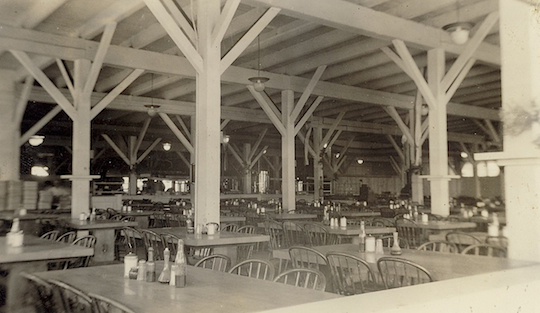
The town is located in the midst of the timber area on a level plateau. It is laid out in wide streets lined with pretty homes with here and there a tall pine as a symbol of the industry which supports the town. The big company department store is the largest in Northern California and there is a cafeteria that feeds over a thousand men an hour, and a great club house where the men can spend their leisure hours.
The schools of Westwood are modern and maintain a high scholarship. There is a union church where all sects can worship, and a Catholic church; and there are libraries, clubs and fraternities. In no aspect is Westwood a lumber camp—it is a city built around one industry and it is a permanent city.