I could not resist to scan and post this article that appeared in the Lassen Advocate. In the era of cell/smart phones, this seems so quaint with the introduction of push button phones. And to think, a century ago operators were known as “hello girls.”
P.S. – Some may not be aware, but if you click on the image, you will see a larger one.
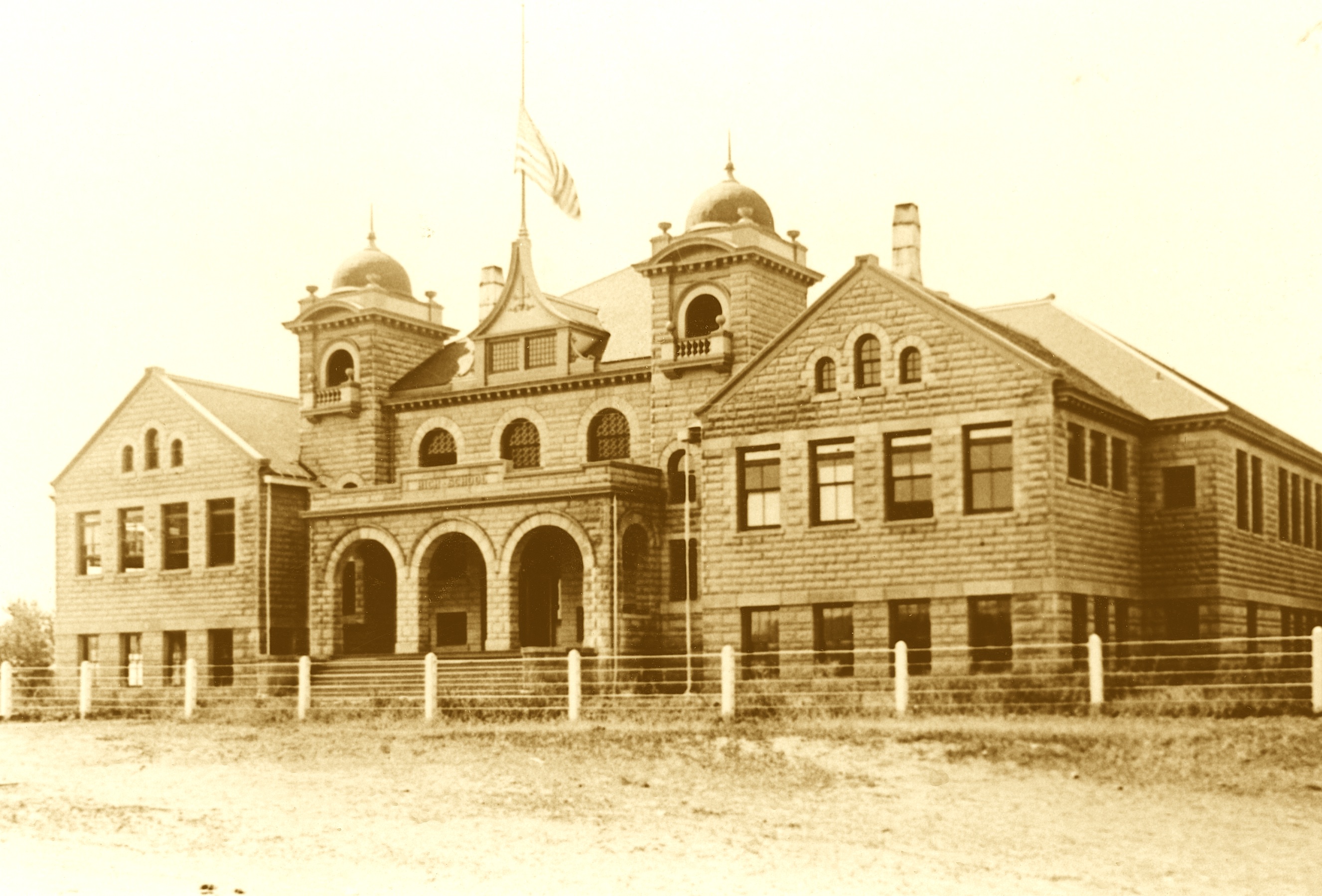
Construction of the high school began in the fall of 1905 and was ready the following year. The school was constructed by Granite Rock Company for $25,670.
The photograph depicted above was taken in 1908, when the school grounds was fenced, not to keep the students in, but to keep roaming livestock off the school property.
Don’t forget you can still get the complete DVD collection of the Lassen High Yearbooks from 1904 to 2013. However, I only have about fifteen left.
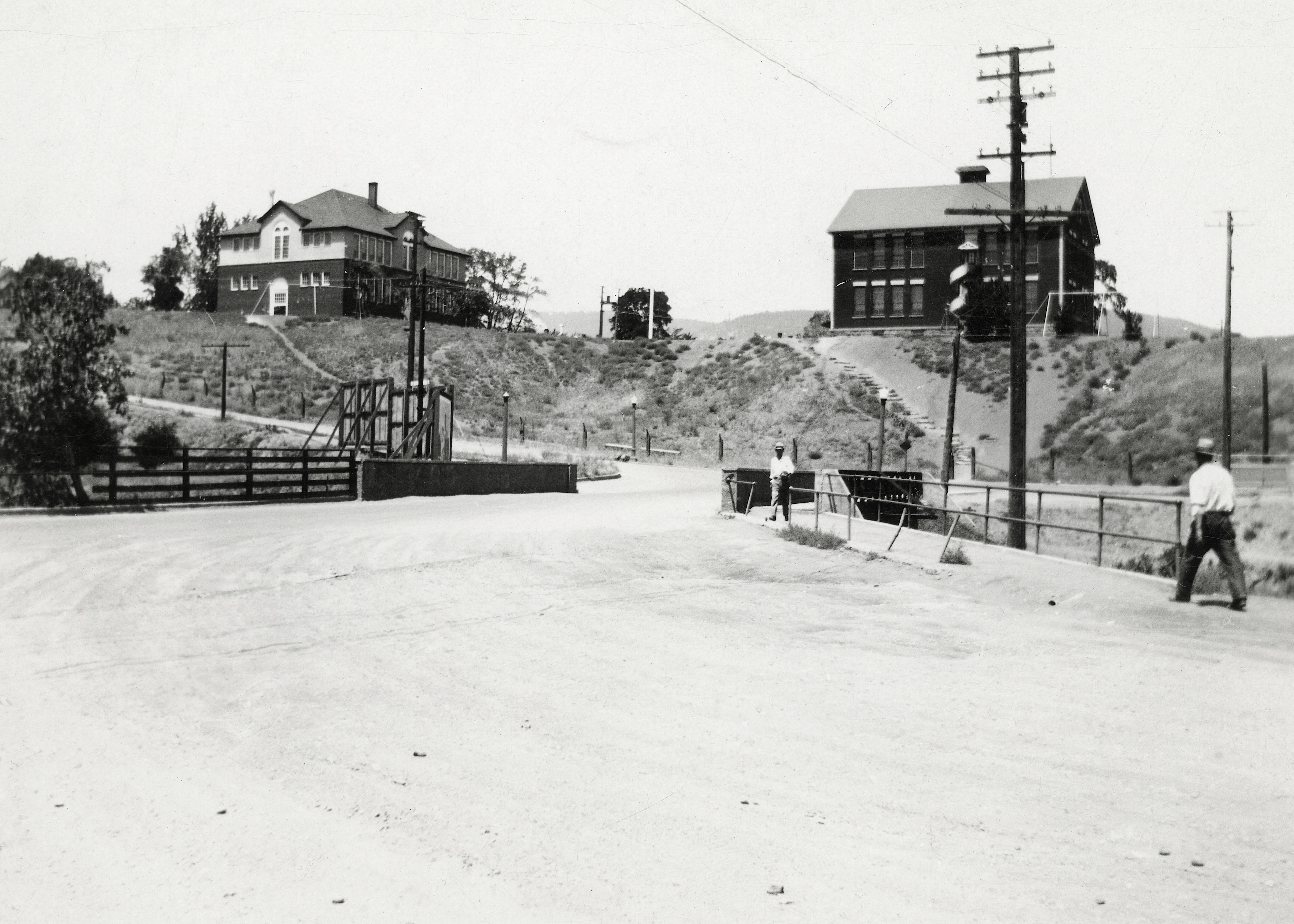
McKinley School (left) and Washington School (right) as seen from Richmond Road, 1935.
When the Susanville School District was established in 1864, the town had only one school, located on Cottage Street. This remained the status quo for nearly sixty years.
With the arrival and the lumber mills, the town experienced a huge population surge. In 1920, a second school was needed and it was also constructed on the Cottage Street property. The growing pains of Susanville continued and a third school was built, this time in the Milwood District in 1922. Another three years went by, and yet another school was constructed, this time on Richmond Road.
With four schools in operation the district, decided to give them names, which they honored past United States Presidents. The first school was named Washington; the second McKinley, the third, Lincoln and the fourth school Roosevelt.
In 1967, when it was decided to build a middle school to replace Roosevelt, a more generic name was given–Diamond View.
The establishment of toll roads in the frontier West was difficult and not usually a feasible business venture—unless you were strategically located at a bridge, mountain pass or narrow canyon where possible toll users could not make a detour and thus not pay the toll fee. On several occasions toll road companies were formed for various routes through Lassen County, but were never successful enterprises. Continue reading Toll Roads→
Twice in Lassen County’s history there have local militia units of the California National Guard. The last time was during World War II. Initially, there was to be one large unit for Lassen and Modoc counties. That plan was neither feasible or practical and was dropped.
A new strategy was drafted. Inside each county, especially in large rural counties like Lassen, several local militia units would be formed. There duties were to protect the area in case of enemy invasion. Their involvement was confined to the boundaries of the county. Uniforms, guns and ammunition would be provided to each unit. They would also be trained in guerilla warfare. In Lassen County it fell upon the Farm Advisor (T.S. Brown) to organize these units.
On May 20 1942, the first organization meeting was held in Susanville. Local units were created for Susanville, Bieber, Doyle, Janesville and Standish. By the first of June, the Susanville Militia had 70 members. It became known as Thomas Tucker Militia—named after Thomas Tucker the first casualty from Susanville in World War I. Fortunately, this volunteer force never had to be activated. At the conclusion of the war, each individual’s enrollment in the militia was automatically cancelled.
Note: If you were not aware, you can click on the image to see a larger version.
Ira and James Purdy posing at Fredonyer Summit, Christmas Eve, 1930
A lot has been written about Atlas Fredonyer early activities in the region. Among other things he filed a land claim in what would later become Susanville, since that town’s founder neglected to do so.
In 1862, Fredonyer was found guilty and sent to prison of a sexual assault charge involving his fifteen year old step-daughter, Sally. Many were of the opinion that Fredonyer did not commit a crime. A petition was circulated and California Governor Stanford pardoned Fredonyer the following year.
After his pardon, Fredonyer seemed to have disappeared, as he never returned back to this region. A few years ago, I finally found out what became of him. He surfaced in a most unusual way in 1880 in San Francisco. Fredonyer it should be noted used the title of “Doctor” to what extent of medical training he had, is not clear. At this time he was suffering from bowel blockage. He attempted perform his own colonoscopy, which a bottle, which got lodged in the colon. The heavy set Fredonyer was finally taken to St. Mary’s hospital. A colostomy was performed to remove the bottle. He did not recover from the procedure and died in San Francisco on August 10, 1880.
As we enter our fourth year of drought, let us hope it does not last as long the 1917-1937 drought. The most severe was the winter of 1923-24. Susanville received less than five inches of precipitation this year. It was so dry that winter that in the middle of March, a one-inch snow fall at Susanville caused great excitement. There was even a greater commotion when eighteen inches of snow fell. It disappeared in a matter of hours. That was the extent of precipitation for the winter. Continue reading The Drought→
It being Easter Sunday, I thought it would only be appropriate to provide some of the history of religion in our region. The Methodist Church had a profound influence on the Honey Lake Valley. In 1860, this church held their first service in Susanville. By 1905, there were Methodist Churches in Janesville, Johnstonville, Standish and, of course, Susanville, more than any other denomination. Continue reading Easter Sunday→
Hat Creek Powerhouse No. 1, 1921. Courtesy of Lola L. Tanner
The Red River Lumber Company operated many enterprises and it still as an influence concerning electricity to many residents of the region. From time to time when the Susanville area has a power outage, many times there will be a reference to the Hat Creek line. So you may ponder how did Hat Creek come to be? Continue reading Hat Creek Power→
As many may be aware, Rite Aid plans a 17,400 square foot building on the 1600 block of Susanville. All the buildings on that block are scheduled to a be demolished. I do not have any problem with this, in fact I am favor of the project. My only concern is the bronze plaque at the bank be saved and incorporated in the new enterprise. Anyone who is concerned needs to contact Craig Sanders at the City of Susanville to express your concern. The details of the project can be found here.