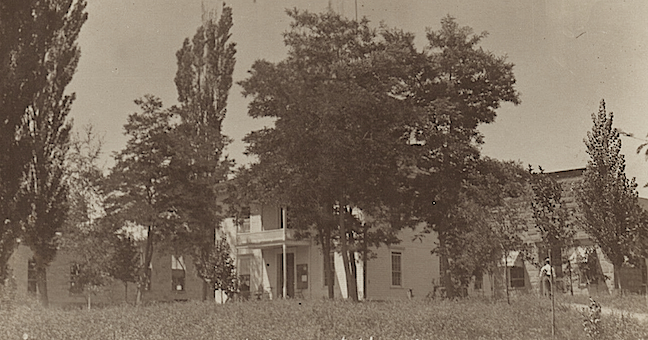
Lassen County Courthouse, 1940. Courtesy of Betty Barry Deal
Today’s topic evolved from a trip to Susanville Supermarket last month. I thought I could manage a quick trip in and out and go on my merry way. Lo and behold, while trying to make my get away, I got lassoed. Anna Stewart who needed some information about Native American Veteran Thomas Tucker, that they want to feature in their newspaper ad, scheduled for July 7. I, of course, obliged.
Thomas Tucker was the first casualty from Susanville in World War I. Numerous records has him listed as the first Lassen County resident, but that distinction belongs to Westwood resident Clyde McKea who died almost two months earlier than Tucker. Continue reading A Living Memorial→
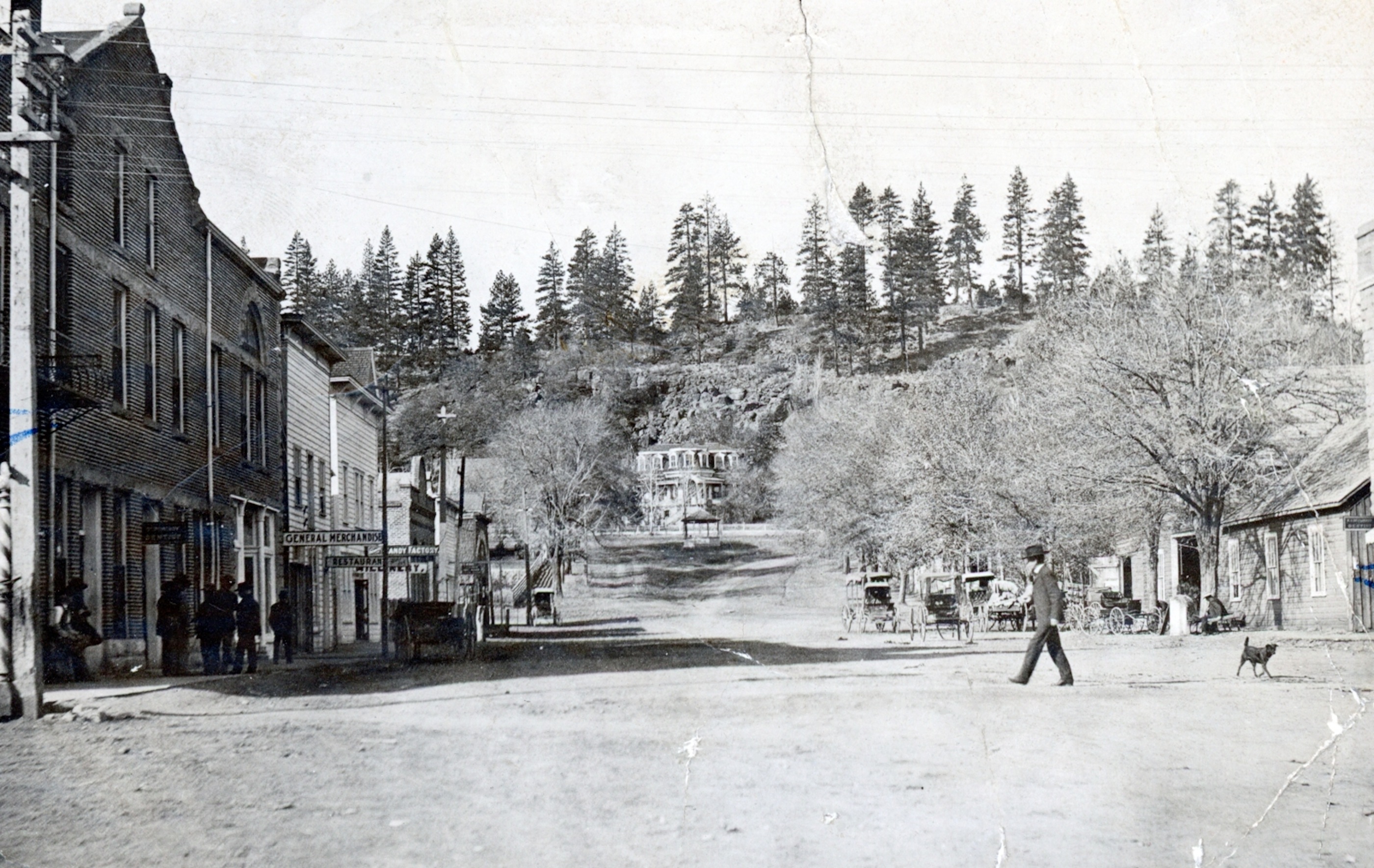
Looking north on Gay Street, Susanville, circa 1863. Courtesy of Gil Morrill
Last month I wrote about the area’s first newspaper, the Richmond Times. The next newspaper, also a handwritten one, the Susanville Reporter. This paper made its debut in February 1861, with Andrew Ramsey at the helm. When the second issue made its debut, the paper changed hands with Isaac Roop, as editor. As the Butte Record noted Roop penned some amusing article such as, “A Hint to Parents,” Something to be Remembered,” and Uncle Sam and his boys.” It would not be for another four years, when the first locally printed newspaper was published—The Sage Brush.
Piute Creek, April 9, 1938. Courtesy of Betty Barry Deal
It was originally named Smith Creek. In August 1854, Isaac Roop called it by that name, when he claimed the water rights to it and began construction of a ditch to divert its water. The Roop ditch was the original water supply for Susanville. In 1872, it was replaced by the Susanville Water Company’s ditch from Cady Springs. In November 1855, Moses Mason, the second person to file a land claim in the Honey Lake Valley, claimed 400 acres along what he too designated as Smith Creek. On September 12, 1856, Captain William Weatherlow took up Mason’s abandoned claim, noting that the creek there, formerly called Smith Creek, was now called Piute Creek. However, on April 15, 1857, when Atlas Fredonyer filed his claim to Isaac Roop’s property, he referred to the same stream as Smith Fork. Who Smith was is not known.
Susanville’s first hotel, if you could call it such was Cutler Arnold’s story and half structure of hewn logs. For two years, beginning in the Spring of 1857, it housed the town’s only dining establishment, meals costing seventy-five cents.
As the town progressed so did the accommodations. In 1860, Emanuel “Mike” Brannan built a two-story hotel on the northeast corner of Main and Lassen streets. It was a transitional period, as the days log structures were being placed with wooden framed ones. Brannan operated the hotel for the next four years, and due to some financial problems lost the hotel. Just as the Brannan House had replaced Arnold’s, Brannan’s was replaced by the superior Steward House in 1864.
The Brannan House did not fade away entirely. Its second floor was converted into lodge hall for the Masons and the Oddfellows. The first floor was used for a variety purposes including that of the post office and the government land office. In 1880, it was torn down and replaced by a new Oddfellows Hall.
Susanville’s Stewart House, 1881. It sometimes was used as a hospital. Courtesy of Dallas & Joyce Snider
Susanville’s first hospital was not built until 1883, and prior to that it was druggist that played a key role in medical care. In the summer of 1860, Dr. Zenas J. Brown arrived in Susanville and began dispensing drugs from a canvas tent. He met with commercial success and at 802 Main Street, he had an octagonal drug store built—which the locals gave him the nickname of Doctor Eight Square. The following year he was joined Dr. Robert F. Moody, and Moody would become sole proprietor of the firm within three years. Dr. Brown it should be noted introduced the first apple trees to the region, which at one time was a major export crop.
For indigent care, those person’s were housed in a local hotel, until they either recovered or not, which the county picked up the tab. For instance, in September 1864, Emanuel “Mike” Brannan, proprietor of the Brannan House, submitted a claim to the county in the amount of $75.31 for lodging, medical and burial expenses of John Tuskey.
Then there is Dr. Zetuz N. Spalding’s arrival to the region in 1857, and would later be the founder of the venerable Spalding Drug Store. One of Spalding’s earlier advertisements noted his many skills: “Z.N. Spalding, Physician, Surgeon and Accoucheur. Teeth extracted without pain, by use of Anaesthetics.”
On a final note, the Lassen County Historical Society’s April 2015 newsletter had a short piece on R.F. Moody. A little known fact, was Moody placed Lassen County’s first billboard back in the late 1870s on the Horse Lake Road. Carved in stone he advertised his Sagebrush Liniment.
Granville Pullen first came to Lassen County in 1870 and worked at various jobs. In the 1880s he located to Sonoma County, but made frequent visits to Lassen County to see his sister, Susan Goumaz. In 1901, he moved back to Lassen County and bought a ranch near Janesville. In 1914, at the age of 76, he retired from ranching and bought a house in Janesville.
Pullen had been collecting various artifacts and curios for over forty years. Not to be idle he opened a small museum in Janesville to display his collection. People fascinated by his collection began donating items to him. In 1920, Granville and his wife Mary, moved to Susanville and bought a home on South Roop Street. Next to his new home, he had a small concrete building built to house his museum. On June 18, 1921, he opened the museum to the public. When he passed away in 1926, and his wife kept the museum open for awhile, but she did not have the same passion as her husband. Over the years, she donated a portion of the collection to Lassen County. The items were displayed for a number of years in the Veteran’s building, and over time slowly disappeared.
The June 2, 1866 issue of The Sage Brush measured only 6 inches by 12 inches and was printed only on one side.
This toll road had a very short life, and that existed only on paper no less. However, when the company was organized they deemed a life span of twenty years, but from the only record indicates, it did not survive twenty days.
Nevertheless, it was an admirable undertaking. It was spearheaded by a group of progressive residents of Honey Lake and Indian Valleys. During the 1850s and 1860s one of the most traveled routes was a road from Gold Run going over Diamond Mountain and following Light’s Creek into Indian Valley. The gentlemen intended to put a toll gate at the summit. As required by law, they published their intent in the Sage Brush newspaper. On June 13, 1866 they held an organizational meeting in Susanville and elected A.D. Headly, President, James Ford, Secretary and W.N. DeHaven, Treasurer. The following day they filed their Articles of Incorporation with the Lassen County Clerk.
The company’s lasting legacy is attached to the articles of incorporation, was a copy of the Susanville, Sage Brush, the forerunner to the Lassen Advocate. This is the oldest known copy in existence. The paper apologized for the small size of the issue, citing their paper supplies had not arrived.
B.R. Zimmerman was a popular Susanville bar owner for many years. In 1919, he converted his famed Owl Saloon into a produce store.
Order of Camels was a fraternal organization opposed to prohibition. The camel was an ideal symbol as it could go for long spells without a drink. As we know they did not succeed in stopping prohibition. In a peculiar move, a local chapter was organized on June 10, 1920, nearly a year after prohibition took effect.
Main Street looking west from Lassen High before the fill, circa 1909. Courtesy of the A.J. Mathews family.
In 1914 Susanville’s uptown business district went through a major transformation when such buildings as the Del Mar and the Star Hotel were constructed along with other properties. There was a byproduct from this construction. The buildings had basements and the problem was what to do with all the dirt piling up in the streets. It should be duly noted that the city ended at Weatherlow Street. In the winter months it could be rather hazardous to get to the east entrance. This was due to the fact that between Weatherlow and Grand it was mainly bottom land where Piute Creek flowed. At least for pedestrians an elevated wooden plank bridge spanned the creek crossing. So all the excess dirt from the excavations was used as a fill for that segment of Main Street.
Photographers, of course, is a favorite topic of mine. After all, thanks to their work we have a visual record of our past. It has been important to document the photographers of the late 1800s, so as to know the time frames when they chronicled the events. Due to a small population many photographers only remained a year or two, and even then they rode the “circuit” traveling to Modoc and Plumas counties to drum up business.
Alexander Howell came to Susanville from Oregon where he learned the photography trade. On April 15, 1891 he opened his Susanville studio. The following year he was lured to Amedee, with the prospects afforded by this boomtown. After a two-year stint, he traveled throughout Northern California and finally settled permanently at Auburn, California. Very few of his Lassen County works remain, but there is one of the Golden Eagle Mine at Hayden Hill, another topic for another time.
The current issue of the Lassen County Historical Society features an article of another photographer, Jervie Eastman. The article has a number of flaws, so just be be aware.