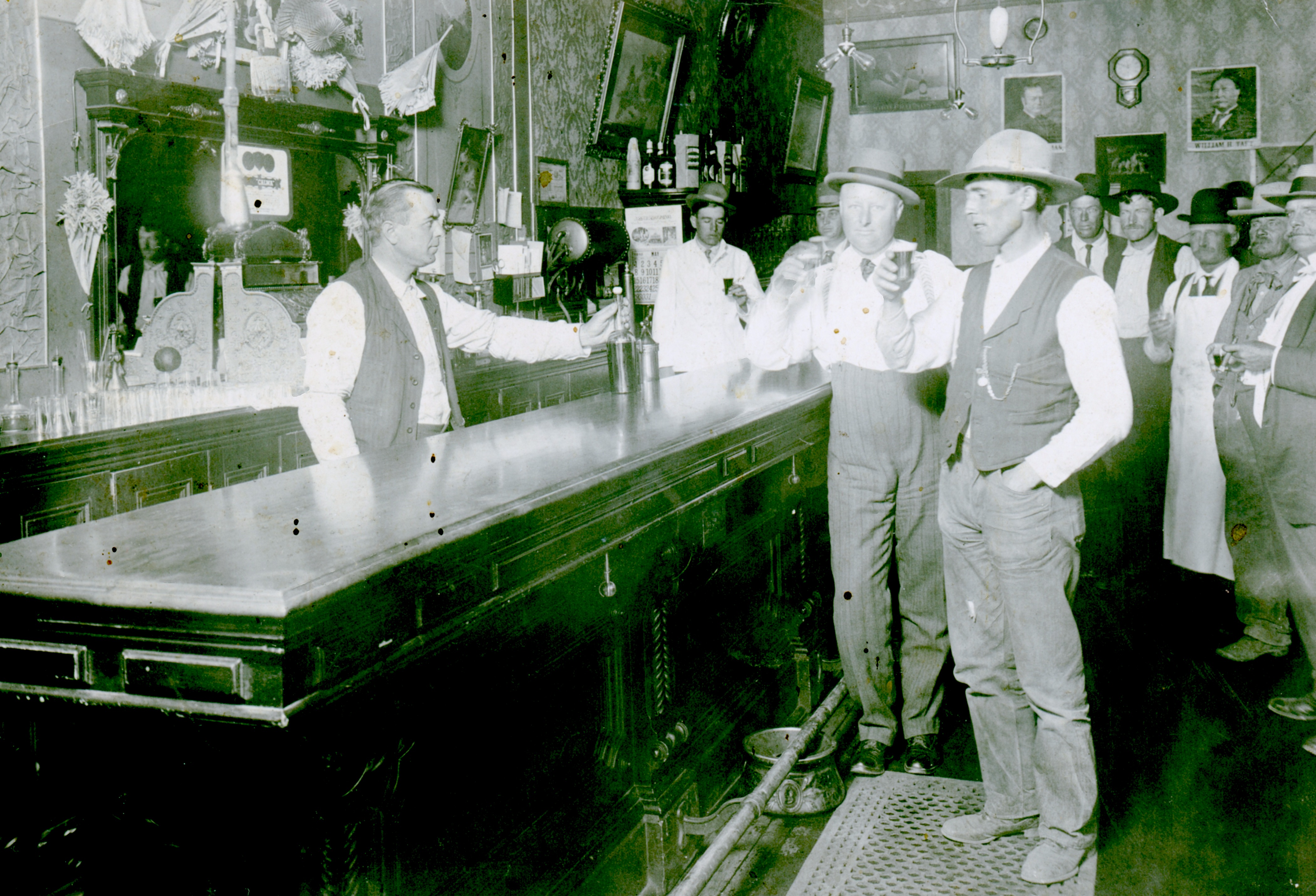
B.R. Zimmerman was a popular Susanville bar owner for many years. In 1919, he converted his famed Owl Saloon into a produce store.
Order of Camels was a fraternal organization opposed to prohibition. The camel was an ideal symbol as it could go for long spells without a drink. As we know they did not succeed in stopping prohibition. In a peculiar move, a local chapter was organized on June 10, 1920, nearly a year after prohibition took effect.
Main Street looking west from Lassen High before the fill, circa 1909. Courtesy of the A.J. Mathews family.
In 1914 Susanville’s uptown business district went through a major transformation when such buildings as the Del Mar and the Star Hotel were constructed along with other properties. There was a byproduct from this construction. The buildings had basements and the problem was what to do with all the dirt piling up in the streets. It should be duly noted that the city ended at Weatherlow Street. In the winter months it could be rather hazardous to get to the east entrance. This was due to the fact that between Weatherlow and Grand it was mainly bottom land where Piute Creek flowed. At least for pedestrians an elevated wooden plank bridge spanned the creek crossing. So all the excess dirt from the excavations was used as a fill for that segment of Main Street.
Photographers, of course, is a favorite topic of mine. After all, thanks to their work we have a visual record of our past. It has been important to document the photographers of the late 1800s, so as to know the time frames when they chronicled the events. Due to a small population many photographers only remained a year or two, and even then they rode the “circuit” traveling to Modoc and Plumas counties to drum up business.
Alexander Howell came to Susanville from Oregon where he learned the photography trade. On April 15, 1891 he opened his Susanville studio. The following year he was lured to Amedee, with the prospects afforded by this boomtown. After a two-year stint, he traveled throughout Northern California and finally settled permanently at Auburn, California. Very few of his Lassen County works remain, but there is one of the Golden Eagle Mine at Hayden Hill, another topic for another time.
The current issue of the Lassen County Historical Society features an article of another photographer, Jervie Eastman. The article has a number of flaws, so just be be aware.
A wide variety of people read the daily posts, and that is a good thing, in the sense for everyone to become more familiar with the region’s heritage.
Of course, while researching one topic, invariably I come across other items, that I was not seeking. Some days it can be hard not to get sidetracked. In a recent instance while researching the Theodore brand, I came across the Susanville Edsel dealership of yore. It was located at 80 North Roop Street, now home to Lasco and Rooptown Bicycles What many people may not realize that the building was constructed in 1957 for the dealership. Of course, Ford’s Edsel automobile was a failure and it soon closed. Many a seasoned resident will recall this building housed the California Department of Motor Vehicles for many years.
The first McKinley School was built in 1920 and located on Cottage and South Gay Street, on the same lot that the former Washington School, nee Credence was located.
Yet, it was the Washington School that was built in 1900 that time had taken a toll on the structure. In 1947, the Susanville School District were concerned that it would not pass a number of safety codes. The following year the building was condemned and the district was concerned McKinley, too, would suffer the same fate. The District now had the daunting task to find funds to replace the two schools. The State of California determined that the District was determined “distressed” and was eligible for $341,065 in funds. It was decided to create two neighborhood schools, and McKinley was located to Fourth Street. The new school building opened its doors in May 1950.
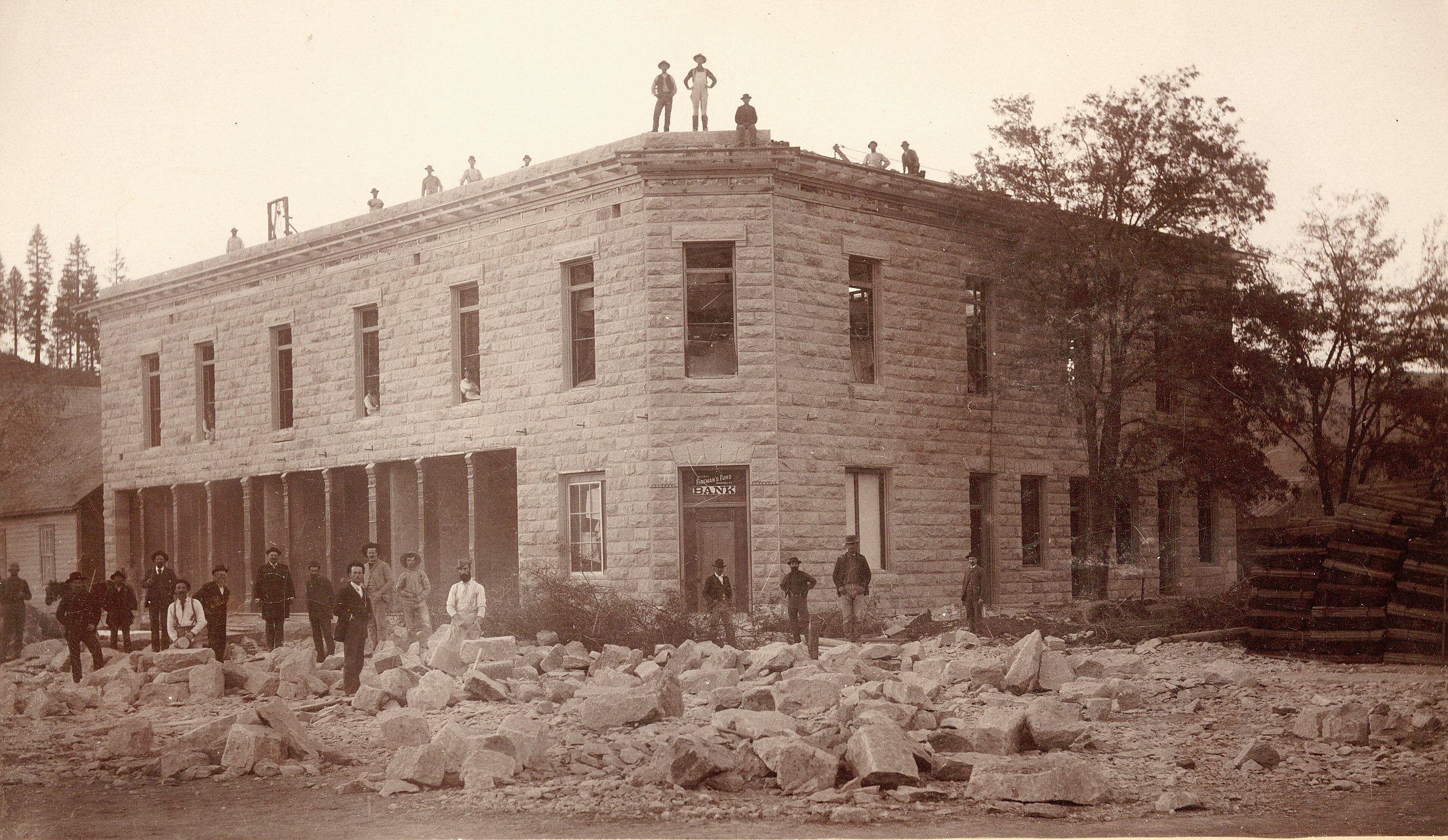
In 1860, saw the discovery of rhyolite tuff at the base of Susanville’s Inspiration Point. It is an ideal building material, because it is light weight, and can easily be sculptured. In 1862, H.F. Thompson began the development of a quarry, and hence how Quarry Street is named. Some of its first uses was for headstones, the largest being for the grave of Captain William Weatherlow who died in 1864. In 1863, Miller & Kingsley had the first stone building constructed from the quarry. The last major use of the quarry was in late 1930s to construct the Spalding home on Quarry Street.
Emerson Hotel under construction, 1901. Courtesy of Mary Dale Folsom
After the devastating fire of June 6, 1900, a new Susanville would arise from the ashes. In addition, the town witnessed a substantial use of brick for the preferred building material.
On July 31, 1900 groundbreaking ceremonies were held for the largest most expensive building to be constructed in town to date. It was Charlie Emerson’s three-story hotel, encompassing a quarter of a block on the southwest corner of Main and Lassen Streets. The $300,000 brick building contained 27,576 square feet. Besides providing the assortment of business spaces, it also included 76 guest rooms. A grand opening was held on June 3, 1901, and The Emerson became the town’s premiere social hub.
Part news and part history. On April 28, the first hurdle was made for the construction of a 17,400 square foot Rite Aid store. The store, along with the parking lot will encompass the entire 1600 block of Main Street. Of course, this site was the former home of Potter’s Maternity Home on the corner of Main and Park. In 1966, United California Bank took over this location and constructed their bank, which held an open house of February 27, 1967. It has housed a number of financial institutions since then. Of course, on the corner of Main and Ash was Baxter’s Flying “A” Service Station. After it closed, for a brief time in 1978 it housed Jim Pardee’s campaign headquarters for Lassen County Superior Court Judge, and then was subsequently torn down and has been a vacant ever since.
According to records filed with the city the bronze plaque commemorating Potter’s will be preserved and replaced on the site. The fire department has sought authorization to conduct fire training on the bank and remaining vacant residences scheduled for demolition. It is Rite Aid’s goal to be in their new location by the of 2015.
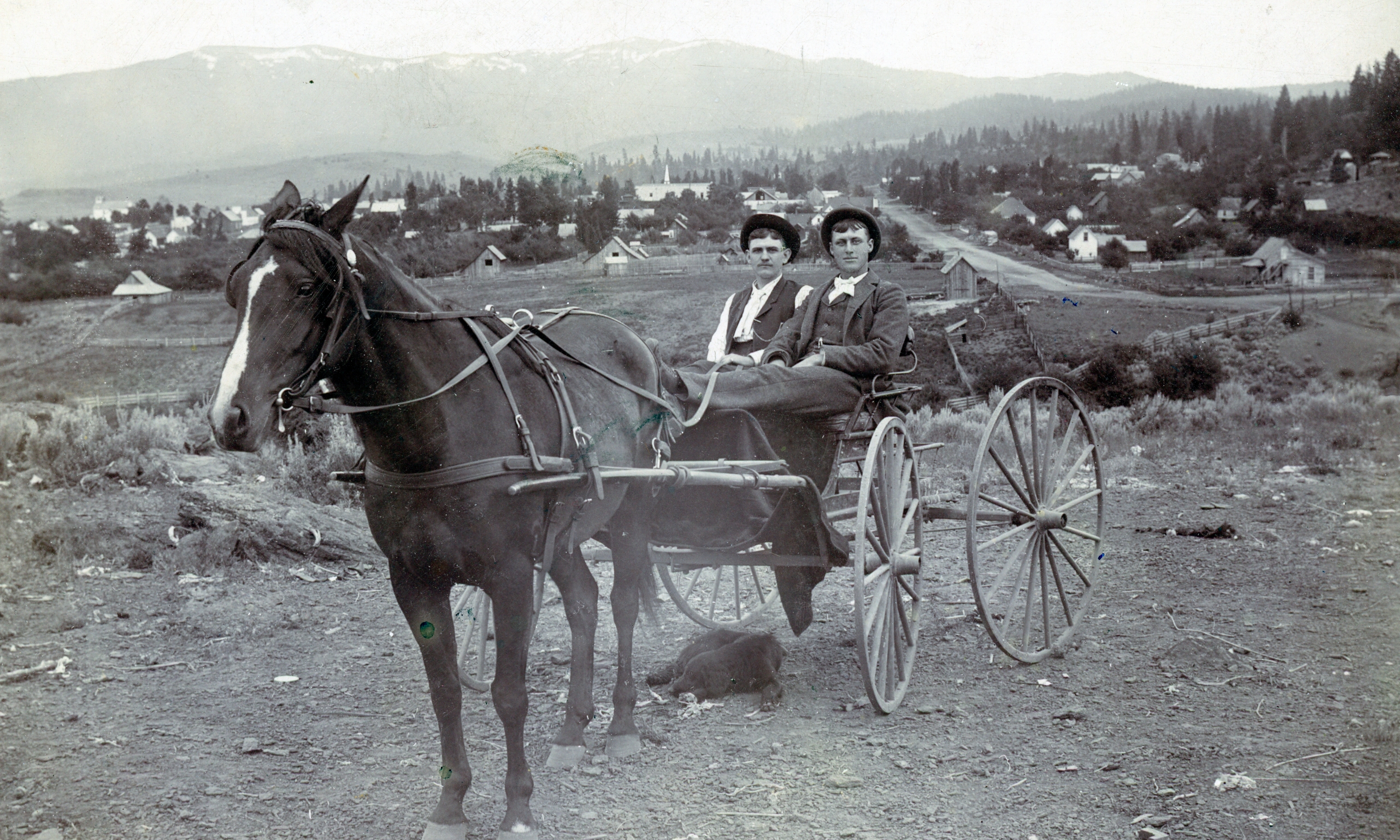
Roop Street in the background from Rooster Hill. Seated, Frank League and Tom Long, circa 1895.
While a few months ago I mentioned the peculiar situation noting that North Street runs in a east/west direction. As duly noted, it made sense back in the day, as it was the most northerly street in the new town.
Another peculiarity is that of Roop and Weatherlow Streets. This was pointed out to me many years ago when Eleanor Vandeburgh and I worked at the museum. After all, her reasoning was, one would think Weatherlow Street should have been designated as Roop, since it went to his original home. Weatherlow lived at the end of Roop Street, though it did not extend that far, since his original home is known today as Susanville Ranch Park. On the same token, Weatherlow Street goes by Roop’s original home.
In 1920, voters of the Susanville School District passed a bond measure to build a second school. The trustees indicated, however, that with the accelerated growth another school would be needed. What they had not bargained for was just how quickly the need would arise. On January 14, 1922 the District held another bond election for a new school. The voters approved the $50,000 measure by a vote of 140 to 5. In March, the District purchased a lot on the south side of Main Street at the intersection of Hall Street. In June local contractors Woodward & Grebe were awarded a $35,000 contract to build it. The school was completed and placed in use during the first week of February 1923. The Lincoln School closed at the end of the 1966-67 school year.