Donate!

Donate!

“Real estate in Honey Lake Valley for the past week has been decidedly shaky, and when things are to get settled down to a firm and reliable basis it is hard to determine. Since last Friday night there have been no doubt at least 50 shocks of earthquakes felt in the valley. Today something like a dozen have been felt here in town. One at seven o’clock this morning was quite lively. The shocks seem to be more frequent and harder around Janesville. It is a well established fact that below Buntingville, crossing the Epley Ranch, is a place that “sounds hollow” when being crossed and at intervals rumbling sounds are heard traveling along this place. The sounds seem to come from the mountains to the west and travel toward the lake. Horses when plowing over this place have become frightened at the sounds beneath their feet. This has been repeated for years. The occurrence of so many earthquakes in this locality seems remarkable and how ad when they will cease seems to be a hard conundrum to answer just now.
“Not the earthquakes alone but the weather is phenomenal. Yesterday the thermometer reached 68 degrees in the shade, while for a week or more there has been no frosts at night. Last night and today we had quite heavy showers of rain and the snow is fast disappearing from the mountains.”
Subscribe!

Donate!

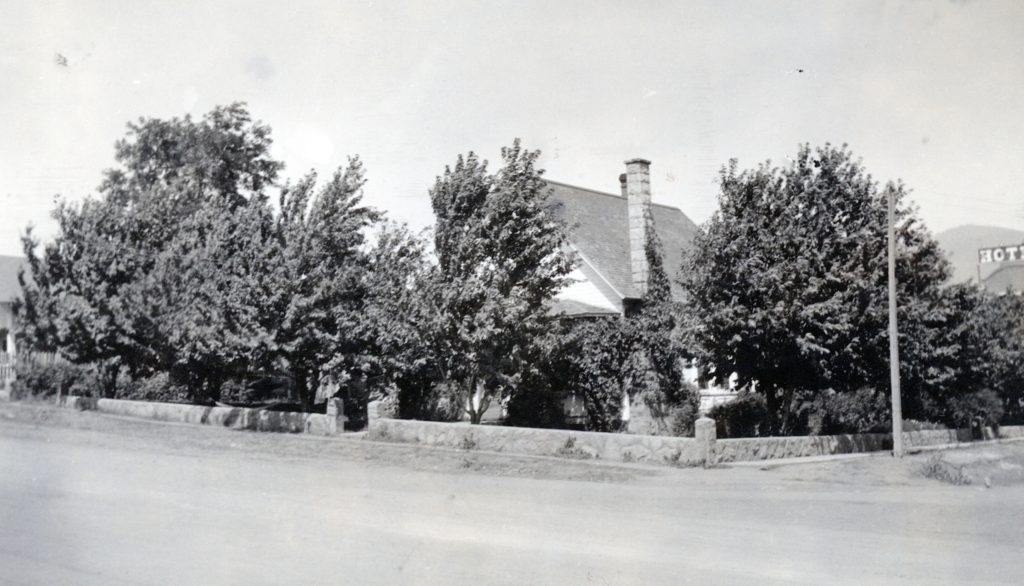
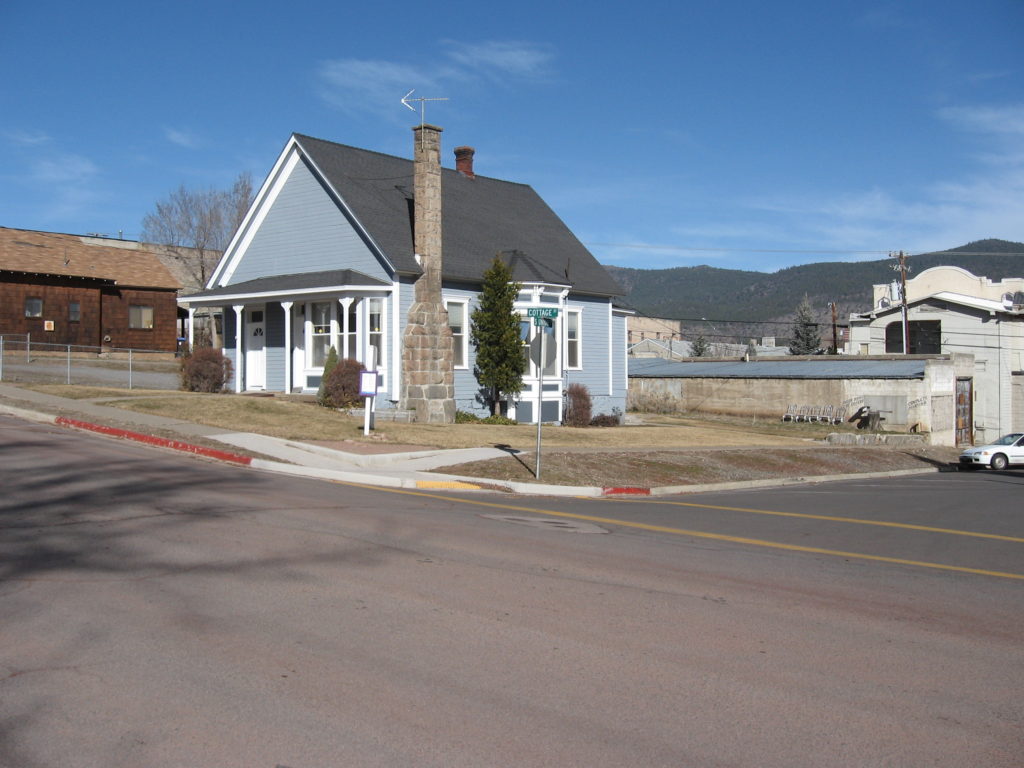
In October 1875 it was announced that the D.H. Tucker was awarded to construct a church on the corner of Pine and Cottage Streets. The edifice would cost $2,200 with a $500 loan from the American Congregational Union of New York. At the same time the Methodist were constructing their own church two blocks away. An informal race ensued as to who would have the first church completed. It was the belief of some that the first church dedicated would receive the most support, since some were doubtful that the town could support two churches. The Methodist won.
On November 17, 1878 the congregational church was dedicated with the Rev. John Phillips presiding. Not only was there a large attendance, but two children—Beatrice Partridge and Grace Olive Lovell—were baptized.
By 1900 the church had disbanded. In the fall of 1903, the Lassen Advocate noted: The old congregational church on Pine and Cottage Streets is going to ruin. It is an eyesore and something should be done about it.” Three years later, something was started to take care of that problem. It turned out the American Congregational Union sued the Susanville Congregational Church Society for the $500 that it had loaned them to build the church. They won by default and Lucy Spencer purchased the church property for $1,150. In 1914, Lucy’s grandson-in-law, Charlie Emerson, moved the church down the street, next to the Methodist Church, where he converted into a warehouse for his nearby mercantile business. On August 5, 1915, a fire broke out in the converted church that would destroy most of the buildings on that block.
Subscribe!

Subscribe!

He was born on November 29, 1848 in Illinois, one of thirteen children, yet ten of his brothers and sisters died in infancy, some of whom are buried in the Susanville Cemetery. It should be noted that the family came west in 1860 and settled in Plumas County and in 1867, they moved to Susanville.
One of his more interesting jobs began in the late 1870s, when he went to work for the Fish & Game Department as a deputy. They kept him busy planting fish in the various lakes and streams to learn what would best adapt in the area. In January 1879, Sanders along with Dr. H.S. Borette and William Dow introduced the first non-native species of fish at Eagle Lake. It was two wagonloads consisting of 225,000 Great Basin whitefish. That fall they planted brown bullhead catfish at Eagle Lake. Sanders also planted catfish in the Susan River and Piute Creek, where they did quite well. Take for instance, in 1883, Masillon Martsteller caught a twelve pound catfish from the Susan River. Sanders, himself, caught a catfish from Piute Creek that weighed fourteen pounds.
While Fish & Game paid Sanders a stipend for what he did, the work was sporadic and the payment not sufficient to make a living. For a livelihood he learned the carpentry trade. He specialized in making cabinets, furniture and trunks. As most furniture makers of this era, he was called upon to make coffins. He added undertaker to his profession and continued until 1896 when he sold out to Tom Oakes. In 1897, he moved to Sacramento where his brother, Plumas Sanders resided. It was not a good move. Two years later, unable to find steady work, he committed suicide.
Subscribe!

It was quite the interesting watering hole, “Shirley” a former nurse, was confined to a wheel chair, but remembered for her generosity. She was also a madam, and cabins behind her establishment took care of certain needs of her clientele. Then there was her friend, gay piano man, and member of Sacred Heart Church’s choir, that assisted her, until he committed suicide in 1938. When she died in 1954, Gene Garayoa and Steve Arainty transformed it into the Juniper Inn.
*Ash Street, was not in existence.
Never miss a story, click here.
FacebookTwitterGoogle+Share

John Hanson came to Susanville and initially opened his photography studio in a tent. With that type of mobility, it appeared Hanson was just traveling through town. Yet, Hanson found romance in Susanville with a young lady, by the name of Fannie Streshley, who operated a millenery store a block from Hanson’s tent. The relationship turned serious and the two were married on October 31, 1883. The couple made Susanville their home until 1886, when they moved onto unknown greener pastures.
Subscribe!

Donate!

Subscribe!