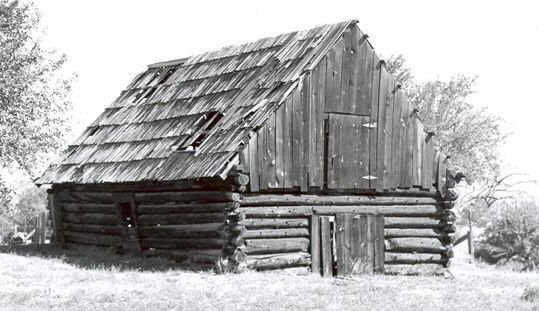
On Sunday morning, July 3, 1927, fire officials were alerted that a fire was threatening Roop’s Fort, Susanville’s oldest structure on Weatherlow Street. When the fire department arrived they found a nearby shed and chicken coop in flames, that threatened the old fort nearby. Luckily, the fire was extinguished in the nick of time. It was determined that children playing with fireworks started the fire.
There are two interesting anecdotes about this incident. First a newspaper reporter was more focused on tomorrow’s holiday, as evident in the lead sentence: “Fort Weatherlow, the first building in Lassen County, built in 1854 by Peter Roop . . . “
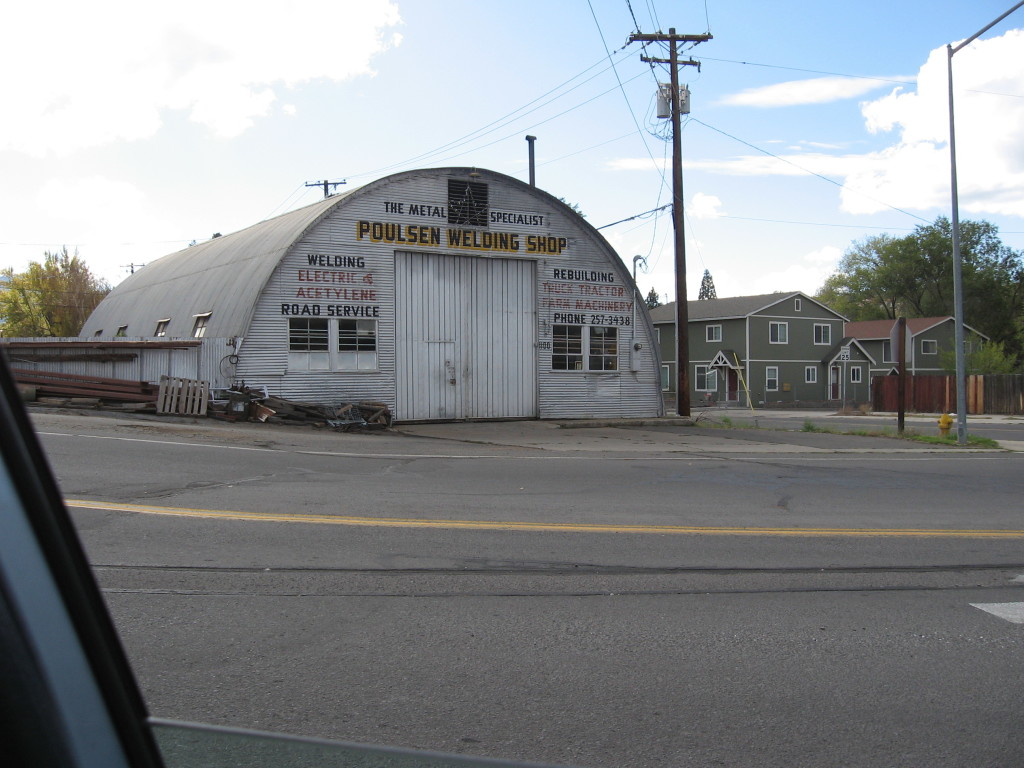
Roop’s Fort was barely located outside the City Limits back then, and the City fire department were prohibited to assist with any fire outside the city limits. In this instance they did. Fast forward to 1946 and a very similar episode. Poulsen’s Welding Shop caught fire, but the city did not respond, because it was just across the city boundary.
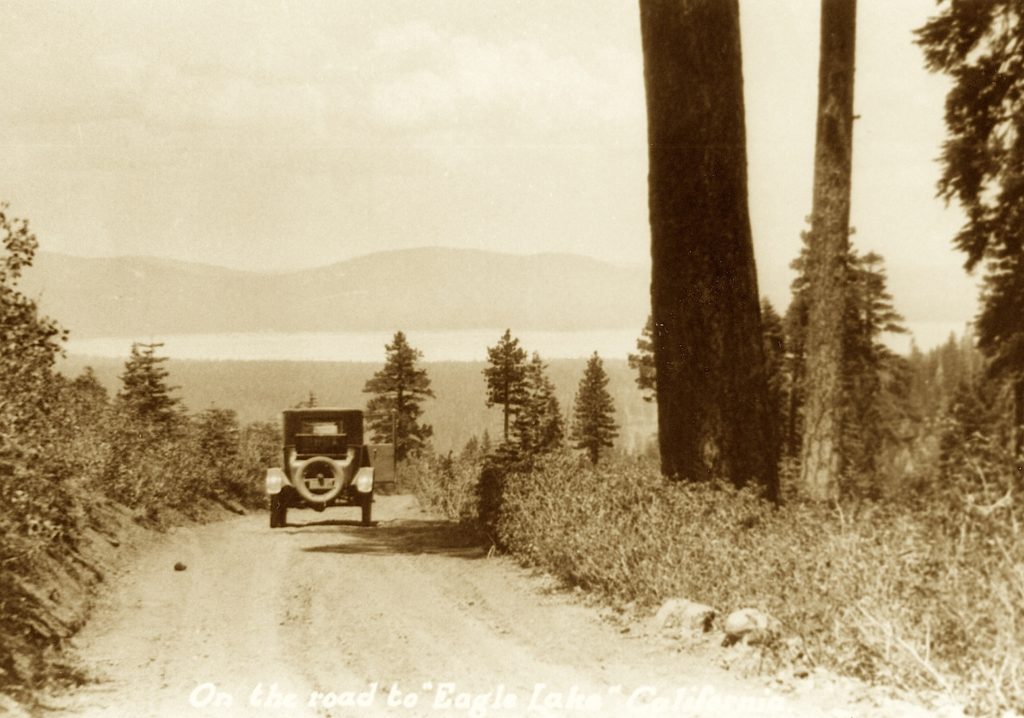
Eagle Lake Summit, 1923. Courtesy of Dick & Helen Harrison
The citizens of Susanville in August 1926, while hosting the California American Legion Convention, did everything they could to make it a memorable event. One of the many events they hosted was a barbecue at Eagle Lake. This was no small feat. It was a logistical nightmare to transport some 2,700 people to the south shore of lake. In addition, to bring all the food and related items to go with it had to been a daunting task. To feed a crowd of that size was more than they were prepared for. Long lines were endured for a serving of steak and beans. Most of the attendees took it in stride. “Happy” Wintz from the El Segundo delegation composed a little ditty he sang the next day at the parade in Susanville, a variation of the local legion’s slogan, “Eagle Lake, Eagle Lake, on the rocks and rills, of California hills. Eagle Lake, Eagle Lake, that’s where we got the belly ache.”
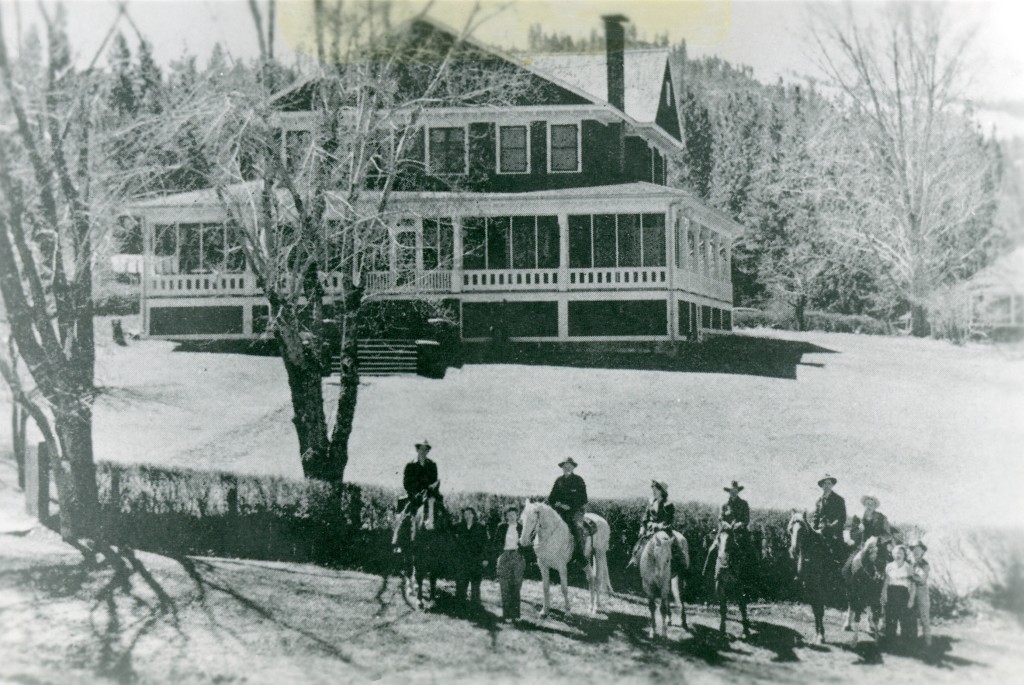
The Wingfield property as it appeared in the 1950s.
In the spring of 1942, Susanville residents were astir when the news broke that a famous western movie star purchased the old George Wingfield, south of Susanville, known today as Mountain Meadows Ranch. That star was none other than Buck Jones, who delighted movie goers since the 1920s. It was his desire to raise horses at the ranch. However, his dream was short lived. In November 1942, Buck Jones was killed in the horrific fire of the Cocoanut Grove nightclub in Boston that claimed 492 lives.
The Susanville plant, 1921. Courtesy of Ed Standard
In this era of being bombarded with the term “fake news” the City of Susanville deserves a gold medal award to distort the record to accomodate someone’s warped mind. It should be noted, after all, I have spent the majority of my life researching the region’s history to provide an accurate record versus false statements, which is different from folklore. For instance, when my Eagle Lake book was published in 1988, Bob Amesbury congratulated me, since he had written a book on the lake, too. Bob went onto say that he had all the bullshit and I had all the facts.
Fast forward to the summer of 2018, when at the City’s urging I met with with two officials, Mr. McCourt and Ms. Schuster, concerning the history of Riverside Park. It was an exercise in futility, for this dynamic duo, could care less about the history of site, and were bound and determined to change the name of Riverside Park to Fruit Growers Park, regardless of the facts, which ultimately they were successful, using a deceptive survey, that the general public was excluded.
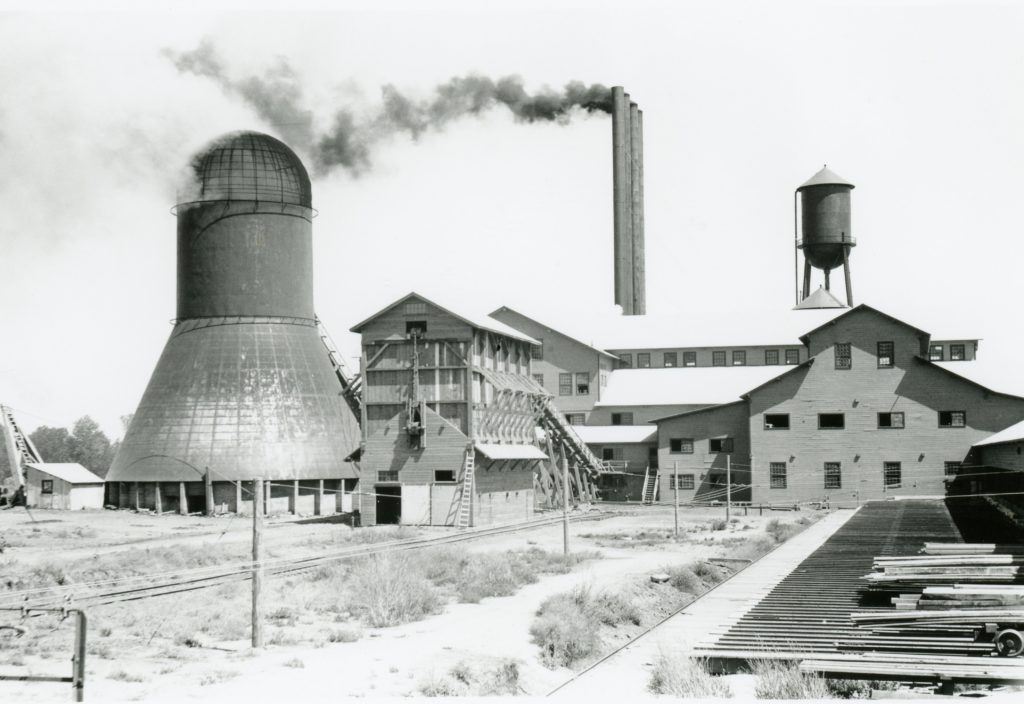
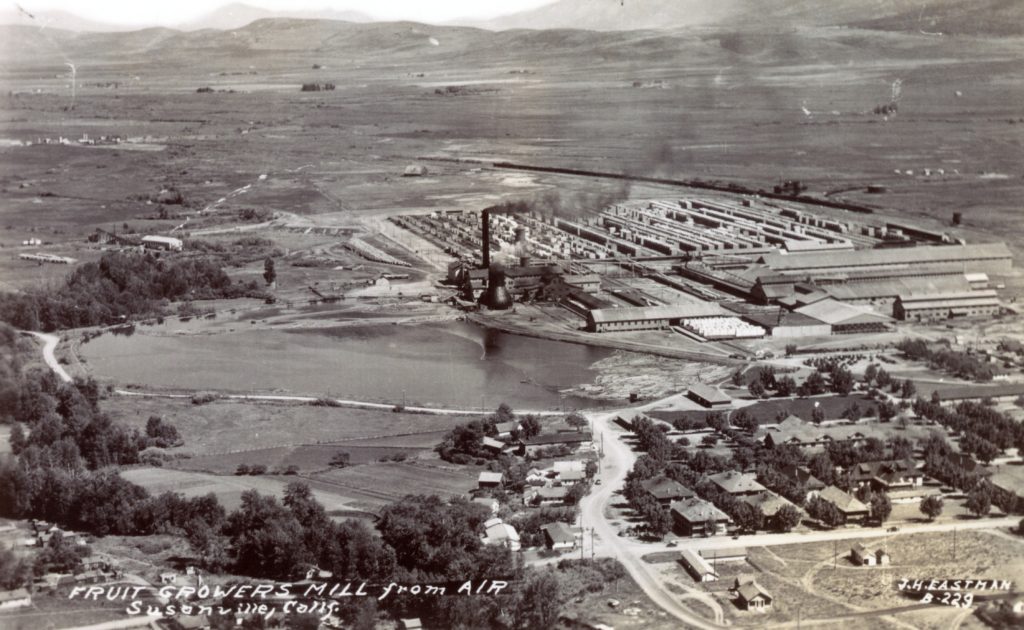
Fruit Growers Supply Company, 1936
Oh, dear reader, it gets worse. To support their claim they lied on the record at a city council meeting at the September 5, 2018, and that information then appears in the local newspaper only to get perpetuated. One of Schuster’s first comments that the city gave Fruit Growers the millsite property consisting of 256 acres, which it should be noted was larger than the city itself, and was located over a mile away from the city limits. Just the twenty acre parcel where the park is located, Fruit Growers purchased that from George and Pearl Bassett for $9,500. In all, Fruit Growers spent more than $60,000 for the millsite property and water rights. It just gets worse. Schuster noted that Fruit Growers sold the mill to Eagle Lake Lumber Company in 1944. Fact, Fruit Growers sold to Eagle Lake Lumber in 1963 for $875,000. Later on it was mentioned that Fruit Growers donated the park property. Excuse me. The city purchased it in 1976 for $23,000 from Sierra Pacific Industries, and it was not the city’s first choice. The city was trying to buy Vallejo Meadows along Piute Creek, north of Willow Street, and west of Parkdale, as part of a greenbelt program, but that deal fell through.
In closing then, with the City’s current thinking, Riverside Hospital where I was born and lots of others could not have existed under that name, as it must have been Fruit Growers Hospital.
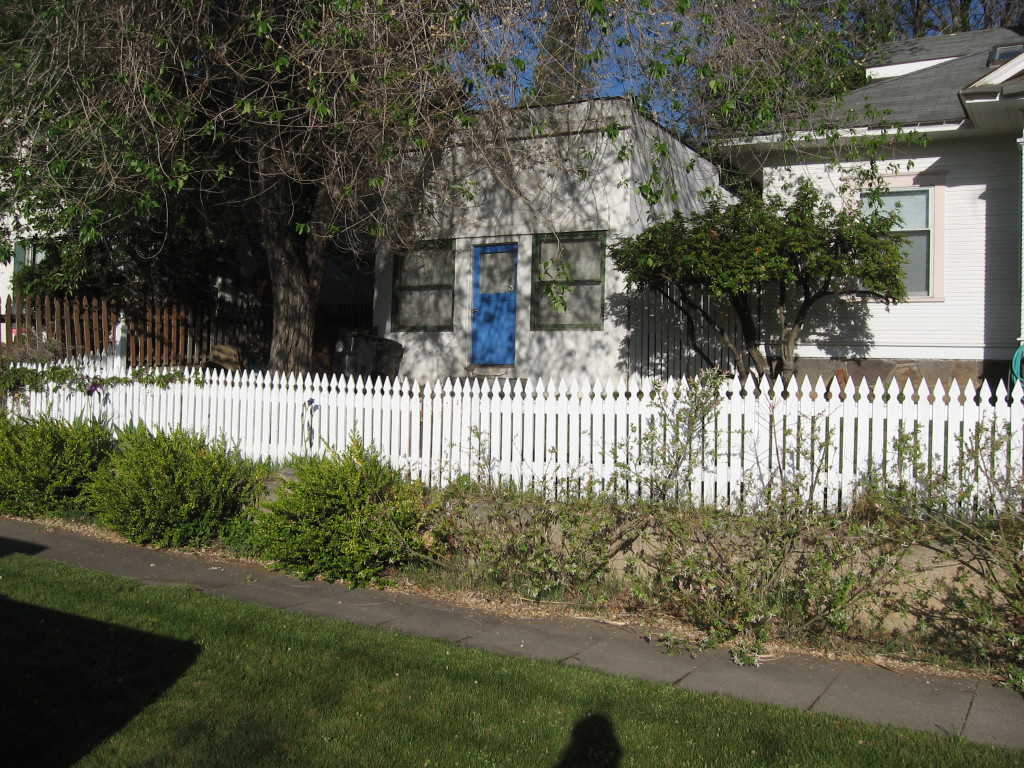
A little background for those not familiar with the topic, that I wrote about in the spring of 2015. Granville Pullen first came to Lassen County in 1870. He moved around, and in 1901 he bought a ranch near Janesville. In 1914, at the age 76, he retired from the ranch and bought a home in Janesville. It should be noted that Pullen had been collecting various artifacts and curious for forty years. Upon his retirement he opened a small museum to display his collection. People were fascinated and donated items to him.
In 1920, Granville and his wife, Mary, bought a home on South Roop Street in Susanville. Next to his new home, he had a small concrete building constructed to house his museum and it opened to the public on June 18, 1921.
When Pullen passed away in 1926, his wife did not share her late husband’s possession for his artifacts. In early 1927, Mary donated the bulk of the collection to Lassen County and many items were put on display in the new Veteran’s Memorial Building. At the December 5, 1927 meeting of the Lassen County Board of Supervisors a discussion was held regarding the Pullen Museum. Mary Pullen offered the museum building on Roop Street to county on the condition it would be moved to another location. County Purchasing Agent E.F. Koken informed the board that it would be too difficult to move the building and the county declined the offer.
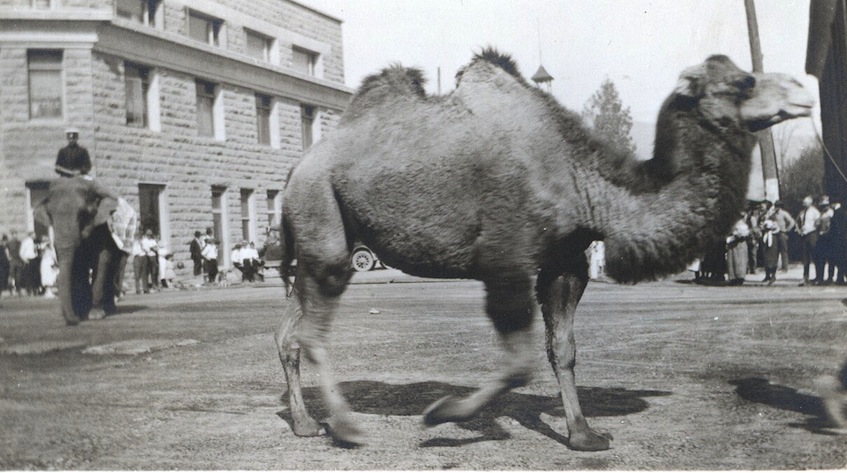
That is right, a camel at the intersection of Main and Lassen Streets, during the 1916 circus held in Susanville. B. Dorsey Collection
It is not really known how this form of entertainment made it to Susanville way back when. On July 25, 1868, Bartholomew’s Great Western Circus came to town to give its first performance of this kind. It was part of their tour into the hinterlands of Northern California. The details of the event are rather sketchy. Its most famous act was the great talking pony, “Napoleon.”
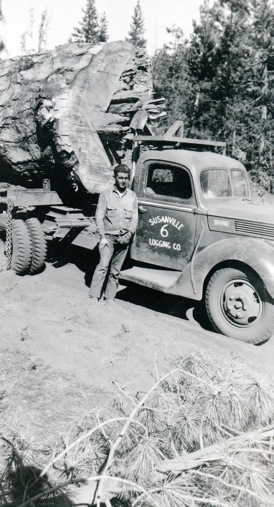
Joe “Tunney” Zunino posing with his one log load. Courtesy of Margaret Purdy
In 1941, this company was created by a partnership between J.S. “Sam” Dotson, William Barbee and Sherman Rea. They initially acted as logging contractors, their biggest client was Lassen Lumber & Box Company. While Lassen Lumber & Box was in decline, Susanville Logging saw there was still opportunities in the milling business. In January 1947, they began construction of a sawmill east of Susanville, the property known today as Lassen Ale Work’s The Boardroom on Johnstonville Road. The mill was completed in April 1947 and had a daily capacity of 40,000 board feet. In July 1947, the company proposed to build a truck bypass from Eagle Lake Road, down the stock trail to the end of Roop Street. They asked the City and County to secure the right-of-ways and they would do the rest. Nothing happened.
In 1954, Dotson died and Barbee & Rea carried on. They sold out in 1958, and the operation was renamed the Susanville Lumber Company. It would undergo numerous ownerships, the last one Jeld-Wen, who closed the mill in the spring of 1993.
A 1920s advertisement for the Pioneer. It had to change its ways during prohibition.
Some times, when I look at historical events, and just do not get it. This is one of them. In 1920, Grass Valley resident, W.H.Tuttle, purchased Susanville’s Pioneer Saloon that had been in existence since 1863. (Now home to Lassen Ale Works) After all, on June 30, 1920, national prohibition would take effect. Not only that, Tuttle announced he was going to replace the one-story wooden structure, with a two-story concrete, which he did and still stands. This, of course, changed the dynamics of the business, founded on providing alcholic beverages to one engaging of selling soft drinks, tobacco and similar merchandise. The one item it had in its favor was a card room, where games of chance were played and lots of money changed hands, which carried on decades after the repeal of prohibition.
The interior wall at the Pioneer courtesy of Lassen Ale Works
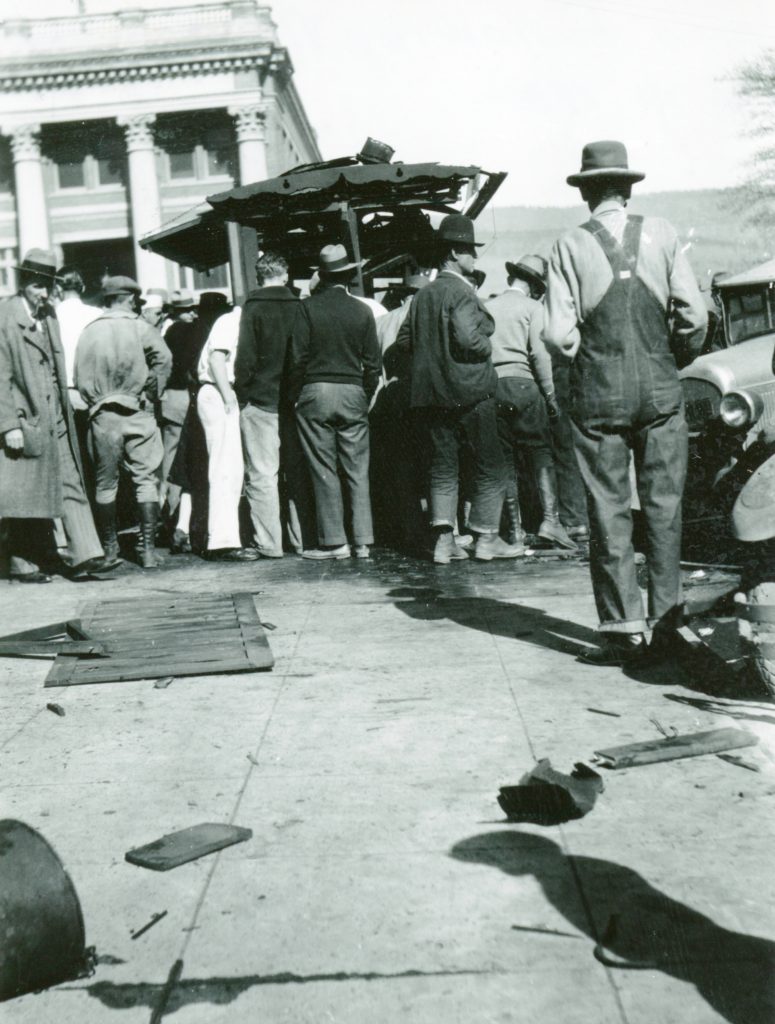
The explosion, February 17, 1930. Courtesy of George McDow, Jr.
In 1920s, William “Dad Popcorn” Vellenworth located his popcorn stand to the corner of Main and South Gay Streets, Susanville. Out of nowhere for no apparent reason on the afternoon of February 17, 1930 the steam boiler connected with the apparatus exploded, injuring not only “Dad Popcorn”, but two small girls, Shirley Shoemaker and Fannie Frizzie. The popcorn machine was blown to shreds, and it was a miracle that the three only sustained moderate injuries. Flying debris broke a window of the Bank of Lassen County, and also broke the rear window of Floyd Bass’ sedan among other items.
It was a devastating moment for Vellenworth, now approaching 80 years of age. The community came to his aid. Vellenworth, was a member of the fraternal organization, Loyal Order of Moose. That organization, along with donations by individuals raised funds and purchased him a new electric popcorn machine. He carried on for four more years, having a very loyal clientele, until his death in May 1934.
“Dad Popcorn” with the Pearce children: Frances, Kathryn and Harry. Courtesy of George McDow, Jr
In 1912, William Vellenworth, who later become known as “Dad Popcorn” arrived in Susanville as bridge carpenter for the Fernley & Lassen Railroad construction. It was during that winter he contracted pneumonia, and nearly died. After he was released from the hospital, Vellenworth who was 61 years old, did not have the strength needed in his former line of work. Nearly destitute, his carpentry tools would be his saving grace. Using the tools as collateral, he acquired a Hot Tamale wagon and began peddling tomales on the 700 block of Main Street, one busiests areas in Susanville. Two years later he was able to upgrade to a popcorn wagon to sell his wares, which now included roasted peanuts.
Vellenworth soon learned that it was in the afternoons was the busy time for his popcorn business. In mornings he spent his time doing furniture repairs, making cabinents and assorted carpentry work. For the next sixteen years, life was good for him. In 1930, tragedy struck.