In 1920, the Christie Brothers—John and James—dissolved their partnership in a general mercantile store in Janesville. John, better known as Burt, had already launched a new career when he purchased the Eagle Lake Resort. For his brother, Jim, he was not quite sure what path to take. In 1921, he opened Christie Furniture at 903 Weatherlow Street, Susanville and continued until his death in 1936.
Eventually, the store moved to 608 Main Street. For several decades it was owned and operated by S.R. “Carl” and Ferne Carlomagno. Christie Furniture store, along with the Murray Insurance were destroyed by a fire on March 20, 1982. The Christie store was never rebuilt, and remains a vacant lot.
This is from the archives of the Lassen Mail, dated November 1, 1935 which appears there were more tricksters than treaters on the streets of Susanville for Halloween.
And the Old Town Is Turned on End. That great institution the American Boy went hog wild in Susanville last night, with the result that the old town looked tattered and torn this morning.
Halloween the eve of All Saints was celebrated by the youngsters of the community with great gusto. It’s an old American custom, and it certainly was carried out unrestraindly here.
Gates, fences, automobiles and outhouses stood the brunt of the holiday pranksters. Many a car owner who foolishly left his machine on a public street awoke this morning to find all four tires as flat as a bride’s first cake, and valve caps gone to the land of missing auto parts.
Streets, even the highways were strewn with debris of all sorts, including logs, paper boxes, city garbage cans, milk cans, tree branches and a dead cat or two.
The usual stunt of marking store and automobile windows with soap and tallow was indulged in freely, and plenty of tick-tacking developed throughout the residential sections before the witching hour of midnight.
Yes, it was a large night for the youth of the town, but it won’t occur again for another whole year and so—-why worry?
Spread the word, and encourage a friend to subscribe
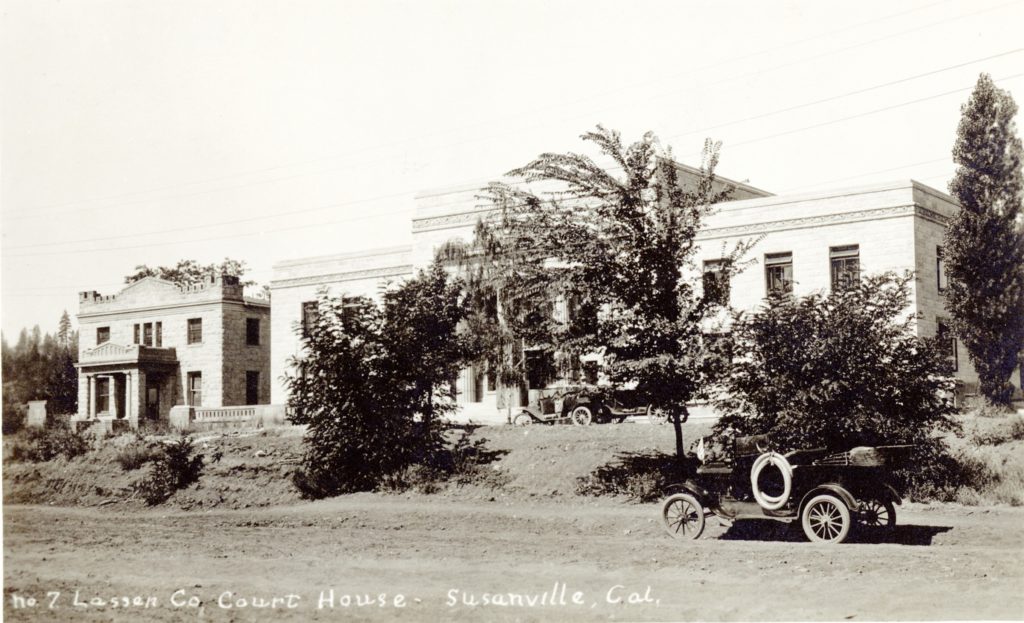
Lassen County Courthouse, spring 1917. Courtesy of Elberta M. Fraley
Lassen County turned down an offer to have a free Carnegie Library built. At the August 1916, Lassen County Board of Supervisor’s meeting, Charlotte Cahlan, Attaway McKinsey, Alberta Dozier and Lassen County Librarian Miriam Colcord approached the board. They had been approved funding to build a Carnegie Library, as long as the County would provide a building site. The women requested a lot on the north side of the courthouse, which at that time was under construction. The board informed the women they would take it under advisement, which was the polite way to say no. More then a century later, the board still uses that lingo.
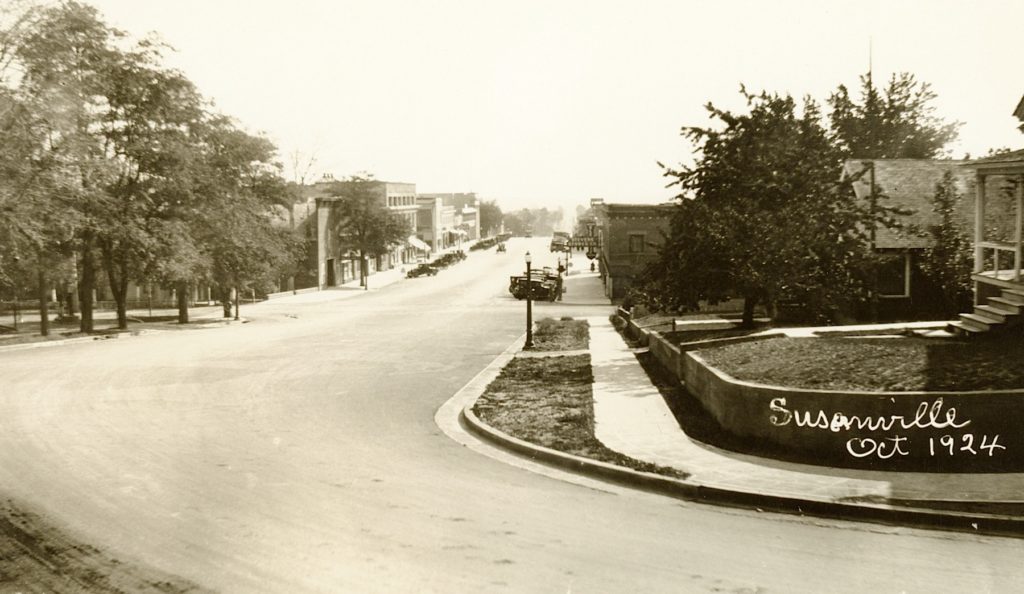
Main Street, Susanville, October 1924—Boyd Benham/Connie Boomer
With Election Day just around the corner, its only fitting to have a local history story. There was a time, and not that long ago, the City of Susanville elections were a stand alone proposition, not consolidated with Lassen County Elections.
The 1924 the City had 604 eligible voters for the upcoming City Council, with three seats up for election. Only 80 went to the polls. A rather dismal figure to say the least. It got worse. In 1930, only eighteen voters cast their vote in that City Council Election. Those poll workers had a very long and enduring day. If there was a bright side to that election, it only took one minute and three seconds to canvass the election!
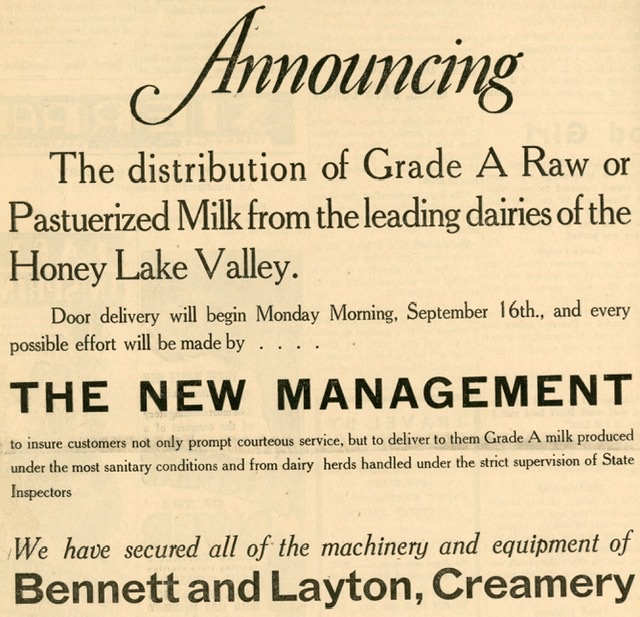
Now, this something different, since I am approaching this topic in reverse. For starters, Bennett & Layton (actually when established it was Bennett & Cardinal) was a regional powerhouse of a creamery located at 75 South Gay Street, Susanville. The two-story concrete building is still there. This was a full fledged creamery that even produced its own line of ice cream.
However, the nation’s great depression of the 1930s took a toll on Bennett & Layton, like so many other enterprises. To protect their vital interest in September 1935 several Honey Lake Valley ranchers negotiated a lease with Bennett & Layton to use its cooling and sterilization section of the plant to properly prepare milk for local consumption. This group of dairymen consisted of: J.H. McClelland, Mardis Barry, L.E. DeForest, Masten Ramsey, Lester Clark, Fred Hall, J.H. Elledge and McKay & Lowe.
Spread the word, and encourage a friend to subscribe
Susanville’s The Big Store as it appeared in 1916. In front of the store, is their exclusive delivery car. Photograph courtesy of the Worley family
With the advent of online shopping with free delivery, and with the conditions caused by Covid-19 and surge of online grocery shopping, in pre-internet times, such services were available in Susanville. In 1915, Fehr & Worley’s Big Store, located at 722 Main Street (the current home of Margie’s Book Nook) implemented free grocery delivery. Telephone the store, and place your order, simple as that. Over the years, other stores, followed suit. The last to do so was Hill’s Market at 629 Main Street, in the early 1970s.
Spread the word, and encourage a friend to subscribe
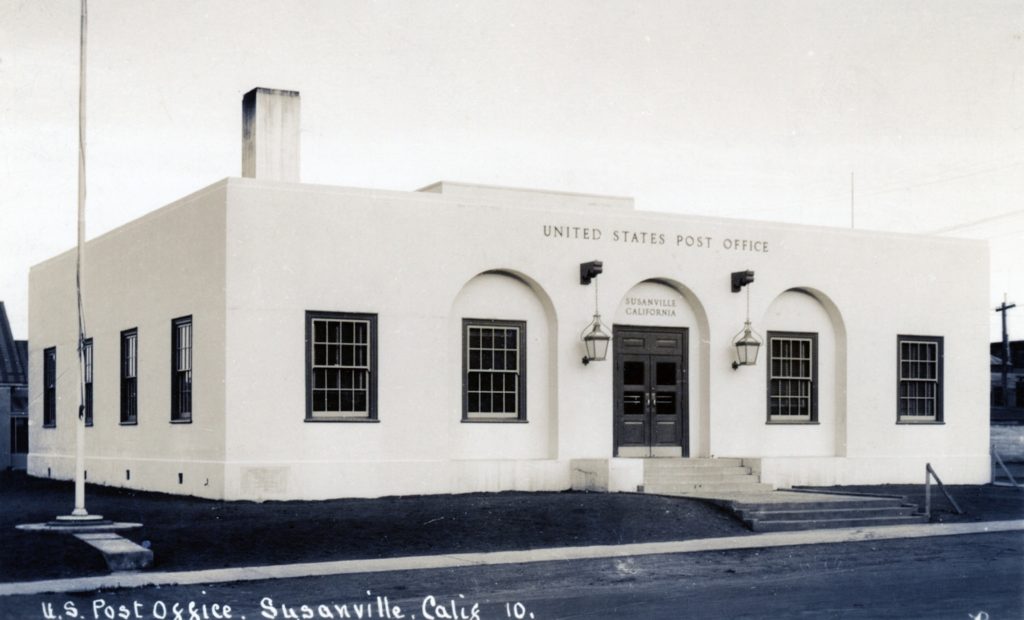
One facility Susanville sorely lacked was a post office building. The Susanville Post Office was established in 1858, and was always housed in some commercial building, with the Knoch building housing it for decades. During the depression of the 1930s, the residents hoped the federal government would fund a post office building. They did. On March 1, 1937 the government purchased the residence of Stanley Wade on the corner of North Lassen and Nevada Streets for $6,750. Construction began that summer and the post office officially opened on June 1, 1938.
Spread the word, and encourage a friend to subscribe.
View of Richmond Road January 1916 from Winchester Hill. Susanville received four feet of snow in January, followed by below zero temperatures. After that it was the beginning of a twenty-year drought, with Honey Lake going dry in 1919, and not filling up until the spring of 1938.
On October 2, 1916 Susanville received its first snowfall for the season, just enough to blanket the town. On the other hand it was reported there were seven inches of snow on Fredonyer Summit. After the storm passed through the temperature plummeted to 22 degrees. As one observer noted, while not cold enough to begin ice harvesting season, no one had to tend to their vegetable garden.
Is a early snowstorm a harbinger for a long cold, snowy winter? Not exactly. Many years, it turns out, when there is an early snowfall, usually is just the opposite and tends to be drier than normal winter. In this case, the winter of 1916-17 marked the beginning of a twenty-year drought.
Spread the word, and encourage a friend to subscribe
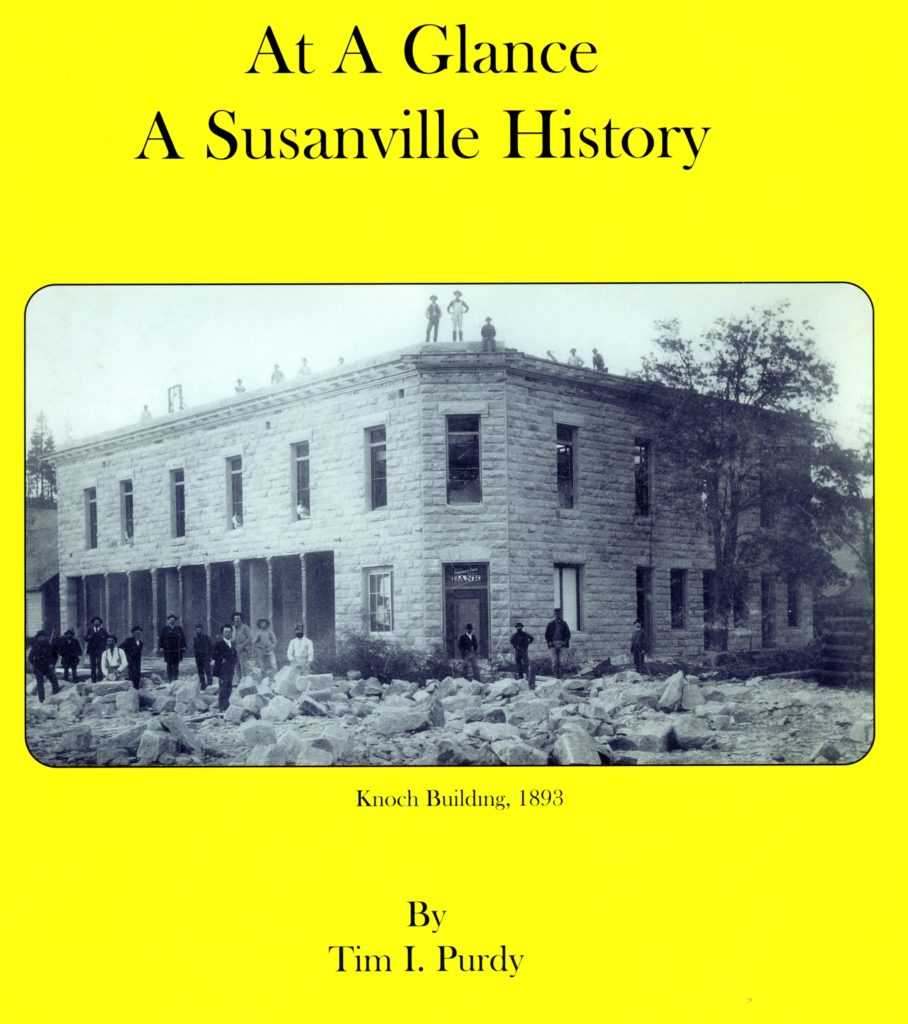
This is to inform any one interested if you want to obtain a copy of my epic book on Susanville, I would not suggested you procrastinate. My inventory is very at about twenty-five copies, and once its gone, its gone. To learn more about the book and to order see books.
Known today as the Susanville Ranch Park, for many years it was the John T. Long Ranch.
Susanville Ranch Park is a 1,100-acre county park located on the northwest edge of Susanville. In 1856, William Weatherlow settled there and remained until his death in 1864. William Long purchased the ranch and his family operated it for nearly fifty years. In 1935, Republic Electric Power acquired the property, which was succeeded by CP National. In 1984, that power company donated the land to the County of Lassen.
Since that time, it has evolved into an open space park. It contains twenty-eight miles of hiking trails! Motorized vehicles are prohibited. The trails vary for the casual walker all the way to advanced mountain bikers.
Personally, I think September and October are some of the best times to go hiking, whether a leisurely stroll, or something more strenuous. At the main parking lot, there is an informative kiosk, which one can pick up a free brochure and map of the trails. Go explore and enjoy this wonderful asset.
For a bit of historical trivia relating to the park. In 1966, Lassen College examined the property as a possible location for its new campus. They liked what they saw, but the asking price of $3,500 was beyond their means.