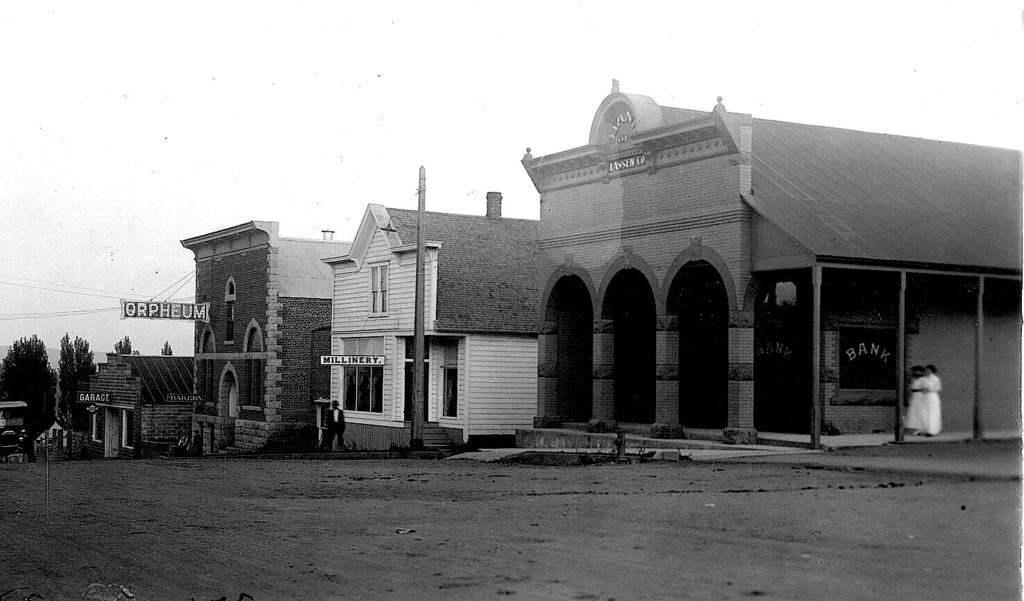
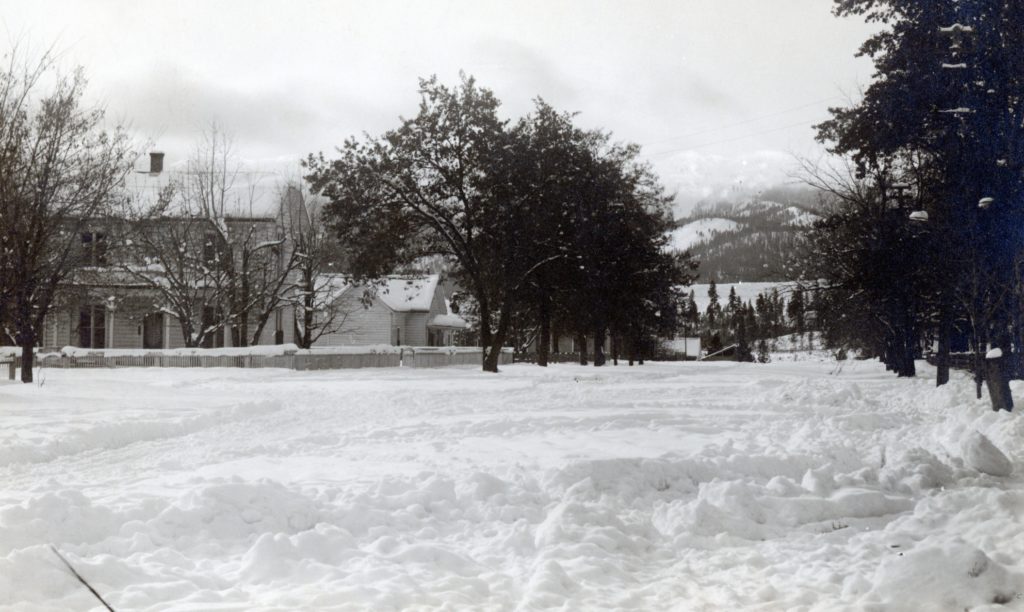
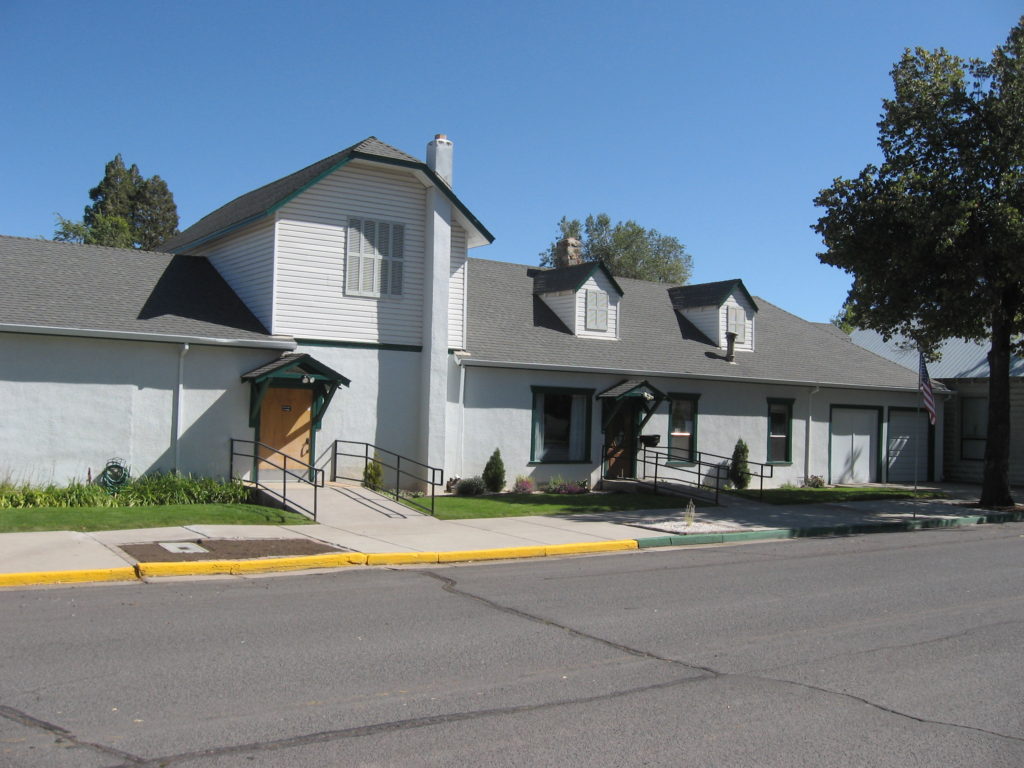
The corner of Main & South Gay Streets, circa 1910.
A number of Susanville merchants agreed to open on Christmas Eve, 1916. That year Christmas Eve was on a Sunday, and as a general rule all stores were closed on Sundays. In this particular instance the stores who planned to open agreed upon the hours from 10 to 6, to accommodate those “eleventh hour shoppers.”
Spread the word, and encourage a friend to subscribe
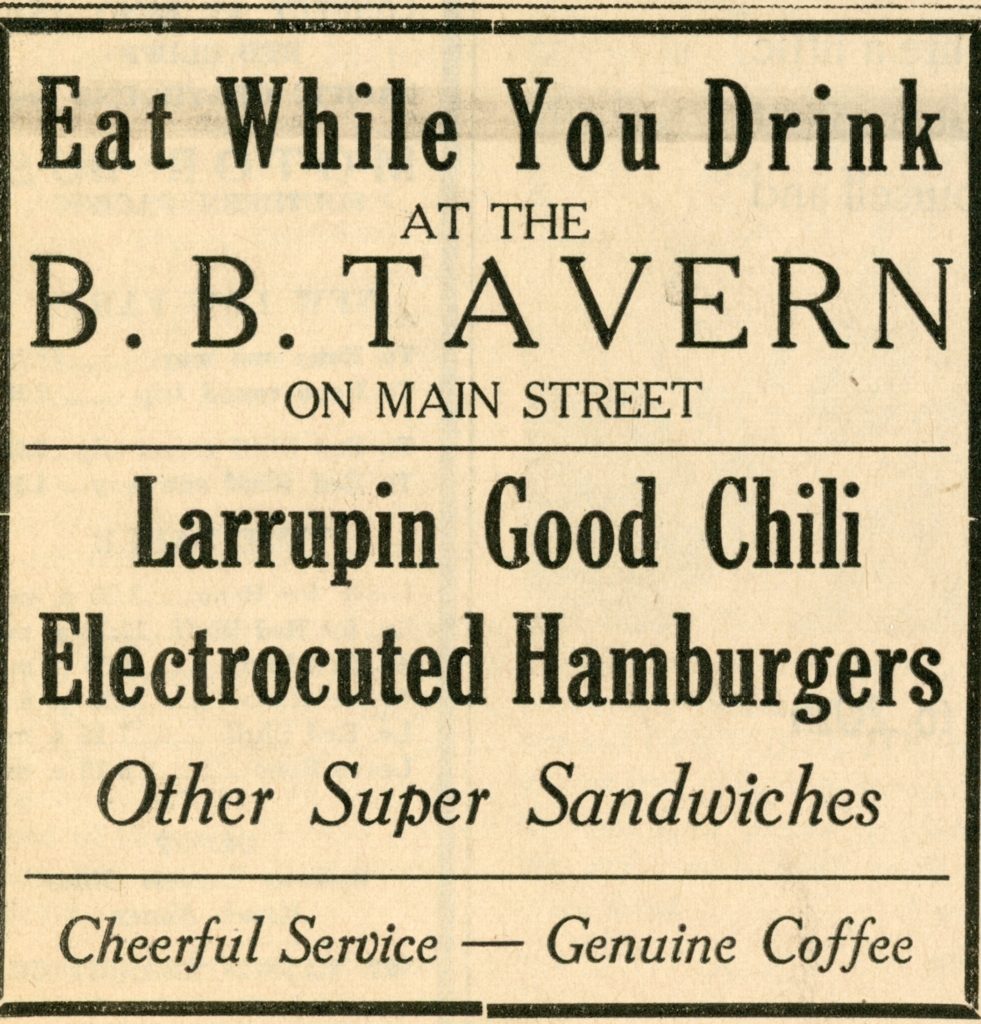
Food is usually safe a topic for a light hearted discussion. The above advertisement caught my attention. Seasoned residents may remember the B&B located in the Knoch Building. The Larrapin Good Chili I understood. The term larrapin was common in the 1930s vocabulary as description for dandy or over the top. Now, can someone explain to me what is a Electrocuted Hamburger?
Spread the word, and encourage a friend to subscribe
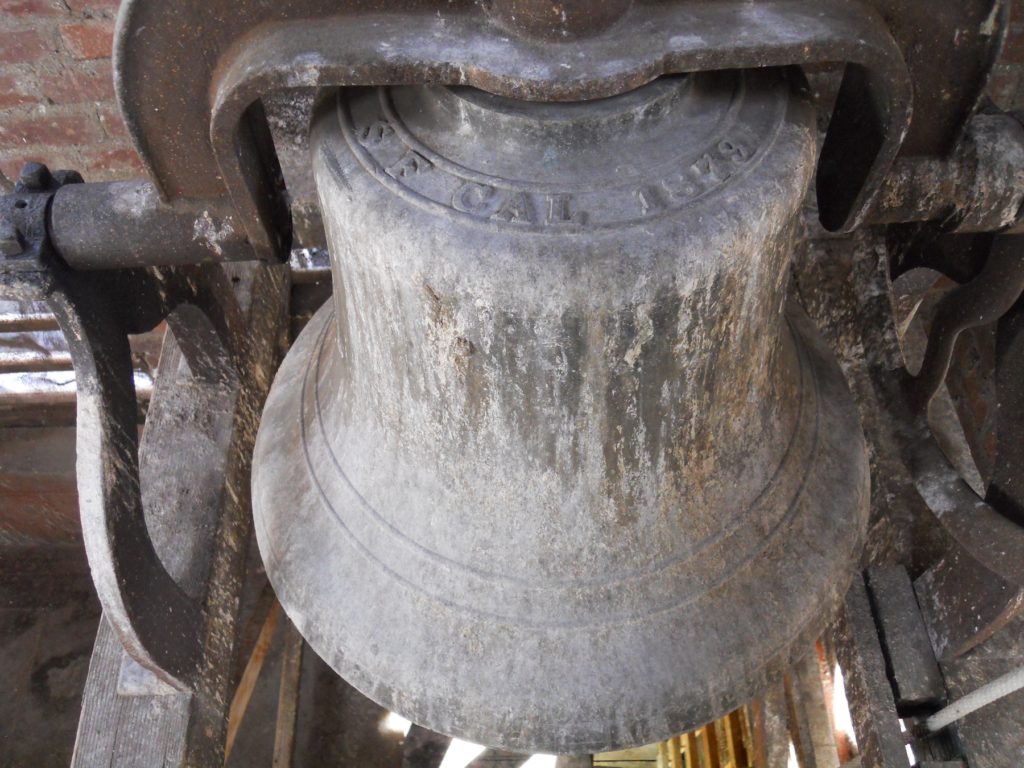
The Methodist Church bell. Courtesy of Martin Balding
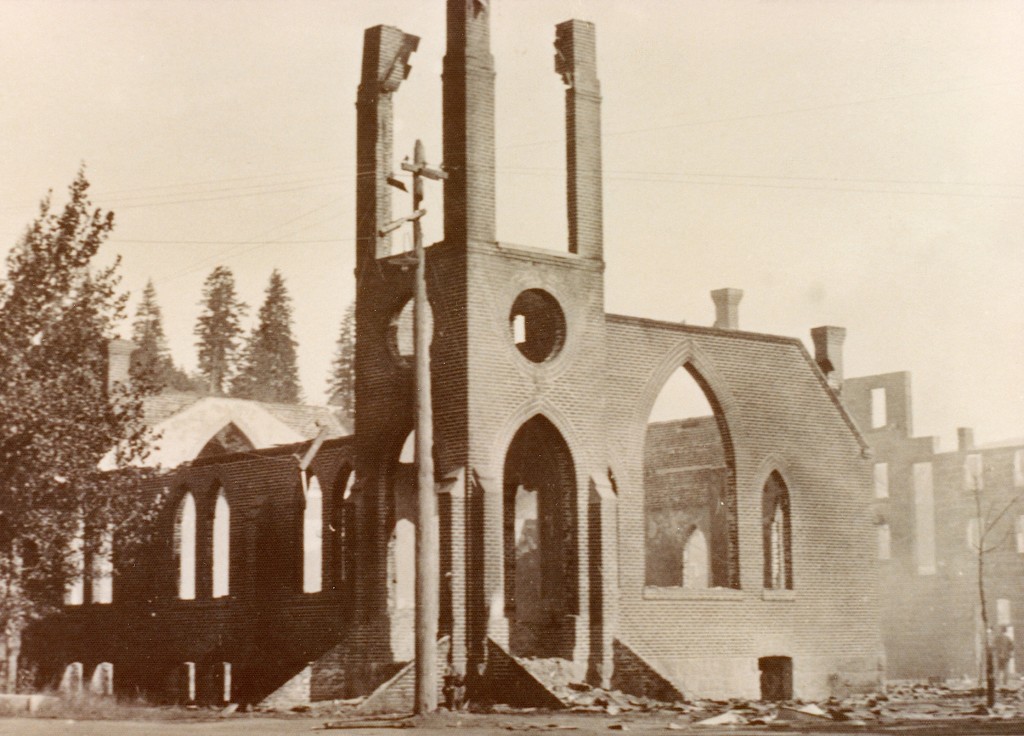
This is a follow up on a story I published on December 17, 2017 about the history of the Methodist Church bell. It should be noted the church was destroyed by fire in 1915, and work started the following to rebuild. The church had limited funds and it initially seemed as though the church would have to go without a bell.
The following was an editorial in the Lassen Advocate of December 22, 1916: “The question of a bell for the Methodist Church has again pressed itself and there seems to be some difference of opinion in regard to the desirability of placing one in the church. It is hoped, however, that a full-toned bell of comparatively low pitch will be decided upon, for a village church without its bell seems almost like a ship without a rudder. But there are bells and bells, and while present financial conditions of the church a question of cost must be considered, a judicious use of money set aside for the purpose can just as well procure a pleasant deep-toned bell as to the mistake of placing in the church a ell every sound of which startles one with the thought of fire.”
The aftermath of the 1915 fire.
By the time church was dedicated in 1917, it did have a bell. It came from the old Lassen County Courthouse, as the new courthouse design did not include a bell.
Spread the word, and encourage a friend to subscribe
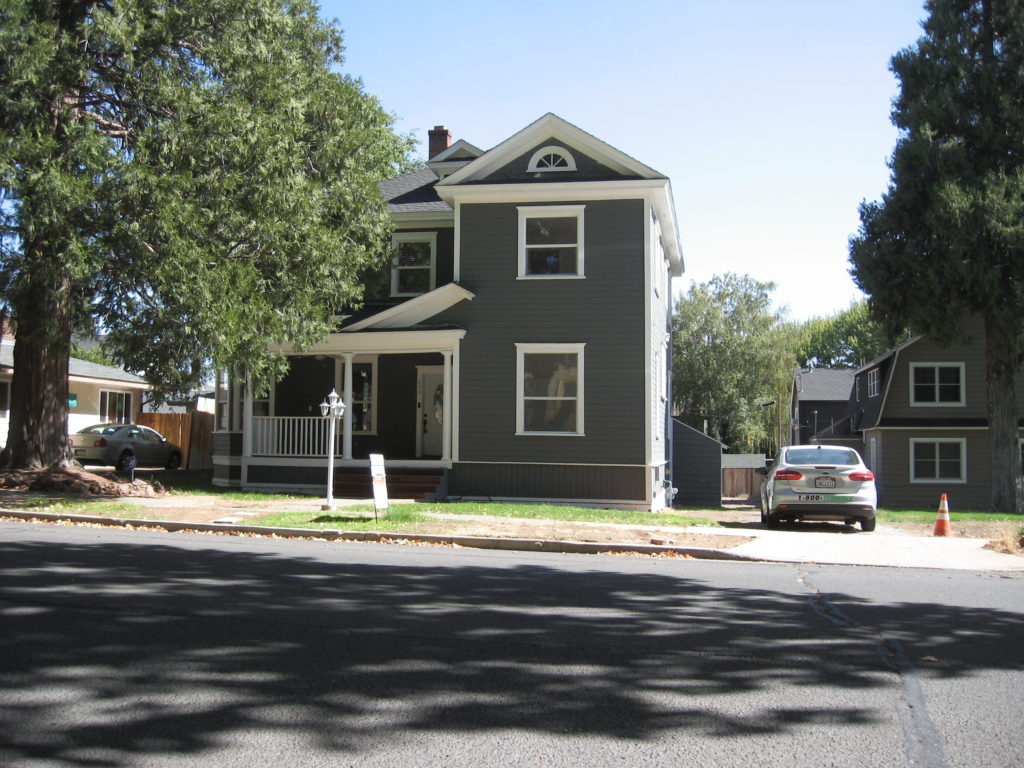
It is always nice to see an old home restored to its old glory. That is what happened this summer with 235 South Lassen Street, across from the Lassen County Courthouse, Many older residents may remember it as the law office of Gary F. Woolverton. However, prior to that is was the home of J.A. “Gus” and Blanche Pardee. It was built in the spring of 1907 as a single story residence. In 1924, a second story was added and the home remained in the Pardee family until 1976 when it was converted into law office. It has gone full circle now, and is now a private residence.
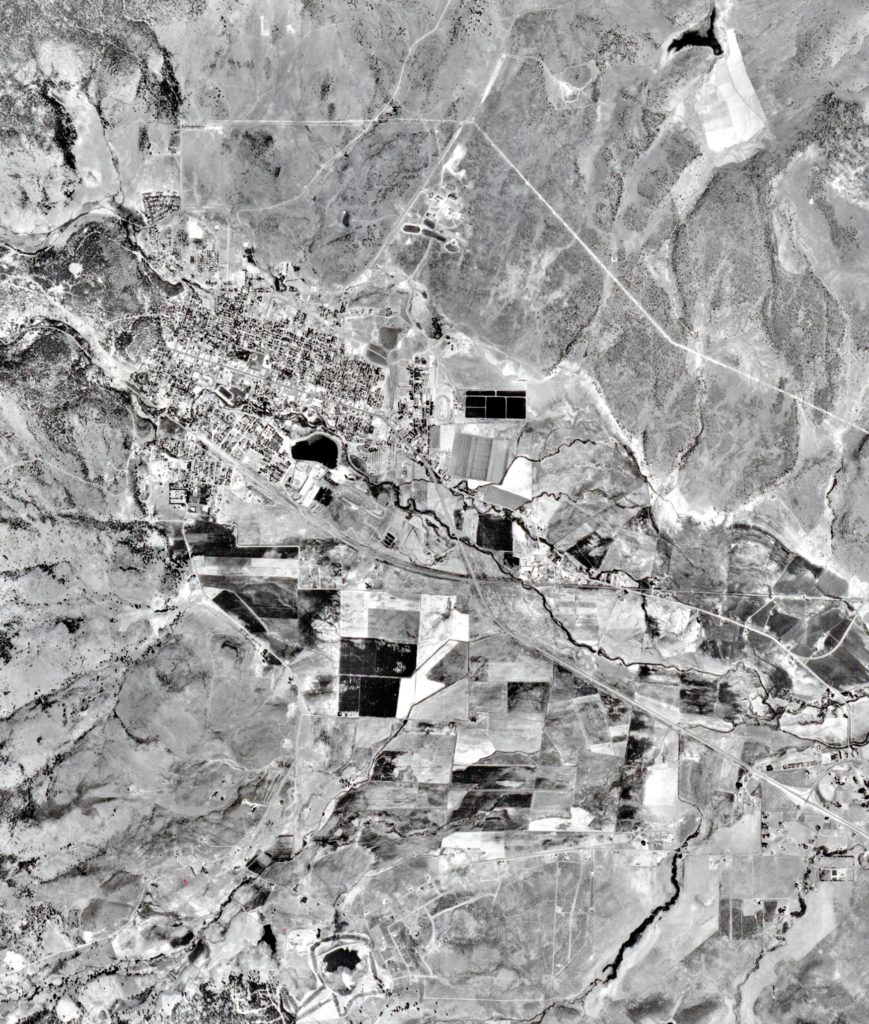
A lot has changed over the years. The one spot that has not changed is the area west of Susanville. Due to a number of factors, it is one area where development is limited.
Now a look to the north. As to residential Cherry Terrace was the only subdivision, and it is small compared to the neighboring ones that sprouted up to its east and north. The only activity north of the town, was the construction of the Lassen Community College campus.
The east end of Susanville more or less ended at Mesa Street. Notice the millpond is still in use at the Sierra Pacific Mill. To the south it was primarily agricultural and open space with very limited residential development.
Gay Street, Susanville, looking north, 1864. Courtesy of Gilbert Morrill
East slope Sierra Nevada communities of the 1850s and ‘60s were isolated from California, especially in the winter months. Thus, certain social developments were a challenge. While folklore describes western frontier outposts as rowdy and bawdy, that was not always the case.
In November 1860 it was announced the Presiding Elder of the Methodist Church from the Sacramento Valley would visit the Honey Lake Valley in late December—a first. However, it is not clear if that preacher ever visited the region. In 1862, the Rev. E. Paddison of the Methodist Church, held a service in Susanville with fourteen people in attendance. From 1862-1864 Honey Lake Valley became part of Nevada Territory District of the Methodist California Conference. In September 1863, the Rev. Richard C. Cardberry was assigned to Susanville, replacing Paddison. By 1868, the Methodist Church was firmly established in the Honey Lake Valley to be followed by Catholics and the Congregational Church.
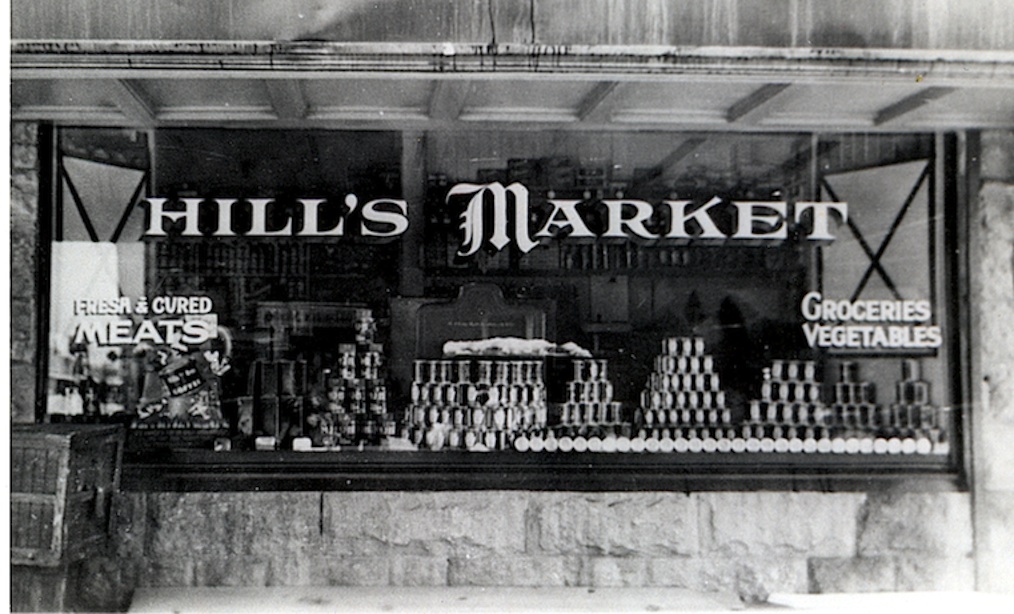
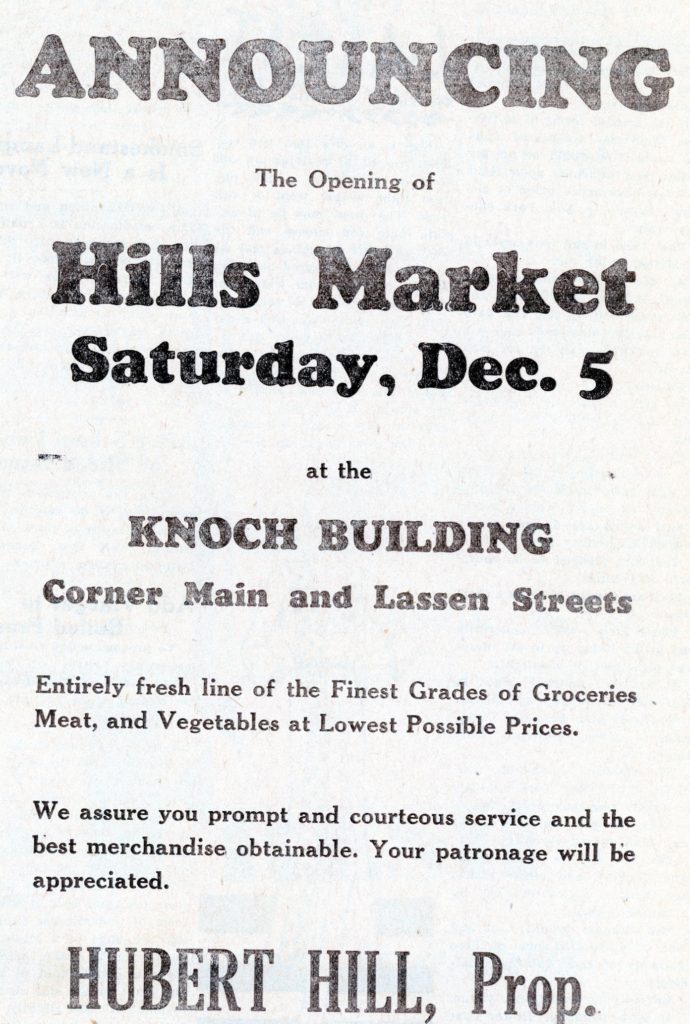
It was on this date in 1931, Hubert “Hoolie” Hill opened Hill’s Market in the Knoch Building on the corner of Main and Lassen Streets. Hill was formerly associated with the Mt. Lassen Packing Company. The market was also known as the Red & White. In 1939, Hill opened a second store on Highway 36, next to the Meadows and across from the Coppervale Ski area. He sold that store in 1941, and it became known as the Meadows Market.
Hill died in 1949, but his wife, Mildred carried on with the market. Unfortunately, I do not have the exact year when it closed. It is one of those research challenges created by Covid-19, as access to certain records hampers research.
Spread the word, and encourage a friend to subscribe
The McDow residence at the intersection of Lassen and Cottage Streets, January 1911.
Seasoned residents will recall Carlos Lucero and his mortuary located on South Lassen Street, which is now Walton’s Mortuary. In November, 1935 Lucero purchased the George McDow residence and proceeded to renovate it into a mortuary to compete with the town’s other mortuary—Edenholm & Morrill. Lucero hired A.K. Philbrook to operate it, who had been in the local undertaking business since the early 1900s.
Fast forward to the spring of 1938 when Edenholm & Morrill took over the premises. They, too, made extensive improvements including the use of knotty pine in the interior, that was quite popular then. Within ten years, Lucero would again own it and this time operate mortuary for several decades.
It is now known as Walton’s Mortuary, 145 South Lassen Street, Susanvillr. September 21, 2019
According to Claude Wemple, who by the way was related to the Christie family, that after Jim Christie’s death in 1936, the furniture store was sold to Frank Stewart, It was Stewart who moved the store to the Main Street location from Weatherlow Street. Stewart later sold to the store to Madge Dolio, who in turn sold to Carlomagno.
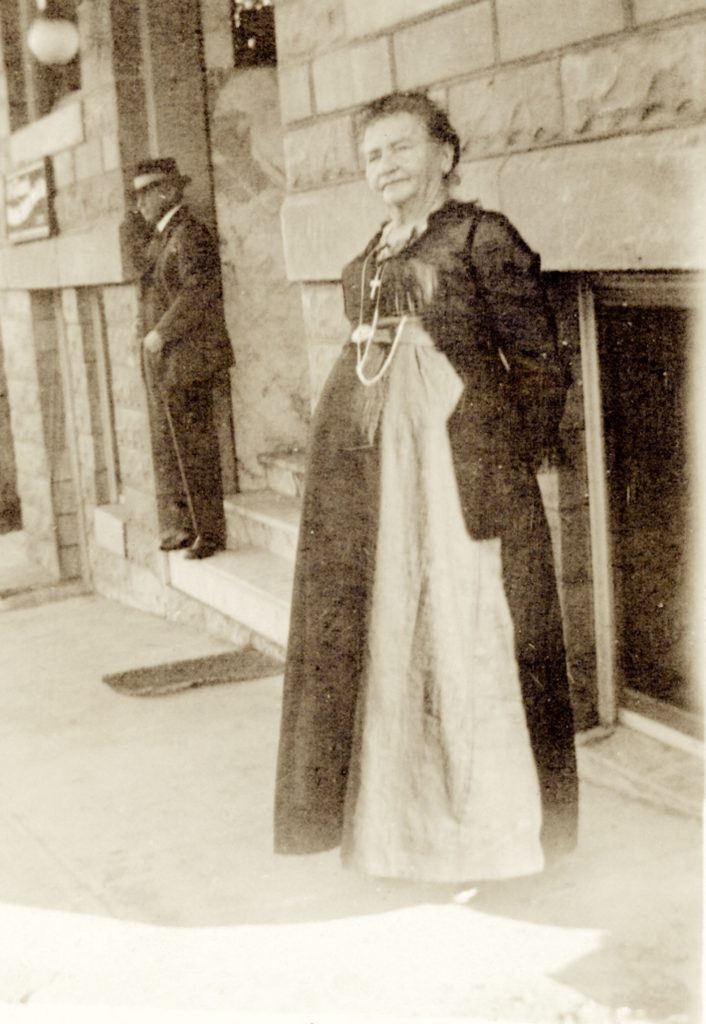
Franceska Murrer Neuhaus, 1916—Leona Jackson Byars
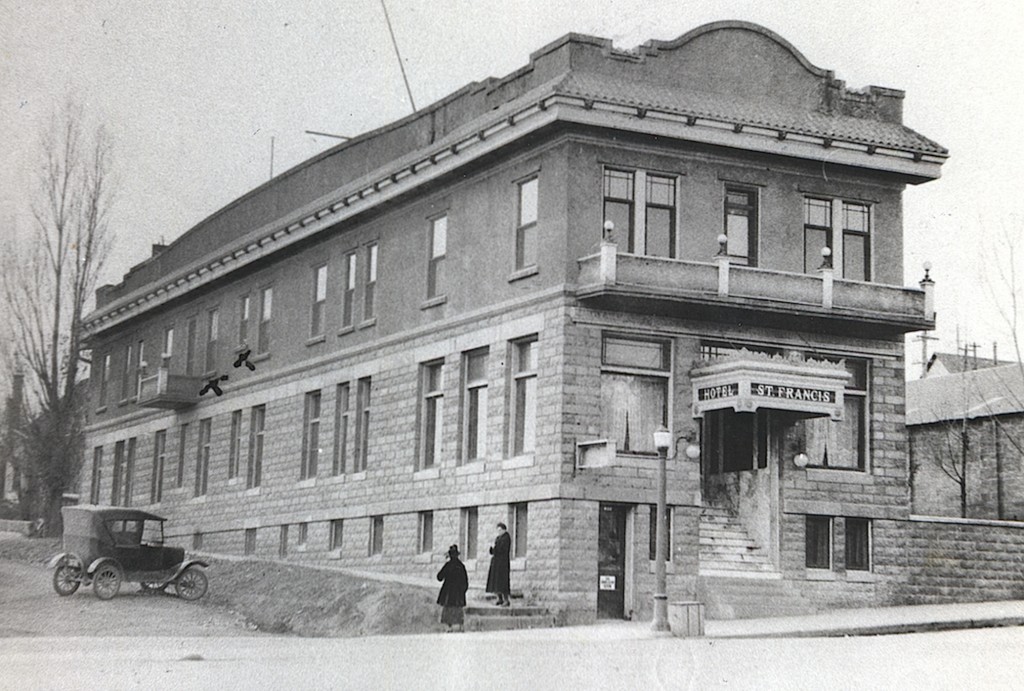
In October 1916, Franceska Neuhaus placed a small 2×2 inch display advertisement in the Lassen Advocate that for sale was the Commercial Hotel on the corner of Main and Union Streets, Susanville. She also offered 80 acres of timberland two miles from Susanville. Innocent enough? The hotel that she offered was named the St. Francis Hotel., after all there was the Commercial Hotel a block away on South Weatherlow Street. As to the timber property she did not own any.
St. Francis Hotel, 1922. Courtesy of Art Almeda
This alarmed Leona Jackson, a granddaughter of Franceska. She went to court to file guardianship papers for her grandmother. Of course, a notice is required to be sent to all relatives. It turned into one of those proverbial “all hell broke loose.” Other relatives filed their own petitions seeking to be Franceska’a guardian. Most of 1917 was tied up in litigation over Franceska’a guardianship, until finally the court appointed, Franceska’s son, W.H. “Bill” Neuhaus her guardian. The following year, 1918, Franceska passed away, a victim of the Spanish Influenza.