One of the most driest was the winters was that of 1923-24. It also occurred during a twenty year drought from 1917-1937. Susanville received less than five inches of precipitation during 1923-24. It was so dry that winter that in the middle of March, a one-inch snow fall at Susanville caused great excitement. There was even a greater commotion in Westwood when eighteen inches of snow fell. It disappeared in a matter of hours. That was the extent of precipitation for the winter. Continue reading The Dry Winter of 1923-24→
Looking east in the Susan River Canyon with Pigeon Cliffs in the background—David Bricker
In December 1955 major flooding in the Susan River Canyon did considerable damage to the Southern Pacific’s rail line. With the pending closure of Fruit Growers Westwood mill in 1956, railroad officials decided not to make any repairs, since there were be little if any traffic. The line was closed from Mason Station to Susanville, but not abandoned. Theoretically, if someone wanted to ship something by rail from Susanville to Westwood, or vice-versa Southern Pacific was obligated and could only charge the railroad freight rate between the two places. On the other hand it would be costly for the railroad to pay a third party to make the delivery.
In 1976, the Southern Pacific filed for the abandonment of this segment of the line. The foundation was laid for the rails to trails conversion to become what is informally known as the “Bizz.”
In 1910, A.J. Matthews arrived in Susanville as part of a small group of men to form a local telephone company. They would be successful. In 1915, Mathews married native daughter Lena Cahlan. Mathews was a firm believer in civic engagement. He was involved in so many different activities on the local and state level.
Mathews also served on the Lassen Union High School/Lassen Junior College Board—the two were intertwined until the college separated in 1965.
In January 1935, Mathews addressed theSusanville Rotary Club concerning the schools reorganization plans, specifically that of the college. Mathews stated, “We should capitalize on the fact we have the only junior college in northern California north of Chico.
Later in 1935, the college board of trustees, met with Mr. J.C. Beswick from the State Department of Education, in charge of Trade and Industrial Education. It was met with enthusiasm by all parties, including the lumber mills and related fields. On September 19, 1935, a Technical Institute course in forestry at Lassen College was offered, with Gale M. Whitchurch in charge. Initially, enrollments fluctuated between 12 and 23. It was a major turning point in the college’s history that attracted students from around the state to attend Lassen.
The Elks Hall Association was a unique entity created to transfer the ownership of the Antlers Investment Company, which owned the building used by the Elks for a lodge, to the Benevolent Protective Order of Elks, Susanville Lodge 1487.
It came about from a meeting held on March 2, 1929 between the Antlers Investment Company and the Susanville Elks Lodge. It should be noted that many of participants were members of both entities. The result of the meeting was the formation of the Elks Hall Association which sole purpose would take the necessary steps to acquire outstanding stock of the Antlers Investment Company. Besides the outstanding stock the Antlers had $2,300 in encumbrances attached to the building—that was the easy part. At issue was certain stockholders of Antlers declined to become members of the Elks organization. In 1931 everything was resolved and title transferred to the Elks. Mission accomplished both the Antlers and Elks Hall entities were dissolved.
Decoration (Memorial) Day, Susanville Cemetery, 1905—Verna M. Wood
In 1915 there was no formal Memorial Day services conducted at the Susanville Cemetery. This was due to fact of the dwindling members of the Benton Post of the Grand Army of the Republic (G.A.R.) No.163 and were no longer able to lead a program. Those not familiar with the GAR comprised of Union Veterans of the Civil War. In 1916, the local parlor of the Native Daughters of the Golden West organized a Memorial Day ceremony at the Susanville Cemetery.
It should be noted when the local GAR was active, they would march from the Methodist Church to the Susanville Cemetery. Once everyone assembled, including the public, a eulogy, usually by the Methodist Minister. After which the GAR members decorated the graves of the veteran’s with flowers donated by the community.
At the same time, it should be noted the local post of the GAR more or less disbanded, citing a membership of three. They donated their American Flag to the Monticola Club. The flag was given to the GAR in 1891 by the Ladies Aid Society.
In 1920, when the local American Legion Post was established, they would carry on the tradition of their earlier counterparts.
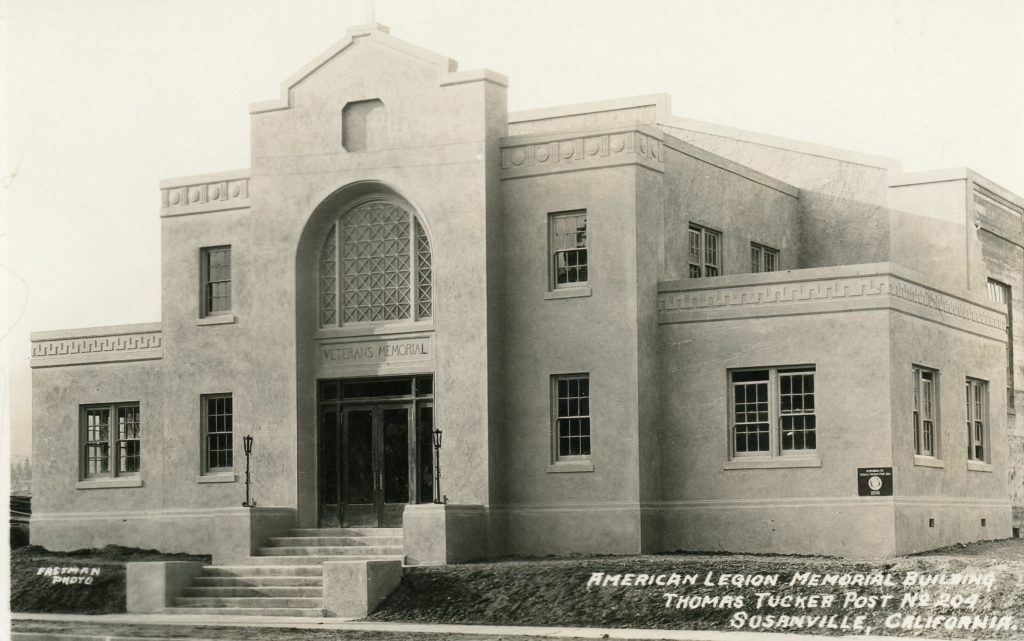
In the fall of 1926, the Elks did a major renovation to the main floor of the building. Instead of six rooms, it was converted into one large room for use a lodge and also lounge for other occasions. On the lower floor what was referred to as hot air heating system was installed. While all of this may not sound dramatic, it was. This remodel project cost nearly $26,000–twice the amount of the purchase price. For even a better comprehension of this expenditure, the American Legion Memorial Building was under construction that year with a price tag of $23,000.
In 1921, a group of Susanville businessmen wanted to form a local Elks Lodge. While they were an enthusiastic group, they had a formidable challenge. One of the requirements from Elks’ organization that a community must have a population greater than 5,000 inhabitants. While Susanville in the last several years witnessed tremendous growth, the City of Susanville’s boundaries did not include where the growth occurred. The confines of the city was rather small the area from Pine Street to the west to Weatherlow Street as the eastern border.
Not to be undaunted, these men formed an Antlers Club, a first step towards a subsequent Elks Lodge in the future. They were an ambitious lot. On February 23, 1922 they formed a stock company—the Antlers Investment Company. There goal was to raise $25,000 with each share at a par value $100. The next order of business to purchase a clubhouse for the future lodge. They set their sights on the Swain residence at the west end of Main Street that overlooks that boulevard. In 1922, they reached an agreement with Annie Swain, the owner, to purchase it. She sold it to Antlers Investment Company for $13,000. However, she retained a parcel adjoining to the south in which she would build a new home.
With everything in place, it would still be a few years before a local Elks Lodge would become a reality.
In 1887, the movement for a pubic park for Susanville made its debut. While a mere hamlet of less than 200 souls, made this quite remarkable. It would not be an easy undertaking, as it would take sixty years to make it a reality. At that time, the residents offered to purchase an 80 acre tract for a park and fairgrounds for $5,000. It was their intent to turn it over to the County. They approached the Board of Supervisors to form a park district and assess a taxy levy for maintenance. The Board rejected the proposal.
In the spring of 1928 the local Rotary Club got on the park bandwagon. They set their site on the Folsom Tract behind the recently built American Legion Memorial Hall. While their intent was admirable, they just could not get the needed traction to move forward. It would not be until after World War II before a municipal park would become a reality. Again, the focus was on the Folsom Tract, now owned by Cyril & Eleanor Houghton. The asking price $7,000. In November 1946 a Park Planning Board had been created. By February 1, 1947 they had raised the money and on March 12, 1947, the property was now owned by the City.
However, there was still another hurdle. The City did not have the funds to make the improvements. The community stepped up to the challenge to purchase trees, shrubbery, a children’s wading pool and of course to construct a grandstand to watch baseball games.
On July 3, 1949 dedication ceremonies were held for Susanville’s Memorial Park. As Judge Ben Curler, Lassen County Superior Court, as opening speaker, simply stated that is was a “truly community park” for the efforts made by the volunteers.
While it is fairly common knowledge that the City of Susanville was named for the town founder’s daughter, Susan Roop, who later married Alexander T. Arnold. Many assume that the Susan River that flows through the community would also be named after Susan Roop. However, that is not the case, because the river was so named, prior to Isaac Roop’s arrival on the scene.
Susan River, February 1972
During the years 1851-1852, William H. Nobles located a new emigrant road from Shasta, California to Lassen’s Meadows, Nevada (Rye Patch Reservoir). This road passed through the Honey Lake Valley. Nobles named the Susan River for his wife, Susan Parker Nobles. While we know a lot about Susan Roop Arnold, very little is known about Susan Parker Nobles. She resided in Minnesota for the majority of her married life, moving to California after her husband died in 1876.
Dr. Leonard’s residence when completed, 1913–Frances Swain
When William Greehn took possession of Dr. J.G. Leonard’s residence he decided to make it a rental. The exterior had a very dilapidated appearance. It had never been painted. The windows on the top floor were never installed, so they were boarded up. Greehn had no intention to make improvements to the building. The residence rented for $10 a month, and it was rarely vacant. In 1906 Greehn passed away leaving this and numerous other properties to his two daughters—Fannie Asher and Hattie Grunauer.
A side view of the Swain’s residence, 1913—Frances Swain
On April 11, 1908, during the liquidation process of the Greehn Estate, Joel Henry Swain purchased Leonard’s residence for an undisclosed amount. In 1888, Swain, along with other members of his family originally located in Dry Valley between Grasshopper and the Madeline Plains. In 1903, Swain decided to switch careers from farmer to saloon keeper and moved to Susanville. Swain found the bar business to be very lucrative. This provided him with the means to finish residence that Leonard had started. In just a short time it became one of the most prestigious homes of Susanville. In an interesting side note, his wife, Annie, somewhat disapproved her husband’s line of work, she being a staunch tea-toler, but she enjoyed the finer things of life that the saloon trade provided. An awkward situation to say the least.
In 1917, J. Henry Swain’s health declined. No treatments seem to improve his condition. He passed away on May 3, 1918. Besides his wife, he left four small children, Frances, Fitzhugh, Blanche and Nellie. In 1922, Annie Swain sold the residence to the Antlers Club, which would in turn become the future home of the Elks Lodge.