Tag Archives: Susanville

An Architect Turned Dentist

Main Street, 1894. You can see the condition of the house—Ivor Lanigar

Susanville’s iconic Elk’s Lodge located at the west end of the town’s Main Street, had a humble origin. The story unfolds when Michigan native Dr. J.G. Leonard (1843-1916) opened a dentist office in Susanville on March 1, 1884.  A large vacant lot at the west end of town caught his attention, especially since it was so centered to have an excellent view looking down through the center of main street. He approached the owner, Sarah Hosselkus about its availability. On March 22, 1884, she sold the lot to Leonard for $450.

Leonard then proceeded to design a unique residence on this unique lot. The instincts came naturally for him, since for a time he studied to become an architect.  Dentistry or Architect are noble positions, such professions, even in cities, during the late 1800s could be financially challenging.

Main floor plan sketch by Frances Swain

In November 1884 work was underway to clear the homesite. The proposed two-story home, contained twelve rooms, many of which were octagonal. Leonard hired local contractor Charles Odette to build it, though no record exist as to its cost. In February 1885 Leonard moved his family into their new home, though it was far from finished.

Top floor sketch by Frances Swain

Leonard quickly learned that there was not a sufficient enough  population in Susanville, as well as the Honey Lake Valley to sustain his practice. Like others before him and after him he rode the circuit to provide his services in neighboring counties, with an emphasis on Modoc County. The other financial obstacle Leonard faced, was his patients would provide goods and/or services rather than paying in cash. After five years of eking out a living, Leonard, filed for bankruptcy on April 17, 1889. One of his main creditors, was Susanville merchant William Greehn who he borrowed money to construct his home. Greehn secured the promissory note with Leonard by attaching a mortgage to Leonard’s home. At the conclusion of the bankruptcy proceedings Greehn was awarded the property. Leonard moved on and by 1898 established a practice in Reno where he lived the rest of his life.

Tomorrow: The residence transformed

Support

Main Street, Susanville, 1901

Main Street, 1901
South side of the 700 block of Susanville’s Main Street, March 12,1901—Sheila Holcomb

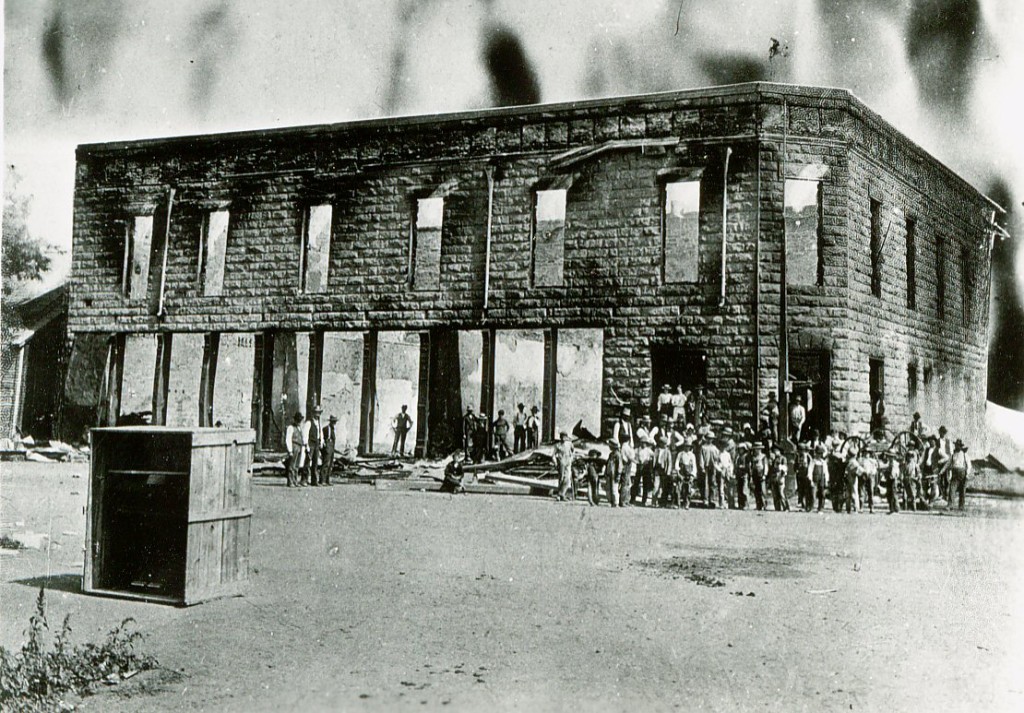
On June 6, 1900 an early morning fire started at Dave Stark’s blacksmith shop on the southeast corner of Main and S. Roop Streets. Within two hours some forty structures from Roop to South Union Street were destroyed in the blaze. The only building remained standing was Alexander & Knoch’s store, constructed of native stone, though it did sustain damage.

While this fire became the catalyst to incorporate Susanville, many resorted to the old wooden frame building practices of the past. The above photograph is a perfect example. What is interesting with this photograph you will notice the vacant lot between the Cohn Bros. and the Pioneer. It should be noted that the Pioneer used the lot for a beer garden, until O.M. Doyle constructed a two-story stone building that eventually became home of the Grand Cafe. The building to the right to the Pioneer, which was Alexander & Knoch’s store, though the store front has been modified is home to Margie’s Book Nook. 

In 1902, Susanville passed Ordinance No. 17 which prohibited wooden frame buildings in the heart of the town’s business district. All future materials, would be brick, native stone or cement. Roofs were required to be metal, slate or tile.

Support


Lassen County Militia

Militia Card
Tro Emerson’s Militia Card

Twice in Lassen County’s history there have been local militia units of the California National Guard. The first was the Honey Lake Rangers of the 1860s. The last time was during World War II. Initially, there was to be one large unit for Lassen and Modoc counties. That plan was neither feasible or practical and was dropped.

A new strategy was drafted. Inside each county, especially in large rural counties like Lassen, several local militia units would be formed. There duties were to protect the area in case of enemy invasion. Their involvement was confined to the boundaries of the county. Uniforms, guns and ammunition would be provided to each unit. They would also be trained in guerilla warfare. In Lassen County it fell upon the Farm Advisor (T.S. Brown) to organize these units.

On May 20 1942, the first organization meeting was held in Susanville. Local units were created for Susanville, Bieber, Doyle, Janesville and Standish. By the first of June, the Susanville Militia had 70 members. It became known as Thomas Tucker Militia—named after Thomas Tucker the first casualty from Susanville in World War I. Fortunately, this volunteer force never had to be activated. At the conclusion of the war, each individual’s enrollment in the militia was automatically cancelled.

Militoa card

Don’t forget to look at the Subscribe feature.

Susanville’s North Street

North Street, Susanville
Look east on North Street from Weatherlow during the 1938 flood. Courtesy of Betty Barry Deal

The history of this street, is a bit odd, when compared to the city’s oldest avenues. The name is a bit of a paradox, the street runs in a east-west direction. Folklore has it, it was so named “North” because it was the most northernmost street. However, when one examines the original town plat of1863, that is not the case. Willow Street which is one block north of North Street, was initially the most northerly street at that time.  In addition, when North Street was laid out, it ended at Weatherlow Street. In 1910 it was extended to connect with Hall Street.

Subscribe

Lassen County Courthouse Square

Lassen County Courthouse and Hall of Records, 1908–David Zoller

On June 18, 1864, the County of Lassen purchased Block 22, in Susanville for $100 from Isaac Roop. It was the only block on the south side of Main Street that was not subdivided into lots. It should be noted that many lots on Main Street sold for more than $100. In many ways it was a fair price. It did contain a stipulation that should the county no longer use it for a courthouse that the property would revert to Roop or his heirs. This was not unusual, as a number of school properties such as Lake and Willow Creek contained such stipulations, but when those properties were no longer used for their original purpose the stipulation was ignored. However, in the late 1970s Lassen County acquired property on North Mesa Street, in Susanville, as a possible new County complex site. When the courthouse stipulation was revealed it brought about some palace intrigue, especially since heirs of Roop still resided in the community. However, the Mesa Street proposal would be abandoned, thus ending that debate. The county could have challenged that stipulation and would have won, because Roop never owned the property in the first place. More about that later.

Support

American Legion Cornerstone Ceremony

April 3, 2021

In March 1926 work began on the construction of a American Legion Memorial Building in Susanville, located across from Lassen Union High School.  On Sunday April 18, 1926 a cornerstone ceremony was held. The stone made of native granite was carved with the American Legion emblem and bore the inscription sponsored by the Thomas Tucker Post No. 204. It was a simple ceremony. A time capsule was placed that included copies of both local newspapers, names of the Lassen County Board of Supervisors, and of course, a list of members of the local Legion and. Auxiliary posts.

Support


A Bump in the Road

500 Block, Main Street, Susanville, 1911—C.R. Caudle Collection

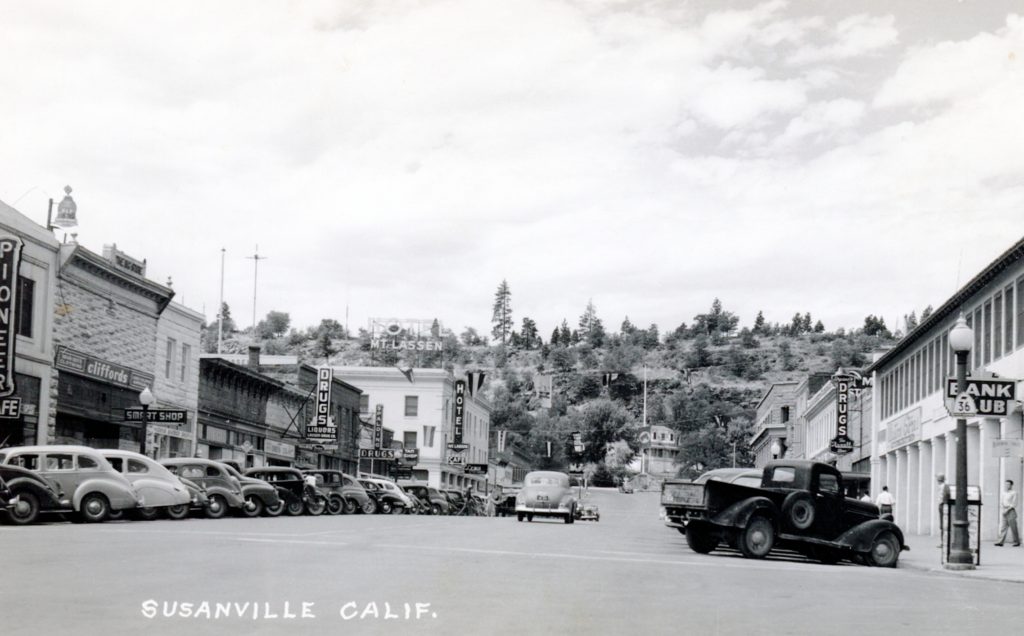
Prior to the construction of Highway 36 which changed the west entrance into Susanville, civic leaders complained about the street appearance first entering the town and/or leaving.  The problem spot was the 500 block between Pine and Roop Streets. There was an unsightly berm in the middle of the street. In 1922, the west entrance was changed to South Pine Street, and with the paving of Main Street, the problem fixed.

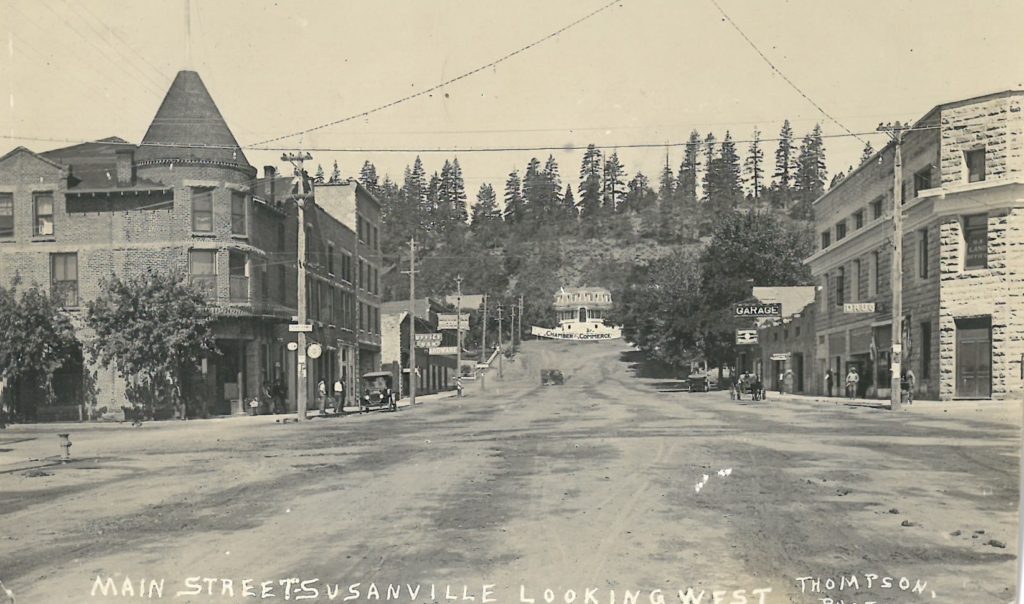
The west end of Susanville’s Main Street

Subscribe

609 Cottage Street, Susanville

Ted Friend, publisher of the Lassen Advocate, 609 Cottage Street, Susanville, June 1944–Life Magazine

There have only been three structures on this site. Considering that it is one block off Main Street, in the original historic core of the town. In 1914, the first building on the site was moved from up the street. It was the old abandoned Congregational Church. C.E. Emerson who had a three-story hotel, along with his mercantile store was just across the alley, the current site of the Hotel Mt. Lassen. Emerson used this building as a warehouse. In August 1915, it caught fire that destroyed the entire east end of the block including the Emerson Hotel, the Hyer Hotel and the Methodist Church.

Emerson’s loss was only partially insured and was never ever to rebuild the hotel. He did construct a smaller native stone building fronting Main Street, that many people recall the home of Millar Hardware. Across the alley, and next to the Methodist Church a native stone building was built as Emerson’s warehouse. In March 1934, the Emerson Estate sold the warehouse building to the Lassen Advocate newspaper. In January 1963, the Lassen Advocate relocated to 2119 Main Street.

In the early 1960s,  the Susanville Methodist Church needed additional space. A 1960 financial bequest by Elizabeth Lytle to the church’s building fund was a major boost. It was decided to purchase the Advocate building and build a second church building to house a Sunday School among other things. It progressed faster than anticipated and the native stone building was demolished in the fall of 1963. The church’s Fellowship Hall  was built in 1967 containing a social hall, kitchen and classrooms. A dedication ceremony and the burning of the mortgage took place on May 12, 1978.

Donate

Fruit Growers Dilemma

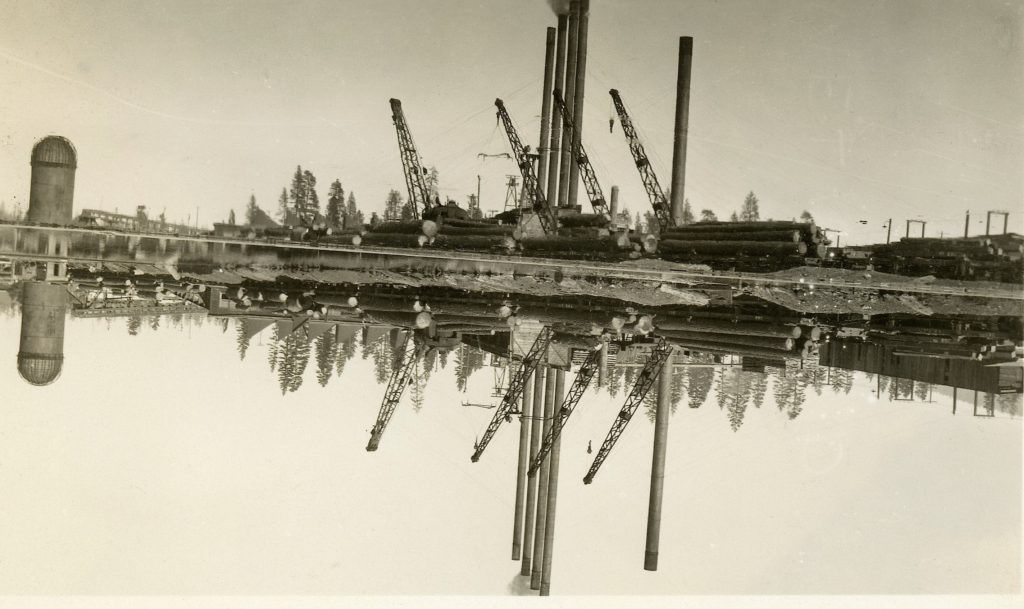
Fruit Growers’ Susanville mill.

During the Great Depression of the 1930s Fruit Growers like so many sawmill operators on the West Coast had the debate whether to close their mills at Hilt and Susanville. This after all, with the realization that Fruit Growers could buy wooden boxes cheaper than they could manufacture.  One other alternative was not just close the Susanville, but sell it.

The final decision was to keep the mills open. It would be costly, but Fruit Growers understood the long-term implications. If they closed the mills, they would lose many valuable employees and would be forced to start over once the economy rebounded. Logging operations at both Hilt and Susanville were suspended that year. At Hilt 1932 witnessed the end of railroad logging there. In addition in 1932, the Susanville mill operations were scaled back to a five-day week, rather than six to avoid layoffs. The decision paid off in the long run and were still able to meet the needs of the grower members.

Subscribe

A Perrenial Flooding Problem Solved

Looking east on Main Street, from Lassen High School, 1908.

Since time immemorial the lower end of Piute Creek naturally flooded. Where today’s Memorial Park is located there were two channels of the creek. In 1920s, this area was purposely flooded in the winter to allow for ice-skating. With the construction of Lassen High School, fill was brought in to start filling the low lying bottom areas near the creek. As more development continued in that area, saw more fill, thus obstructing the natural flow of the creek. When Memorial Park was created in 1947, it eliminated one of the natural channels of the creek.

Piute Creek flood of April 9, 1938. Courtesy of Margaret A. Purdy

In 1916 the bridge across Piute Creek on Main Creek was replaced with a culvert. During the winter and spring time. when the water was high debris would find its way down the creek and block the culvert, thus flooding the area of Memorial Park and vicinity. It was not until 1998 that the culvert issue modified and no more flooding.

Donate