Tag Archives: Schools

Cove School District, Lassen County

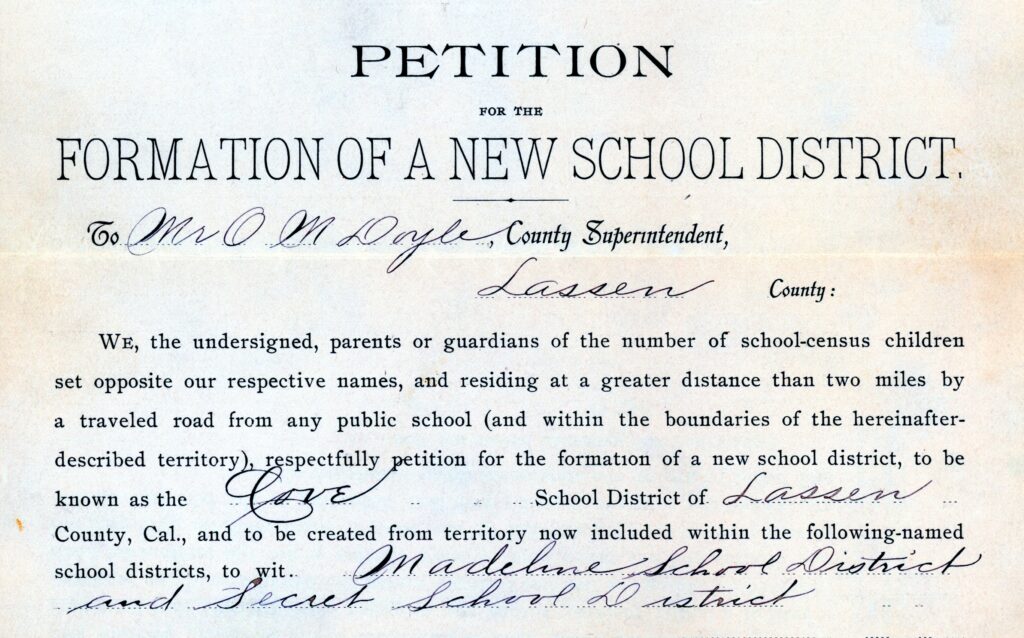
Cove School District Petition, 1901

The Madeline Plains historically is not the easiest place to make a living.  Raising a family with children and to provide for their educational presents another challenge, whether yesteryear or today.

On the eastern Madeline Plains when the Moulton School District was abolished in 1898, it was succeeded by Cove School District.  It took several attempts to get the district established due to problems associated with the proposed boundaries. It was finally approved on April 4, 1901. The petition was signed by nine families who, on the average, resided 25 miles away from the nearest school—though M.L. Millsaps’ three children resided 45 miles from the nearest school, at the old Tuledad station next to the Nevada border. According to Madeline Plains historian, Don Garate, the residents built the first school on the west side of Cold Springs Creek.  The region experienced a record population growth with the influx of homesteaders and the school building needed to be enlarged and placed in a more central location. On October 16, 1908, the voters approved a $100 bond measure to build a new schoolhouse—the smallest bond measure ever to appear on a ballot in Lassen County. Just as quickly as the population increased, it dwindled.  The school closed in 1916, as there were only four students, one shy of minimum requirement of five.  The school never again opened its doors to students.  In 1918, it was annexed to Ravendale. On November 24, 1924, Elinor Coldren offered $25 for the Cove schoolhouse, but it was rejected.  In 1927, the Board of
Supervisors offered the schoolhouse for sale, but no bids were
received.
Support by subscribing.

A Change of Name

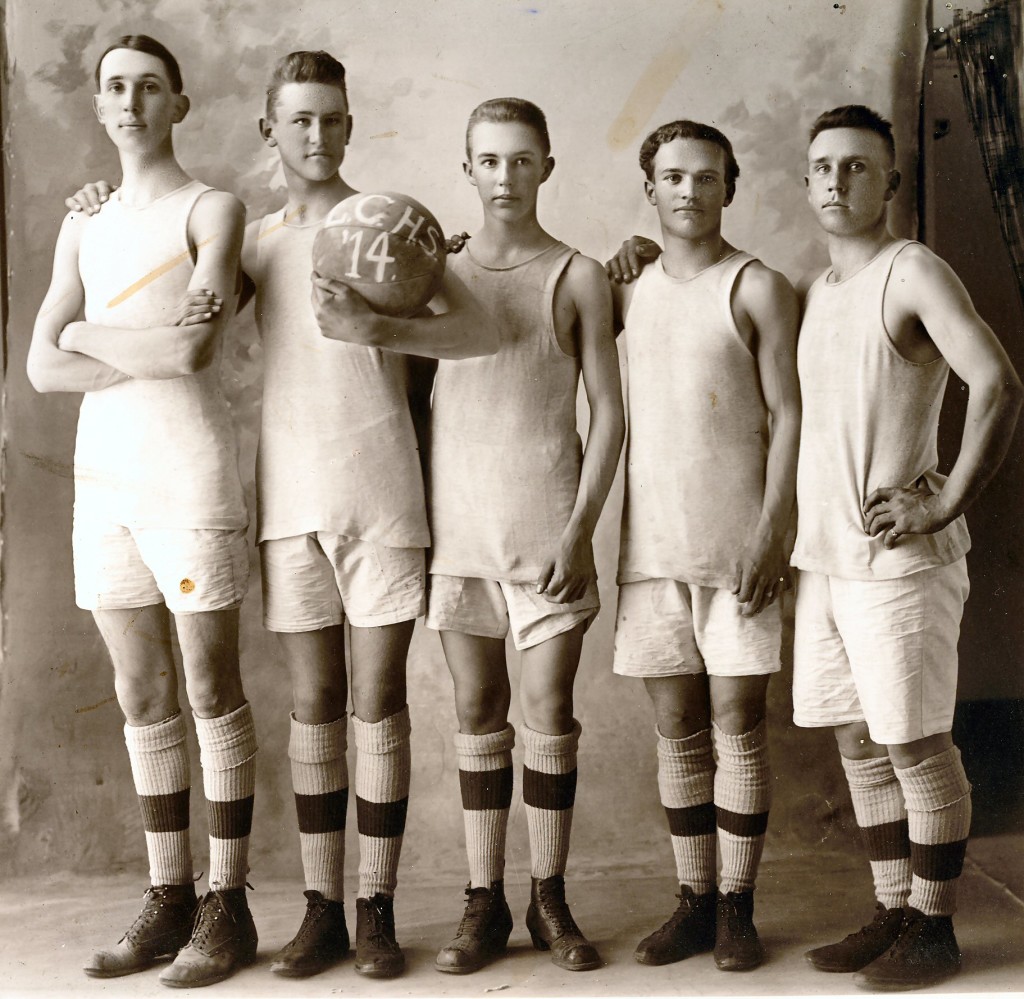
Lassen County High School Basketball Team, 1914. Notice L.C.H.S on the basketball ball. Left to Right:Will Raker, Donald Shanks, Claude Wemple, Burton Spalding, Ira Baldwin.

Name changes can be a tricky issue. After all people are a creature of habit, so name changes can be disruptive. This is different from were names slowly fade away. Take for example Seven Bridges in the Honey Lake. Valley, if you know the locale, you are dating yourself. Anyhow, back to the name topic at hand—Lassen High School.

When high school was created in 1902 it was known as Lassen County High School. When it was established it was the only high school in the county. That changed in 1916, when two new county high schools opened—Big Valley and Westwood. California state law required Lassen to drop “County” and adopt “Union” to embrace all the districts in the county—thus is became known as Lassen Union High School.

A lot of people grumbled about the name change, since it was all they ever knew. Years later there is a generational change. The older insist its Lassen Union High School and the younger simply refer to their alma mater as Lassen High School.

Subscribe

They Tried and They Failed

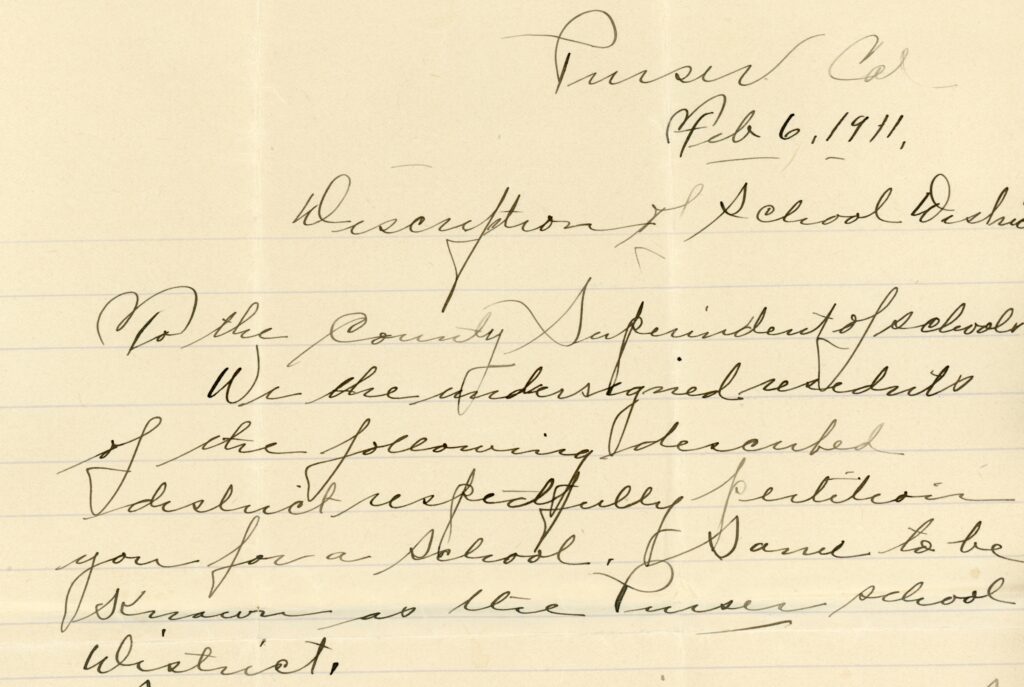
Purser School District Petition

This is what some referred to as a “ghost” school. The circumstances are rather odd. In January/February 1911 W. Mylar, who had three school aged children circulated a petition to establish the Purser School District. It met all the criteria. In the proposed district boundary there were 22 children. They were also more than five miles from the nearest school. For reasons unknown Lassen County Board of Supervisors did not approve it. Three years later, a new petition, known as Caloreta School District, which was identical to Purser, was approved.

Purser would later become known as the railroad community of Wendel. That locale had many names in its early years. It was named after Edward T. Purser, a major player in irrigation projects of the Honey Lake Valley in the 1890s.  I have large size professional photograph negative of him  but not a print, but once with a positive scan I will write about him.  A person has offered to scan negatives like this, but I have experienced issues on my part that have have stalled the hand off of such. Hopefully soon, another project to be completed during the forthcoming Thanksgiving holiday weekend.

Tim

A Penmanship Revival?

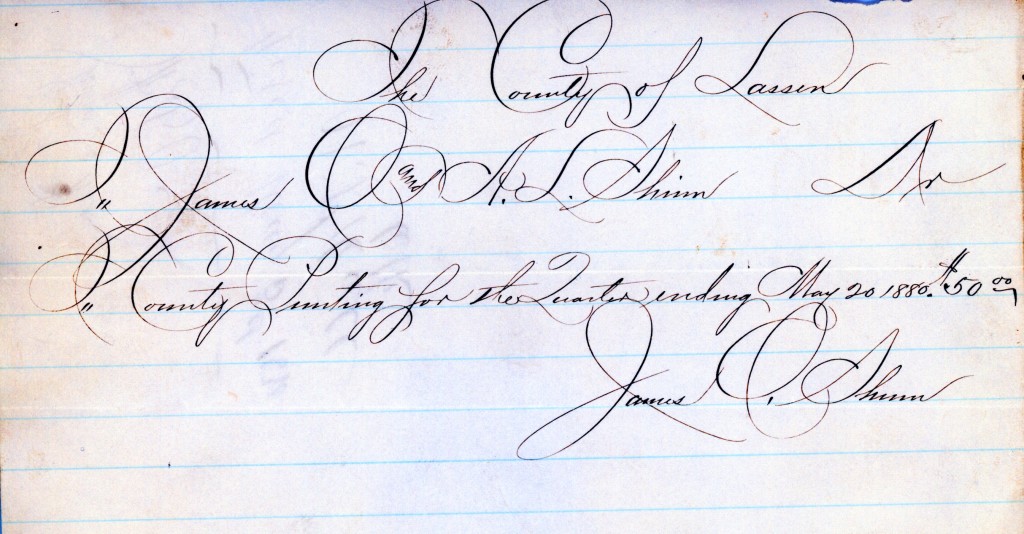
Shinn Brothers 1880 bill for printing services to Lassen County. James O. Shinn excelled in spencerian script, no doubt influenced by his mother, Louisa, being a school teacher. His two brothers,Al and Robert, who became attorneys had sloppy handwriting.

There has been for some time a debate brewing over whether cursive handwriting should be taught. Debate no more. One of the many bills California Governor Newsom signed into law in October was to bring back cursive writing in elementary schools. Seventeen other states have cursive writing as part of the education process.

It should be noted that by 1850, Spencerian Script had been widely adopted in schools as well as in the business community. With the advent of typewriters it began to fade away in the early 1900s. By the 1920s, schools began adopting the Palmer Method. It was considered more streamlined, less laborious and faster technique.

Of note, the Spencerian had some quirky traits, which one sees a lot in early documents of Lassen County. A double “s” such as Lassen, looks like a “p.”  This was evident in the short-lived Lassen Post Office in the Willow Creek Valley that only operated from June 19, 1874, to July 14, 1875.  Some records cite it as “Lapen,” due to the penmanship of Edward Bonyman, its first and only postmaster.

Become a supporter for just $5 a month to ensure quality history continues. Click here


Spanish Springs School District

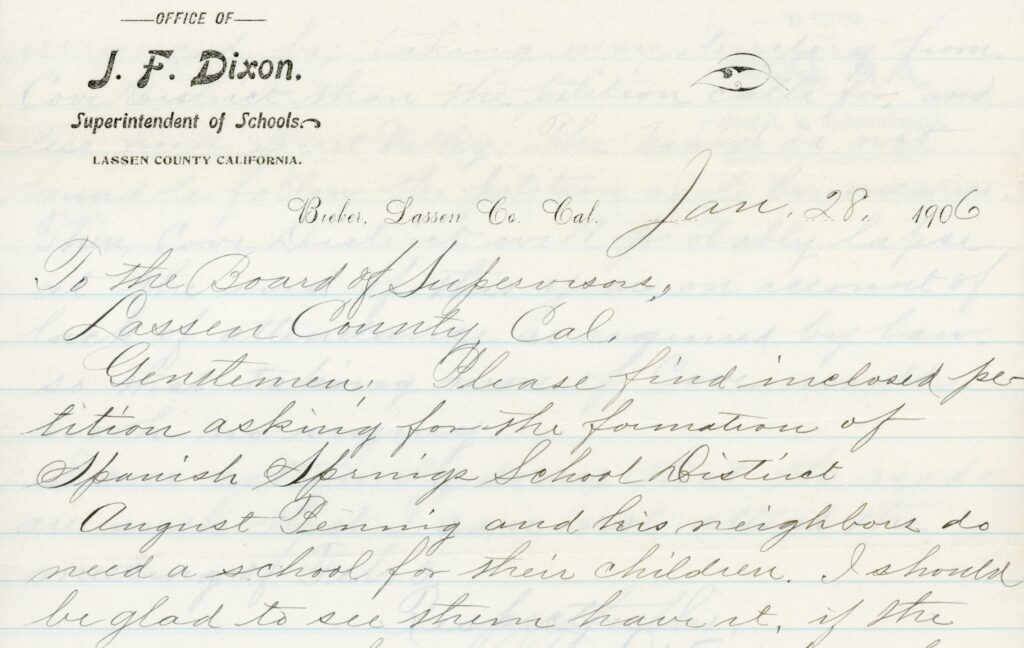
A portion of Superintendent  of Schools letter for consideration.

There were only a handful of proposed rural schools in Lassen County that were never approved. Spanish Springs School District was one of them.

On January 28, 1906, Lassen County Superintendent of Schools, J.F. Dixon, received a petition from August Penning requesting the formation of a school district, to be named Spanish Springs.. Penning stated he  and his neighbors were too far removed from
the nearest schools at Cove in the eastern portion of the Madeline Plains  and Secret Valley to the south.  Dixon was concerned about the proposed boundaries, for it could jeopardize the enrollment
populations of the Cove and Secret schools.  On the other hand, Dixon requested that the Board of Supervisors to consider Penning’s petition carefully, for he felt that the Spanish Springs residents would benefit from having a school.  At the March 5, 1906 meeting, the Board of Supervisors declined to consider the petition, stating it was received too late. No attempt was made by residents press the issue any further.

Support by subscribing.

Hayden Hill School—One Of Three

Hayden Hill School, 1916—D.M.Durst

The Hayden Hill School District operated from 1878 to 1925. When it was established, the mining town was at its peak and would enjoy prosperous times for the next several years.

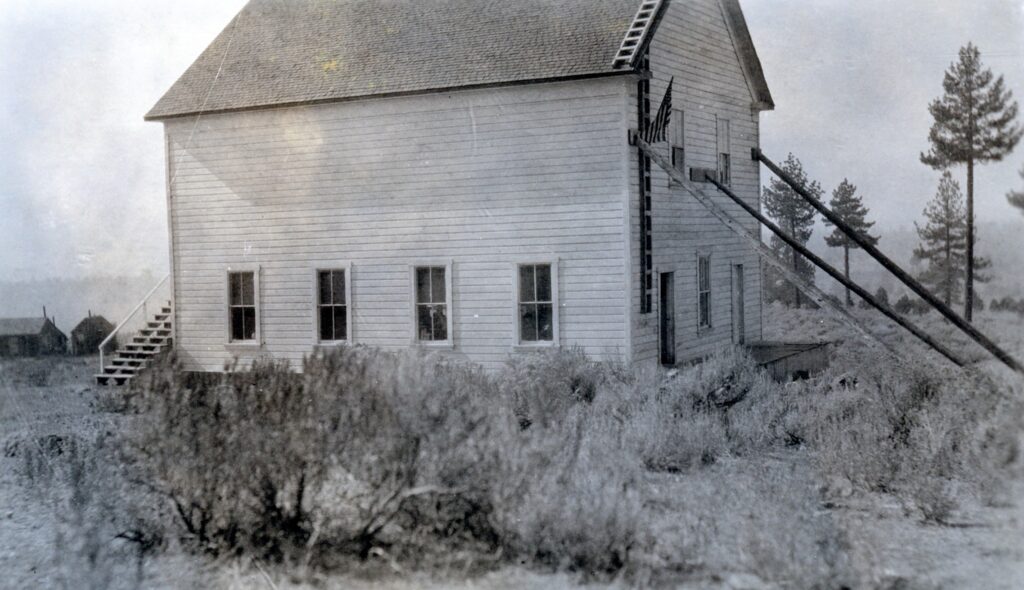
A lot of details of the school are sketchy. Since there was no town plat title research is a real challenge. It does not appear the school district owned the property where the school house was situated on.  When the school was built is a matter debate, unlike most rural schools, those school houses were funded by local bond measures. The Hayden Hill School was built without the aid of public funds. In addition, it was one of three rural Lassen County schoolhouses that was a two-story structure. The two other schools were Lake (near Janesville) and Long Valley (Doyle). In all three cases, the second floor was used as a community hall.

Hayden Hill School, 1918. B. Dorsey Collection

When school closed in 1925, due to a lack of students, it was apparent that the mining community was not going experience one more revival. In 1931, the Lassen County Board of Supervisors sold the abandoned school building on June 1, to Fred Bunselmeier and Lloyd Walsh for an undisclosed amount.

Support by subscribing.

Who Wants to Buy a Courthouse?

Lassen County Courthouse and Hall of Records, 1908–David Zoller

In June 1915, Lassen County voters approved a bond measure to build a new courthouse. It would be constructed on the site of the existing one. In September 1915, the old courthouse was put on rollers and moved to the property line along Lassen Street. It would remain in place there and used until the new courthouse was completed, though eventually many of the county offices were relocated in the county jail.

In November 1916, the county advertised for bids for the sale of the old courthouse in anticipation of moving into the new facility. Plenty of people inspected the building. The county did not know when the building would be available. In January 1917, the county received two bids for the structure one from Sierra Packing Company for $50 and the other from Charlie Emerson for $60. The county rejected both and decided to auction it off. When that event would happen no one knew. There were delays in moving into the new building, one of the big obstacles was that of the cost of furniture. During the first week in April moving into the new courthouse began in earnest.

On April 28, 1917, the auction was held with Johnstonville resident George Bennett’s winning bid of $85. Bennett immediately sold it at a higher undisclosed amount to Susanville resident Dan Armstrong who tore down the building and used it for scrap lumber. Armstrong, it should be noted in 1920 subdivided his property east of Weatherlow Street to Foss Street, which over the years the majority was purchased by Lassen Union High School.

Subscribe

Lassen High’s 1907 Valedictorian

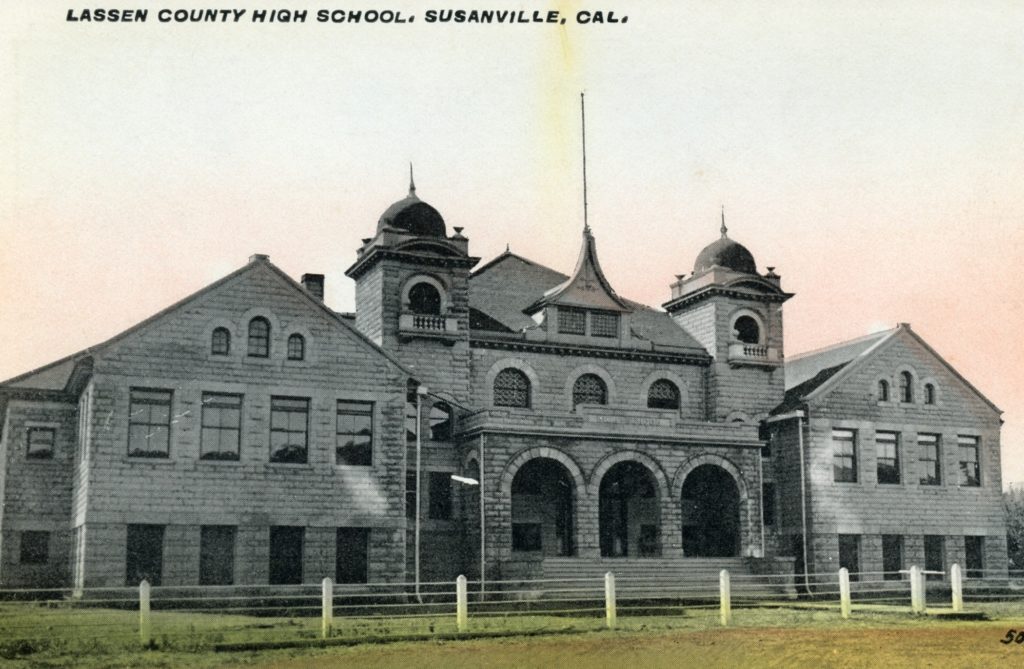
Lassen County High School, circa 1908

On June 21, 1907, Lassen County High School held its first graduation ceremony. It should be noted that in 1906, there was a three year-commercial course of graduates. The Class of 1907 consisted of Medford Arnold, Hanchen Lesser, Lena Cahlan, Jessie Hulsman, Evelyn Hulsman, Ralph Taylor, Jeanette Alexander, Kate Deforest, Ruth Hemler, Wright Spalding and Percy Holmes.

Evelyn Hulsman was the Class Valedictorian and the following is a synopsis of her speech that appeared in the Lassen Advocate, June 28, 1907: “Nemesis of an Amateur” was the theme of Valedictorian, Miss Evelyn Hulsman. The young lady had gone to Shakespeare for inspiration and in the pictured career of MacBeth she found it. Vividly with well chosen language she retold the story of MacBeth’s machinations, his great crime and the disastrous consequences to himself when ‘Great Birnam wood to high. Dunsine hill,’ came against him and sword Manduff put an end to his unworthy ambitions. Miss Hulsman’s effort was a notable one in many particulars. It was delivered with strong dramatic effect and token conscientious preparation. It is much too long for reproduction in these columns. A fact we regret.

Subscribe

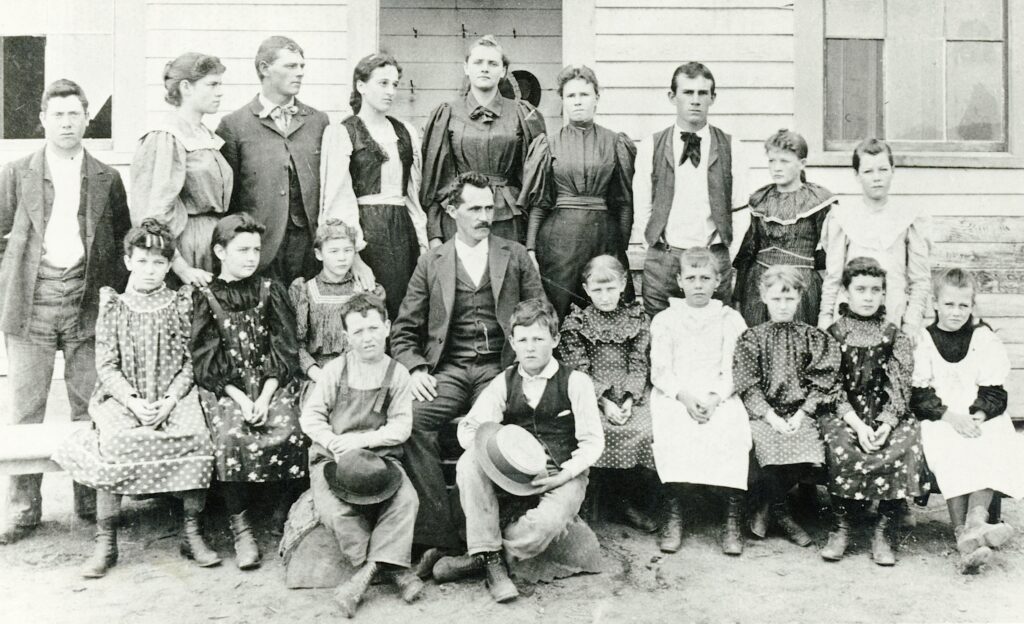
Johnstonville School, 1895

Back Row, Left to Right: Ross Bangham, Fannie Leavitt, Tom Sugro, Cora Longnecker, Maggie Sugro, May Hart, Jess Hall, Lizzie Brockman, Laura Elledge.
Sitting: Pearl Cooper, Neva Cahlan, Edna Brockman, Teacher Will Spoon, Kate DeForest, Rose Bantley, Gilberta DeForest, Lena Cahlan, Grace Elledge
Front Row: John Cooper and Charles DeForest

Today is a special day. It happens to be Arthur Cahlan Mathews 101st Birthday, who was born in Susanville on June 5, 1922. This explains today’s photograph of the students and teacher of Johnstonville School, 1895. Art’s mother Lena Cahlan, and his aunt, Neva attended Johnstonville School and are featured in this photograph, notice the matching dresses. They grew up on Cahlan ranch which was located about halfway between Susanville and Johnstonville. Lena, was a member of the first graduating class of  Lassen County High School in 1907. Art’s grandmother, Charlotte Cahlan, by the way, was a moving force behind the establishment of the Lassen County Free Library in 1915.

Happy Birthday Art. I will have the traditional ”Susanville pour” in your honor.

Tim

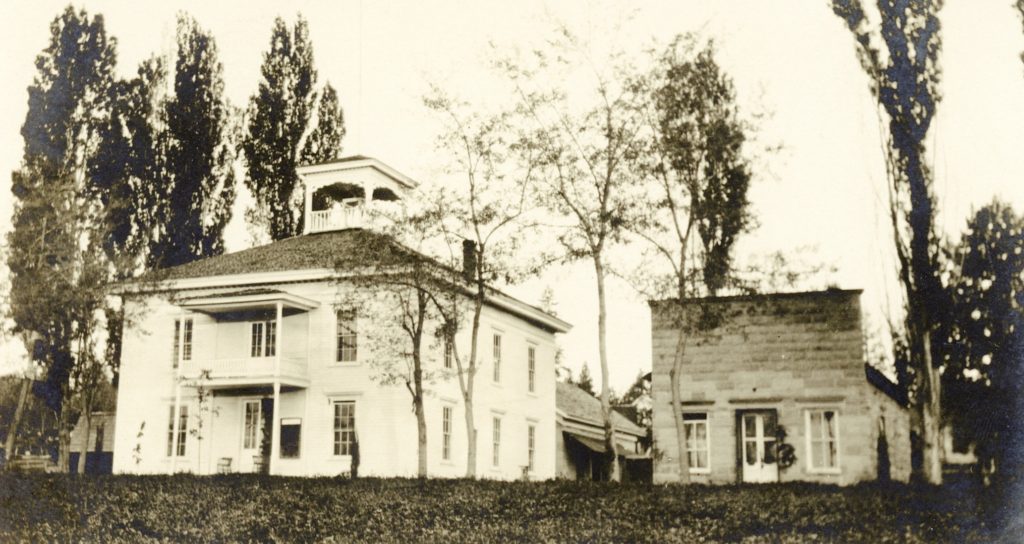
Susanville’s McKinley School

McKinley School
McKinley School, 1950

The first McKinley School was built in 1920 and located on Cottage and South Gay Street, on the same lot that the former Washington School, nee Credence was located.

Yet, it was the Washington School that was built in 1900 that time had taken a toll on the structure. In 1947, the Susanville School District were concerned that it would not pass a number of safety codes. The following year the building was condemned and the district was concerned McKinley, too, would suffer the same fate. The District now had the daunting task to find funds to replace the two schools. The State of California determined that the District was “distressed” and was eligible for $341,065 in funds. It was decided to create two neighborhood schools, and McKinley was relocated to Fourth Street. The new school building opened its doors in May 1950. Of course, school campus has undergone many changes since it first opened.

Support by subscribing.