Tag Archives: Red River Lumber Company

It Almost Never Came to Be—Susanville Ranch Park

A historic view near present site of Susanville Ranch Park parking lot/trail head.. Courtesy of Hank Martinez

Susanville is fortunate to have the Bizz Johnson Trail on the south side of town and Susanville Ranch Park with multiple trails on the north side of town. Each has their own unique story how they evolved. Today, we focus on Susanville Ranch Park.

The first person to examine the property for non-agricultural purposes was T.B.Walker, founder of the Red River Lumber Company. In 1912, the Walker family had a heated debate. as to their permanent mill, though a site had been selected at Mountain Meadows. T.B. Walker had given considerable thought to this particular site. However, as we known Mountain Meadows would win over, and the town of Westwood became a reality,

The ranch as it appeared in 1922, when Fruit Growers owned it.

In 1919, enter Fruit Growers Supply Company when they were scouting around for a mill site. That company went one step further and purchased the property for while undecided one the site, they wanted the water rights to Bagwell Springs.  While Fruit Growers chose a different Susanville location, they retained the property. After all it would be beneficial for pasture for horses, a then an important component in logging. Fruit Growers then established a dairy there. It was brief, and it was a leased to the Okelly family who operated Lassen Dairy there for several decades.

In 1934, Fruit Growers offered to sell the ranch to the City of Susanville. Fruit Growers cited it would make an ideal golf course, that the money received from the golf course could be used to develop the remainder of the property into a park. The City liked the idea, but said no. In 1935, Fruit Growers sold the ranch to the Republic Electric Power Company who wanted to acquire Bagwell Springs as an additional water supply for Susanville. Over the years, that Company went through numerous reorganizations and became CP National. In 1984, CP National donated the ranch to Lassen County, and it is now a county park.

An interesting footnote to the story is that Lassen Community College examined the property for a future campus back in the 1960s, but the asking price was too expensive at $3,500.

Subscribe

Goodrich Reservoir, Lassen County

Goodrich crossing and reservoir in 1914. Minnesota Historical Society

While most reservoirs in the region were constructed for agricultural purposes, there is always an exception to the rule. The Goodrich Reservoir on Goodrich Creek near Westwood was constructed in 1912, by the Red River Lumber Company. Its main purpose was for a domestic water supply for the residents of Westwood and also as a water supply for Red River’s millpond. During the winter months, it found another use as it was a popular ice-skating spot.

During the drought of 1924, Goodrich Creek could not provide for a stable water supply for Westwood. A pipeline was constructed  from Clear Creek to Westwood to correct the problem. In 1931, the State of California inspected the dam, deemed it a hazard and was removed.

Tim

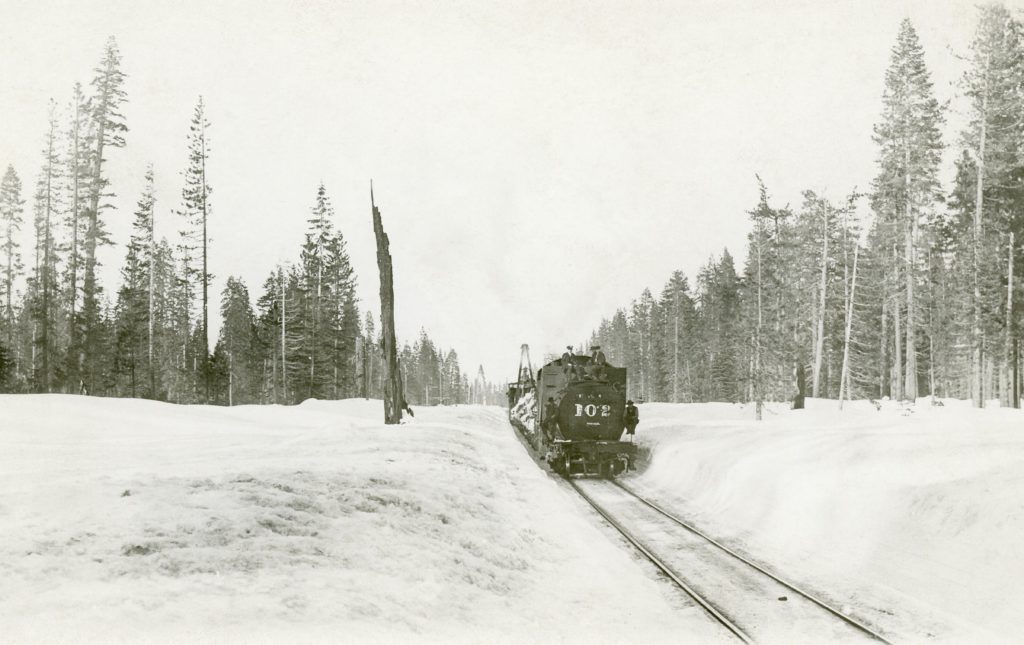
Red River’s #102 Locomotive

Red River’s 102, with a jammer in tow.

In 1914, Red River Lumber Company purchased three Baldwin locomotives from. the Tonopah Goldfield Railroad for its Westwood operation. Of course, Red River had quite a fleet of locomtives at Westwood.

The 102 remained in operation during Red River’s tenure there and the locomotive became the property of Fruit Growers Supply Company in 1944. When Fruit Growers closed the Westwood mill in 1956, the 102 was sold for scrap.

Tim

Piute Logging Railroad – Part II

Flood waters from breached earthen fill trestle, April 1938. Courtesy of Betty B. Deal

Construction of the line was stalled during the early 1930s, while Red River went through its financial reorganization. Finally, in July 1933, construction began at the west end near Hog Flat. A station was established where the Piute line connected with the Southern Pacific, and named Blair, after Kenneth Walker’s wife. At Hog Flat, Red River established logging camp #2. That summer Red River logged eight million board feet of timber and sold it to Fruit Growers. The following year the line was extended further east to Big Springs, and Camp #8 was established.

The year 1935 was a pivotal one for the Piute. Early in the year it was announced Red River would complete the line to Susanville—a distance of twelve miles from its terminus at Worley Ranch to the Fruit Growers plant. Continue reading Piute Logging Railroad – Part II

The Piute Logging Railroad

Map of the line, showing spurs.

The completion of the Western Pacific’s highline in 1931 was not the only railroad development to make news. In the 1930s, Red River’s most unusual railroad logging line, the Piute, came to fruition—so named as it followed Piute Creek in its approach to Susanville.

Red River owned a large swath of timber west and north of Susanville. While they had already logged over its easily accessible timber in Mountain Meadows and Lake Almanor, the Piute line was not intended to service Westwood. The Piute was built to generate much needed revenue to sell timber to other parties, such as Fruit Growers and Lassen Lumber & Box. However, they had a back-up plan; should Red River’s timber sales fall flat, they could mill the timber at Westwood. Continue reading The Piute Logging Railroad

A Westwood Independent Business

Taylor’s Advertisement, Westwood Independent, 1918

While many are aware of when Red River Lumber Company’s mill town of Westwood first came into operation in 1913, it was a true company town. All the housing was owned by company, and about 99 percent of businesses were too. There are exceptions to the rule.  There were some tasks the company did not want to undertake, such as the mortuary. Of course, that business needed Red River’s approval to operate. The featured illustration provides another example.

In. 1918, WesleyTaylor advertised in the Westwood Independent his services as insurance agent and notary public. How long he remained in business there is not clear. However, in 1920 with the formation of the Westwood National Bank, that institution provided notary services. It should be noted since Westwood was initially a company town, there is little public documentation of the coming and goings of the town’s residents.

Tim

Ad from Westwood Independent April 2, 1918

Red River’s Logging Camp 33

Camp 33
Camp 33

Red River Lumber Company operated numerous logging camps from 1913 through 1944 when it sold to Fruit Growers. The camps were assigned numbers, though in no particular order. The majority of the camps were short lived and only had a span of one to maybe three years. One of the more interesting camps was Camp 33, but referred to as Town Camp, as it was located less than a mile west of Westwood. What made it unique was that Red River’s company town of Westwood would experience from time to time a housing shortage for its employees. On occasion, this camp was used to house mill workers instead of loggers.

Tim


Old Logging Movies

Westwood Theater. Courtesy of David Zoller

Red River Lumber Company was unusual in that it did not routinely have commercial films made of its operations, as their competitors did. It was deemed a good business practice to show prospective retail buyers, as well as investors, of one’s operation. In the 1930s, Red River officials debated the issue, particularly as it might be beneficial if forced to sell Westwood. On the other hand Red River’s neighbor the Fruit Growers Supply Company routinely had films made. For them it was important for the citrus growers to see what was involved with their investment.

In the summer of 1928 Caterpillar tractors sent a camera man to Westwood to film Red River Lumber Company’s entire operation–from the falling of trees to finished board. Caterpillar was interested in Red River’s operations. Red River’s skilled machinists were constantly making improvements to Caterpillar tractors. Among old time Red River employees there was the folklore that Red River had more patents on Caterpillar tractors than Caterpillar.  Whatever the case may be, in November 1928 the film made its debut at the Westwood Theater.

It would be interesting to know if the film exist in Caterpillar archives. After all, Fruit Growers had a 1925 film of their Lassen Operation in their archives, which I did a showing at the Susanville Depot many years ago.

Subscribe


Fire Train Restrictions

fire train
Red River’s fire train, courtesy of Doug Luff

The Red River Lumber Company at its Westwood operation developed its own fire trains used to fight forest fires. Of course, Red River had its extensive railroad logging network. However, if Red River wanted to access the Southern Pacific’s railroad tracks between Westwood and Susanville there were protocols set by Southern Pacific. In 1936, a Southern Pacific Bulletin stated ”The fire train of the Red River Lumber Company may make the following speeds: Between Mason and Westwood Junction, 35 MPH’ Between Westwood Junction and Susanville, 25 MPH; and through all tunnels, 10 MPH.” I do not know what type of restrictions the Western Pacific imposed.

Tim

Susanville’s Piute Creek

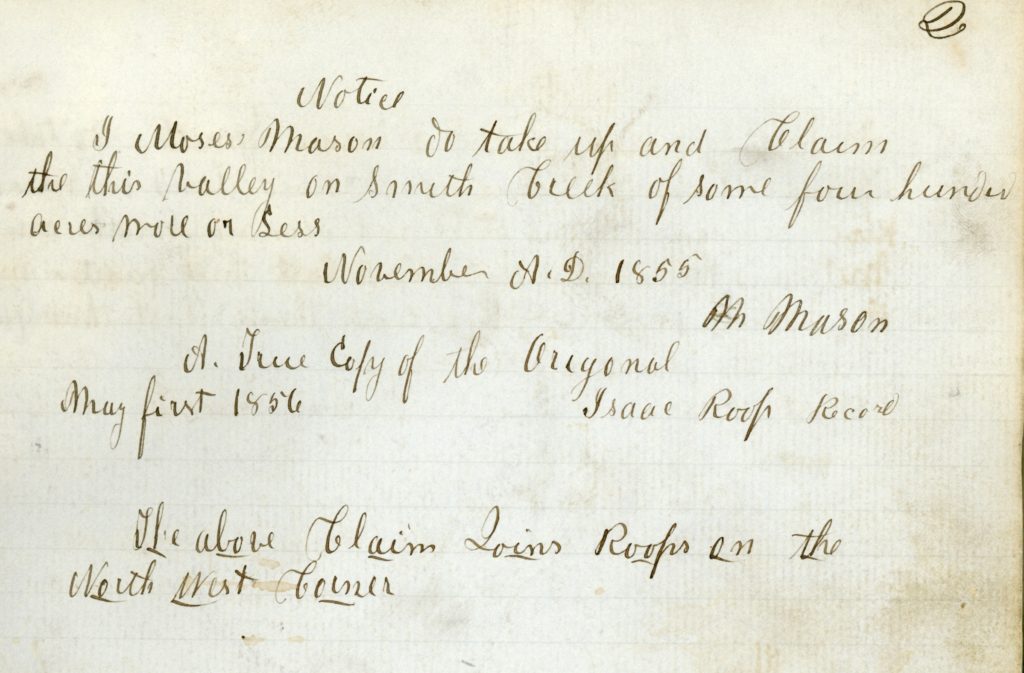
M. Moses was the second claim recorded in Roop’s Land Register. He settled on present day Susanville Ranch Park and referred to Piute Creek as Smith’s Creek.

This small stream a tributary to Susan River is approximately ten miles in length. For a brief period it was originally known as Smith’s Creek, who and why it was so named such we may never be known.

Another peculiarity is the spelling of Piute. Back in the 1850s and 1860s that was how the Anglo settlers of the western Great Basin spelt the name for the Native American tribe now referred to as Paiute.

Piute Creek was also the source for the original water supply for Susanville. It would be replaced with what is now known as Cady Springs in the Susan River Canyon.

Flood waters from breached earthen fill trestle, April 1938. Courtesy of Betty B. Deal

In 1935, the Red River Lumber Company completed its railroad logging line known as the Piute that traversed a portion of the canyon the creek flows through.  Just above Desmond Meadows, the Piute line crossed Piute Creek. In an effort to save money, Red River decided to forgo a wooden trestle, and substitute an earthen fill. It was a rather substantial one at that, being over twenty-five feet tall. The winter of 1937-38, was one for the record books. By the end of March, 1938, the spring run-off was in earnest. The earthen fill at Desmond Meadows was equipped with a culvert to handle the stream flow. It was no match for this type of heavy water flow and then the culvert became blocked with debris, creating a substantial reservoir. As one eyewitness observed, this newly created lake extended back 300 feet from the fill with an estimated depth over twenty feet. On April 9, the fill breached, sending a wall of water downstream creating havoc in its path and washing away segments of the Piute railroad tracks into the fields of its dairy property now known as Susanville Ranch Park. In the aftermath, Red River decided not to repair the destroyed trackage. Red River took its time salvaging the line, since the company had given consideration to abandon railroad logging. In the 1940s, the abandoned railroad grade was converted into the Paul Bunyan Logging road.

Support by subscribing.