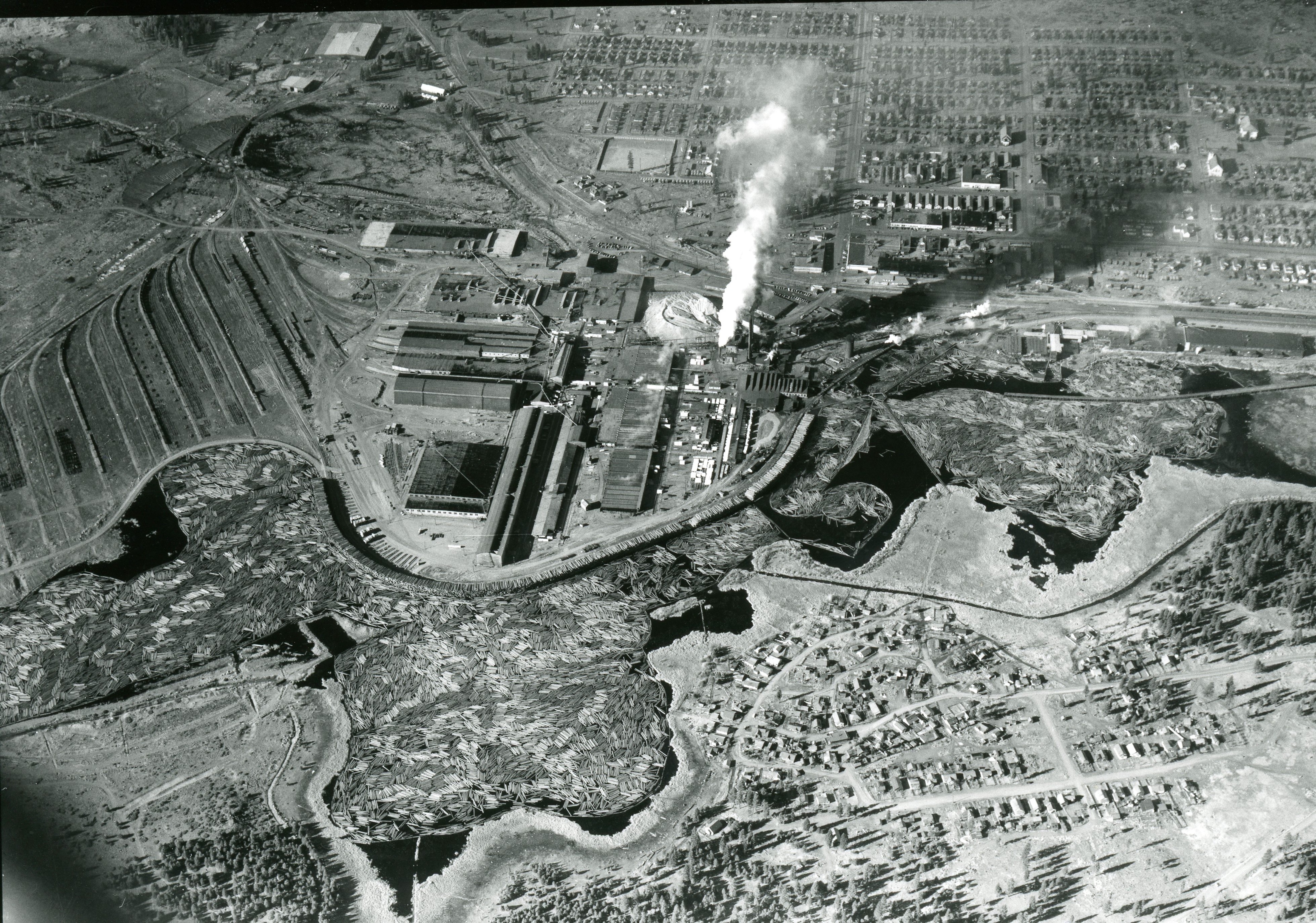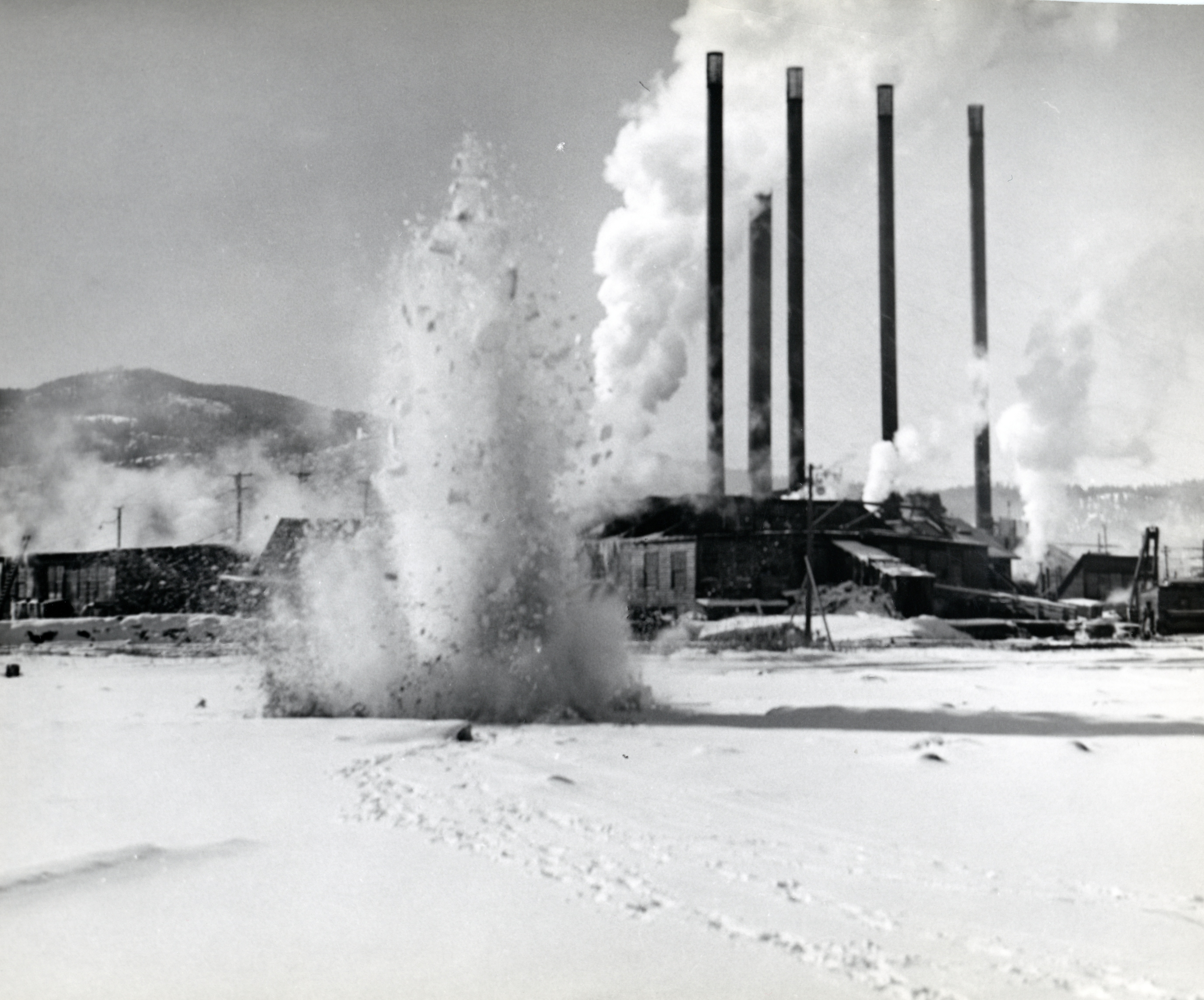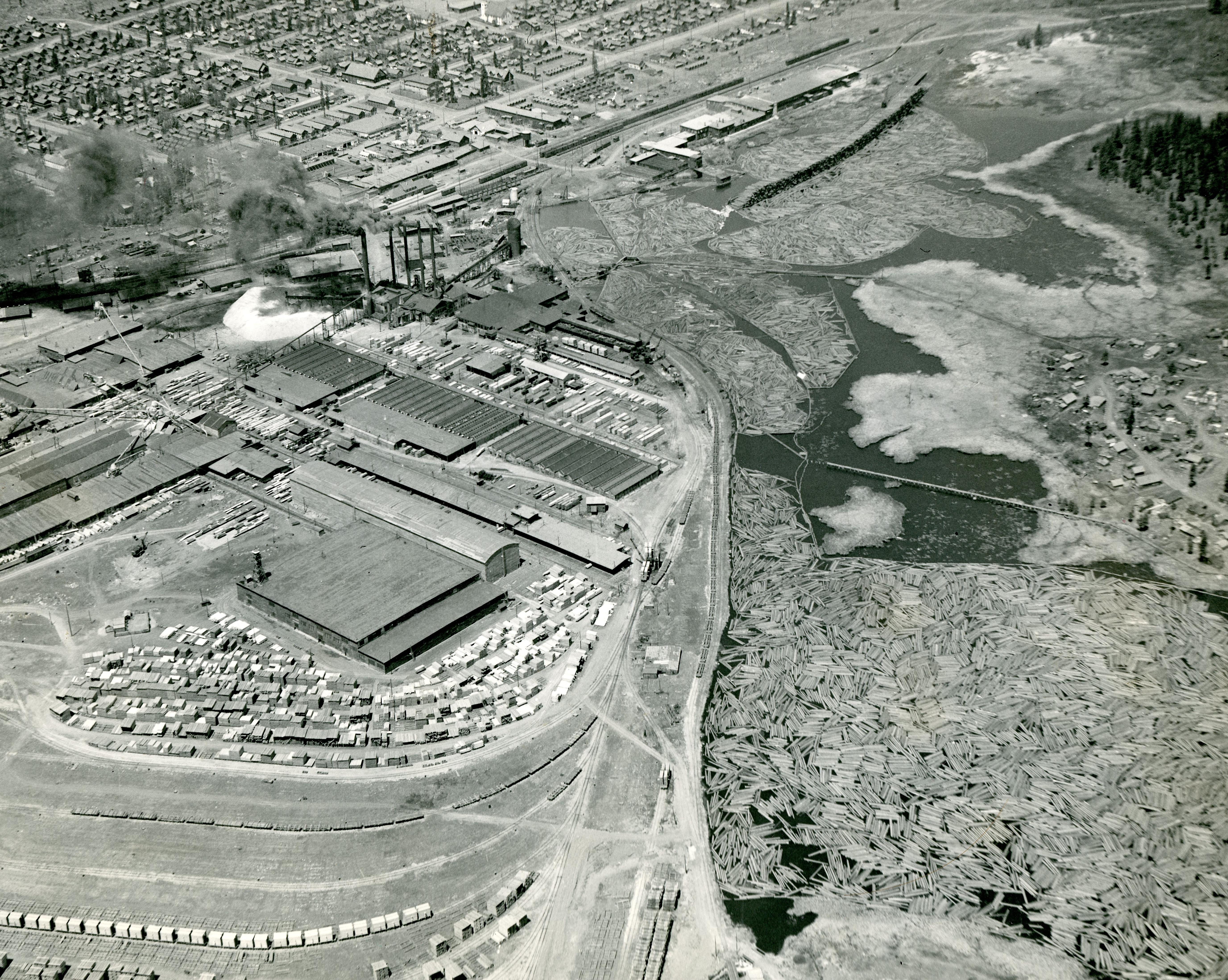
Dynamiting the Westwood millpond, January 27, 1949. Courtesy of Fruit Growers Supply Company
In January 1949, the temperatures plummeted to nearly thirty degrees below zero. The millpond froze. When Red River designed the facility, they placed piping from the powerhouse that forced steam air directly into the millpond near the sawmill. This system was no match for Mother Nature. To keep the mill operating it was necessary to use dynamite to blast loose the logs in the millpond. Continue reading Westwood’s Frozen Millpond→
First of all, coming from a family logging heritage, its still hard to fathom, that lumber mills no longer exist in Lassen County.
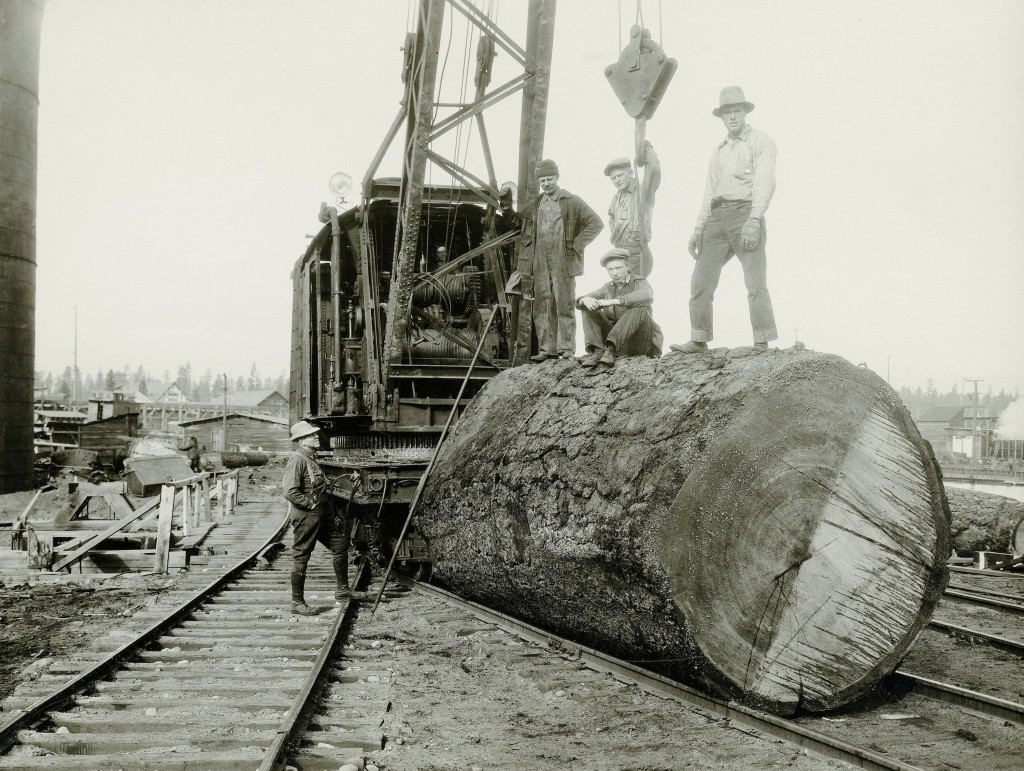
The two largest mills, Fruit Growers and Red River maintained two type of winter log decks. Usually, normal logging operations ceased in November. Yet, to keep the mills operating throughout the winter, required to have a substantial amount of harvested timber. There was the log deck at millpond, and then a second one out in the woods. The latter was not brought into the mill until spring, since the winter supply was nearly exhausted. The log decks in the woods provide enough ample supply during the transition, since it would take some time when the logging camps opened in the spring, to provide a steady supply to the mill.
The county wanted to oblige, but it had no funds. They deferred to take any action and turned the matter over to the federal immigration officials. J.C. Borden of the Immigration Bureau was brought in to investigate the situation. What he found on his arrival was that of the forty-five applicants only a handful were eligible to receive aid to pay for their return to Mexico. Yet, the issue was also moot, as Borden noted, because all the Mexicans had gone back to work. He informed the Board, should the issue arise again, that under a federal ruling any alien who had been in the United States for three years and becomes indigent can be returned to his native land with the cost borne by the federal government. Continue reading Westwood’s Deportation – Continued→
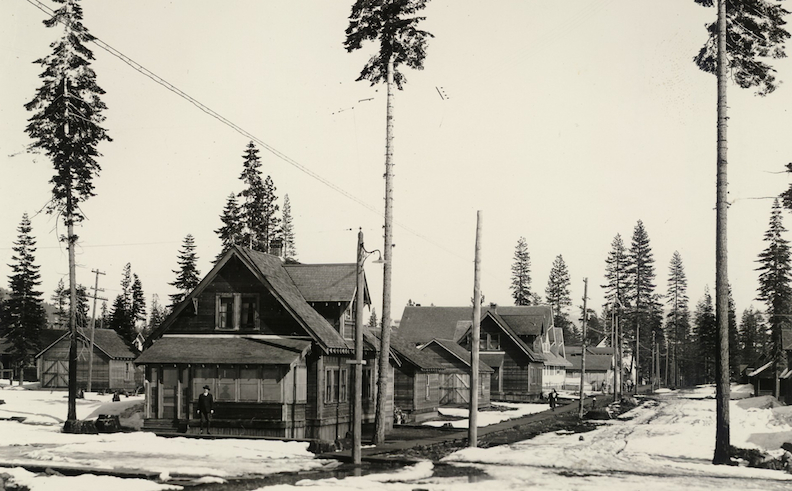
Westwood’s Old Town, home of many of its immigrant workforce. Courtesy of Hank Martinez
One of the more unusual annals in Red River’s history was deportation. Red River hired a large percentage of foreigners whether it be Scandinavians, Italians or Mexicans. With the downturn in the lumber market, the company was forced to layoff some of its workers. If they thought that the layoff was temporary, they allowed the affected worker to remain. By 1930, however, Red River sought alternatives, as they could no longer bear the financial burden. Continue reading Westwood’s Deportation of Immigrants→
It has been awhile since I wrote about the professional photographers of the area who left a valuable historical record behind.
In September 1912, Peter Julian “Jack” Thompson announced he was going to relocate his photography studio from Loyalton, which had been in operation there for ten years, to Susanville. However, due to some delays he did not open for business here until February 1913. Continue reading Susanville’s Thompson’s Photography Studio→
The Sergi-Sacco wedding cake. Courtesy of C. Derek Anderson
One just never knows how pieces of history make it to the surface. The above photograph is just one example. When the bar from Marion’s on Weatherlow Street was being moved to a new home in Chester, some interesting material somehow managed to get lodged behind the bar. There was an assortment of about a dozen Red River Lumber Company photographs and this wedding cake picture.
On 10:00 a.m. Sunday, November 15, 1936 at Sacred Heart Church, Rose Agnes Sergi and James Sacco were married. The bridesmaids were Louise Saffores, Concha Larrea and Camilla Alosi. The best man was Marion Larrea. After the ceremony a wedding breakfast was held at the Veteran’s Memorial Hall, with 500 guests. The centerpiece at the bride’s table was a magnificent five-foot tall wedding cake, weighing 250 pounds.
Subscribe and support this site at $5.00 a month, that is a bargain costing 16 cents a day.
As its name implies it was a real junction. The railroad constructed a spur to the south to Westwood. The Southern Pacific’s real goal was to extend the line north to Klamath Falls, Oregon. It was after all, the Red River Lumber Company’s intent to build several mills, the next one scheduled for near Lookout. By 1917, the Southern Pacific was anxious to extend the line north, but Red River was not ready. The mammoth mill at Westwood was more than it could handle. In the meantime, the Southern Pacific was nervous that its competitor the Western Pacific might extend a branch to Westwood and siphon off traffic, since Southern Pacific’s five-year all inclusive freight deal with Red River was about to expire.
Then came along World War I and that changed everyone’s plan. When the war ended, the nation went into a severe recession, so expansion was off the table for many. Red River kept adding more divisions to its lumber manufacturing plant. In the meantime, the Southern Pacific focused on the troubled Nevada-California-Oregon Railroad, as an alternative route north of Oregon, which it eventually did.
The site, it should be noted, also served as a junction for the railroad logging operations of the Fruit Growers Supply Company and the Lassen Lumber & Box Company.
It is never too late, subscribe today and enjoy tomorrow with daily notifications. You can also surprise someone with a gift subscription
World War II ushered in a new architectural style, that after the War was adopted by the civilian population.
The two most notables one was the old Naef Electric building in the 1800 block of Main Street. After it closed its doors circa 1977, it has been home to numerous enterprises. In the fall of 1978, it is where the Lassen County Times made its debut.
The other is Poulsen Welding Shop located on Richmond Road and Riverside Drive, and carries with it, an important historic significance.
In the 1930s, Bigelow and Poulsen operated a blacksmith shop at this location, in which Poulsen would take over the business and branching out into welding. On July 11, 1946 a fire destroyed Poulsen’s shop and provided the catalyst for city annexation. The City was unable to respond to the fire as the city limits stopped on the north side of the Susan River, while Poulsen’s was on the south side, and outside the City. Efforts over the years to annex areas to the east of Weatherlow and south of Susan River had failed. The Red River Lumber Company which owned the Milwood subdivision fought efforts for fear of property tax hikes. Residents of the outlying areas wanted services such as fire protection.
Thus, the movement for “unification” was born. On April 8, 1947 a special annexation was approved by the voters. Susanville’s Main Street now extended from Weatherlow to Fairfield Avenue. The City’s land mass quadrupled in size.
It is never too late, subscribe today and enjoy tomorrow with daily notifications. You can also surprise someone with a gift subscription
One of the nice features using this forum, instead of traditional print, some photographs will not print well. The above is a perfect example, yet it is an interesting photograph. This is at 501 Main Street, now Uptown Cinemas. This caravan of equipment is headed to Westwood while the first sawmill was under construction. Courtesy of Marcella Mathews Searles.
When the Red River Lumber Company finally decided, or actually more to the point Fletcher Walker demanded the Mountain Meadows location or otherwise he was going to quit, there were numerous hurdles to overcome.
During the initial construction phase of 1912-13, everything would have to be freighted in, while the railroad was under construction, and it would not be completed to Westwood until February 1914.
The road over Fredonyer as it appeared in 1914.
The bulk of the machinery was shipped by rail on the Western Pacific to Doyle. Smaller shipments also went by the Western Pacific to Keddie. In either instance, that is still a long haul for all the machinery to build one of the largest electric sawmills. In addition, all the auxiliary items needed to build a company town. This is before paved highways no less, and the truck traffic certainly made its imprint on the roads, though not in a favorable way.
Hopefully, bringing you this information, it might give you a tiny incentive to part with five dollars a month to keep things running.
Rodman’s grave was part of my Westwood Cemetery Tour
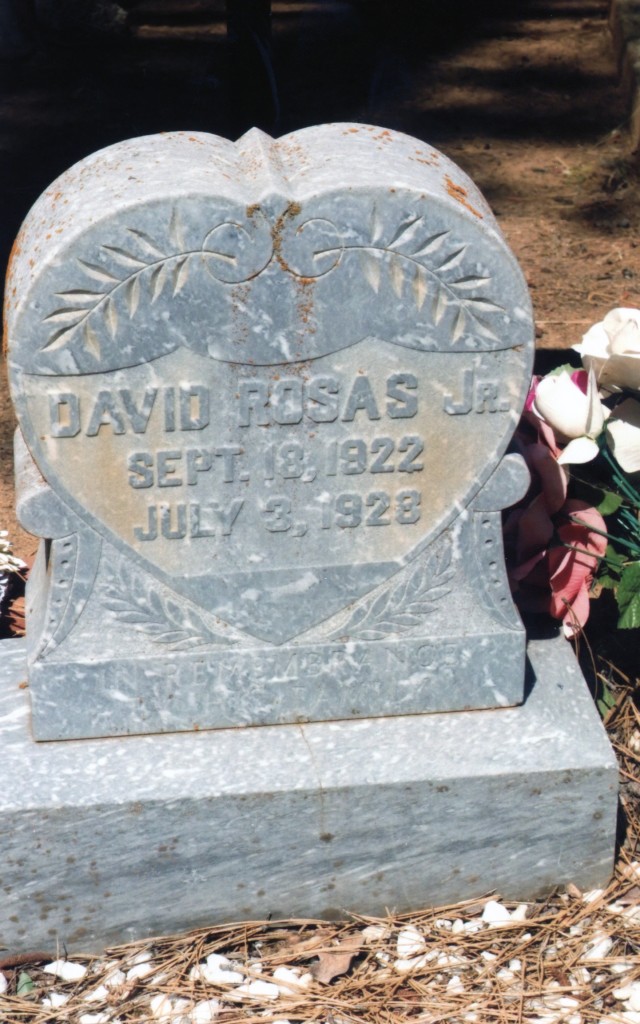
Rodman was part of the large influx in Westwood’s population during World War I. He came there from Akeley where he worked in bank, but there being no financial institution he went to work in the mill. That would change when Red River decided to go into the banking business in 1920 when it formed the Westwood National Bank. The bank was a very contentious issue among the Walker family, but it was one of many of the heated exchanges the family engaged in. Anyhow, the bank was conveniently located in the office building across the street from the Big Store and the mill entrance. In 1921, Rodman accepted the position of head cashier at the bank, a position he held until 1936, when Red River got out of the banking business when it sold it to the Bank of America. He died in 1943 and is buried in the Westwood Cemetery. On a final note, a remnant of the bank still remains, the concrete vault across the visitor’s center.
Subscribe and support this site for as little as $5.00 a month, or a mere 16 cents day.