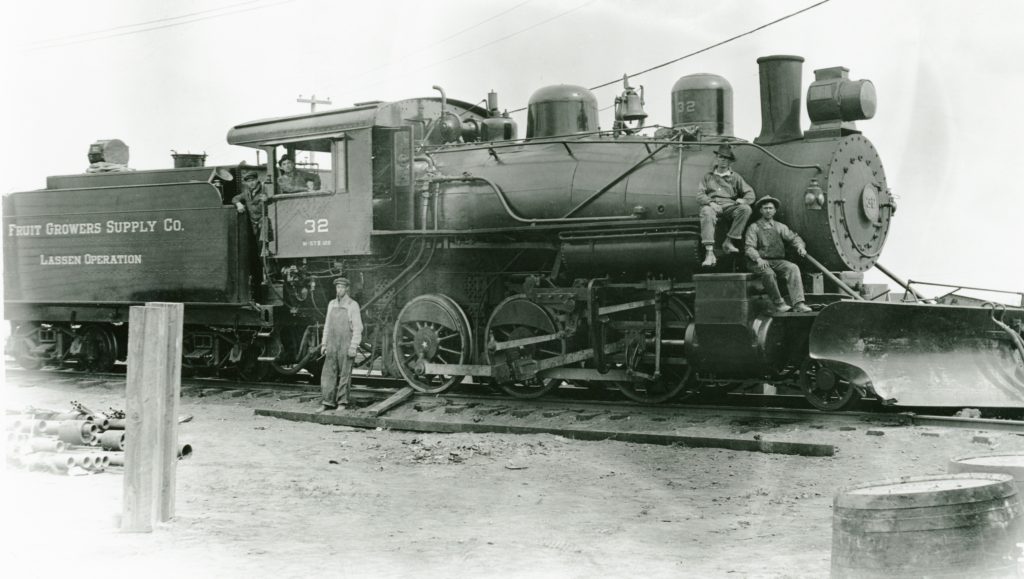
In 1919/20 when Fruit Growers Supply Company established its Susanville operation, they of course needed locomotives for its railroad logging operations west of Eagle Lake. They purchased this Baldwin locomotive from the Ocean Shore Railroad that operated a line along the Pacific Coast from San Francisco to Santa Cruz.* Fruit Growers ownership of the No. 32 was brief and they sold it in 1924 to the Red River Lumber Company. In 1944, Fruit Growers reacquired it when they purchased Red River’s Westwood operation. In 1953 the locomotive was scrapped.
*The Ocean Shore Railroad, was not completed with a gap in the middle.
Spread the word, and encourage a friend to subscribe
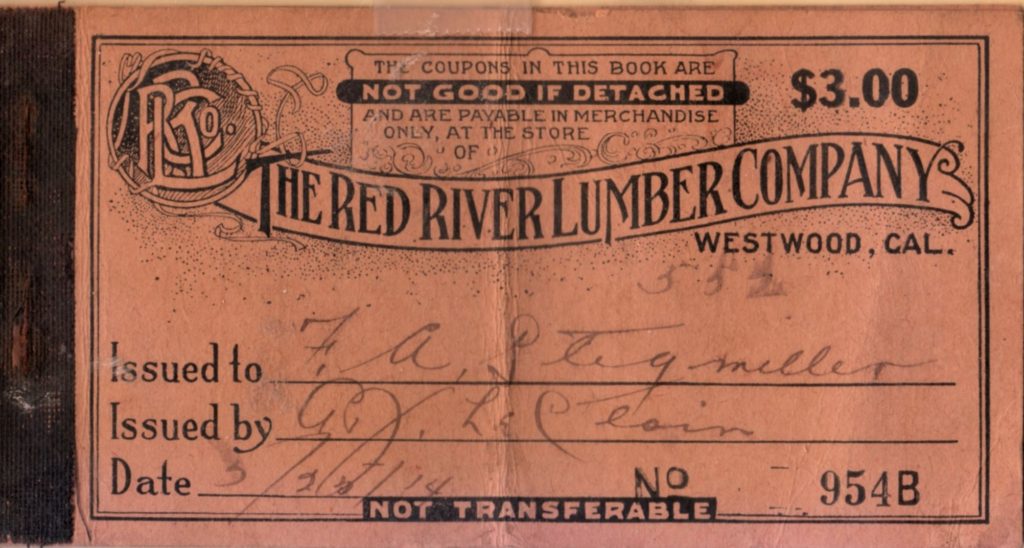
Red River Lumber Company like so many other company towns issued scrip—a form of company currency utilized when an employee received an advance on wages. When an employee received scrip, the amount was deducted from his wages. It was basically worthless as it could only be redeemed in company stores. The usage of scrip declined when employees were issued badges. With an employee badge number, the employee or a member of his family could charge anything they wanted from the company store using that number. Those charges were then deducted from the employee’s paycheck.
In November 1923, John Thomas of the Oakland Tribune wrote a complete description of Red River’s operations at Westwood. As to the company scrip he noted, “The company runs a general merchandise and department store, covering a whole block. Here you can buy anything from a paper of pins to a threshing machine.
“All the employees of the big mill trade here, also dad, grandma, auntie and the kids related to the employees. This is the only store in town. The strange part of it is you don’t need money in this store. You use scrip or paper money—not Uncle Sam’s brand of currency, the kind the banks hand out. You procure books of scrip tickets from the office. These scrip books contain five, ten, twenty-five and fifty cent checks, or tickets, and are good in the big store, also the movie show, newsstands and clubroom. I never tried putting scrip in the plate of the church, as I did not attend.
“These scrip books are transferable to members of the immediate family, that is to pa, ma and the kiddies. Grandma buys her darning cotton, uncle buys his chewing and smoking, sis buys her new slippers and the kiddies their candy and chewing gum all with scrip.”
Spread the word, and encourage a friend to subscribe
On November 10, 1931 was a historic day in many ways. A golden spike ceremony was held at Bieber to mark the completion of the Highline/Northern California Extension of the Western Pacific and the Great Northern Railroads.
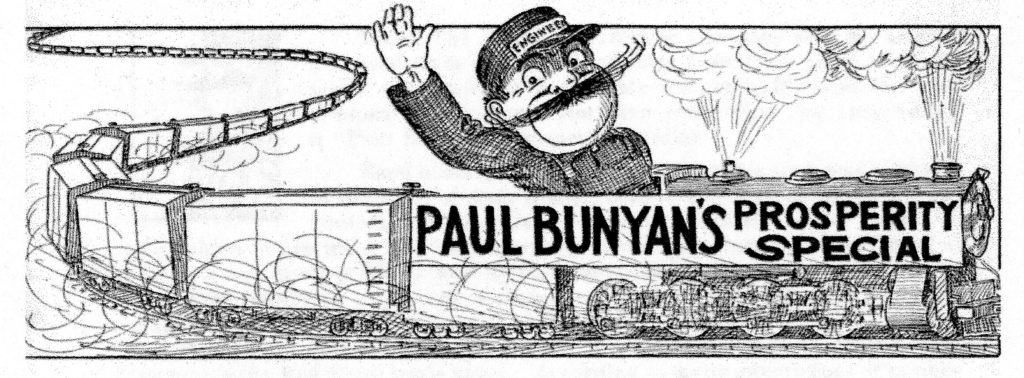
The next morning at Westwood the festive mood from the day before continued. Red River unveiled its impressive Paul Bunyan Prosperity Special train. This was no ordinary train for it consisted of 171 carloads of manufactured lumber, along with six locomotives and a caboose. The Prosperity Special measured 8,325 feet long—one and six-tenths miles. It was, one of the longest, if not the longest string, of loaded cars ever handled in one train movement at the time. Equally impressive, it was the single largest shipment of lumber products ever made and that came from one plant—Red River. The train contained 4,350,000 board feet of lumber, box shook, plywood, sash & doors, etc.
There was a tremendous amount of logistics involved to make the event happen. Red River had to coordinate with its customers to place their orders at the same time and they had to agree on a specific date. This was a challenge since winter was fast approaching and the demand for lumber would decrease. Yet, their customers supported the effort, and orders came from twenty-one states—ranging from Arizona to Tennessee to New Hampshire. As Arthur Curtis James, Chairman of the Board of the Western Pacific proclaimed, “There never was a train like this before in all the world.” Willis Walker stated: “The movement of this unusual volume of lumber products at this time demonstrates confidence on the part of consumers and indicates that conditions have stabilized and that a considerable volume of building hitherto postponed, will now proceed.”
Three weeks later the train pulled into Castle Rock, Colorado, its final destination. However, when the train arrived in Denver, most of the railroad cars were split up and went to a multitude of destinations.
Spread the word, and encourage a friend to subscribe
During the 1930s, Red River Lumber Company’s, Westwood Operation was going through tumultuous times. The one bright spot, and its biggest asset was the Burney Tract of eastern Shasta. It consisted of 83,000 acres with an estimated 2 billion board feet of timber. That’s a lot of wood.
The problem with Burney it was not accessible by rail. In 1936, a proposition was floated internally by Red River management to correct the situation. There were, of course, two obstacles the distance and the natural barrier of Hat Creek Rim. To bypass Hat Creek it was suggested to branch off the Western Pacific Railroad at Little Valley (in northwest Lassen County south of Bieber). Problem solved, or some thought. Then a family feud ensued that logs would be shipped all the way to Westwood to be milled. There were two train of thoughts, one to keep Westwood going and the other Westwood had run its course and time to shutter. Neither side prevailed. Sheer economics won, when it would cost to pay Western Pacific toll fee to haul the logs from Little Valley to Westwood was thirty cents per car mile—way too expensive. The project would be resurrected again, with a different, and closer departure point, which will be examined in a future post.
Spread the word, and encourage a friend to subscribe
It is interesting to note that the Union Pacific Railroad has a fire train, which was deployed during the recent (2020) North Complex fire, or more specifically that of the Claremont Fire near Quincy, Many may not realize, the Red River Lumber Company had their own fire train.
The winter of 1923-24, was one of the driest on record in California. That summer another record would be broken–forest fires. It was June, 1924, when the Red River Lumber Company having been in operation for over a decade experienced its first major forest fire. The fire broke out at Chester Flats between Camps 34 and 38 and burned a narrow strip of land, eight miles in length. Red River’s loss was minimal as the fire burned recently logged over land and the only significant damage was 500 cords of wood burned along 1,000 feet of railroad track. Red River considered its biggest loss was to the men fighting the fire which cost the company a $1,000 a day in wages, and it took a week to contain the fire.
In October 1931, the Red River Lumber Company disclosed a whopper of a fish story. First a little background. In the summer of 1922, Red River built the Indian Ole dam on Hamilton Branch just a short distance south of Westwood. The main purpose was to provide water power for a hydro-electric plant located along Hamilton Branch where it enters Lake Almanor. The newly formed reservoir created by the dam was officially named Mountain Meadows Reservoir, but the locals referred to it as Walker Lake. Whatever the case may be, fish flourished there, especially catfish.
Walker Lake aka Mountain Meadows Reservoir—David Zoller
In mid-October 1931, Red River needed to drain the reservoir to make some necessary changes and repairs to the dam. Of course, lots of catfish were sent cascading down Hamilton Branch, or so everyone thought. It turned out the catfish decided to take a short cut and went down to the penstock that feeds the power plant. All of a sudden the turbines at the plant came to an abrupt stop. Upon investigation, it turned out the turbines were clogged with catfish, and a lot. When things were all said and done there was a pile of catfish that measured twelve feet square and five feet deep. A new control gate was installed so that in the future, all fish would be detoured to the natural channel of Hamilton Branch.
Spread the word, and encourage a friend to subscribe
Something a bit different, but over the course of time we will explore the various locomotives in the railroad logging operations of the region. Lassen Lumber & Box was a relatively small operation when compared to it neighbors Fruit Growers and Red River. In addition, its railroad logging operation only lasted a decade starting in the 1919 season.
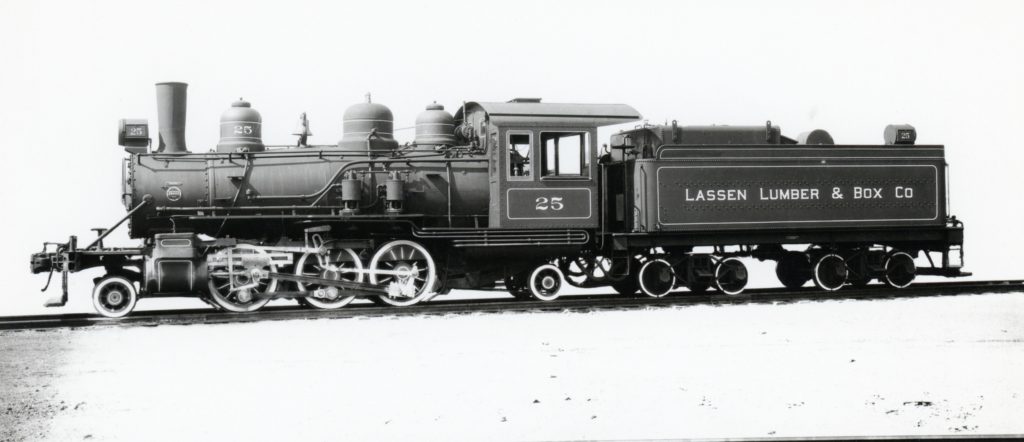
In 1923, Lassen Lumber purchased a brand new Baldwin locomotive they numbered the 25. It seemed only fitting to have this go with their new logging camp Lasco on the north side of Peg Leg Mountain. But the good times did not last long and by 1929 the company would abandon logging due to a dwindling timber supply compounded by glut of lumber on the market. They sold the No. 25 to the Red River.Lumber Company. In 1938, Red River in turn sold the No. 25 to Modesto & Empire Traction Company. What became of it after that, I do not know.
In 1912, when Red River Lumber Company began construction of its company town of Westwood, Lassen County officials did not know what quite to expect. Lassen County had experience with planned communities, such as Standish, but none of these proposals ever came to full frutition that the promoters envisioned. Westwood was entirely a different proposition. County officials were relieved that all of this development would not only cost the county any money, but its tax base mushroomed beyond their wildest dreams. The county was spared every expense, even the deputy sheriff, Red River paid that salary.
The good times would not last forever. By the early 1930s Red River was in a serious financial crisis. The days of a company town would soon only exist as a memory. Red River’s company owned businesses would be no more, those enterprises leased to outsiders. In the fall of 1934, Red River and Lassen County began working on the transition wherein the county would be responsible in maintaining the streets of Westwood. On November 10, 1934 Red River deeded over the streets of Westwood to the County of Lassen, however for reasons unknown the county did not accept the deed until September 1935.
Spread the word, and encourage a friend to subscribe
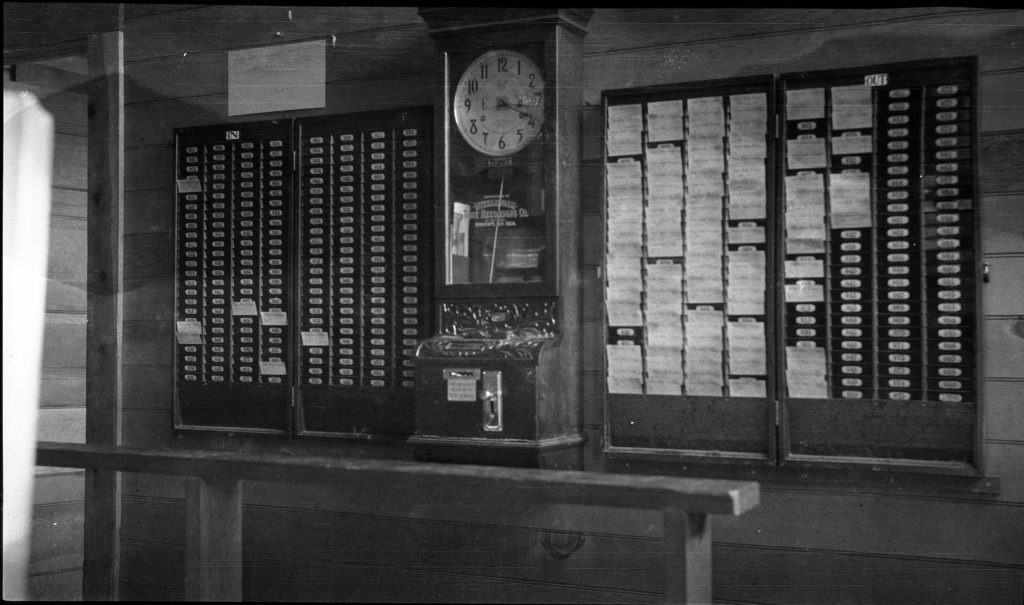
The Red River Lumber Company’s Time Clock, 1915—Otto Kratz Collection
The Loyal Legion of Loggers and Lumbermen, also known as the 4Ls was a unique government intervention to get sawmill operators and their workers to work together during World War I. This unique labor organization was created due to a lumber strike of the Pacific Northwest that crippled the production of spruce lumber. This commodity was essential for its strength and flexibility in airplane construction and the government was in dire need of the aircraft.
When the War Department intervened it was able to get both the mill operators and lumber workers to work together as a patriotic association. Concessions were made by mill operators to provide for an eight-hour day and better working and living conditions. In return the employees were required to sign a loyalty pledge. Those who refused to sign the pledge were not hired. In essence, the 4Ls was a government sponsored union.
After the War the 4Ls reorganized and it remained a regional organization of the Pacific Northwest. It was the American Federation of Labor that was the main rival of the 4Ls. It had problems competing with the 4Ls since the latter was a de facto “company union.” The company’s management were members of the 4Ls and basically dictated the organization. This had great appeal to Red River Lumber Company. In July 1933 Red River joined the 4Ls, and Ted Walker, a member of Red River’s management served on its Board of Directors. It was short-lived when Congress approved the Wagner Act that allowed the labor movement and union formation more clout.
Spread the word, and encourage a friend to subscribe
By the late 1930s, the Red River Lumber Company had exhausted most of its timber tributary to Westwood. Red River officials consulted with the Lassen National Forest about a possible exchange of cut-over lands for timber rights on Forest Service lands, which could be done under the accordance of of the Land Exchange Act of 1922. The Forest Service considered the exchange program beneficial in the long range for future recreational aspects for the public and also for the re-growth of the forests. A deal was struck and on January 21, 1941, Red River deeded over some 50,000 acres adjacent to Lake Almanor and Butt Valley to the Forest Service in exchange for 50 million board feet of timber in the Moonlight district, east of Westwood.
Camp 38, Red River Lumber Company, 1922. It was located on the east shore of Lake Almanor. Courtesy of R.S. Pershing