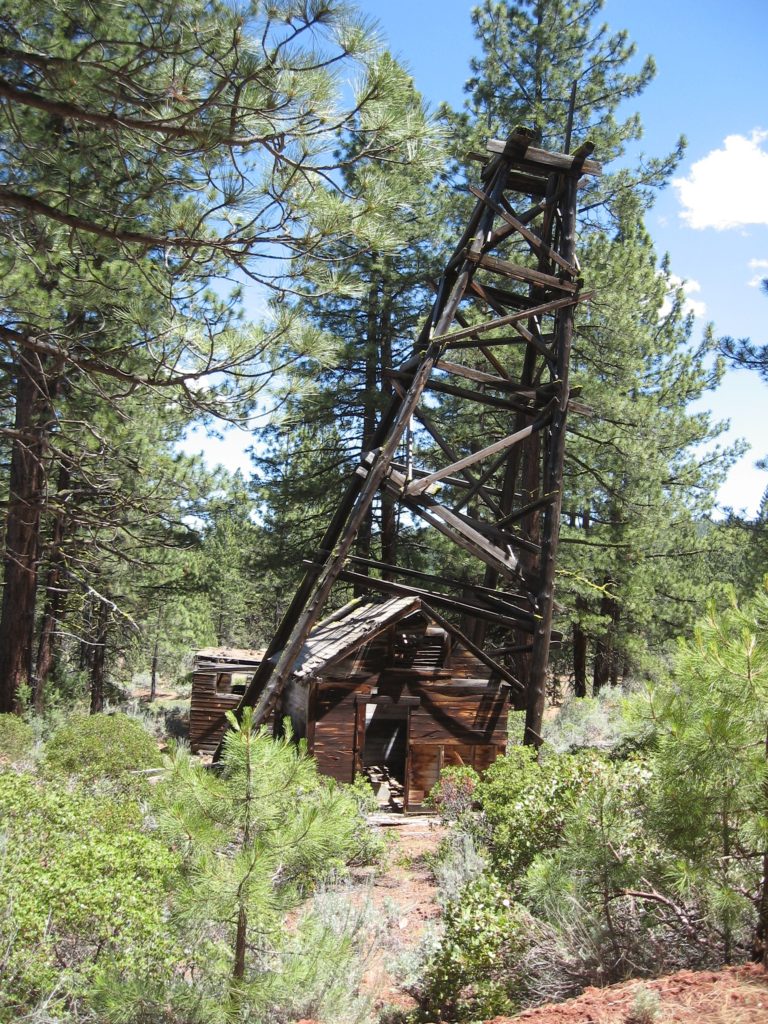
Last summer, in one of those “Where are We” segments was Camp Harvey. While I provided details about the old railroad. logging camp, I neglected to state why the old water is even in existence. When the Fruit Growers Supply Company abruptly shutdown the camp in the spring of 1949, they were in hurry to move the portable buildings to a new location. The days of railroad logging and their counterpart camps were quickly fading on the horizon. Fruit Growers had reached an agreement with Shasta Forest, who managed the property for the heirs of the Red River Lumber Company, that they could take their time in removing the structures. Most all of the logging cabins and related structures were removed in 1952. It was mutually agreed to keep the water tank tower with its 10,000 gallon redwood water tank, along with the pumping house and pipes in place for fire protection.
Spread the word, and encourage a friend to subscribe
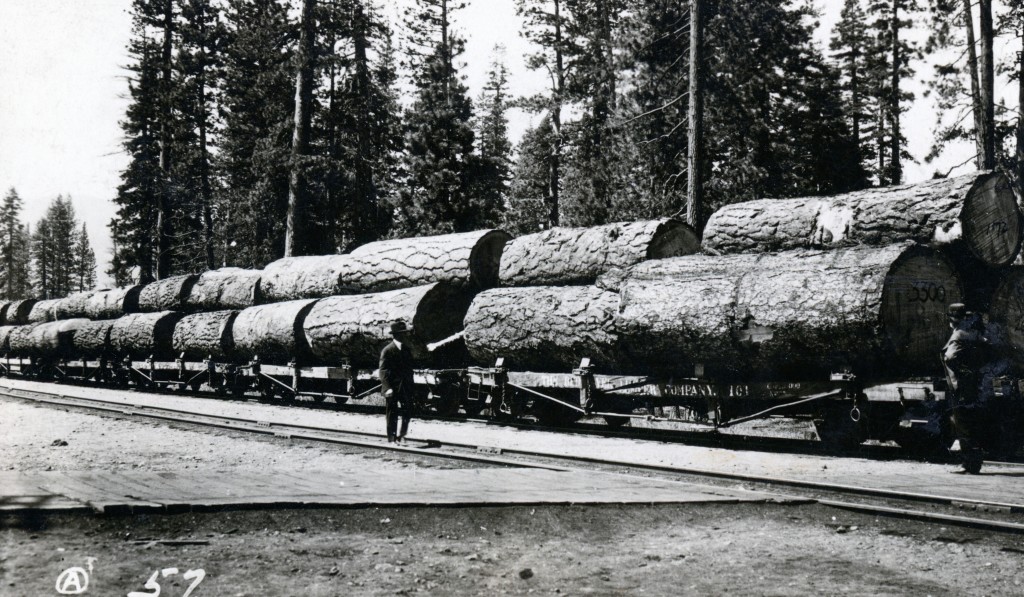
Train load of logs leaving Camp B, Fruit Growers Supply Company, 1922
A reader noticed recently the logs depicted above where on railroad flat cars belonging to the Red River Lumber Company. Fruit Growers found it to be more economical to lease flat cars from the Southern Pacific Railroad, who transported the same from Westwood Junction to the Fruit Grower’s mill in Susanville. Fruit Growers initial operations in the early 1920s, experienced a flat car shortage with Southern Pacific. Red River being a good neighbor obliged to provide Fruit Growers with flat cars until the matter could be resolved with Southern Pacific.
Another point I might add, the above was not a typical load of logs. These type of images, are common among lumber companies. They were used to show investors, bankers and the lot the most premium logs, to show them where the money was being spent. In Fruit Growers case, this photograph would be published in a portfolio to show the citrus growers where their money was used to provide them wooden boxes to ship citrus.
Red River operated numerous logging camps from 1913 through 1944 when it sold to Fruit Growers. The camps were assigned numbers, though in no particular order. The majority of the camps were short lived and only had a span of one to maybe three years. One of the more interesting camps was Camp 33, but referred to as Town Camp, as it was located less than a mile west of Westwood. What made it unique was that Red River’s company town of Westwood would experience from time to time a housing shortage for its employees. On occasion, this camp was used to house mill workers instead of loggers.
Spread the word, and encourage a friend to subscribe.
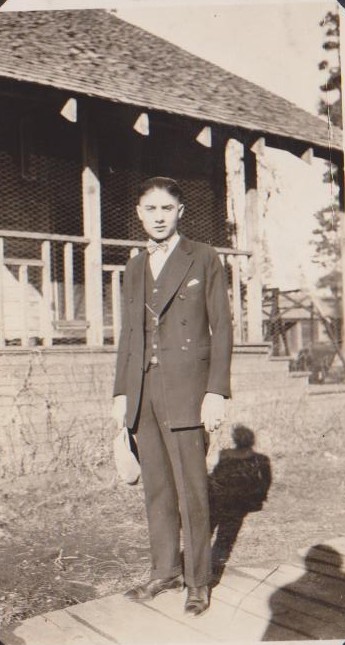
Unknown gentleman in front of the Old Town General Store, circa 1930s. Courtesy of David Zoller.
In 1922, the Red River Lumber Company announced that Westwood was to become a permanent town. Additional investments in community buildings commenced, such as a American Legion Hall and Masonic Hall. Across the log pond was Old Town home to large immigrant population. The residents of Old Town felt left out with no hall of their own. They, too, had their own fraternal organization the Centro Hispano Americano Society and desired to have a place to hold their functions.
In 1926, the residents of Greenville built a modest community hall for $2,100. This inspired the Old Town to do the same. They contacted Fletcher Walker, Red River’s resident manager, with a proposal to build a hall similar to Greenville’s and offered to pay half the costs. Fletcher took the matter of under consideration and on August 20 wrote to His brother, Willis Walker, part of the local management, about the topic: “The Mexicans and wops want a recreation hall similar to the one recently built in Greenville. The Old Town bunch are willing to dig up $1,300 which will cover the labor cost, and they have $1,000 of it in the Bank, if you are willing to build a building on this basis. “The way it stands they cannot take part in the recreations on this side of the Pond as the majority of them do not speak English. A Hall of this sort would make a place for their parties, dances, a Movie occasionally, and a general social center and they have a Fraternal Society organized so they feel competent to police, janitor and generally conduct the building so it will make a better place for them all to live, and as this common labor is quite essential to the Plant as they do work that the short staked Americans will not stay long enough as to become sufficient in it has a commercial value to us that it is hard to measure dollars and cents, but I believe is a good proposition to go ahead with.”
Willis was agreeable and wrote back, “If for amusement only and thus we could do this much to retain men and helps on labor turnover.” Archie Walker who constantly watched Red River’s bottom line wanted to know if they would receive any rent for the building, or were they just donating the use of it? What is rather remarkable while the Walkers quibbled about spending so little money to build this hall, they did not blink an eye when in the previous year they had spent over $100,000 to build and furnish the halls for the American Legion and Masons, as well as the Westwood Theater.
For the residents of Old Town, they were just pleased to learn that their request for a hall was approved. When completed they referred to their hall as the El Centro.
This post nearly slipped through the proverbial crack. Some may recall the initial piece on Red River Facts. Those two articles were done prior to my fall from grace so to speak and and thus some things were sidelined.
As some may recall, the 1916 publication extolled the many virtues of Red River Lumber Company’s plant at Westwood. In the end not only did it inform the perspective customer that they would receive a superior product at the lowest cost. Satisfaction guaranteed. One statement that caught my attention: “Special items can be cut to order at Westwood with unusual promptness. Even should it be necessary to fell trees and cut logs, every operation from stump to car moves without friction or delay.”
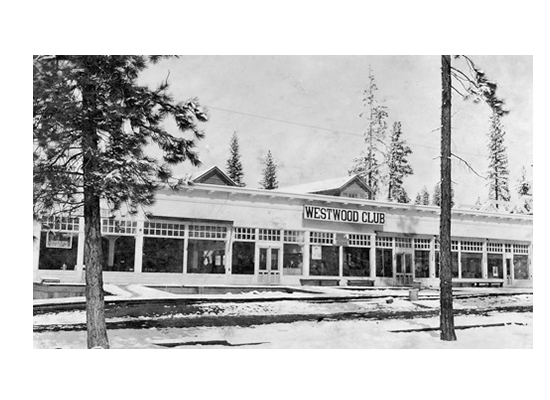
When the Red River Lumber Company established its company town of Westwood in 1913, it had to provide numerous amenities due to its remote location at the time. It was necessary to not only attract employees, but to retain them, as the lumber industry experienced a high turn over rate in labor. The Westwood Club was one of several facilities designed to meet the recreational needs of its employees. It included a restaurant, lunch counter, soda fountain, cigar and newsstand, barbershop, reading room and a billiard room.
On early Friday morning, March 31, 1944 a fire broke out in the Westwood Club though the cause, was never determined. Within twenty minutes the whole building was engulfed in flames. The heat so intense, that Nick Kannier’s automobile which was parked in front of building, burst into flames. Even neighboring buildings from across the street were smoking, on the verge of spontaneous combustion, which with quick action by the fire department prevented the same.
The J.R. Bartlett Company were the concessionaire of the Westwood Club, which included the clubhouse, cafe, pool hall, bar and lounge. There were four other tenants in the building—Ehorn’s Pharmacy, Quitman’s Apparel, Westwood Market and Kilpatric’s Used Furniture department. Estimated loss for all parties was placed at $125,000.
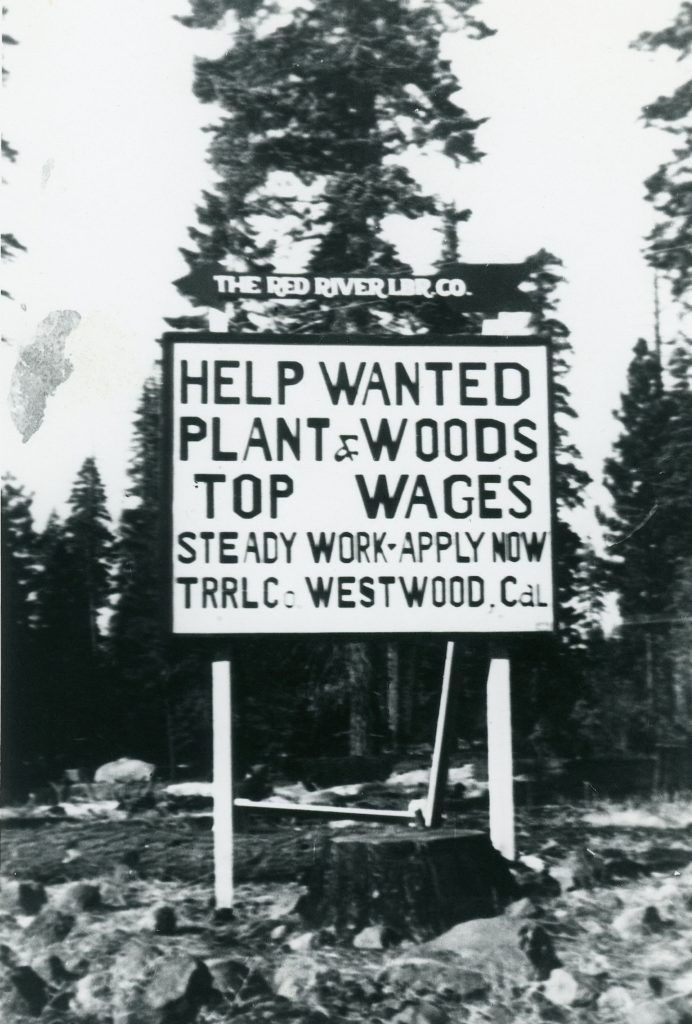
Red River Lumber Company had a large employee turnover.
The Industrial Workers of the World (IWW) and sometimes referred to as the “wobblies,” is a labor organization that formed in 1905. As a matter of fact, certain Starbucks shops are affiliated with it. The IWW had an image problem in its early years. Some considered it radical in its thinking for the time. Others considered it a communist organization. It gained notoriety for its strikes that were marred with violence.
The biggest problem IWW faced in Lassen County was that all three big lumber companies paid the prevailing wage, if not above, and provided better housing than found in other regions on the west coast. The employees had few grievances, so there was no incentive to be a part of the labor movement. It was because of these conditions that Lassen County sawmills remained union free during the 1920s.
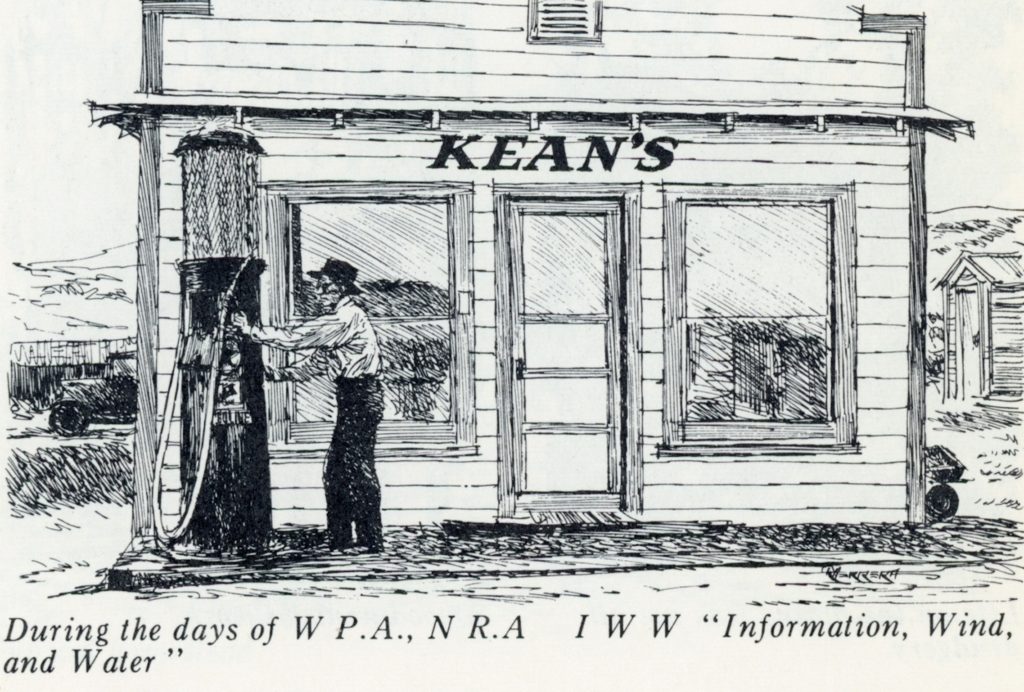
A sketch by R. Herrera from the early days of the Madeline Plains
In the 1930s witnessed Franklin Roosevelt’s economic recovery program for the nation, which brought about with it a whole new terminology. It could actually be called alphabet soup, with such acronyms as the Civilian Conservation Corps (CCC), National Recovery Administration (NRA) and the Works Projects Administration (WPA). In Margaret “Peg” Woodrich’s small booklet about the history of the Madeline Plains, she added the whimsical non-existent program Information, Wind and Water (IWW).
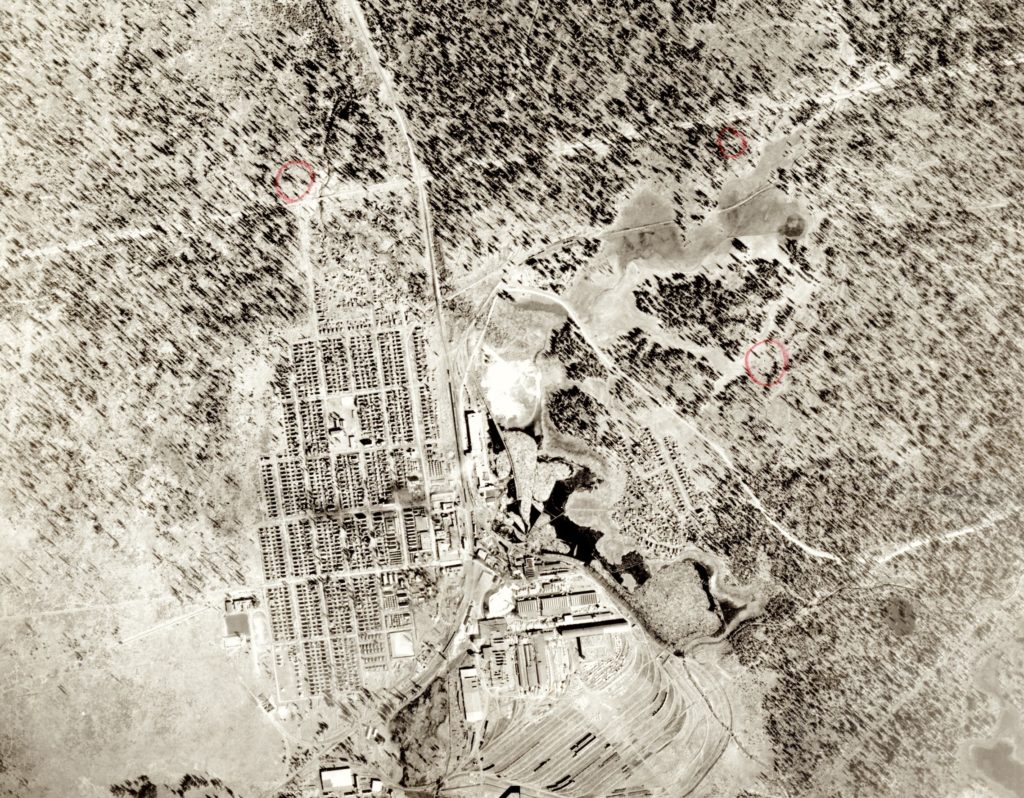
Westwood, October 13, 1941 —Courtesy of Hank Martinez
This was an exciting era for the residents of Westwood. While the United States had not entered into the global conflicts, the nations economy was in high production to meet the nation’s allies. Lumber was a high priority commodity, and Red River Lumber Company’s operation at Westwood was put into high gear.
The installation of the Hammerhead Crane at Westwood, was one of many improvements to entice buyers.
Red River not only went into a full production mode, the first time since World War I, it went on a major modernization campaign. Not only where there substantial upgrades in all the mill equipment, but its logging department saw major changes as well—among other things its own fleet of logging trucks.
While the casual observer or Westwood resident thought all these improvements was just a sign of prosperity from the recovery of the nation’s Great Depression of the 1930s. Behind the scenes, Red River was busy putting its Westwood operation on the market, to sell, nothing different what a current homeowner does prior to listing their house on the market.
Red River timber fallers preparing to do their job 1915.
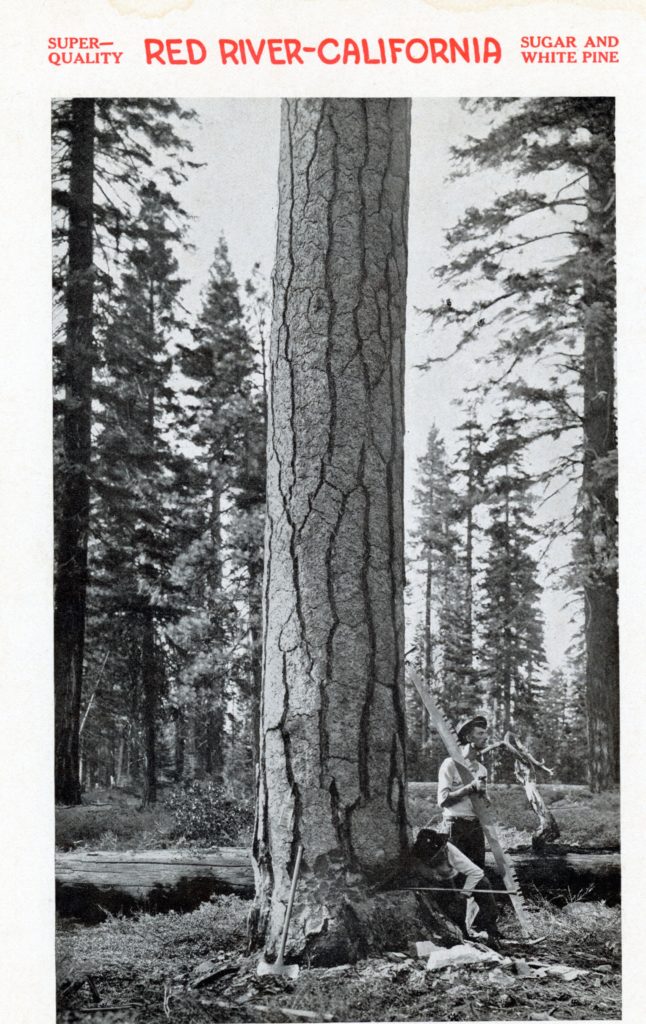
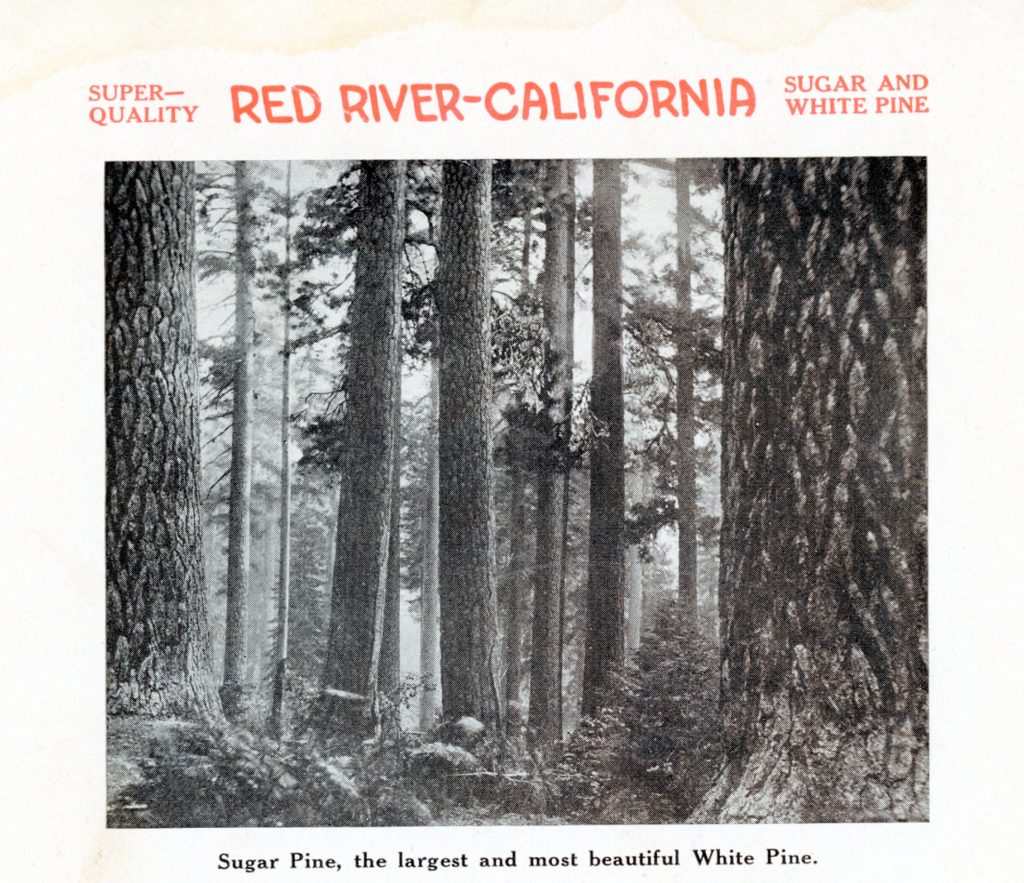
It was only until recently that I learned when the federal trade commission cleared up something that confused me for years. In 1931, the commission ruled that thirty-nine West Coast lumber producers would be banned from using “white pine” in their advertising, when in fact it was a “yellow pine” i.e. ponderosa pine. The commission stated there were no true white pine the west. It was stated these producers used white pine in advertising that resulted in a “substantial monetary sales advantage.” Two local companies were cited, Lassen Lumber & Box and Red River Lumber.
When I first began my research, I was confused with the term white pine, yet the two aforementioned companies sold their product under that label. In fact, they aggressively marketed their lumber as such in the Midwest and Eastern markets, since for them that was their preferred lumber.
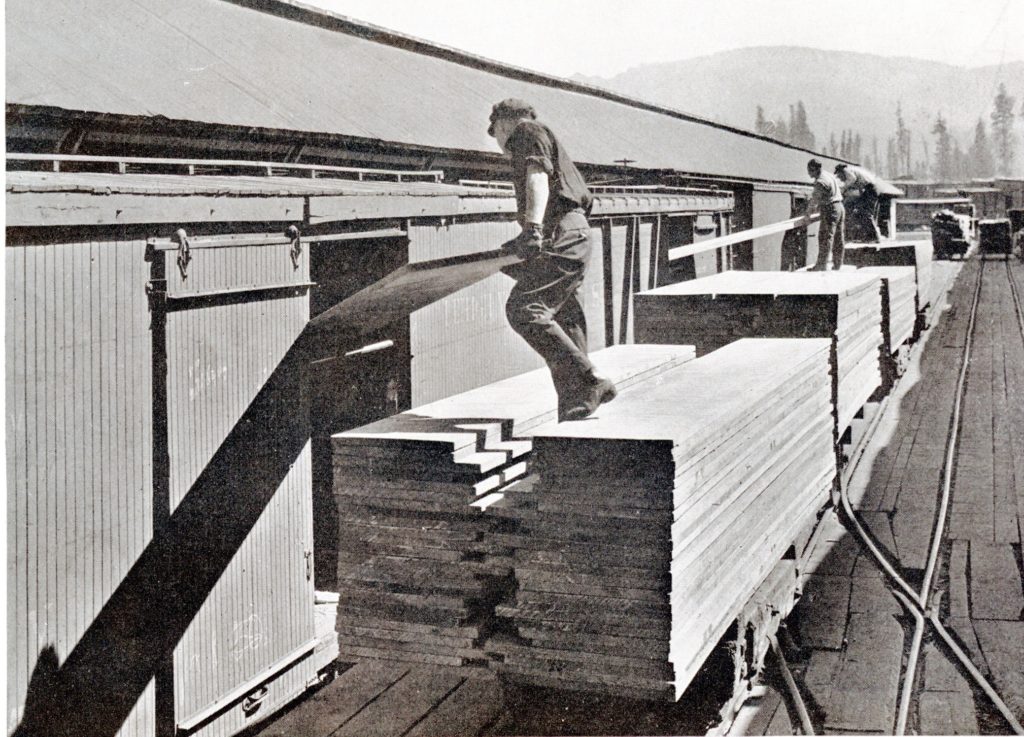
Every pine buyer wants to know , “What do I get for my money?” And “What does Red River-California offer that I can get nowhere else?” We submit herewith a few facts concerning Red River-California Sugar Pine and White Pine and the plant at Westwood, California, that produces it and delivers it to all parts of America. This service, more than any other gives you:
QUALITY: “Old-fashioned White Pine, “scientifically manufactured.
UNIFORMITY: Full specified thickness and width, thoroughly seasoned.
ECONOMY: Reduces your working-up cost. Gives you a superior product.
SECURITY FROM SUBSTITUTION: As manufacturers, we ship nothing but genuine Red River-California. Unlimited forest resources assure this uniform supply of many years to come.
RELIABLE DELIVERY: Plant runs the year ‘round. Westwood lies east of the Sierra Nevada snowsheds, on a direct line to eastern points and near a great transcontinental empty-car center.