Tag Archives: Native American

Milford’s Potato War

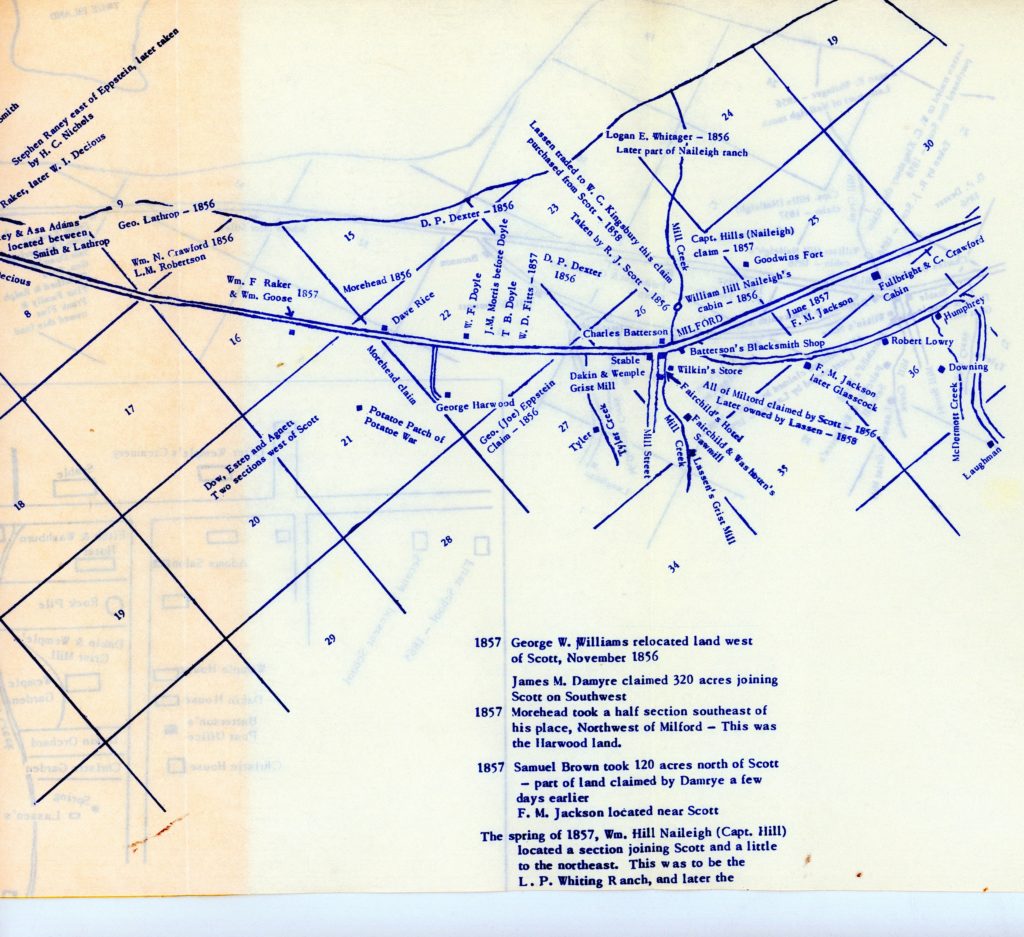
Claude Wemple's historical map of the Milford region, shows not only the location of the Potato War, but numerous other sites.
Claude Wemple’s historical map of the Milford region, shows not only the location of the Potato War, but numerous other sites.

Who knew that the almighty spud would be the cause of conflict? It all began in October 1857 when a band of Washo Indians visited William Morehead’s potato patch, some two miles northwest of Milford. When confronted by Morehead and others the Washo became belligerent and this did not go over well with the residents of the Milford district. The locals received re-enforcements from the California state arsenal, volunteer fighters from Sierra Valley, and a band of Piutes. During the skirmish several Washo were killed and many wounded. In the aftermath, the Washo withdrew from the lower end of Honey Lake Valley and never ventured north of Long Valley. Again, the residents petitioned for a permanent military fort after the Potato War, only to be ignored, again and again.
Spread the word, and encourage a friend to subscribe.

Lassen Park – Butte Lake

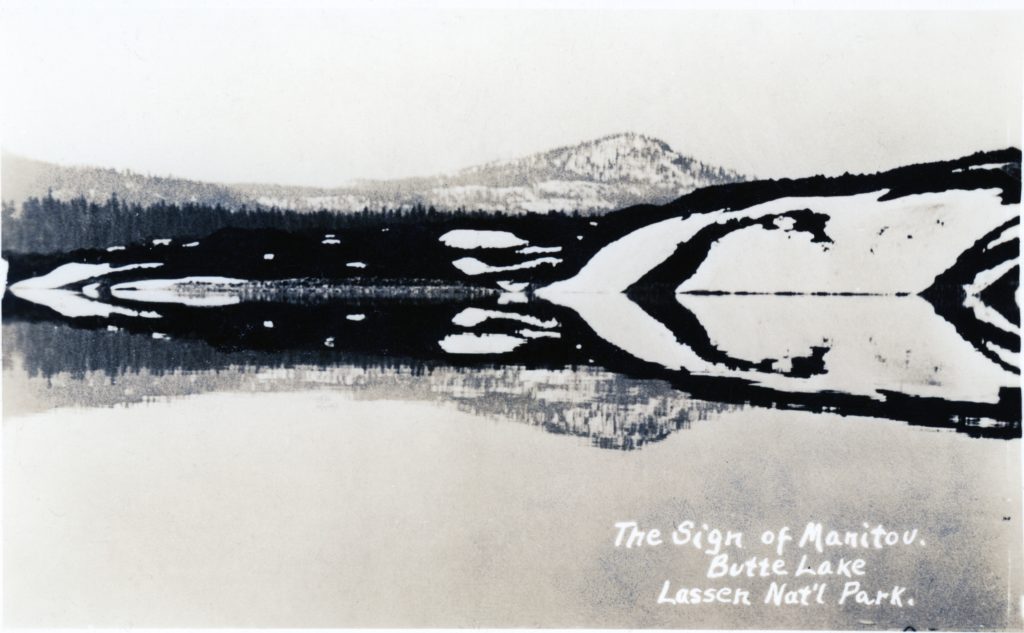
Butte Lake, circa 1920. Roy Sifford, of Drakesbad fame wrote: "The sign of the Manitou which means the sign of God. The shadows in the water made a long arrows which the Indians thought that was a sign of the Great Spirit (Manitou) or God gave them. Courtesy of the Sifford Collection.
Butte Lake, circa 1920. Roy Sifford, of Drakesbad fame wrote: “The sign of the Manitou which means the sign of God. The shadows in the water made a long arrows which the Indians thought that was a sign of the Great Spirit (Manitou) or God gave them. Courtesy of the Sifford Collection.

This lake in the northeast portion of  Lassen Park was originally referred as Black Butte Lake and Lake Bidwell. J.S. Diller named it Lake Bidwell in honor of General John Bidwell who came to California in 1841 and founded the town of Chico. The official name dates back to 1883 and no doubt received its name from two surrounding landmarks, Cinder Butte and Black Butte.

The French Canadian trappers of the Hudson Bay Company introduced the term “butte” to Western Americana. It was used to designate a landmark for an isolated peak, but not high or large enough to be a mountain.

Never miss a story, click here to subscribe for as little as five dollars a month.

Summer Solstice Tour

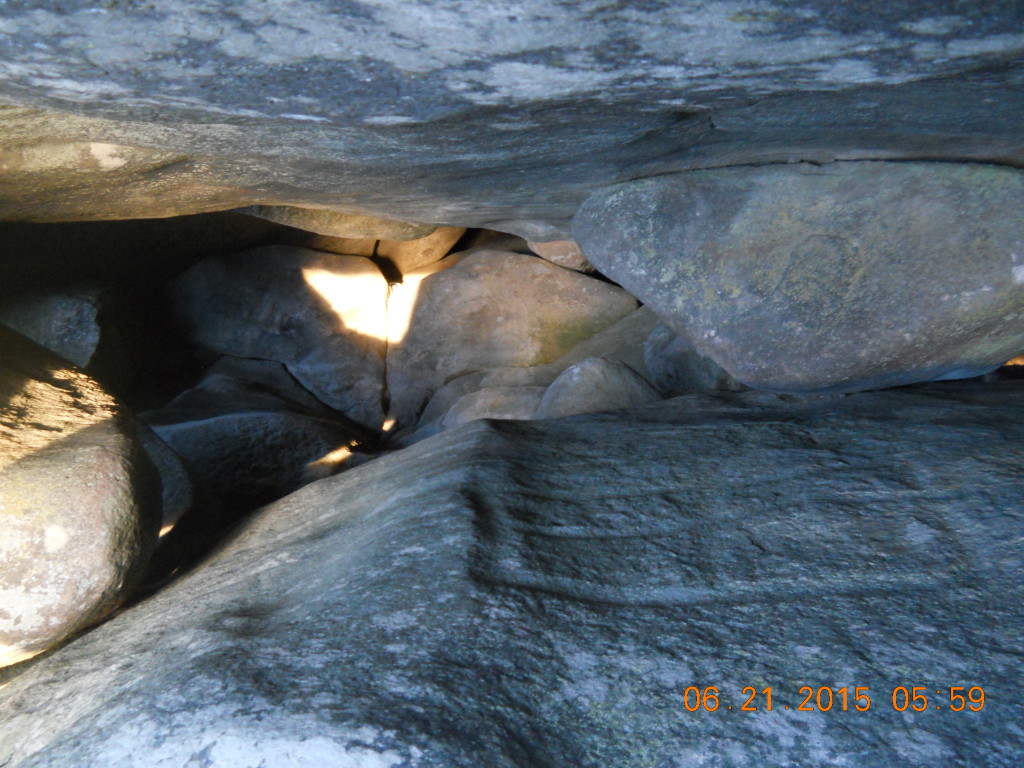
Sunrise Chamber, 2015

Were you aware that the Belfast petroglyph site also serves as ancient observatory?  This event only occurs on the morning of the summer solstice when the sun enters a chamber highlighting a variety of glyphs, among other things. It is quite the sight to see.

sunrise chamber
The sunrise chamber.

Last year we had a small delegation that made the trek. This is an early morning excursion and I mean early as we gather at 5 a.m. to make the trek. In preparation attendees receive in advance John Rudolph’s paper, “An Ancient Solar Observatory.” If there is enough interest we can make the trip again this year. Please let me know. One final note the solstice occurs on Monday, June 20.

Note: There is a $5.00 fee for non-subscribers.

Never miss a story, click here to subscribe and support.

Thomas Tucker

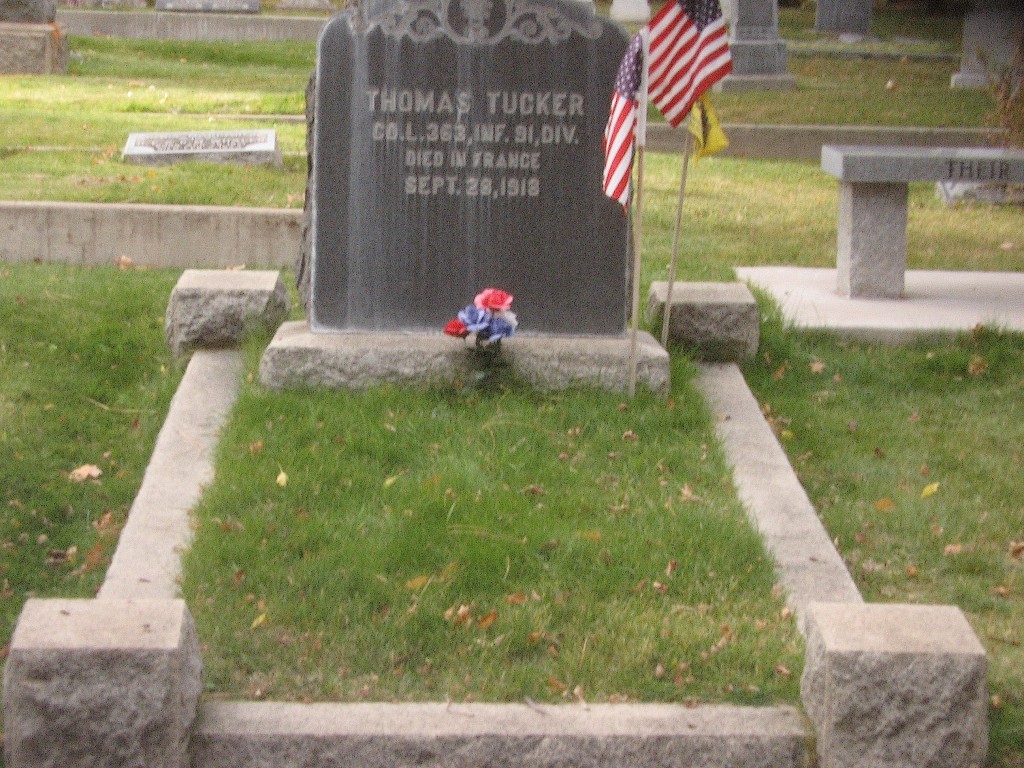
Thomas Tucker's headstone prior to cleaning.
Thomas Tucker’s headstone prior to cleaning, November 2014.

Thomas Tucker, a Maidu born at Big Meadows (now Lake Almanor) in 1895 and moved to Susanville at an early age, where he was raised by his aunt and uncle Cap and Emma DeHaven. He first attended the Greenville Indian School, where he excelled in his studies. He was noted for his gifted vocals in singing, as well as his athletic abilities. When the U.S. entered World War I, he enlisted. On the fateful day September 28, 1918 he was killed in action in France, becoming the first casualty from Susanville in the War. His comrades held him in high esteem and when the local American Legion Chapter was formed in 1920, it was named in his honor, Thomas Tucker Post No. 204. In 1940, a tree was planted in his memory at the Lassen County Courthouse, and a small marker placed with his name. Continue reading Thomas Tucker

Coyote Scalps

Coyote Scalp418
rec

In 1880s and 1890s, California began offering a bounty on coyotes at the insistence of the livestock industry. By 1894, the price per scalp was five dollars. The whole procedure was handled through the county clerk’s office.  For some individuals it was a lucrative deal, and could actually make a living at it. Many Native Americans partook in the program, instead of working as a laborer for a rancher. Once the county clerk received reimbursement from the state, the clerk would take the scalps and burn them.

Never miss a story, click here.

n

Papoose Meadows Conflict

Papoose Meadows, 1914.

During the 1860s, a state of uneasiness existed between the Indians and the new settlers. Because of the hostilities, the settlers were suspicious of unusual Indian activities. In June 1866, Joe Hale, who had been hunting in the mountains, returned to Susanville and stated that he had seen some Indians who might be selling ammunition to another group of renegade Indians. The latter group, purportedly, were planning a possible attack in the Summit Lake country of Nevada. The following day, a party of men from Susanville consisting of Joe Hale, Byron B. Gray, Charlie Drum and E.V. Spencer went to investigate Hale’s observation. On the return trip from the rendezvous they stopped at Papoose Meadows where they found a group of Indians camped. Continue reading Papoose Meadows Conflict

Pogonip

fog
A pogonip as seen from Antelope Grade

In 1859 residents of the Honey Lake Valley experienced one of the most dreaded winter weather conditions, a pogonip—the Indians term for an ice fog. The term loosely translates into “white death,” for many Indians caught pneumonia and died. This fog settles in the mountain valleys. One can ascend a few hundred feet above the valley floor, bask in sunny temperatures and overlook a sea of clouds. Pogonips vary in severity. A mild one will consist of persistent endless fog with sub-freezing temperatures. The worst variety is when it turns into a literal ice fog, coating everything. The first day can be spectacular with ice crystal formations on everything. After several successive days of those bone chilling temperatures, it quickly loses its appeal. The pogonip of 1859 was one of severest on record. The heavy cold fog lasted six weeks. So much frost accumulated on the grasses that cattle could not eat it. In addition, since the first settlers had been accustomed to mild winters, very little hay was put up, and a great many cattle starved to death that winter.

Never miss a story, click here.