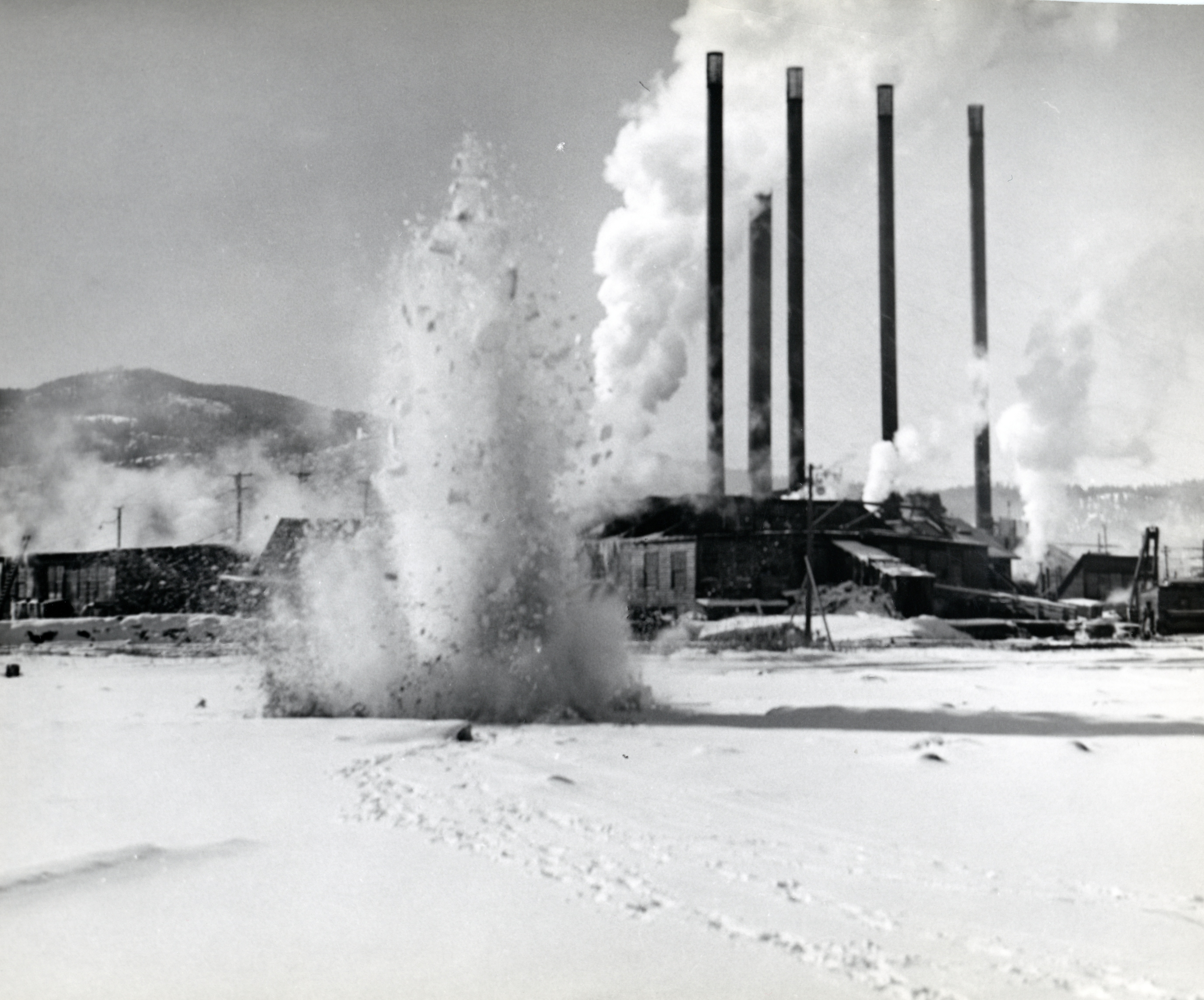
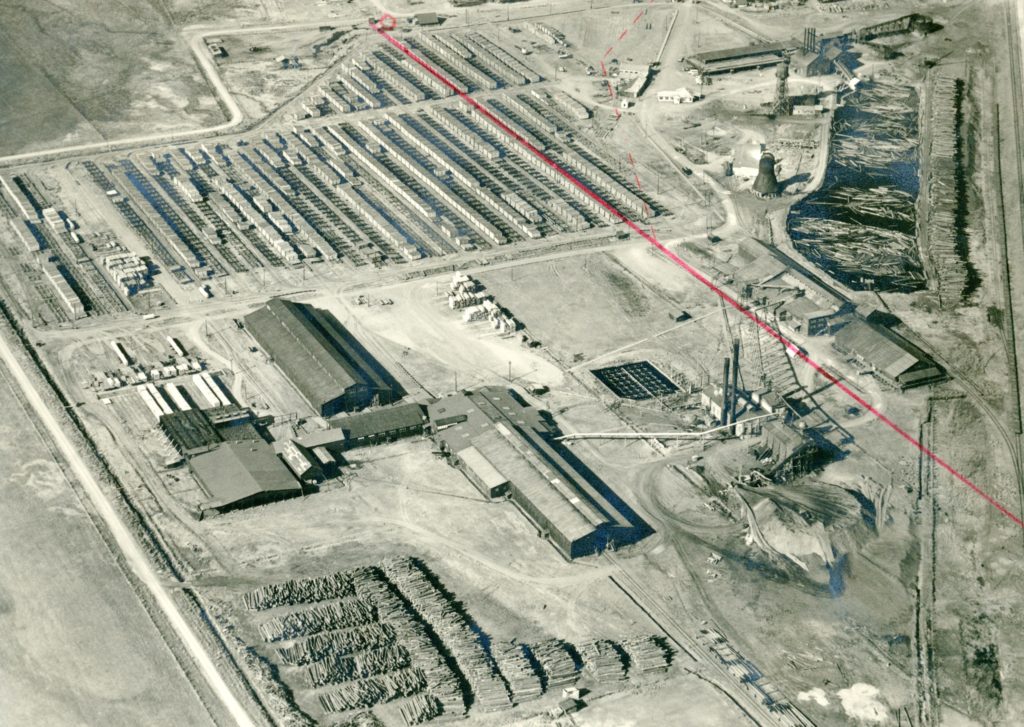
Dynamiting the Westwood millpond, January 27, 1949. Courtesy of Fruit Growers Supply Company
It has been some time since this region has experienced prolonged sub zero temperatures, which is fine with me. When it does get that cold things happen. In January 1949, the temperatures plummeted to nearly thirty degrees below zero at Westwood. The millpond froze. When the Red River Lumber Company designed the facility, they placed piping from the powerhouse that forced steam air directly into the millpond near the sawmill. This system was no match for Mother Nature. To keep the mill operating it was necessary to use dynamite to blast loose the logs in the millpond. Continue reading How Cold?→
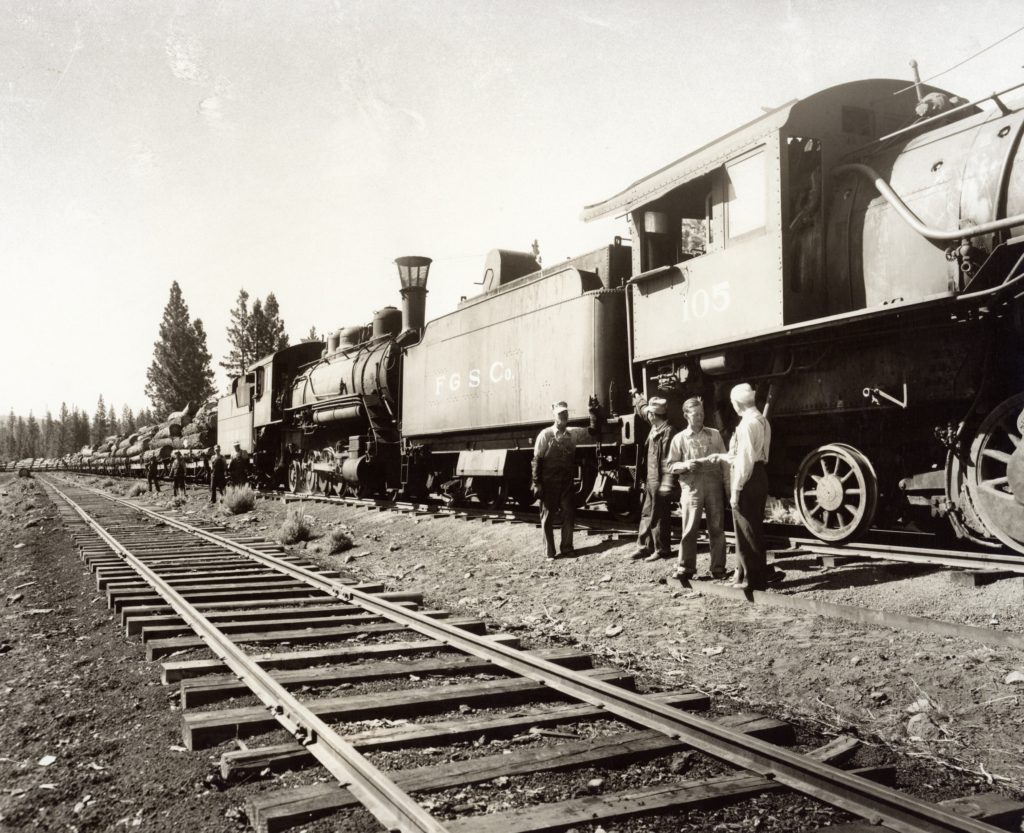
Fruit Growers Locomotive No. 105 at Halls Flat, 1946.
In 1940, with the Red River Lumber Company making plans to log north of Westwood in the Poison Lake and Blacks Mountain region further discussions were held as to construct a railroad line to Burney to harvest their extensive Burney Tract that contained two billion board feet of merchantable timber. An initial railroad survey was conducted with a starting point at Poison Lake. The major barrier was that of Hat Creek Rim. It was determined to follow the rim and slowly make a descent at Cassel and then onward to Burney. It was estimated it would cost one million dollars to construct the line. Fletcher Walker, the resident manager of Westwood was eager to build and wrote, “We would increase the Veneer Plant output and get good logs to operate it and this alone would more than pay for the cost to build the railroad.” However, no one else in the Red River family shared Fletcher’s railroad proposal. In 1941, Red River made the decision to sale Westwood and the Burney Tract.
In 1944, after intense negotiations, Fruit Growers Supply Company purchased Westwood and the Burney Tract. They, too, contemplated to build a railroad line similar to the one proposed by Red River. As late as 1951, Fruit Growers still considered the option of a railroad to Burney. Yet, changes were occurring rapidly with the conversion to cardboard boxes, that forced Fruit Growers to reconsider its future plans, as the needed for wooden boxes to ship citrus would eventually be eliminated.
This is to inform any one interested if you want to obtain a copy of the only complete history of the entire Northern California logging operations of the Fruit Growers Supply, here is your last chance offer. I suggest you do not procrastinate. My inventory is very low with less than thirty copies, and once its gone, its gone. To learn more about the book and to order see books.
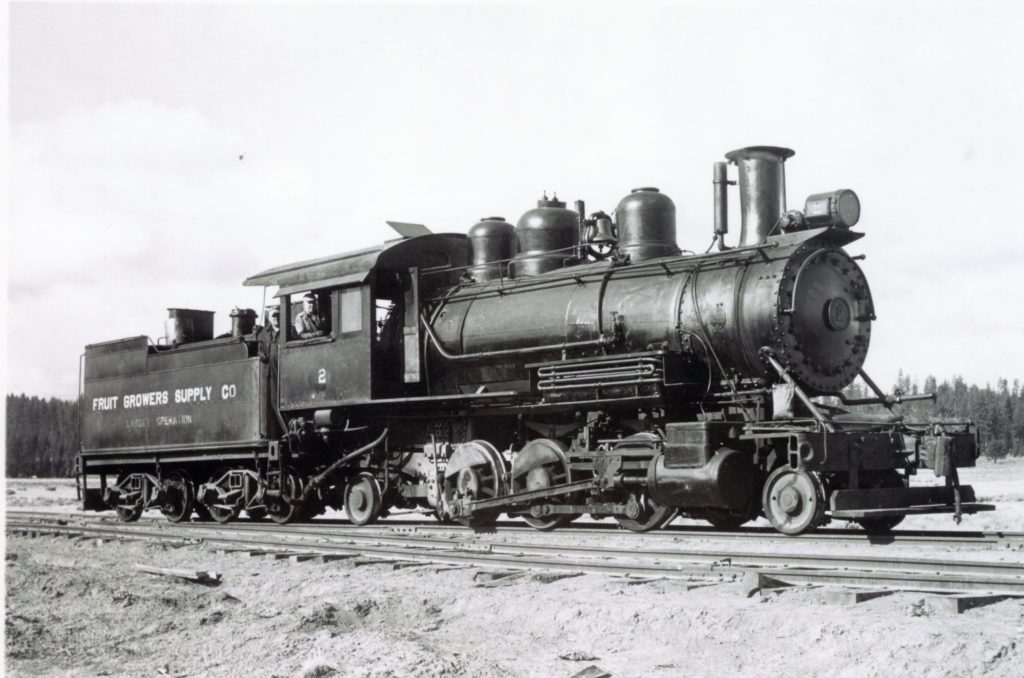
Fruit Growers No. 2 was purchased new from Baldwin in 1921. It remained in operation throughout the existence of railroad logging operations on the Lassen Operation until 1952. It was scrapped in 1953.
It should be noted when Fruit Growers built its mill in Susanville in 1919/20, they referred it to simply as the Lassen Operation. In 1944, when Fruit Growers purchased nearby Westwood from the Red River Lumber Company, they changed the name of Lassen to the Susanville Operation.
Spread the word, and encourage a friend to subscribe
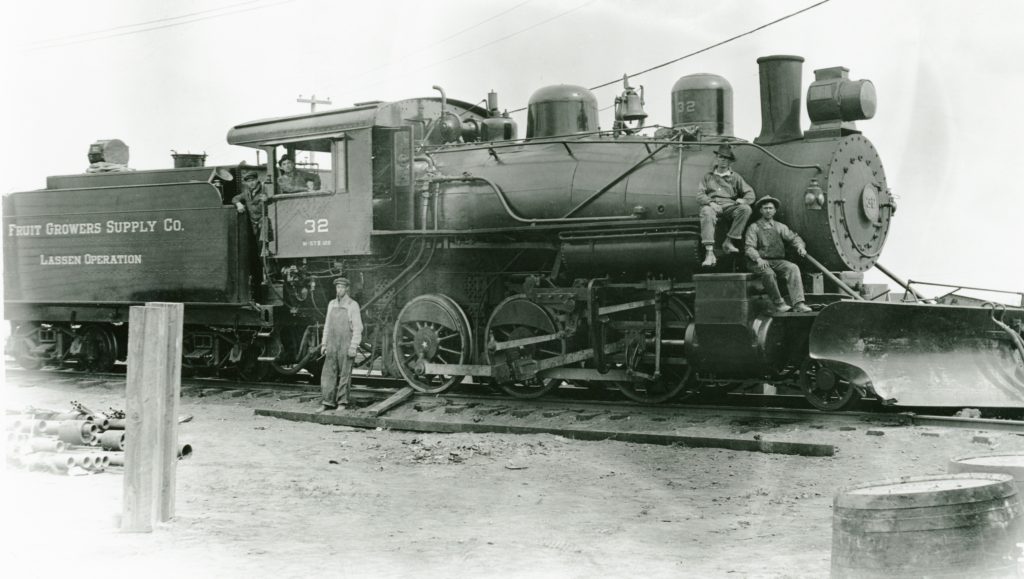
In 1919/20 when Fruit Growers Supply Company established its Susanville operation, they of course needed locomotives for its railroad logging operations west of Eagle Lake. They purchased this Baldwin locomotive from the Ocean Shore Railroad that operated a line along the Pacific Coast from San Francisco to Santa Cruz.* Fruit Growers ownership of the No. 32 was brief and they sold it in 1924 to the Red River Lumber Company. In 1944, Fruit Growers reacquired it when they purchased Red River’s Westwood operation. In 1953 the locomotive was scrapped.
*The Ocean Shore Railroad, was not completed with a gap in the middle.
Spread the word, and encourage a friend to subscribe
In the spring of 1952, the Lassen Lumber & Box Company began liquidating its assets. This involved a sawmill, box factory, 100 acres of land along with 9.9 million board feet of timber, 7.7 million board feet of logs and almost a million board feet of box shook.
They found an unlikely suitor in its neighbor, the Fruit Growers Supply Company. Fruit Growers purchased it all for $1,425,000. While researching the history of Fruit Growers this transaction puzzled me. With the need of box shook declining why a need for another mill with a box factory? Fruit Growers was keen in exploring future venues to protect the citrus growers needs. Lassen Lumber & Box Company had one asset that Fruit Growers needed—-water. If at some point, Fruit Growers wanted to manufacture cardboard cartons, the purchase of the Lassen Lumber & Box Company gave them the water supply needed to convert their Susanville mill into a paper/pulp plant.
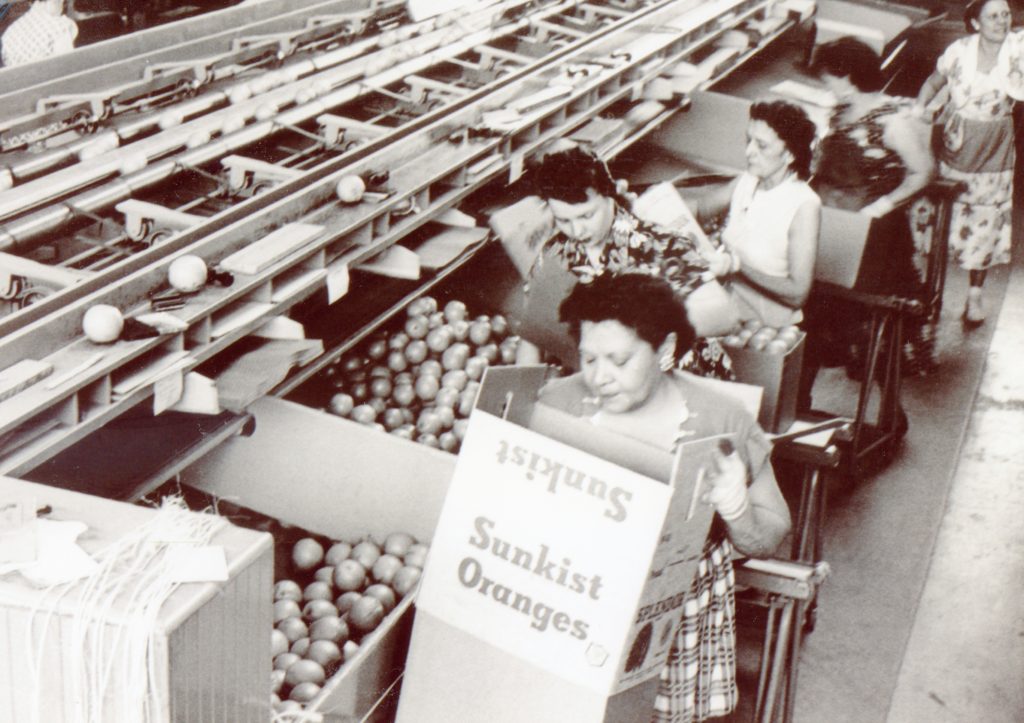
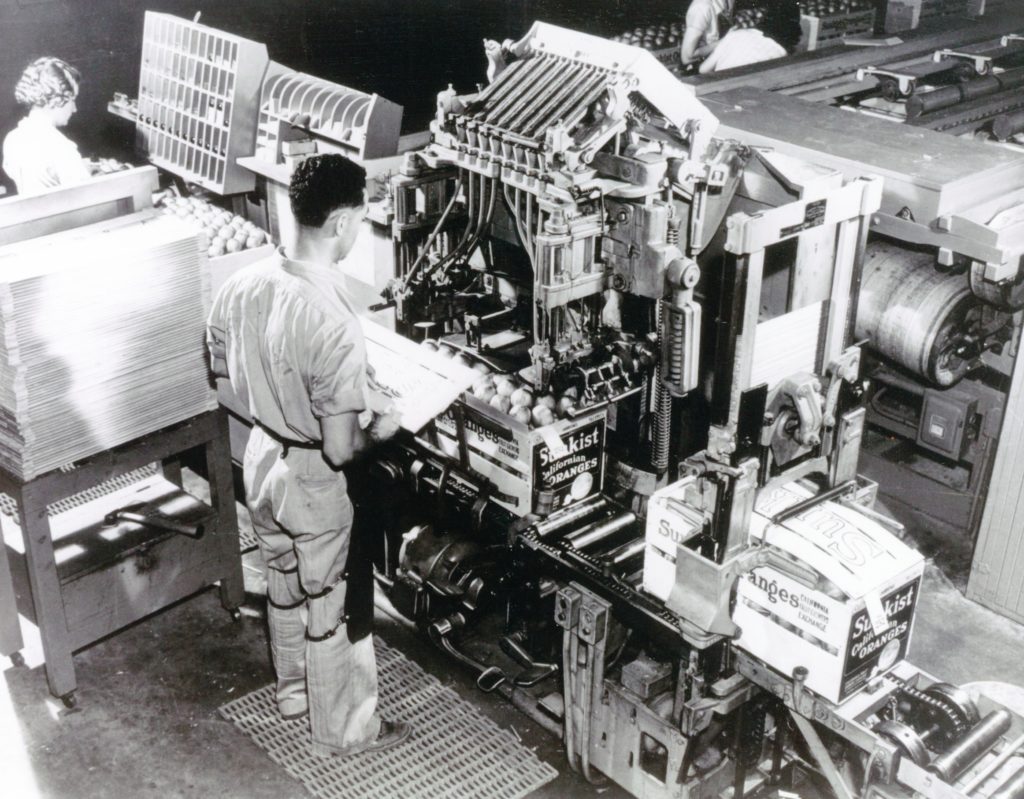
A packinghouse using cardboard boxes—-Sunkist Growers, Inc.
While the cardboard box has been around for over 150 years, when it came to shipping fruit and vegetables it would take many decades of refinement before the growers made the switch from wood to cardboard. During World War I the growers did make an attempt to use cardboard containers, but was deemed a failure. Those early boxes had two major flaws, they were not durable, and with no ventilation the produce quickly spoiled.
During the critical lumber shortage during World War II, the War Production Board asked the citrus industry to work with the Container Corporation of America, experimenting with the cardboard carton as a substitute shipping container. The growers complied, despite the far greater cost. They also experimented with mesh bags. Neither, however, proved satisfactory. The lack of proper ventilation in the cartons resulted in considerable spoilage and the lack of protection from the bag resulted in bruised fruit.
After the war ended, however, paper companies continued to refine the cardboard carton. The new containers were called half cartons because they were half the size of the standard wooden box. Grocers preferred them because they were easier to handle—-and empty cartons made great “carry home boxes” for customers.
Some citrus growers by the early 1950s had met with success with the cardboard boxes. Fruit Growers Supply Company, along with its parent company Sunkist Growers were still reluctant. One company official thought cardboard was just a passing fad. A fad it was not, and on November 1, 1955 Sunkist adopted the cardboard carton the package of choice, and the wooden box was now a part of history. Fruit Growers Susanville box factory curtailed production but continued making wooden picking boxes until 1961.
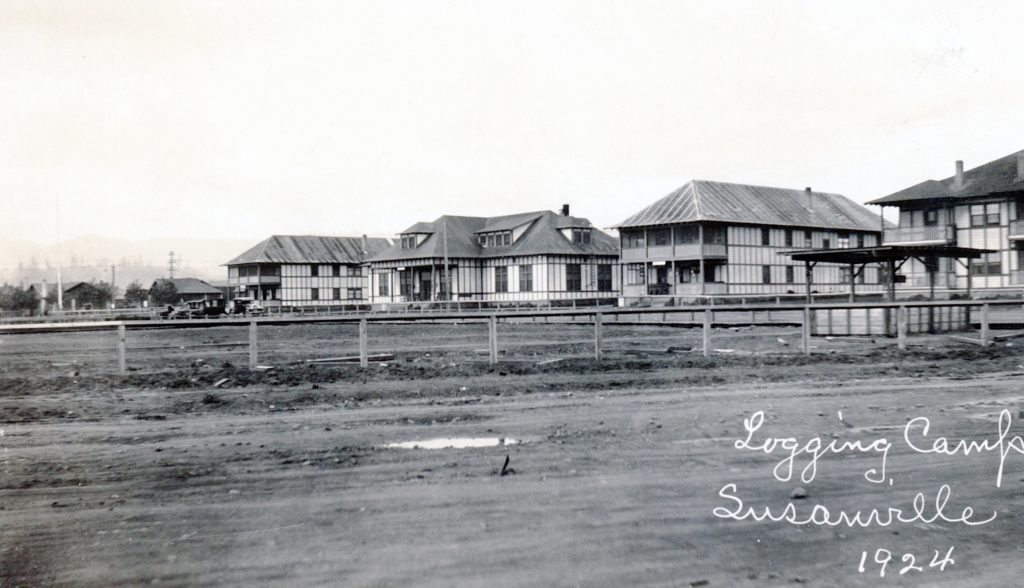
Fruit Growers Supply Company housing, Susanville, 1924—Boyd Benham/Connie Boomer
This was a major labeling blunder by the photographer. The scene depicted is Fruit Growers housing for mill employees in Susanville, located along Alexander Avenue. When Fruit Growers proposed to locate in Susanville, they had wanted to avoid to provide housing, whereas their operation at Hilt was a complete company town. They had hoped some enterprising individuals would step up to the plate to provide housing. That was asking a lot, since Fruit Growers would need housing for over 1,000 employees and their families. Fruit Growers would eventually build 80 houses, in addition to dormitories at a cost of $245,000.
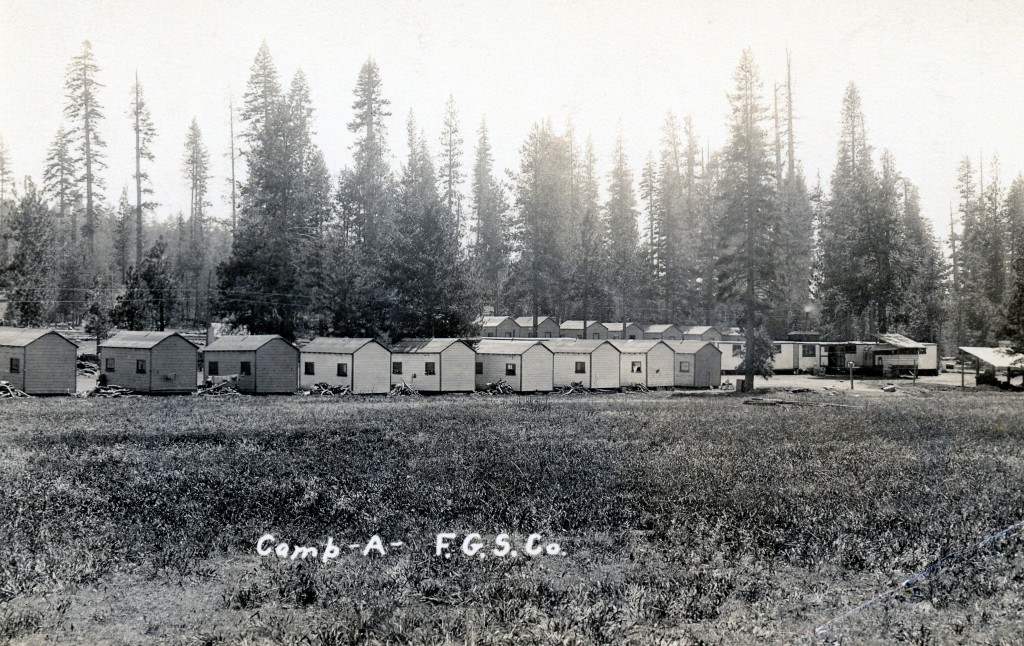
Camp A, Fruit Growers Supply Company, located just north of McCoy Flat Reservoir, 1921
The above was a typical Fruit Growers logging camp, that consisted of portable cabins that could be easily moved by rail from one location to another.
Attaching covers at a packinghouse—-Sunkist Growers, Inc.
While I do write a lot about the Fruit Growers Supply Company, many may not be aware of its association with the citrus industry. Fruit Growers, established in 1907, is a purchasing co-operative initially for the members of the California Fruit Growers Exchange. The Exchange was a marketing co-operative of citrus growers in Southern California.
Also, in 1907, the Exchange hired the advertising agency of Lord & Thomas to develop a trademark or brand name to distinguish its fruit from that of its competitors. The agency came up with “Sunkissed.” However, an Exchange agent in Chicago, taking a bit of poetic license changed the name to Sunkist. In April 1908, the Exchange adopted Sunkist as its trademark, mandating that only the highest-grade oranges would bear the Sunkist name.
The Exchange embarked on a very successful and very expensive advertising campaign. From 1908 to 1951 the California Fruit Growers Exchange spent $61 million to advertise the Sunkist brand. So successful were the campaigns that the name Sunkist became synonymous with citrus. On February 8, 1951 the California Fruit Growers Exchange officially changed its name to Sunkist Growers, to reflect the famous trademark.
Last summer, in one of those “Where are We” segments was Camp Harvey. While I provided details about the old railroad. logging camp, I neglected to state why the old water is even in existence. When the Fruit Growers Supply Company abruptly shutdown the camp in the spring of 1949, they were in hurry to move the portable buildings to a new location. The days of railroad logging and their counterpart camps were quickly fading on the horizon. Fruit Growers had reached an agreement with Shasta Forest, who managed the property for the heirs of the Red River Lumber Company, that they could take their time in removing the structures. Most all of the logging cabins and related structures were removed in 1952. It was mutually agreed to keep the water tank tower with its 10,000 gallon redwood water tank, along with the pumping house and pipes in place for fire protection.
Spread the word, and encourage a friend to subscribe