Tag Archives: Eagle Lake

Leon Bly’s Original Intent

Leon Bly
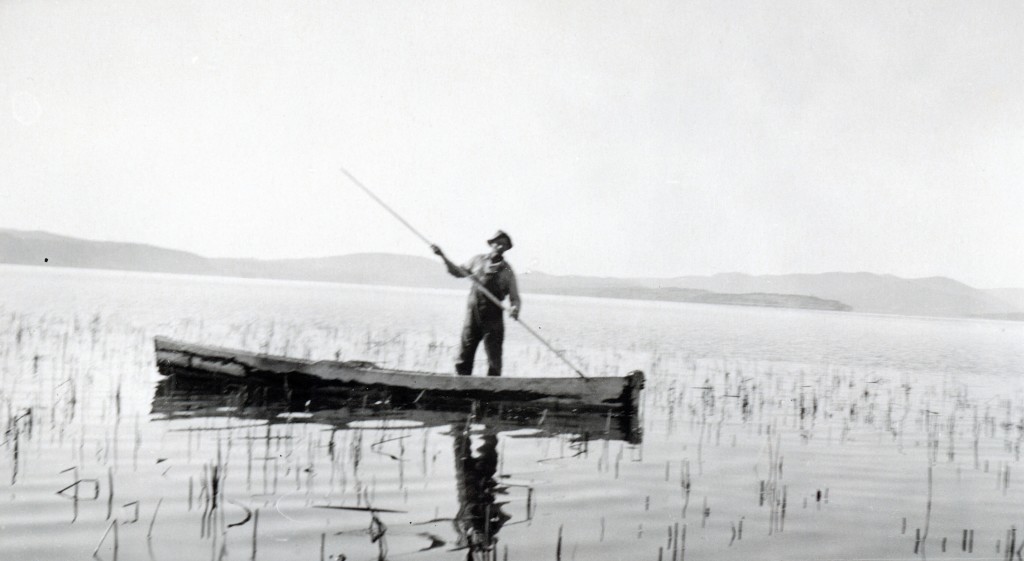
Leon Bly sounding Eagle Lake. Courtesy of Wyn Wachhorst

There were all kinds of social groups of days gone by, prior the advent to television and later the internet. The Lakeside Literary Club was a group of women comprised of the Tule District a region that encompassed the lower Susan River before it enters Honey Lake.

At the May 1922 meeting of the Lakeside Literary Club, Mrs. J.T. Barnes and Mrs. Erma Haley presented a lengthy report on the Eagle Lake Irrigation Project that was currently under construction. According, to the two women, Bly’s original plans were rather dramatic. Below is an excerpt:

”While spending a vacation at the summer home of the Gallatins at Eagle Lake, Mr. Leon Bly, an engineer from San Francisco, became interested in the possibilities of making some use of this large body of water. Thirsty land might be found and the ever increasing demand for electric power could be partially applied. He planned to take the water to the Sacramento Valley by means of tunnels connecting with the natural channel of the Feather River.”

The women noted that there were too many obstacles to overcome and Bly turned his sights on the Honey Lake Valley. While Bly’s initial proposal sounds farfetched, as late as the 1960s there were plans to divert Susan River into the Feather River drainage. That would be very simple to do.
Support

An Interesting Observation—Merrill’s Enterprise

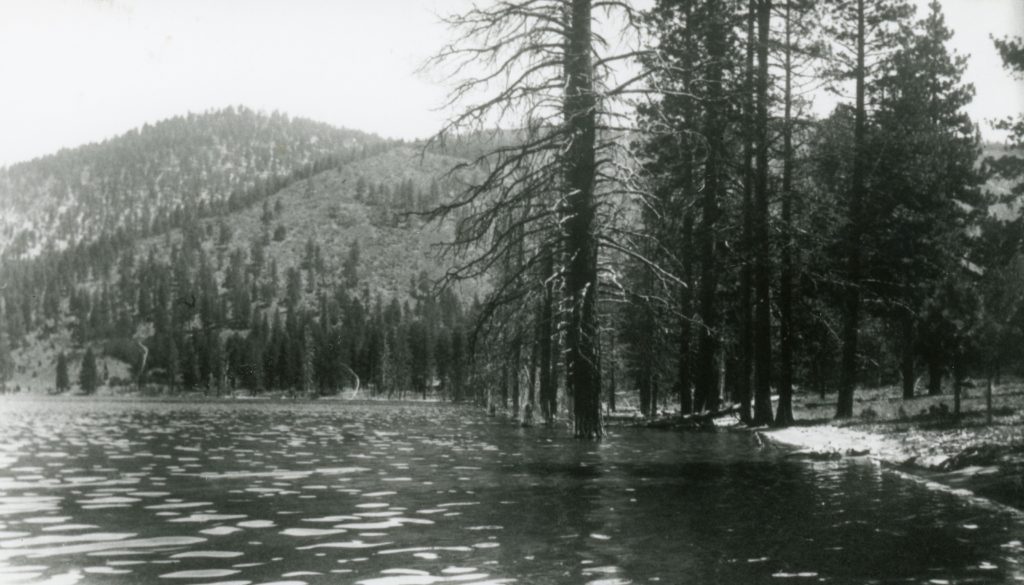
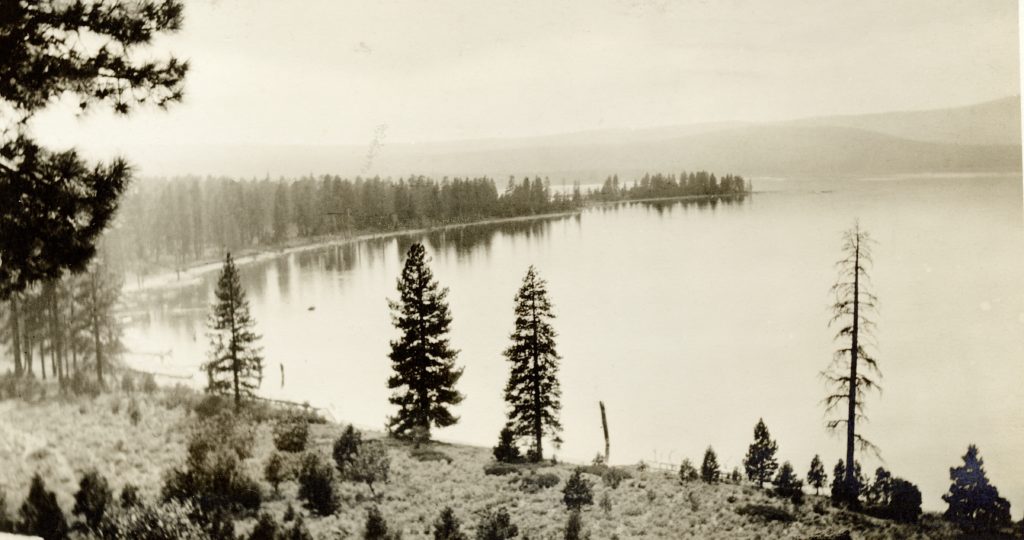
A partial view of Eagle Lake, 1921—Lola L. Tanner

The following appeared in the Candelaria, Nevada newspaper about Capt. C.A. Merrill’s undertaking at Eagle Lake. (For those not familiar with Candelaria  was a mining town between Hawthorne and Tonopah.

Not only did Merrill plan to tap Eagle Lake for irrigation, but he planned for a major manufacturing city at Belfast. With the tunnel, along flumes, it was the intent to log the timber at Eagle Lake, float it across to the tunnel, where eventually using Willow Creek and a series of flumes, the logs would then be manufactured at Belfast. The enterprise was widely followed by the press in California and Nevada.

True Fissure, March 25, 1882:  “The Eagle Lake Tunnel. The tunnel to tap Eagle Lake is being advanced at the of thirty-five feet per week. It will be about a mile and half long, and it is expected that it will be completed next fall. It will furnish water power for running several sawmills and finally will irrigate a great area of now barren sagebrush land in Honey Lake Valley. The tapping of the lake is an experiment that is being watched with great interest everywhere on the coast. Should it prove as successful as is anticipated, it will be followed by a similar tapping of many lakes on both sides of the Sierra for mining, timbering and other purposes.”

Finally, a big thank you to Bill Johnson for sending along this article.

Donate

Eagle Lake’s Coho Salmon

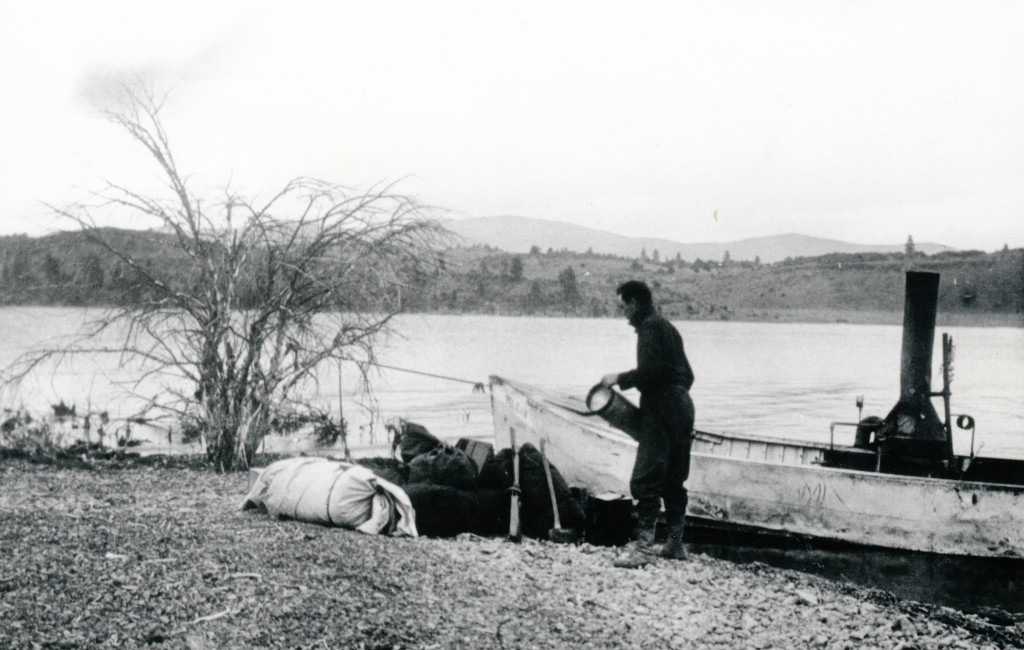
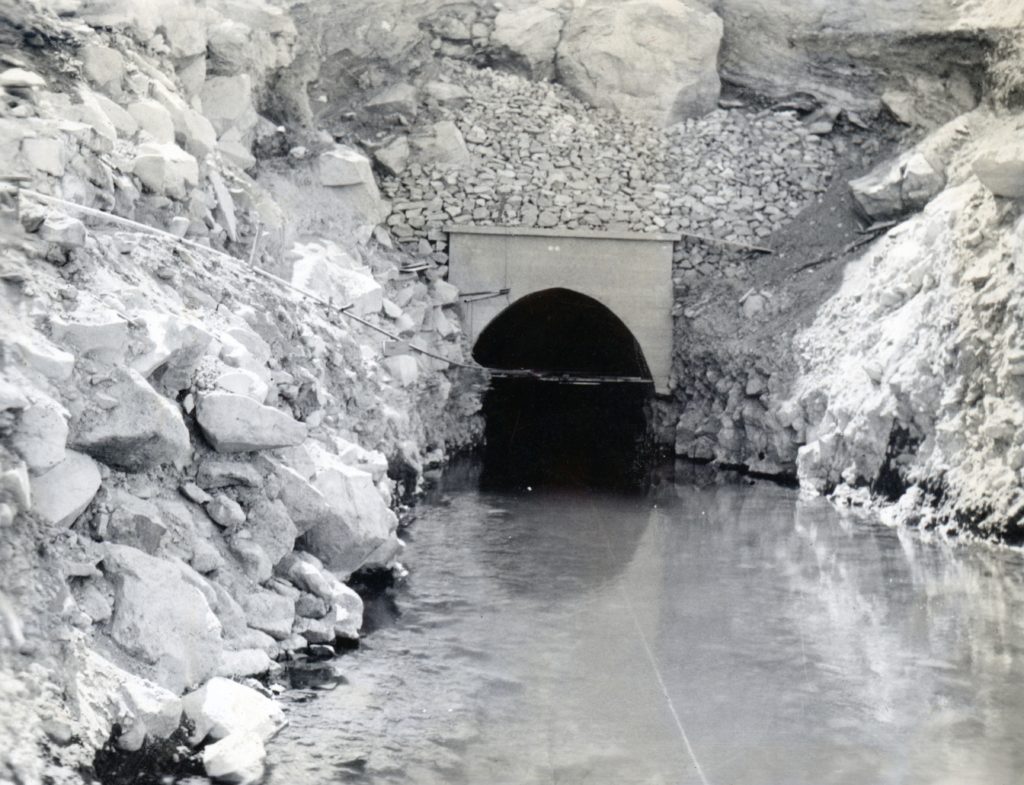
Bly tunnel inlet, July 1924. Courtesy of Wyn Wachhorst

In 1934, the California Department of Fish & Game introduced two varieties of fish into Eagle Lake. The first was a spiny ray fish, though exactly which specie it did not identify. They thought they would be successful because of their breeding habits. However, due to the lake’s high alkaline content the fish were almost immediately killed when planted in the lake.

The other experiment was with coho salmon. It was a substantial planting of 250,000 of coho. A problem occurred sometime between the initial planting and the spring of 1935. Unknown parties had removed the fish screen at Bly Tunnel. Instinctively, a large population of the salmon migrated through the tunnel, just as they would like a regular stream to reach the ocean. Fish and Game officials were furious to say they least. They stated there would be no more fish plantings until the problem was fixed.

While the fish screen was reinstalled, Fish and Game were hesitant of future plantings due to the high alkalinety  of the water.

Donate

Archival Information

Grant Smith’s tunnel works, Eagle Lake, 1922–Courtesy of Lola L. Tanner

Without archives, we would not have records about our past. Some readers might find this a bit mundane. Since we are approaching the end of year, some focus on tidying things in the record department.

In 1996, a colleague of mine and dear friend, Francis, better know as “Fritz” Riddell desired to assemble all collections of the Baxter  Creek  and Tule Irrigation Districts, i.e., Bly Tunnel and have them deposited with California State Archives. Riddell’s father, Harry, was hired as an engineer in the late 1920s to see if he could find a remedy to the problems of Bly Tunnel. He had all of his father’s records. In my possession were the district records by two of their attorneys, Hardin “Finn” Barry,  and J.A. “Gus” Pardee. There was a third piece, the County of Lassen, which the Planning Department had stored boxes of the irrigation districts records. The County was agreeable and mission accomplished.

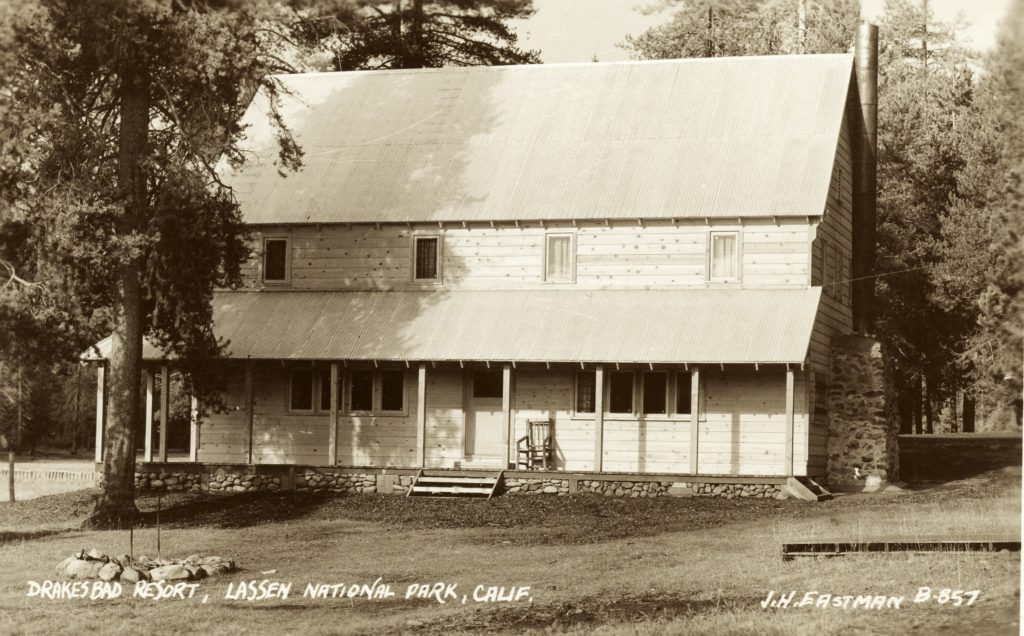
Drakesbad, 1939

During the early 1990s, I came into possession of the Sifford papers. This material primarily generated by Alex Sifford and his son, Roy. In 1900, Alex Sifford purchased what was known as Drakes Springs, and later transformed into Drakesbad resort located in Lassen Volcanic National Park, that was created sixteen years later. They, too, needed a permanent home. In May 2021, they are now part of the archives of Lassen Volcanic National Park.

Tim

Dry Years Responsible

Gallatin Beach and Peak, 1916. Courtesy of Wyn Wachhorst

This was part of the headline statement featured in the Lassen Mail of November 20, 1931 when it was reported that the water level of Eagle Lake had reached its lowest level, yet. The newspaper stated from the lake’s highest point had now dropped by twenty-six feet. That over a ten year period the lake had dropped two and half feet each year. The paper blamed the unusually light winter precipitation that was cause of the drop. It went on to state that in normal times the spring run off into the lake varied from two to five feet. Had this occurred, according to their opinion, that was sufficient amount of water to cover from the effects of evaporation and the water drawn from irrigation.

Gallatin Beach
Gallatin Beach, Eagle Lake, 1940.

Support

The Eagle Lake Road Challenge

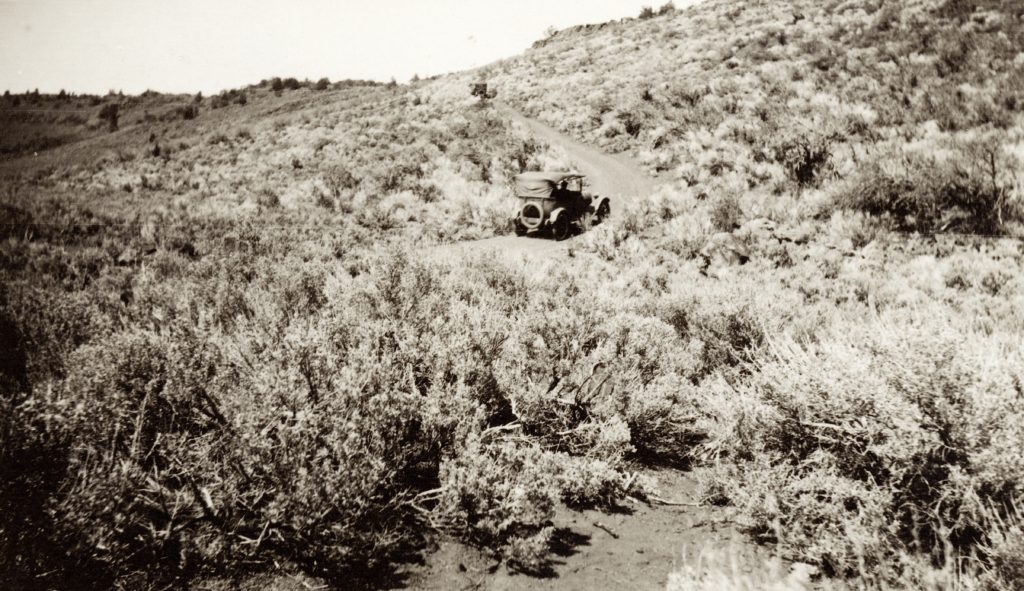
Heartfailure Grade, Eagle Lake, 1921. Courtesy of Lola L. Tanner

By 1920, Westwood residents made up a large segment of visitors to the south shore of Eagle Lake during the summer season. What they desired was the ability to drive to the north shore of the lake. There was a crude wagon road, between the south shore and Spaulding Tract, but it was not in any condition for automobile use.

Enter the Westwood Auto Club. This was an unusual organization created by the Red River Lumber Company. In many ways it served as a de-facto chamber of commerce. The auto club were  true to their name in road development and played an important role during the construction of Highway 36.

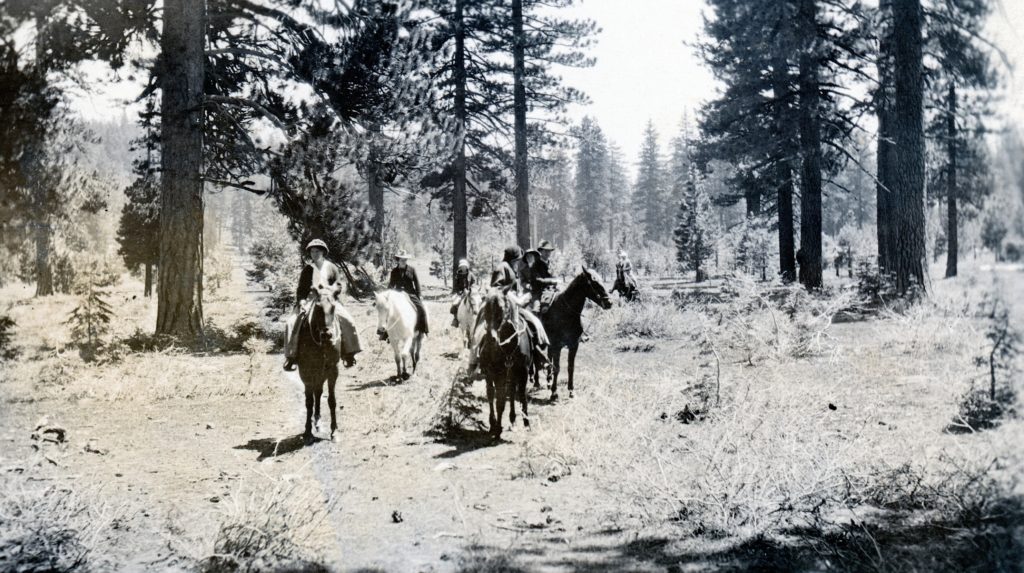
Eagle Lake trail to Gallatin Beach, 1914. Courtesy of Dolores Gasperoni

In the summer of 1921, the Westwood Auto Club led a group of Lassen County and Red River Lumber Company officials on a reconnaissance survey for a road to connect the north and south shores of Eagle Lake. All agreed that the obstacles could be easily overcome, with the only major outlay for a bridge to cross Pine Creek. On the other hand the over all cost would be minimal and Red River would assist with its equipment to make it possible. They all stressed the benefit of people to have access to various features along the lake, and shortly after this outing, work was slowly undertaken. In the 1940s, the road between the south shore and Spaldings was greatly improved when the Paul Bunyan Lumber Company was logging the west side of Eagle Lake.

Support

A Gallatin Subdivision?

A view of Gallatin Beach circa 1918. Courtesy of Wyn Wachhorst

In September 1913, construction of Malvena Gallatin’s summer home on the southeast corner of Eagle Lake was well underway. At that same time, her step-son, Albert Gallatin, Jr. hired Charles Caughell to survey bungalow sites on the lake’s south shore. He stated that the family had received requests from residents of San Francisco, as well as from Susanville. It was Gallatin’s intention not sell the lots, but rather give a 99 year lease. He also consulted with Lassen County Supervisor, L.R. Cady about the possibility of a new road to the south shore of Eagle Lake. Cady assured him he would do everything in his power to make it a reality. Neither the bungalow sites or road work transpired.

Tim

Lesser Known Fruit Growers Logging Camps

Camp E395
Camp E, Fruit Growers Supply Company. Courtesy of Lola L. Tanner

Fruit Growers Supply Company had a total of eleven railroad logging camps on its Lassen Operation, west of Eagle Lake.. Technically, the longest operating, Camp 10, which closed in 1952, should have been named Camp 11. Then again, Fruit Growers had given consideration of a Camp 11, further north of Camp 10.

Anyhow,  there were  three camps that were quite small and operated for only one logging season during the 1920s. The first was Camp E at Merrill Flat. It was followed by tiny and peculiar Camp Y. Then there was Camp 9, which from most accounts only housed timber fallers, which was located on the Eagle Lake side of Antelope Mountain. Unlike the other camps that had portable wooden buildings these camps had canvas-wooden tents.

Donate

An Interesting Fish & Game Presentation

EL bass spear
Spearing for bass was a popular method.

At the March 1926 meeting to the Lassen County Fish & Game Conservation league there were two interesting topics. It should be noted the League was an organization comprised of sportsmen to aid and support the county’s fish and game commission.

The first matter they approved the law to spear bass at Eagle Lake. Even though there was a ban of spear fishing of bass at Eagle Lake, it was ignored and not enforced.

The second issue concerned the Eagle Lake trout and the effects of drought and the Bly Tunnel lowering the lake. The local fish & game commission proposed an egg collection station at Pine Creek and establish a hatchery at nearby Willow Creek. This received enthusiastic support from the league.

The proposal was to intercept the trout during their annual spring run up Pine Creek with nets and fish traps to remove the eggs and then return the trout back to the lake. The commission stated there was a great amount of trout that perished each year with the drying up Pine Creek. With that in mind, the eggs would then be taken to the proposed Willow Creek hatchery and when the fish were sufficiently developed, be planted back into the lake.

These folks were ahead of their time. In 1958, the Wildlife Conservation Board allocated $38,810 for a fish trap/egg collection facility for Pine Creek.

Pine Creek, 1921. Courtesy of Lola L. Tanner

It should be noted the league had a membership fee of one dollar a year. The money raised to provide financial assistance to the fish and game commission.

Donate

Sunkist Lodge, Eagle Lake

The water carnival at the Sunkist Lodge, 1921. Courtesy of Ed Standard

In 1921. Fruit Growers Supply Company built a cabin at the south shore of Eagle Lake. They named it Sunkist Lodge. It was built for the recreational needs of its employees. Even though Fruit Growers closed its Susanville operations in 1964, employees of Fruit Growers who worked at Burney, Hilt and Los Angeles still vacationed there.

Another view. Courtesy of Ed Standard

In 1921 and again in 1922, Fruit Growers sponsored a water carnival at Sunkist Lodge. This was a water competition between the three big mills—Fruit Growers, Lassen Lumber & Box Company and Red River Lumber Company. The event attracted large crowds of over a thousand in attendance. For the overflow camping, a new site was located and dubbed the Circus Grounds.

In 2019, Fruit Growers sold its Lassen Operation holdings to Sierra Pacific Industries. In 2021, Sierra Pacific has placed this parcel for sale.

Never miss a story click here to subscribe.