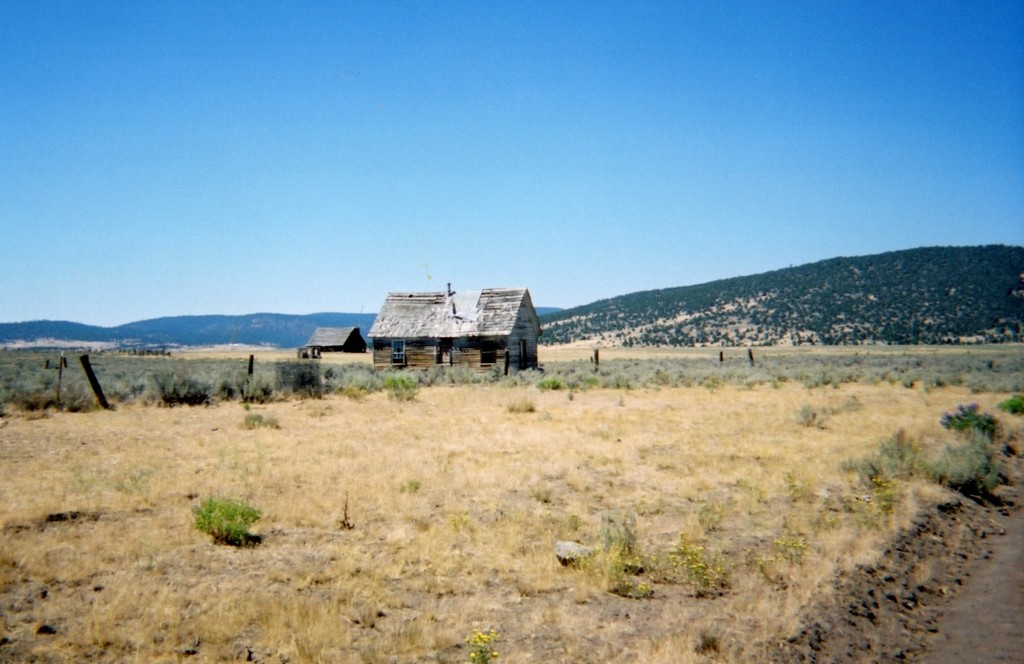
While today, the east side of Honey Lake may look bleak and barren, it was not always the case and there were numerous attempts to develop it. In 1915, Rosendal Minster envisioned a Scandinavian settlement south of Amedee. Minster had a lease/option to purchase the lands and the pumping plant of the Standish Water Company. He then formed the Farmer’s Land Company to operate the holdings.. The properties were split into 40-acre tracts with a price range of $45 to $65 per acre. The new settlement was named Rosendale. While Minster vigorously promoted the project, but due to debts he quickly accrued, he abandoned it the following year.
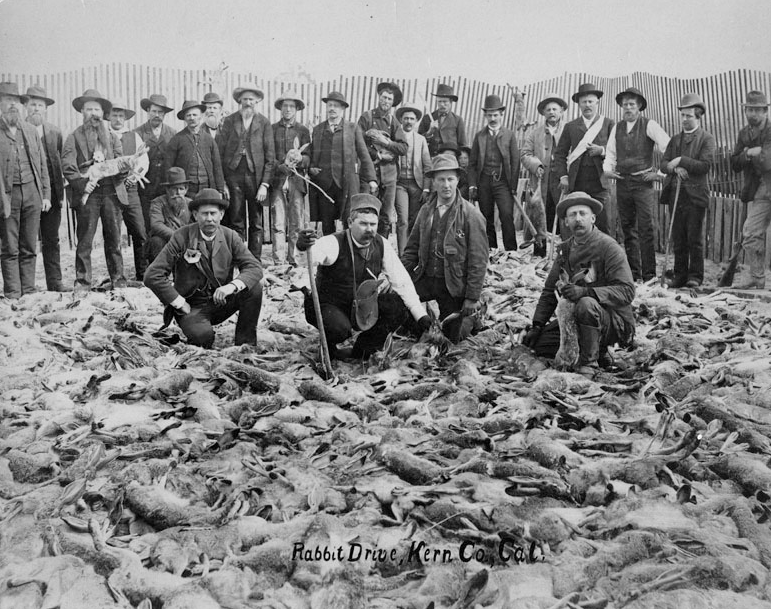
A Kern County rabbit drive, date unknown.Rabbit drives were common during the first part of the twentieth century. On March 10, 1932 one was held at Milford and an observer wrote: “Blooey! and another jack rabbit bit the dust! In fact 1200 rabbits pulled this little trick as some 30 marksmen armed with shotguns blazed away continuously all day in a big rabbit drive. The drive was one of the most successful ever held in the valley. The drive started at the Harwood ranch and covered about a two-mile area. With the termination of the drive, a lunch was served to the hunters by various ladies of the community.
“Smoking gun barrels and black and blue arms were quite apparent throughout the day. Those participating were thoroughly pleased with the results and voted the occasion as most enjoyable form of hunter’s sport.”
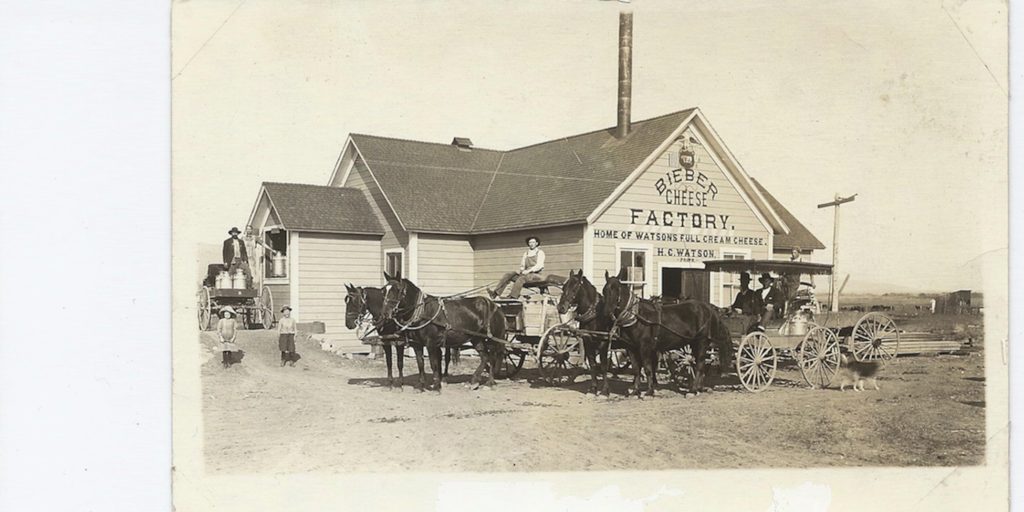
H.C. Watson’s Bieber Cheese Factory. Courtesy of the Big Valley Museum
In 1883, Bieber resident, H.C. Watson established the Bieber Cheese Factory, not only a Lassen County first, but was the only one to exist, though it should noted that there were numerous dairies throughout the region. An interesting anecdote was relayed to me, from someone who remembers the facility. It was related that the catfish in Pit River at Bieber grew nice and fat thanks to cheese factory—the excess whey was disposed by dumping it into the river.
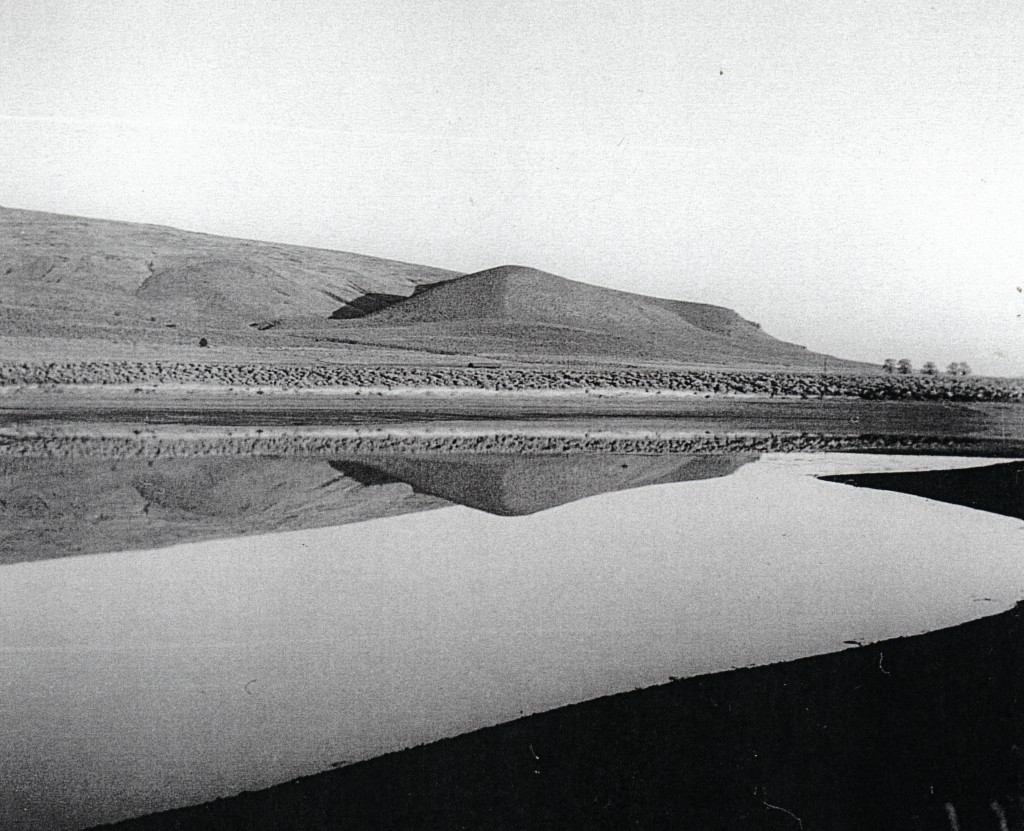
The site of the original McKissick Ranch on the Madeline Plains.
The desert homesteaders of eastern Lassen County encountered numerous problems in their quest to make their land there productive. One unassuming predator they had to deal with was the rabbit. In 1920, the residents of the Madeline Plains requested aid from their Congressman, John E. Raker, to help them with this particular problem. A study sent to Raker reported: “As soon as the crops are up and making good progress the rabbits begin work on them. The heaviest damage is done during August. One rancher reported losing 100 acres of wheat last summer. They take this crop in preference to oats and rye. It was reported that 70 tons of rabbit meat [to make tamales] had been shipped last season to the San Francisco market. It appears that the animals cannot be killed fast enough in this region to furnish relief to the ranches.”
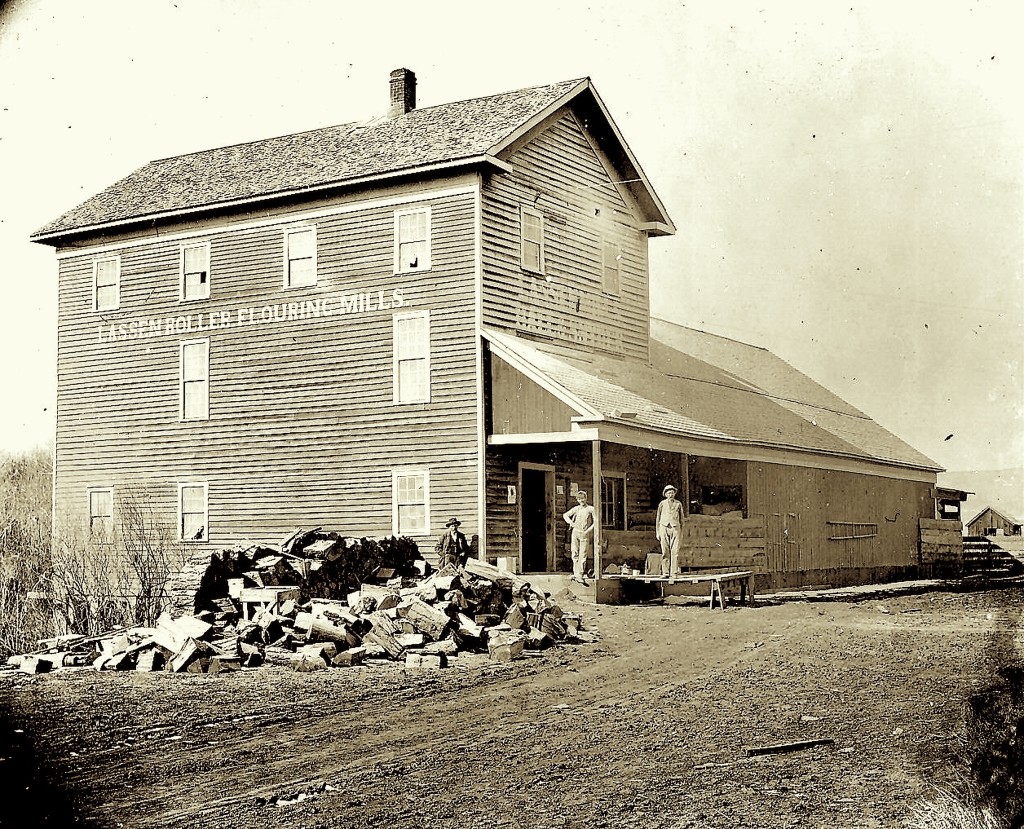
The Lassen Flouring Mill, 1901. Courtesy of the A.J. Mathews family.
In spring of 1863, Dr. John Briceland of Cow Creek, Shasta County had a problem. The stream which his flour mill was located had begun to erode the foundation. He made an agreement with P.W. Cunningham and Fred Johnson to relocate the mill, or rather the equipment. For their efforts they received one-half ownership. They found a new location for their enterprise at Johnstonville in the Honey Lake Valley. The mill was located along the Susan River, which was needed for power. They built two small reservoirs and at night they would dam the river and fill the ponds. The two ponds held enough water to power the mill until the next night.
During the late 1860s through the early 1870s, mill changed hands numerous times. In 1875, William H. Hall and Henry Snyder took possession and would operate it for thirty plus years. In 1907, Snyder sold his interest in the mill to Hall, as he desired to retire and move to a warmer climate. Shortly thereafter the mill closed and would remain idle for nearly a decade. In 1919, it was sold to M.A. Taylor of Oakland who dismantled it and took the machinery to the San Francisco Bay area. It should be noted that Standish resident, Sam Alexander purchased some of the lumber that he used to build a barn at his place. Finally, for the record the mill was located at the site of the Gables.
Haying at the Elledge Ranch, near Standish, 1900. Courtesy of Camilla MoodyIf you were gainfully employed in Lassen County in the early 1880s, the following was the prevailing wage. Regular farm hands with board were paid $30 to $40 a month. If you happen to just work at harvest time such as haying $2 a day, and possibly board. The sheep industry was a major component in Lassen County’s agricultural community and sheepherders salary ranged from $25 to $40 a month. The task of sheep shearing was paid at 6 cents a head.
In the lumber industry the head sawyer was paid $75 a month, plus board, while the average mill worker received $40 a month plus board. Since firewood was a much needed commodity those laborers were paid on the average 75 cents per cord.
Ward Lake, October 26, 1969. Photo by D.B. MartinThis was the name of the construction camp of the Balls Canyon Reservoir Company. Established in 1889, when construction of a dam across the lower end of Secret Creek, near Belfast, to capture the spring floodwaters to create Ward Lake. It was named for Edmund R. Dodge was the President of the Company. Dodge, it should be noted wrote the Lassen County segment of Farris & Smith Illustrated History of Plumas, Lassen and Sierra Counties, 1882, among other things.
Ash Valley School, as viewed from the cemetery, 2002.Ash creek and valley were named by Adin G. McDowell who settled along its banks in 1869, establishing what became the town of Adin. Those not familiar with the valley it is located between Adin and Madeline. In 1869, Solomon Geller, one of the Madeline Plains first settlers, had the distinction of being Ash Valley’s first Anglo resident. By 1873, Geller had plenty of company with the arrival of Walter Briscoe, David Finnegan, Peter Hagan, George Sturdevant, Milbern Hill and Joseph Richardson, mostly bachelors as he was—a stigma the valley would carry for many years. Hagan received the distinction of being the first person buried there in 1878, and thus the Ash Valley Cemetery was established. These gentlemen would soon witness the arrival of the Bath and Fulstone families, whose descendants continue to ranch there.
In 1892, the Adin Argus correspondent provided the following glimpse of the conditions found at Ash Valley: “Farming in the Valley has been looked upon as unprofitable for years past but experience has taught us differently. Every old plow has got the rust of idleness knocked off and assumes a brightness equal to the owner’s ambition. The fact is, if a rancher can cut two tons of hay off one acre of land by plowing and sowing, it will surely cost less than to cut two acres of swamp land for one ton of hay and get a much poorer quality of hay. We would harvest lots of grain in our valley if a market could be had. Mr. Spooner has enough oats on hand at present to supply Lassen County for a year.
“Mr. Moll is waiting for favorable weather when he will commence to sow his wild oats for experiment. Mrs. Spooner is having an addition built to their residence and improvements in the shape of building will be lively soon. Mr. Moll will soon have a new one under headway, and if we could get lumber, there would be still more hammers in use. Mr. R. F. Comfort will have his house finished in a short time. There are more old bachelors in our Valley to the square inch than in any other part of the State, and still we don’t seem to catch on. But still we all wear a smile that denotes happiness and content and live to forget the past and look to the bright side of the future.
“Big Valley and especially Adin, ought to be proud of its neighbor, Ash Valley, it being the prettiest in the northern part of the State, corralled by one side by juniper capped hills and on the other by lofty pines for which the Sierras are widely noted. It furnishes the water to run their mills, trout for its angler’s good sport, water for stock and in fact, the best of society.”
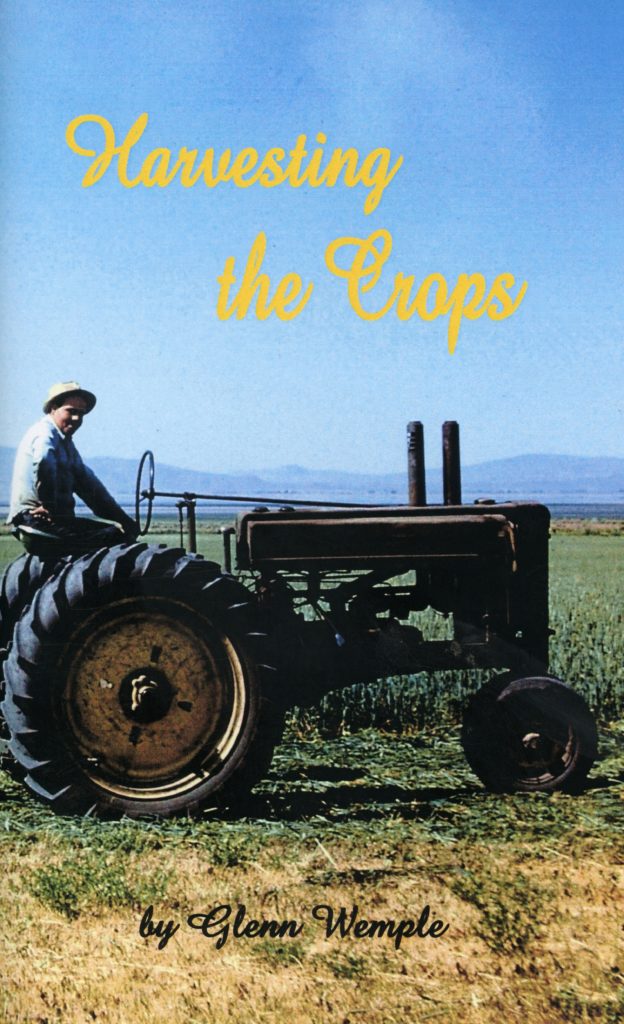
The last memoirs of the late Glenn Wemple.Harvesting the Crops: the Final Recollections of a Milford Rancher are the memoirs of the late Glenn Wemple which was released last month. Glenn wrote and many a soul has experienced this a similar episode: “As I have written earlier I always said I was never going to be a rancher, but honestly I didn’t have any idea what I wanted to do. Thanksgiving dinner in 1950 was the turning point in my adult life.” For those interested the publication is available in Susanville at Margie’s Book Nook.
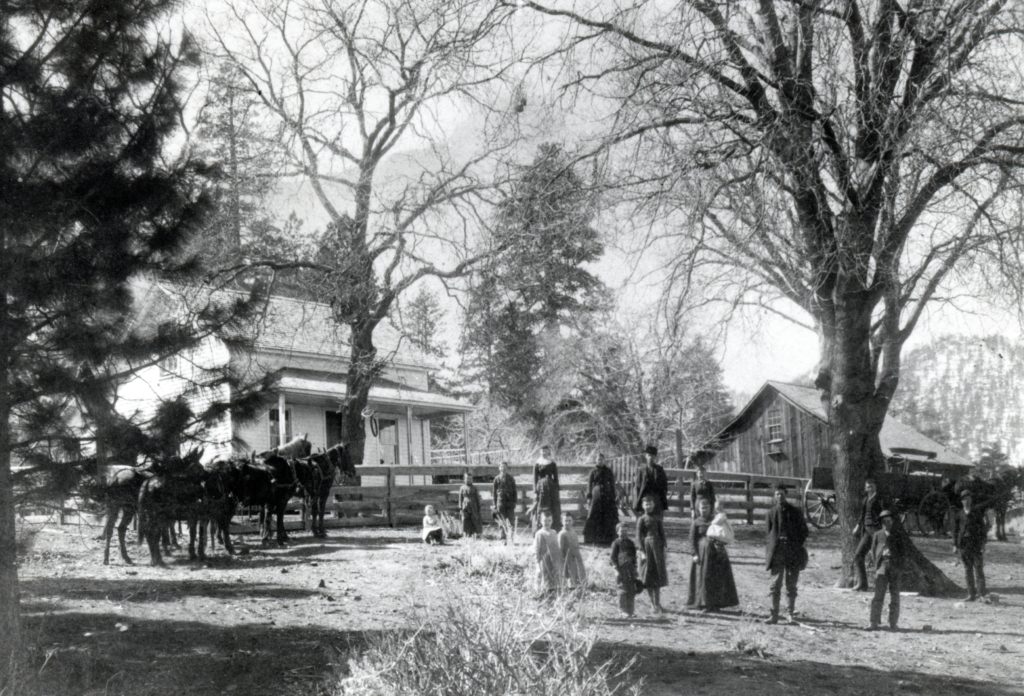
Decious Ranch, 1886. Courtesy of Judith Matley GibbonsIn 1875 Joseph Decious purchased 213 acres five miles north of Milford. It was in a primitive state, only a small portion was under cultivation, and a log house for a dwelling. This would, of course, change over time. In his 1906 biography he boasted: “Visitors to the ranch notice with interest, on the shore of Honey Lake, the only steamer that ever sailed upon its waters, a small craft built in 1895, capacity thirty thousand pounds, which has been used principally for the bringing of freight to the residents of the valley.” In addition, his biography noted he had rented the ranch and retired to Chico, before he was sixty years of age.