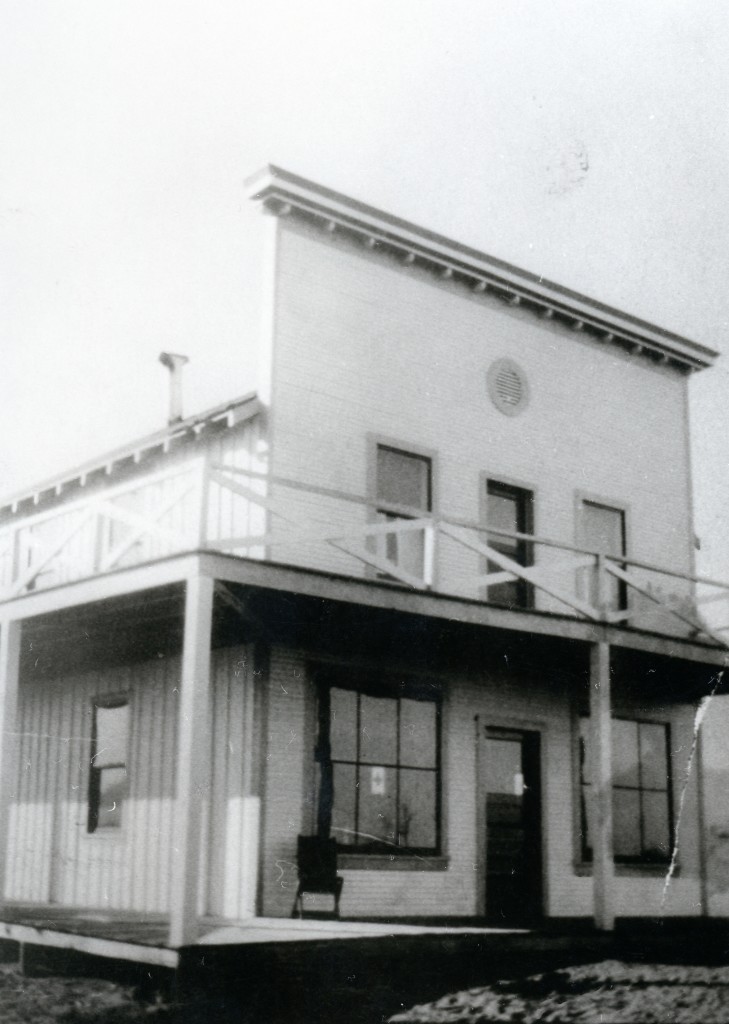
Some one wanted to know if the former town of Amedee was part of the Sierra Army Depot. The confusion may stem as the Depot has an air strip known as Amedee. However, the Depot’s properties are south of the Amedee townsite.
On February 24, 2014, the Humphrey family that owned Amedee Hot Springs, the abandoned townsite and surrounding ranching property for nearly a century sold it to Hays Ranches for $450,000. It should be noted, that the Humphreys were involved in the McKissick Cattle Company that purchased the Amedee holdings in 1915. By the late, 1920s the town had been abandoned, save for a caretaker. However, visitors would stop by to take advantage of the old bathhouse for a soak from the hot springs.
The spring of 1923 brought a new surprise when the store clerks of Susanville organized, but not as a labor union. On May 3, 1923 the Clerks Co-operative Association was organized with an initial membership of twenty-two. Harry Coleman as selected as Chairman and Fannie Winchester as Secretary.
The first item on the agenda, was a committee of five were appointed to meet with the merchants to have uniform closing hours. It was their desire to close at 6:30 p.m.. during the summer and 6:00 p.m. in the winter. Another item, was to aid each other to improve salesmanship skills. Finally, it was their desire to work in harmony with the merchants.
Lassen County was created on April 1, 1864 from the eastern portions of Plumas and Shasta Counties. On April 11, 1864, California Governor F.F. Low appointed three men—L.N. Breed, Frank Drake and H.C. Stockton—to serve as county commissioners to organize the county.*
The main task for these men was to put on a election for a slate of county officers and equally important to select a county seat. The date set for the election was May 2, 1864. Janesville and Susanville were the two sites selected for the county seat. On May 12, 1864 the final canvass of the election was held. It was a messy affair, and two precincts Fort Crook (Fall River Mills) and Surprise Valley were ultimately rejected. The minutes were vague: “The board proceeded to estimate the vote . . .Susanville having received the highest number of votes for the county seat, was declared the county seat of Lassen County.” The Quincy Union newspaper reported that Susanville won by 72 votes.
*In 1879 California adopted a new Constitution whereas the county commissioner became county supervisor and the District Court Judge became the Superior Court Judge.
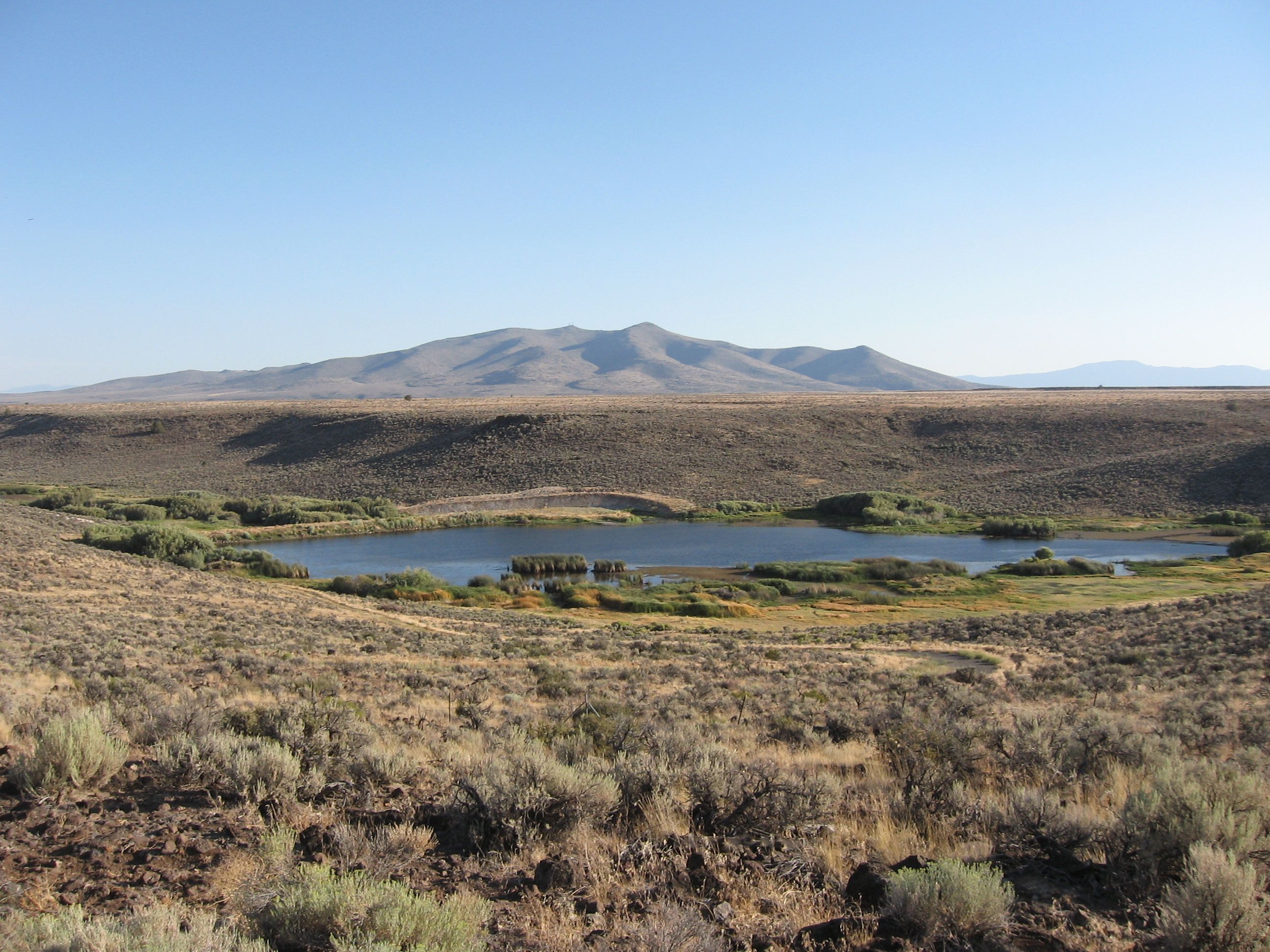
Pierre “Pete” Biscar (1881-1947), a native of France, came to Secret Valley in 1904. In 1909, he constructed the first reservoir at the mouth of Snowstorm Canyon. In 1915, it was washed out by a flood and subsequently rebuilt. Today, there are two small reservoirs that are part of the 550-acre Biscar Wildlife Area.
In 1923 for the first time in the nation’s history the shift of the majority of the population had moved to urban centers. A portion of this can be attributed to the effects of World War I. Many young men who served in the war did not want to return to the farm. This was especially true for those who prior to the war had a hardscrabble life in eastern Lassen County with desert homesteads.
Locally, with the establishment of the lumber mills in Susanville and Westwood brought more opportunities. In the early1930s, with the completion of the Western Pacific Railroad’s Highline, Big Valley saw a major increase of population, whereas other rural areas of Lassen slowly declined.
In the 1860s, stockmen on the Great Plains first introduced barbwire to keep their livestock in one region and to fence springs, preventing unwanted livestock access to the water. It was also an economical measure, wood was not a common commodity on the plains.
The introduction of barbwire in Lassen County was a slow process, and no doubt a 1880s lawsuit hampered its local use. In 1883, Charles F. Gardner and A.J. Rhoads claimed substantial acreage through the Swamp and Overflowed Land Act in northern Grasshopper Valley. The men proposed a large-scale livestock operation. In the spring of 1886, they hired William Tanner to construct a barbwire fence to enclose their lands to protect their
pasture from roaming livestock. Tanner constructed a three-strand
fence—the top strand 52 inches high, with posts thirty-six feet apart.
Charles F. Loveland, the adjoining property owner claimed the fence
was a hazard and poorly maintained. He claimed that five of his
horses had been killed by the fence and an additional twenty horses
had been crippled by it. On July 4, 1886, Loveland filed a lawsuit
against Gardner, Rhoads and Tanner for the loss and injuries sustained by his horses from that fence. On April 11, 1887, the jury awarded Loveland $575 plus costs. Gardner appealed verdict. On May 27, 1889, the appellate court remanded the case back to the local court with two options. Loveland could accept damages in the amount of $300 or the parties could have a new trial. Loveland accepted the $300 award.
During extremely wet winters, come spring time, California and Nevada usually experience a mining bonanza, and locally it has occurred in this region. While, this was a wet winter in Lassen and Modoc, it was far from record breaking.
1907, on the other hand was a different story. It was a whiplash winter throughout California and Nevada with heavy rains, followed by heavy snows, and the scenario repeated itself. It caused a mini-gold rush with massive erosions in gullies and streams, exposing gold and other minerals. On Bass Hill between Susanville and Janesville one ravine along the road revealed gold nuggets. Thus, there was a prospector frenzy there, as well as the entire Bald Mountain. Spoonville native M.E. “Mul” Mulroney, noted that on that side of Bald Mountain a tunnel was made in hopes of gold ore, but found none.
It did not stop there. Discoveries were made just north of Susanville, on Antelope Grade. An unlikely spot was Skedaddle Mountain, where there was so much interest that caused for the creation of the Hot Springs Mountain Mining District, the last one of its kind in Lassen County. While nothing materialized there, one desert mountain seemed more promising—Fort Sage. Prospecting on Fort Sage continued for decades and I can personally attest. When my father passed away in 2002, while sorting through his paperwork, unbeknownst to me were several mining claims he had on Fort Sage.
Roop’s Trading Post better known today as Roop’s Fort
On April 26, 1856, twenty settlers in the Honey Lake Valley gathered at Isaac Roop’s Trading Post nee cabin and held a “mass convention” to establish a territory of their own. After all, the group concurred, they were not residents of California and they did not want to be under Mormon domination of the Utah Territory whose boundaries extended to the eastern boundary of California. They named their new government Nataqua Territory. Nataqua, or Natauga as it is sometimes spelt, purportedly, was a Paiute word for woman. Their land grab was grand to say they least. They carved out a territory, 240 miles long and 155 miles wide, almost two-thirds the size of the State of Nevada. Ironically, the legal description of their new sovereign state, excluded themselves. Roop’s Post for instance, was located 35 miles west, outside the their western boundary. The Nataqua Territory, in essence, served as a form of local government to provide an avenue to protect their rights and to handle local land affairs. The territory served as a foundation until a more formal government was established. In 1857, the Territory was abandoned when an attempt was made to form the Territory of Sierra Nevada.
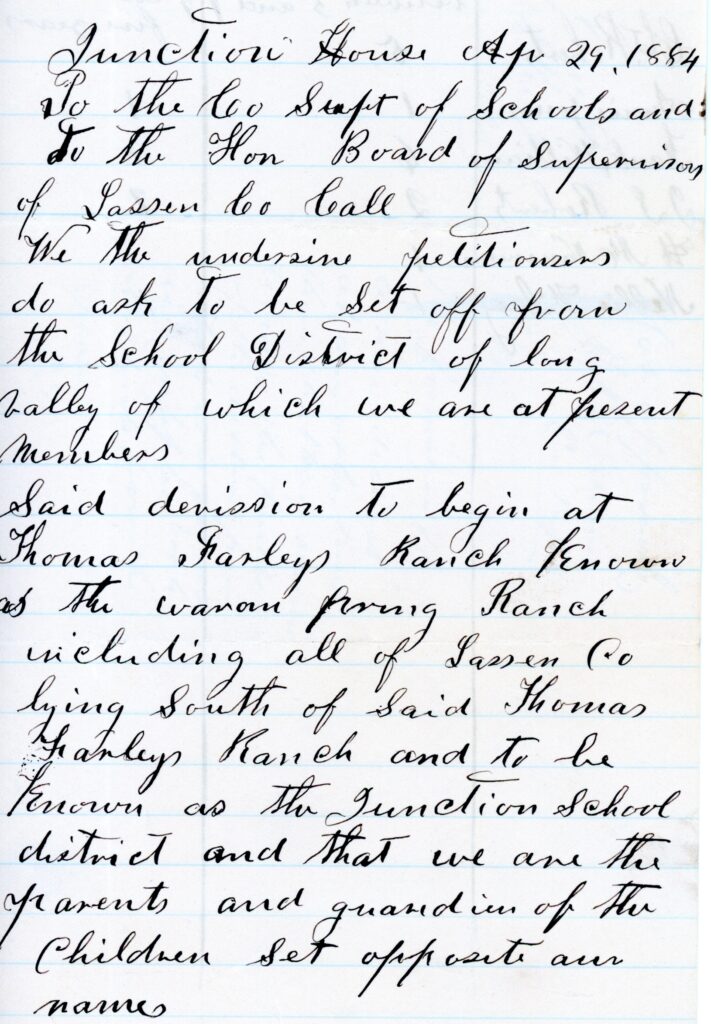
A movement began in the fall of 1870 to form a school district in the
extreme south end of the County. The Junction School district was finally established in March 1871. It later closed, though the records do not indicate when that occurred.
In the spring of 1884, Jonathon C. “Chat” Roberts, along with his neighbors, requested the formation of another Junction School District. Roberts wrote: “I have built a school house at my own expense and we are entitled to a district.” E.A. Williams, Lassen County Superintendent of Schools, echoed that sentiment to the Lassen County Board of Supervisors. Williams noted that they had spent nearly $400 to build and furnish the school. In addition, they had hired a teacher and the school was in operation with sixteen students. Williams concluded: “Ás the financial guardians of the County you can determine the expediency of forming this new district, as to the justice of their claim, there can be no question.” It was approved. It should ber noted Junction, in the present vicinity of Hallelujah Junction, with the establishment of the NCO’s railroad station, that would be named Chat.
After the NCO Railroad moved onward there was a population decline. In 1898, the school was abandoned and annexed to Long Valley School (Doyle).
Known today as Herlong, and it was the one-time junction of
Nevada-California-Oregon (NCO) and Western Pacific (WP) railroads. In 1915, Stanley G. Rayl arrived on the scene. When Rayl petitioned to establish a post office, he proposed the name Rayl—the NCO opposed it. Charles Moran, President of the NCO, wanted the post office named Hackstaff—in honor of his mother-in-law, Clara Hackstaff Adams. After five months, the Postmaster General decided upon the name of Rayl, instead of Hackstaff. This delighted Robert M. Cook, editor and publisher of the Lassen Weekly Mail, Cook wrote: “ The NCO wanted a monument to an uncle of the wife of Moran, the New York capitalist behind the NCO. Hackstaff was never in Lassen County and no one here knows anything about him.”
When Rayl left in 1921, he assigned the postmaster duties to Cyrus Helman. Those two men had a disagreement and fought that battle in court. In the end, the Rayl post office closed. On March 18, 1922, the Hackstaff Post Office was established with Helman as postmaster. It did not last long and the post office closed on December 30, 1922. In 1927, Hackstaff’s meager population
was wiped out when the WP moved its section crew to Doyle. The
location continued to be known as Hackstaff until the Sierra Army
Ordinance Depot was established in 1942.




 A movement began in the fall of 1870 to form a school district in the