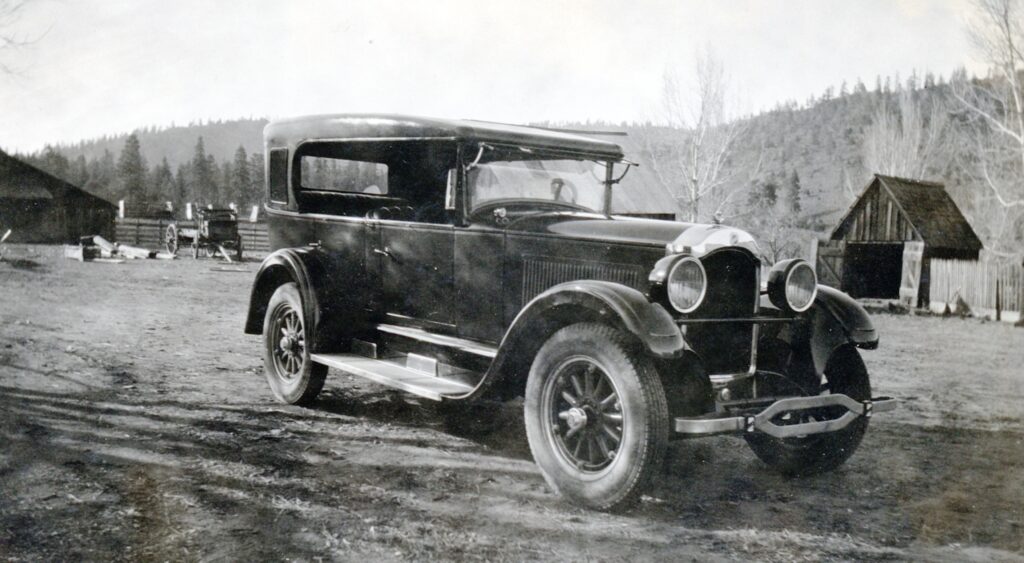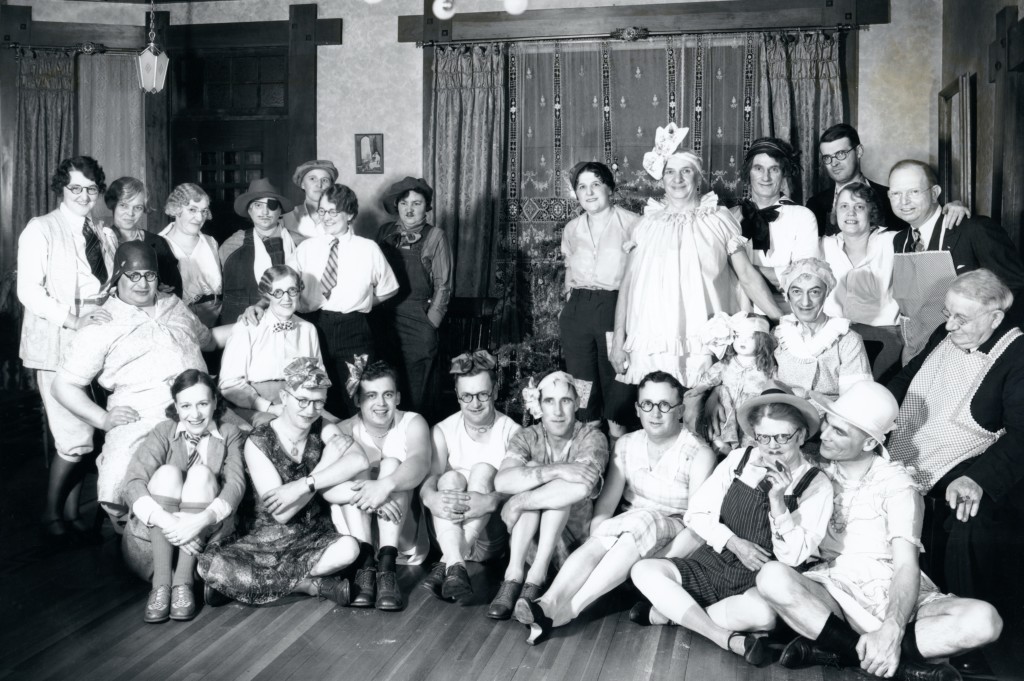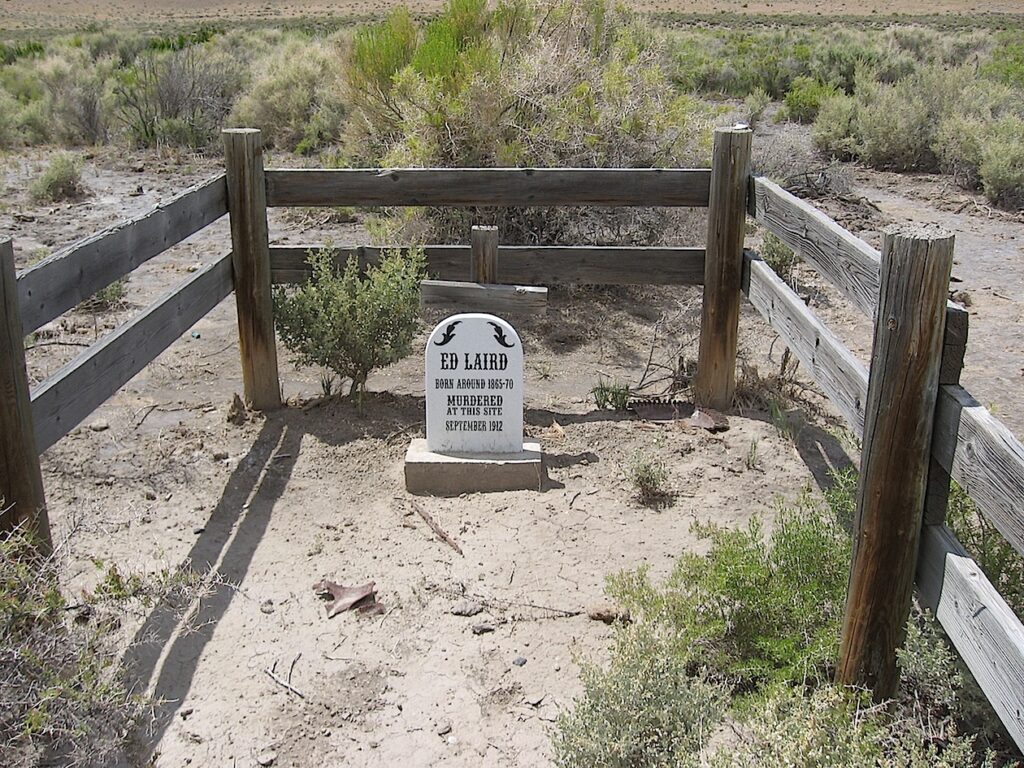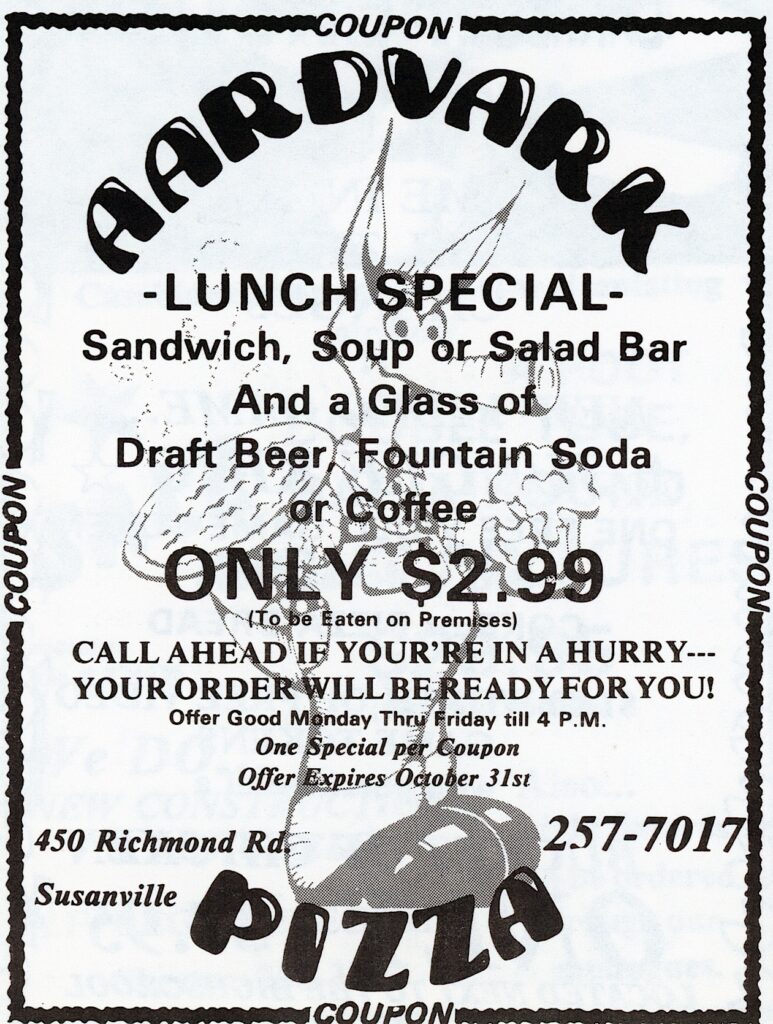
For awhile on Tuesdays, I will providing some old time advertisements. A.K. Philbrook came to Susanville in 1900 and became a partner with T.A. Oakes in the furniture making business. As was customary in the day, furniture makers also made coffins and had the sideline job of undertaker. In time, Philbrook became a full time mortuary director. He remained in that capacity until his death in 1936.
Davis Cut near Susanville of the Fernley & Lassen Railroad, 1912
Thousands of people drive by this landmark, and ,many are probably oblivious. Located a short distance north of Johnstonville on Center Road, is a railroad cut—named Davis. It really is somewhat insignificant as railroad construction goes, but it was the first in the Honey Lake Valley when the Fernley & Lassen Railroad was under construction.
In April 1912, the Southern Pacific Railroad announced construction of the Fernley & Lassen Railroad, and awarded the contract to the Utah Construction Company. That company hired a numbered of sub-contractors, the most prominent of which was J.H. Maxey Construction Company. No time was wasted on construction as there was a deadline to reach Westwood by March 1, 1914. In the fall of 1912, a construction train reached Davis Cut, near Johnstonville. There were several fatalities associated with the construction of the railroad, and one of them occurred at Davis Cut. On April 13, 1913, James Cook, a powderman for the J.H. Maxey Construction Company, was killed there in an explosion to blast the rock.
John C. Davis family, circa 1890–Courtesy of Robert and Eulalee Trussell
The cut was so named for the John C. Davis family. Davis, a native of Germany, came to California in 1850. In February 1858, he made his home in the Honey Lake Valley. In 1866, Davis purchased property just north of Johnstonville where he lived until his passing in 1894.
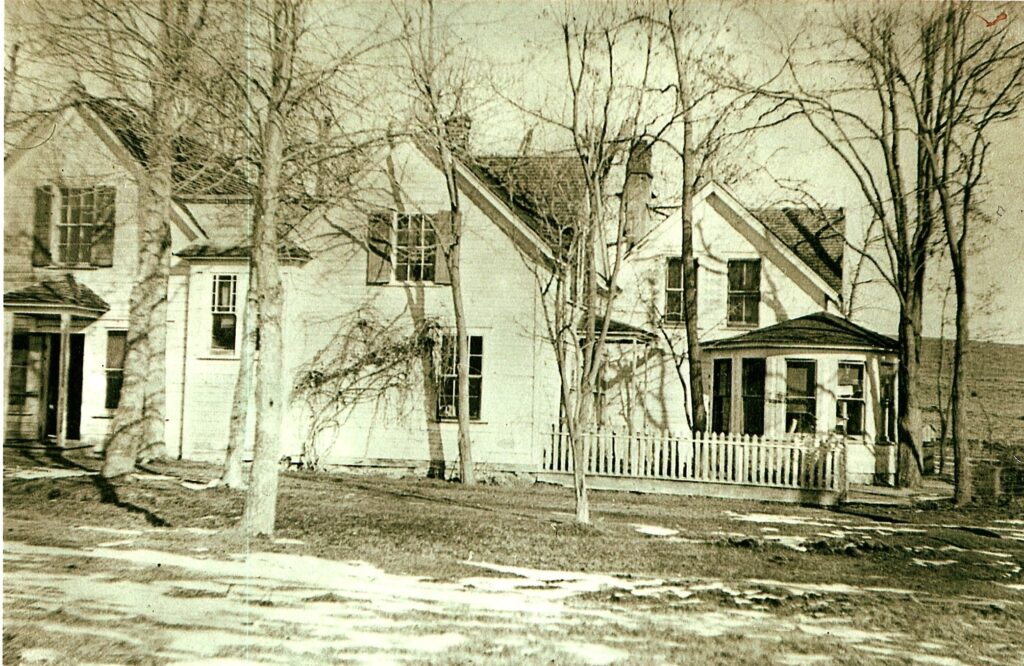
The McDow residence at the intersection of Lassen and Cottage Streets, January 1911.
Today marks a new water year. Historically, it was done on a calendar year. Some organizations still do a fiscal year July 1 to June 30. According to California Water Watch Susanville received 23.12 inches of precipitation from October 1 to September 30.*That is the official measurement taken at the Susanville Airport. However, precipitation totals are greater the further south along the base of Diamond Mountain, This holds true, as well, at the west end of Susanville. On the other hand, further to east such as the Standish district the amount of precipitation is substantially less.
According to California Water Watch 16.33”’ is the average. A historic high of 31.32” and a low of 6.82”.
Tim
*Due to yesterday’s storm, the figure may be higher.
In the category of learning something new was the Hampton House located at present day Mineral. In 1894 Elbert “Bert” Hampton purchased 480 acres that would be part of the present site of Mineral. In 1900 to accommodate travellers he built a store and some cabins. He soon expanded with a small two-story hotel known as Hampton’s Resort. For some people, timing can be everything, and that was the case with Hampton. With Lassen Peak’s initial 1914 volcanic eruption, Hampton’s was only one of a handful places near the mountain for visitors to stay, so he did a very brisk business for several years. In 1920, Fred Beresford and Warren Woodson bought out Hampton. In 1935, Fred’s son,“Husky” Beresford built the Mineral Lodge and that was the go to place. This was especially true when he developed a ski run there.
This is one of those Ebay items I came across. I am not sure what caught my attention the illustration itself, or the description on the reverse. “Lake Almanor, Plumas Co., Calif, is an artificial lake 20 miles long and covers 30,000 acre valley surrounded by heavy timbered mountains affording the finest wild game and deer hunting in the West. Since 1913, after completion of the dam which was begun in 1906, Lake Almanor stores 1,300,000 acre feet of water which contains Rainbow Trout weighing up to 16 pounds.”
While there is no date, these types of color linen postcards were popular in the 1940s and early 1950s.
The Westwood Club was one of the first buildings constructed in that community and it was a major social hub—Westwood Museum
In 1935, with the creation of the National Labor Relations Board brought about the collective bargaining between employers and unions, which had a ripple effect in organized labor. During the late 1930s, unions big and small sprung up everywhere. Many a business even with a handful of employees became subject to union membership with a community’s union providing an umbrella for
these workers to join.
H.S. Anderson Company, who leased the Westwood Club, knew the
situation very well. On March 13, 1940, the Bartenders and Culinary
Workers Union No. 654-A went on strike, protesting the firing of
fry-cook Bill Knighton. They desired a closed shop with H.S. Anderson as their working agreement was set to expire in April. When the union signs were removed from inside the Club, this caused a general exodus of the patrons. Four waitresses—Margaret Miller, Vivian Buffo, Donna Weber, Ramson Bingham—for a brief time formed a picket line outside the Club, until the manager of the Westwood Club announced it was closed, for how long no one knew. The displaced customers found relief at Pland-Evans lunch counter on Ash Street, while the Westwood Rotary Club moved their meetings to Tunison’s at Goodrich.
A month later negotiators were brought in with little success. It
took several more weeks before a compromise was reached. On May 4,1940, the eight-week strike ended, the longest in Westwood’ history, with a Union Shop Agreement that affected the thirty workers at the Westwood Club.
The fall is a wonderful time to go exploring. For the most part the weather is ideal, the heat of summer is fading, but the chilly days are a few weeks away.
A favorite destination is Pyramid Lake, not that far for Lassenites, if you take the back way via Wendel Road. It should be noted that it is a dirt road from Nevada State line to near Sutcliffe on the north shore of the lake.
The lake was named by John C. Fremont on January 13, 1844. Fremont wrote: “. . . we encamped on the shore, opposite a very remarkable rock in the lake, which had attracted our attention for many miles. It rose, according to our estimate, 600 feet above the water; presented a pretty exact outline of the great Pyramid of Cheops. . . . This striking feature suggested a name for the lake; and I called it Pyramid Lake; and though it may be deemed by some a fanciful resemblance, I can undertake to say that some future traveller will find a much more striking resemblance between this rock and the pyramids of Egypt, than there is between them and the object from which they take their name.”
Of course, I would be amiss not to mention the lake’s famed Lahontan Cutthroat Trout. Up until the 1920s, members of the Pyramid Lake Paiute tribe would bring wagon loads of the trout to sell in Susanville.
Fredonyer Lookout—California Department of Forestry, Lassen Modoc Unit
A week ago, [September 18, 2023], I wrote about how this lookout came to be. In a follow up Eric Ewing of the California Department of Forestry sent me some additional photographs. Two had to deal with a memorial plaque for Richard K. Smith, as can be seen in the above the photograph, the monument is located at the base of the stairs of the lookout.
Richard K. Smith Memorial Plaque—California Department of Forestry, Lassen Modoc Unit
So as a public service I did some research on Mr. Smith, so those who visit the site might learn more. Richard Smith was born in Brawley, California in1921. In 1948, he went to work for the California Division for Forestry until his death in 1973. Unfortunately, his obituary in the Lassen Advocate provided meager information about his life, but that was typical of obituaries in that era. Smith was buried in the Veteran’s Section at Diamond Crest Cemetery.
In June 1974, a dedication ceremony was held for the new lookout at Fredonyer. It was named in honor of Richard K. Smith who oversaw the operations at Fedonyer for many years. When more information surfaces, this post will be updated to include such material.
Susanville photographer Jervie Eastman was certainly in the slow lane the day this photograph was taken. Courtesy of Eleanor Vandeburgh.
Some one wanted to know how I amassed a large collection of historical photographs. This started decades ago, long before scanners. Back in the day, to have quality reproductions made, involved a skilled photographer to make a copy negative and print. Then, after that was done, I returned the original back to whom I borrowed from. I make sure credit is due, and whatever photograph appears, that person’s name is provided.
There are occasions when no name appears. Some of these are photographs that I purchased. Many years ago, Murl Simmons of Susanville’s Eastmans Studios allowed me to examine thousands of negatives stored in the vault. Of course, I was like the proverbial kid in the candy store. Reality, I had limited funds. I would order some prints from time to time as funds would allow.
Lassen Lodge #149 F.&A.M., 1879
Then came the age of the internet and Ebay. On that particular website I have come across some interesting finds. One such as the original Masonic Lodge in Susanville. While way out of my price range of $90 I succumbed because it was a very rare photograph. Once purchased, I asked the seller about the photograph’s origin. He bought in a yard sale in San Francisco for twenty-five cents. Ouch!
Finally, my grandmother, Lola Murrer Tanner, was a good photographer. Alas, I only have portion of her collection. The rest sits in closet, because of a difficult family relative. A sad tale, since especially with the internet, they could be shared to many.
There is, of course, a hidden collection not tapped into. I have a large collection of over sized negatives some dating back to the 1920s. I do not have the capability or resources to scan them. A few individuals in the past have offered, but for reasons unknown never followed through.
The grave of Isaac N. Roop, Susanville Cemetery, circa 1966.
During the frontier era a lot of procedures were a lot simpler then. Take for instance taking the bar examination to become an attorney-at law. For a brief time in the early 1860s the Honey Lake Valley had two Justice Courts—one for the Nevada Territory and the other for the State of California. That is a complicated story in itself. It did require practicing attorneys to have a license to in each jurisdiction, just as one has to due today.
Susanville’s founder, Isaac Roop (1822-1869) wore many hats, and one of those being an attorney. Since Roop was a high profile person back in the day, there is quite a bit of documentation about him. One item that shows a lot, was his interesting wit. A perfect example occurred when he took the Nevada Bar examination. At that hearing a lawyer attempted to provide Roop with some assistance. The bar examination was fairly simple and one of the more difficult questions was the definition of a corporation. The Carson attorney informed Roop that: “A corporation is a creature of the law, having certain powers and duties of a natural person.” When Judge Gordon Mott asked Roop to define a corporation, Roop replied: “A corporation is a band of fellows without any soul, of whom the law is a creature, who have some powers and take a great many more, and entirely ignore the statutory duties imposed on them.” Thus, with that remark, Roop was admitted to practice law in the Nevada Territory.