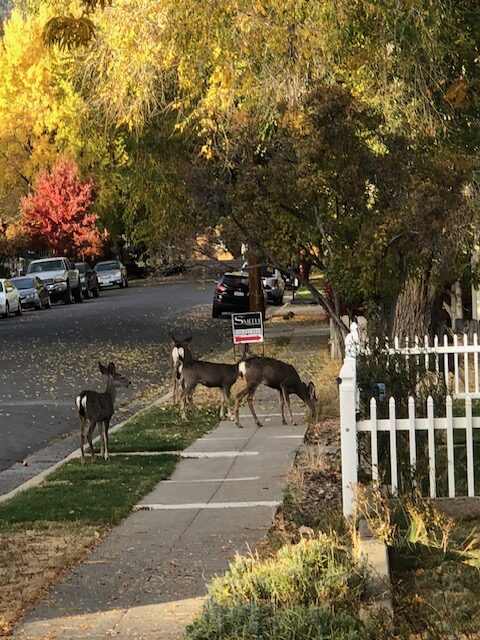
Deer grazing along Maple Street, Susanville-Courtesy of Jim Chapman
There was a time that to spot a deer in Susanville was a rarity. Those days are long gone. The deer population in the community is plentiful is an understatement. Some attribute the deer population with the passage in 1990 of the California Wildlife Protection Act. This law protects mountain lions from being hunted etc. With the increased mountain lion population, it would only make sense for deer to seek refuge inside the city from this predator. With that in mind the following is an account of a deer sighting years ago, that certain residents might find quaint.
Lassen Advocate, 16 February 1917 – It isn’t very often that deer wander into Susanville from our surrounding country, but a beautiful doe came in to see the sights last Wednesday. The animal was first seen in the Taylor fields north of town, and various persons living on North Street had a glimpse of it as made its way west to the hills.
Crater Lake is located seven miles east of the Bogard Rest Area on Highway 44. In 1907, Lassen National Forest Supervisor, Louis A. Barrett, included this lake in his inventory of proposed National Monuments, the other two being Lassen Peak and Cinder Cone. The lake remained inaccessible for years, except for hardy hikers who climbed the mountain. In 1952, the Fruit Growers Supply Company constructed a logging road to the 35-acre lake that is situated in a volcanic crater, on lands owned by the Lassen National Forest. The Forest Service originally proposed to offer summer home sites, but established a campground instead.
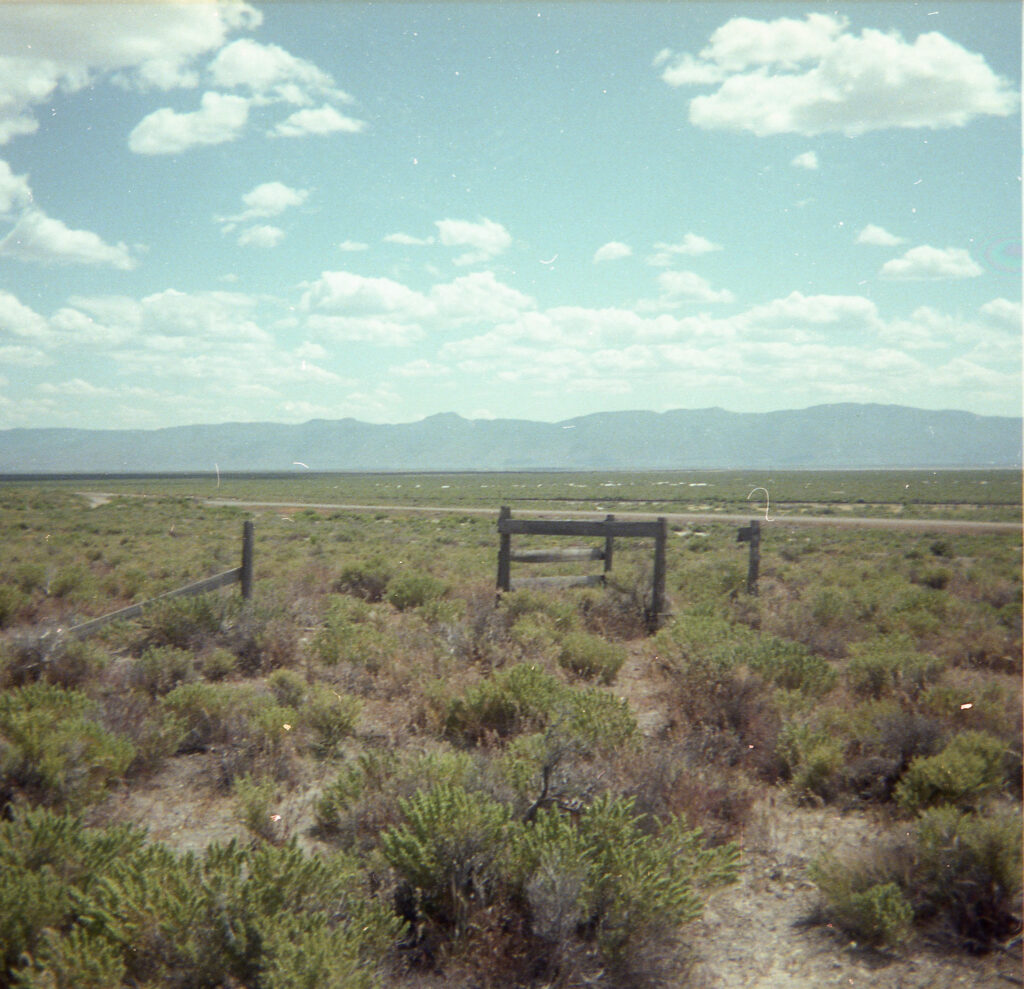
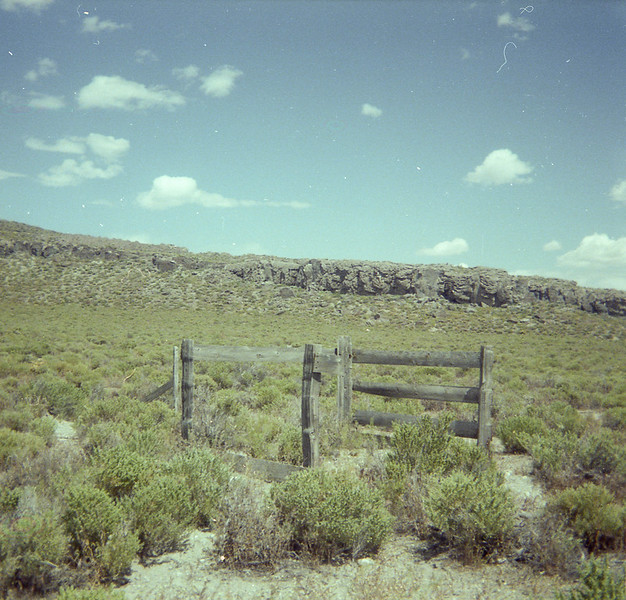
Initially, how the local wild horse population came to be was in the mid1800s. At that time, the Honey Lake Valley had few fences and the settlers allowed their livestock, both cattle and horses, to roam freely during the winter months. Annual spring round ups, that became the origin of today’s rodeos were to capture and brand the animals. There were always some stray horses escaped from being caught, thus began the local wild horse population.
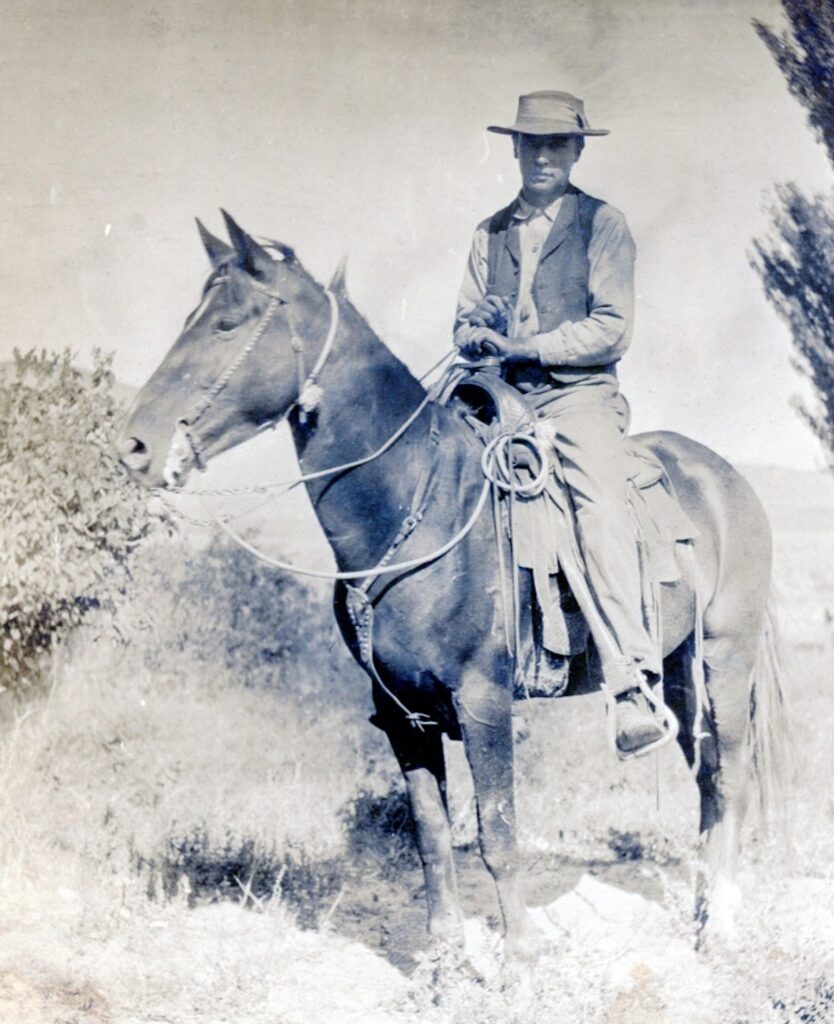
George Wrede’s winter homestead remain at Bull Flat, where he would catch and break wild horses., June 1977
Yet, back then the wild horse population was kept under control by out of work wranglers. During the winter months, it was not unusual for ranches to let go extra help, especially single men. A number of these men, would take up a 160 acre desert homestead to make a home, especially properties with unclaimed springs. To make some extra money, they would catch wild horses and break them. By spring they would sell the horses, and pocket the money.
The Marr Brothers of the Madeline Plains turned that into a fine art of rounding up wild horses. In the 1930s, they would gather wild horses to be used in rodeos, which made for wild times. By 1940, the demand for horses dramatically decreased, thus allowing for the wild horse population to grow unchecked. More about. that later.
Thought some might be interested of on accounts of the lizard that was relayed by a Big Meadows Maidu and published in 1883:
“Speaking of Indians, reminds of a curious legend of theirs that I drew a few days ago from Dick, an Indian, an intelligent Big Meadows buck. Accidentally, I spoke of the arrowheads occasionally found everywhere over the country, and he remarked ‘they were no account, as they were made by lizards.’ This excited my curiosity, and with a little questioning I obtained the following, which in a tradition they have the appearance of religiously believing, as it is told them by their fathers.
“A long time ago the lizard was a little man, very little man indeed, and he was very much afraid of the grizzly bear, who was the ‘hi[yu’ boss-the right bower-the four aces so to speak, of all beasts, and what is more could talk. Well, these ugly bears seemed to hanker after these little lizard men and would think nothing of making a lunch of whole family, with mother-in-laws thrown in as dessert. The lizard were mortally afraid of them, but would shoot arrows at them without doing any harm, only making the grizzlies laugh. (These arrowheads are the ones we find.) At last there was a smart little cuss of a lizard who had had all his relatives eaten except his grandmother, with whom he lived, and resolved to make at a bow and arrow that would kill the bear. So he set himself to work and when questioned he told them all what he was doing at which they would laugh. When he got his bow completed his grandmother would not let him leave the campooda, for fear he would meet the fate of the others. At one last evening, while the old lady was gone after a basket of water, he took his new bow and quiver of arrows and stole away to a valley where the bears congregated to hold their meetings and all over the prospects of yellow jackets crop. Arriving at the valley, he soon saw a number of bears, among was the old boss himself-a monster that had grown fat on lizard men. Climbing a small sapling, he made a noise by shouting, whistling and other means, to attract the attention of the bears, which soon did, and the old boss bear walked growling up to the tree, and savagely inquired what Mr. Lizard wanted. The little fellow up and told him what he had made, and that he was going to kill him, at which the bear laughed and told the little fellow to come down and he would go home with him and they would have would have big spree that night. But lizard declined the bear’s invitation to his own home and told him he meant business, and if the old grizzly did not believe him, to just shut his eyes and open his mouth and he would show how it was done. To this the bear laughingly consented, when the little fellow fired away, the arrow entering the bear’s mouth, killing him on the spot. He then hastened to his grandmother, whom he found weeping, thinking that he, too, had been a made a lizard angel, just like the rest of his relatives. He told the old woman to ‘dry up’ and then told her what he had done, and it took him some time make her and the other lizards believe him, although he had never been known to tell a lie. At the last the truth became known, he was made a big chief, a great feast of crickets, acorns and suckers was given, and he lived long to enjoy the honors he had achieved by his daring act, while the bears, having found their match, became frightened and sought the darkest shades of the forest, where they have ever since remained, only when forced by hunger to seek food in the valleys.”
Zamboni Hot Springs, located in Long Valley just south of Constantia and the place has been widely known as Great Basin Pottery. In the 1970s numerous changes were taking place and not just in Lassen County but the nation as a whole. Of course, there was an element in the youth that promoted a back to nature movement. After all what could more natural than soaking au natural in a hot spring. These young folks studied geography/geology and had penchant to locate obscure springs such as Zamboni. The timing was an exquisite as Zamboni had all the right elements–the property was more or less vacant, easily accessible, yet hidden from view and equally important, it has just right temperature, as so many of the hot springs were too hot. Once discovered, it became a popular gathering spot, especially with students from Lassen Community College.
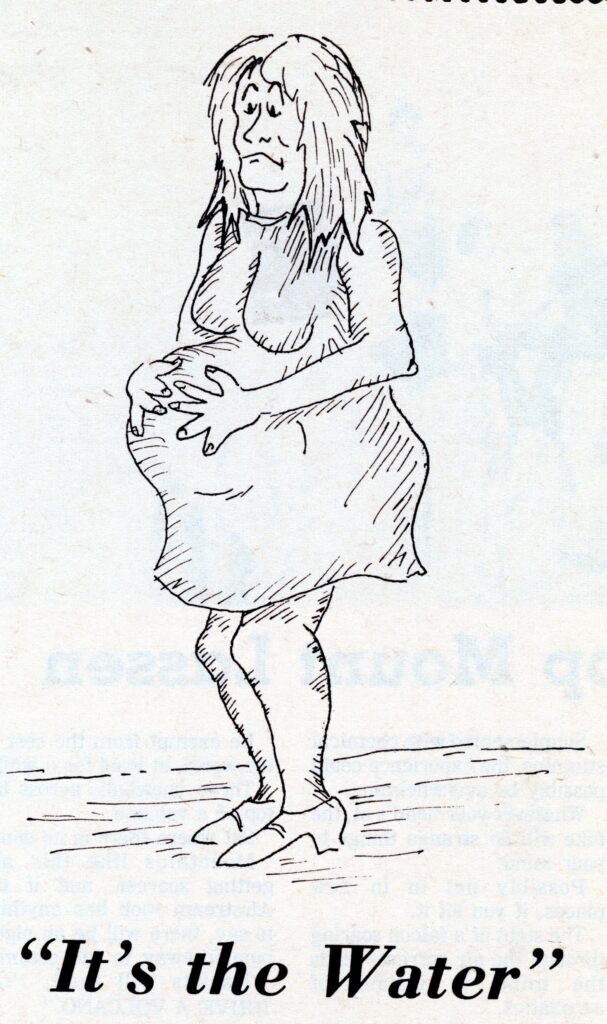
The college’s newspaper, The Cougar first carried a story about the springs. The paper ran a brief follow up story with a drawing a very pregnant woman. The caption stated, “It’s the Water.” In addition, the paper wrote, “If you can remember the closing of Doyle [Zamboni] hot springs.
“As a follow-up, we wish to run an account of an incident told to this reporter by a store-keeper in Doyle.
“It seems that the Army ran tests on the water in the hot springs and discovered that a sperm cell could live in the water for a period of four hours.
“When asked to comment, spokesman for the Army could not answer.
“As a public service, we have a picture above a very unhappy visitor to the Doyle hot springs, with her Sad tale.”
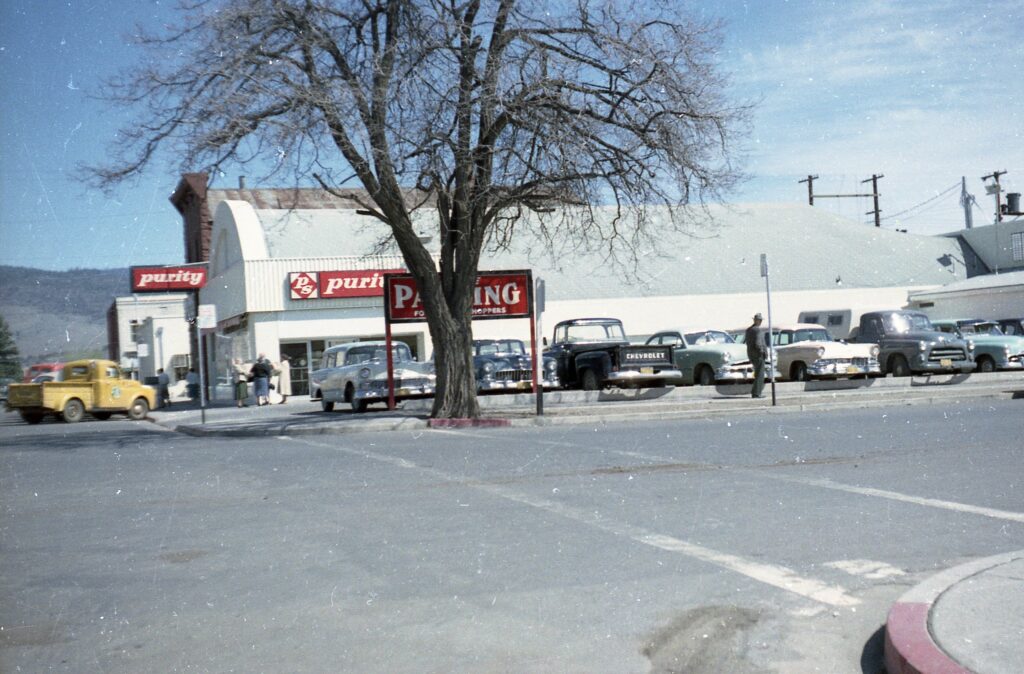
Purity Grocery Store, 65 South Lassen Street, Susanville, 1960- Another dumpster dive salvage
In the early 1920s, chain stores slowly started making inroads at Susanville, though some thought them to be a menace. One of the first grocery chains was Purity, and they opened in the Star Hotel building on the northeast corner of Main and Gay Streets. In the summer of 1938, they purchased a vacant lot on the northeast corner of Cottage and Lassen Streets and shortly thereafter constructed a store, which the building still exists. Purity closed its Susanville store in the mid-1960s, and Food Lane took over the location. Food Lane lasted nearly a decade and then it closed. Taking its place was Chicago Title Company, who operated at the location until the mid 2010s. The building is now occupied by Community Church.
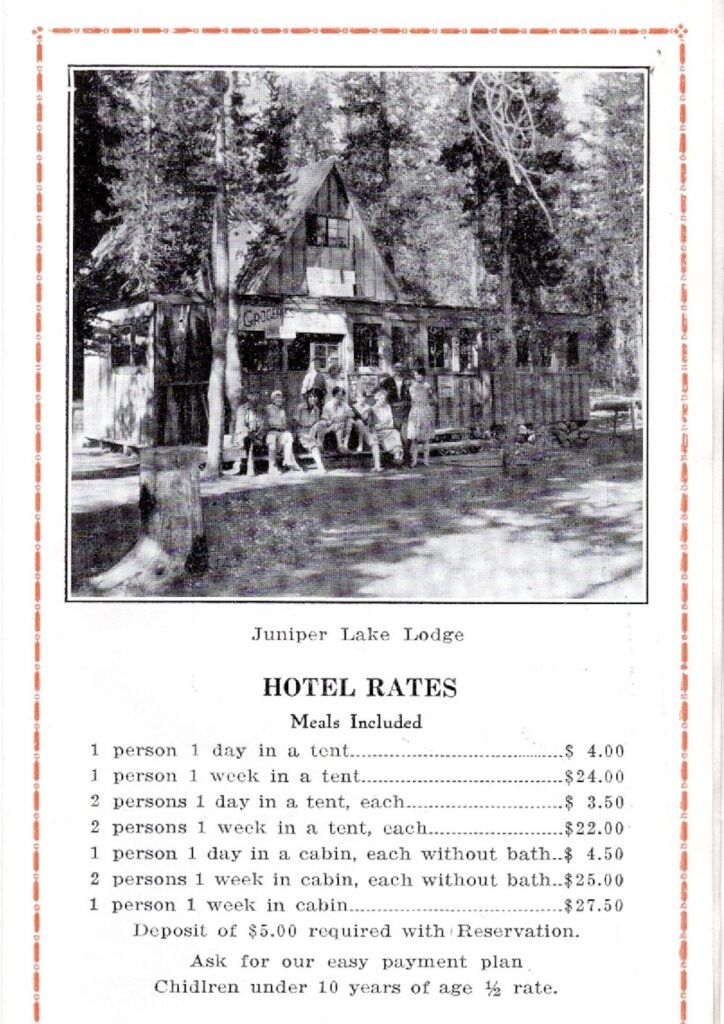
Staying inside a national park overnight can be pricey. Lassen Volcanic National Park accommodations has always been sparse. The Sifford’s Drakesbad Resort that the family owned from 1900 to the 1950s, would eventually cater to the well-heeled residents of the San Francisco Bay Area.
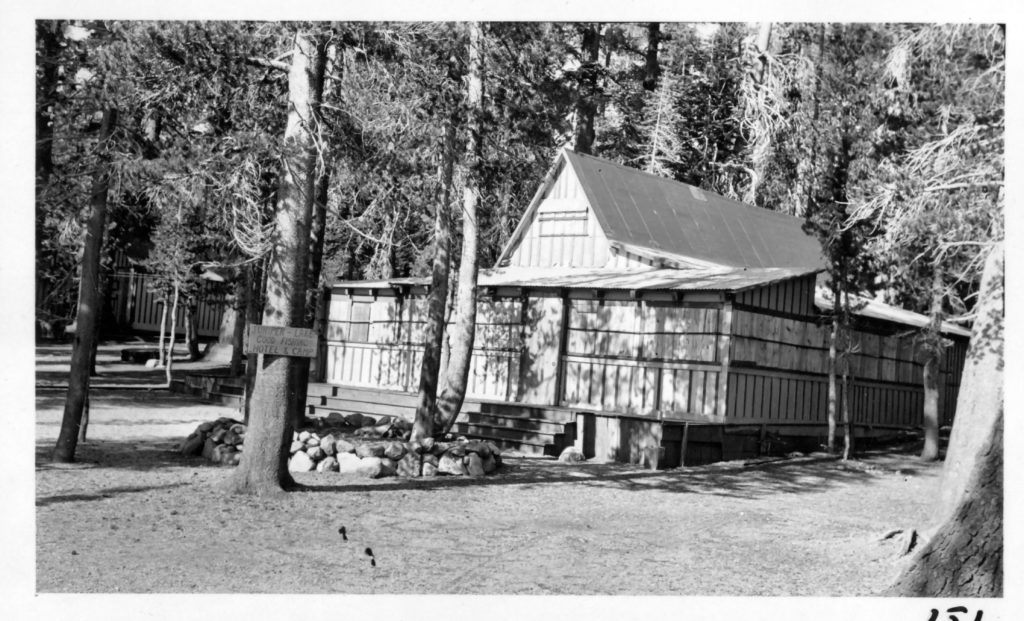
Juniper Lake Lodge — National Park Service
The Snells who owned Juniper Lake Resort east of Drakesbad, was primitive by Drakesbad’s standards. Nonetheless, one could rent a tent there for one night in the 1930s for four dollars. For a couple it was seven dollars. While that might not sound a lot today, the average prevailing wage just happened to be four dollars a day!
Small railroad communities are transient in nature, and not necessarily noted for their longevity. At first, NCO’s railroad town of Amedee, located on the east side Honey Lake might break that cycle. In 1891-1892 was it peak boom years, then a gradual decline.
As with most communities in general, a cemetery was an after thought, until a death occurred, that created a need. This was exactly what happened at Amedee. In September 1894, Samuel & Harriet Johnstone, infant daughter, Cora Aline passed away. The bereaved parents had her buried on the hillside overlooking the town and Honey Lake. The next interment was twelve-year-old Mabel Brubeck who died of pneumonia. There were two other burials, one for baby boy Rogerman, date unknown and the last was for Robert Isigheit, who on died 22 February 1913, at the age of 66.
Amedee Cemetery
Some former residents, thought there might have been 11 burials, but I have never could find a record of such. Then there was a strange occurrence. In 1955, Thomas Ogilvie, Lassen County Surveyor plotted out the cemetery. His map contains 79 plots, not including three existing graves. It is interesting to note the property then and now is private ownership.
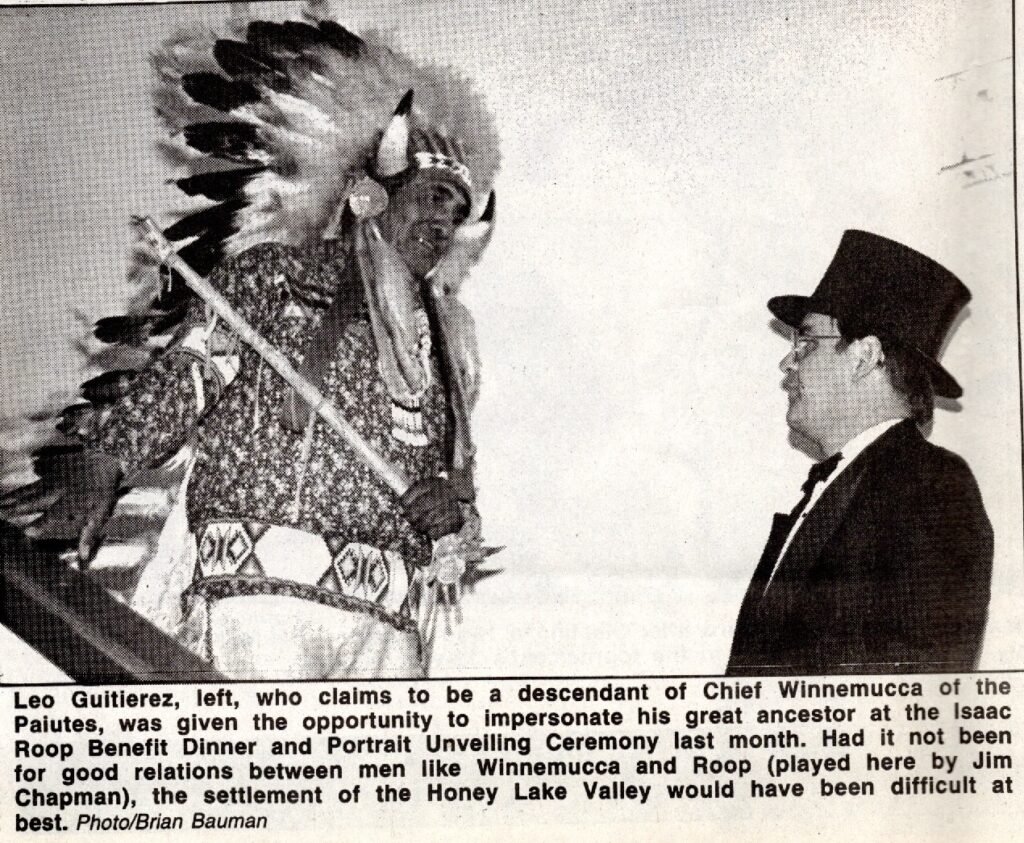
In the early 1990s there was a local lobby effort to have a portrait hung in Carson City for Isaac Roop, he being the first Provisional Governor of the Nevada Territory in 1859. Nevada officials agreed to a portrait placement, but private citizens would have to pay for such a portrait. Fundraisers were held.
Once such fundraiser occurred in April 1994, a month after the portrait was hung. The Lassen County Times covered the event which included Chief Winnemucca’s treaty with the local settlers and the Papoose Meadows Massacre of 1866. I have covered this with Version One, Version Two and Version Three. At this dinner, there is now a Version Four. Without further ado here is the published account.
“Harold Dixon, who consider himself a local Indian historian, provides some insight into that historic treaty.
“Young Winnemucca, according to Dixon, was a Paiute Indian born near present day of Litchfield in the Honey Lake Valley. He was chief of the Wadatkut band of the Paiutes who for centuries roamed the Eagle Lake and Honey Lake areas, as well as other areas of Northeastern California, Oregon, Washington and Nevada.
“Winnemucca was related to Old Man Joaquin who was best known as being the only survivor of the Eagle Lake Massacre (1862) in which 80 to 100 Paiutes were killed by the local settlers.
“According to Dixon, the massacre occurred at Papoose Meadows, and the settlers who did the killing had actually journeyed to the area to take revenge on Pit River Indians who had reportedly been stealing cattle.”
Unfortunately, this account is full of factual errors, but since it is published, some might take as factual to quote and perpetuate it.