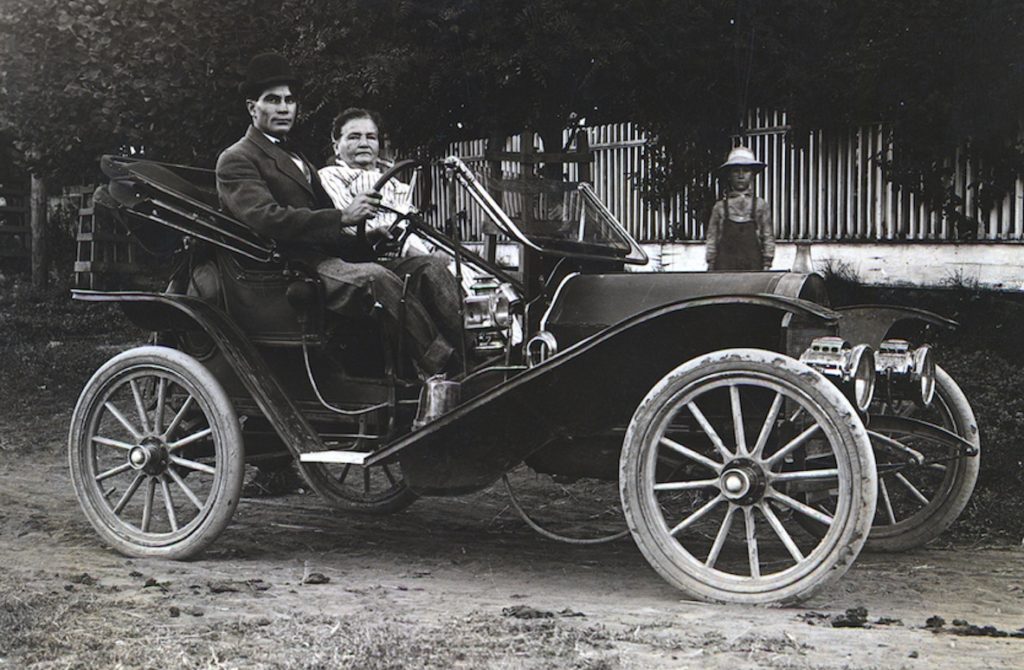
Chester, California, 1914. Courtesy of Dolores Gasperoni
On April 26, 1894, the Chester Post Office was established at Burwell Johnson’s establishment, which included a saloon plus rooms for travelers. Johnson’s was located at the base known today as Johnson Grade on Highway 36, approximately where the causeway begins. The post office was named after Chester, Vermont, former home of the Jonathan Martin family, Johnson’s neighbors, who were instrumental in the development of Chester.
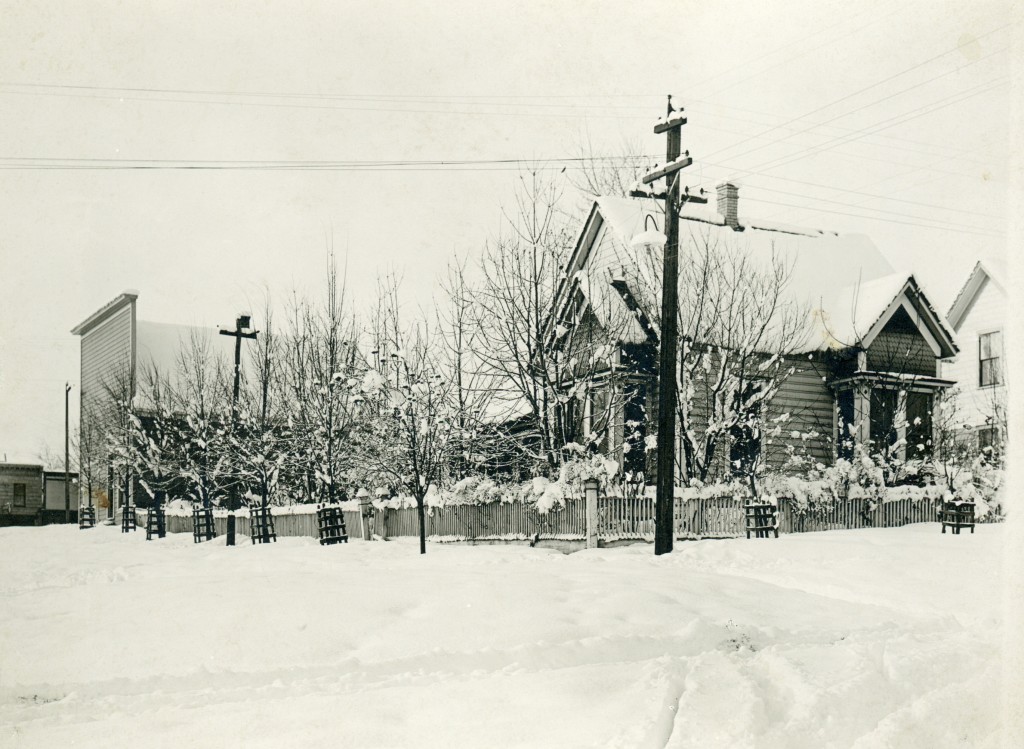
In the early 1900s, the Great Western Power Company began acquisition of properties of Big Meadows, which it was their intent to construct a reservoir for hydro-power development. This they did, and the reservoir is known today as Lake Almanor. The Martins along with their neighbors Olsen sold their properties to Great Western Power, retaining everything about 4500 elevation contour. In 1911, Edith Martin hired Everett M. Cameron to survey and subdivide her property and thus, the town of Chester was born.
Bill & Franceska Neuhaus, Willow Creek Valley, with Leo Murrer in the background, circa 1912–Phyllis Beard
Several people asked for more information on my great great grandmother Franceska, since they were intrigued at the age 74 she went in hotel business when she had a St. Francis Hotelconstructed in 1914.
For starters she was born in 1840 in Switzerland. In 1858, she married fellow countryman, Jacob Murrer. She gave birth daughter, Pauline, in 1859. The following year, Jacob and Franceska migrated to California, leaving infant Pauline care to her parents. The Swiss couple moved around a lot in Northern California where Jacob tried his hand mining, but fell back as a dairy farmer. Their family grew by additional five children–Jacob, Edward*, Mary, Emma and Rose. In 1874, the family moved to Willow Creek Valley, north of Susanville. On July 4, 1876, Jacob died of a heart attack, leaving Franceska to a daunting task of trying to make a living on the 160-acre homestead. After all, Franceska now widowed at the age of 36, had the responsibility of raising her five children who ranged in the age from 3 to 14 years.
This is where the story gets interesting and revealed her strong character. Franceska did find solace with her neighbor Ben Neuhaus. Since they both spoke German.. She had someone she could easily converse with, as she had trouble speaking English. There was an added bonus that they were both devout Catholic. On April 20, 1879, Ben and Franceska were married at Reno, Nevada. It was an unusual union for that they both kept separate business accounts. In early 1900s, Eulalee (Yoakum) Trussell, who grew up on the San Francisco Ranch (now Five Dot), explained this arrangement. Eulalee recalled when Franceska told her about her marriage to Ben, “That we did not marry for love, but marry the ranches.”
50 North Gay Street as it appeared in 1919. This was the home of Ben and Franceska. Courtesy of Leona F. Byar, a grand daughter of Franceska.
In 1902, Ben and Franceska retired from ranch life in Willow Creek Valley and moved to Susanville. They leased a ranch for $1,000 a year. Franceska invested in Susanville’s commercial property and did quite well. In 1912, they sold the Willow CreekValley ranch to Edward Murrer for $13,000. Edward made a down payment of $1,000 and paid balance the following year. Flush with cash, Franceska’s final venture was for the construction of Susanville’s St. Francis Hotel, that son and daughter-in-law Bill and Flora Neuhaus would operate. It should be noted that Franceska was well versed in the inn keeping business. For years the Neuhaus home in Willow Creek was well known for its hospitality to accommodate travelers. Her daughter, Rose, operated hotels at Hayden Hill and Susanville. Rose’s home in Susanville happened to conveniently located behind the St. Francis Hotel and her elaborate flower garden complimented the hotel.
815 Cottage Street, Susanville, February 3, 2018 This was home of Rose Murrer Bagin.
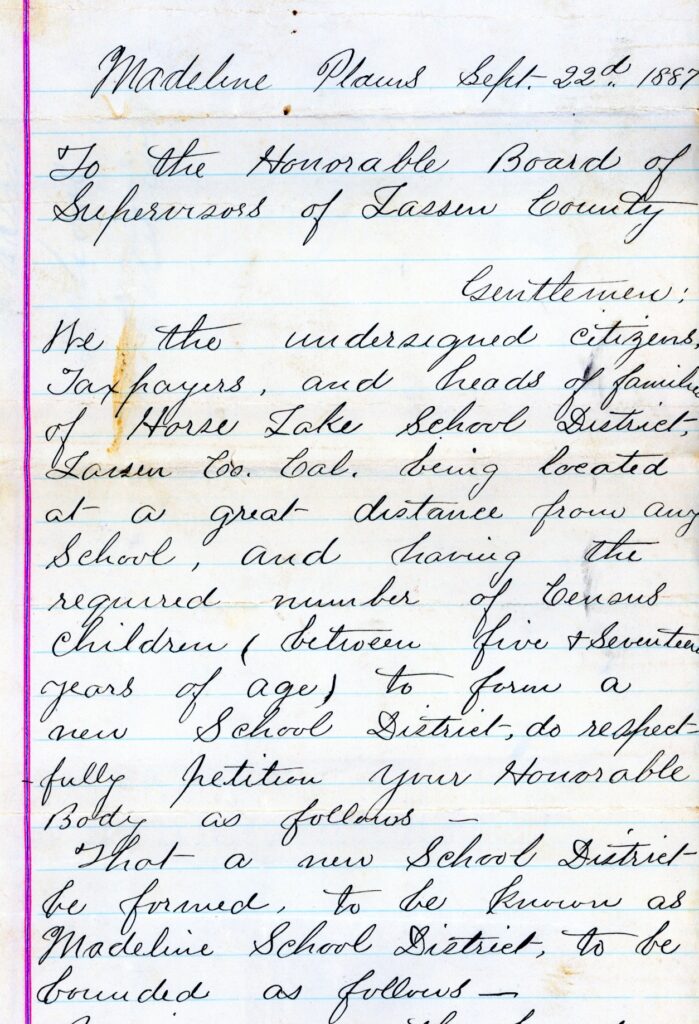
In the fall of 1887 Madeline Plains residents petitioned the Lassen County Superintendent for a new district to be named Madeline. It was signed by thirteen residents who have sixteen children. After all, they cited the nearest school was Horse Lake. In 1888 the petition was granted.
A school house built at the A.W. Pinneo, three miles south of the present day Madeline. Then, in 1902, courtesy of the NCO railroad saw the creation of the town of Madeline. The district hired Ike Metcalf to construct a new school there. In the fall of the 1927, that school was destroyed by fire. The school trustees had planned to construct a new building. But another opportunity arose, and they purchased Cliff cCarter’s house and converted into a school. The Madeline School closed in 1968.
An astute Fish & Game deputy, C.O. Fisher who was stationed in Susanville during 1920s kept records of the wildlife in the region. He noted that was a band of forty big horn sheep (Lava Bed Bighorn) that lived on Observation Peak of the Madeline Plains country. Fisher believed that they all had perished during the severe winter of 1922. In the summer 1923, Fisher found horns and skeletons of the sheep on the mountain.
By happenstance, in 1927 Fisher discovered a small herd consisting of four females and two males in upper Smoke Creek/Painter Flat region. What is became them is not known.
This Amedee business partnership lasted less than a month. Courtesy of Tom Armstrong
Today marks the fourteenth anniversary of the passing of the famed jazz musician Dave Brubeck. One of his most notable pieces was Take Five.
Many people may not be aware that Dave’s family played an integral role in the region’s history. His grandfather, Lewis Warren Brubeck, settled on the east side of Honey Lake at a place known then as Lower Hot Springs in 1881. To build his home and outbuildings he rafted the lumber across Honey Lake from Milford. Dave’s father, Peter Howard was born there. In 1890, the NCO Railroad arrived at Brubeck’s Ranch and it was transformed into the bustling community of Amedee. Lewis was married to Louisa Grass. That family had deep ties in the region’s history. Seasons residents might not beware the late Beth Doyle and Erma Haley, were both Grass descendants.
Dave’s aunt, Mabel Brubeck was the first person buried in the Amedee Cemetery. After the family sold their holdings and moved to Concord, one member would return, William. Will Brubeck had a small homestead across the highway from the wild horse corrals. Of course he had numerous cousins in the region. After all, Litchfield was named for his aunt and uncle (Mary Grass and Andrew Litch). One of the more interesting cousins, who happen to marry in the George Wingfield family was the intrepid explorer, Leonard Clark.
Subscribe today to receive daily notifications and more about Lassen County history.
Ted Friend, publisher of the Lassen Advocate, 609 Cottage Street, Susanville, June 1944
It was on December 2, 1987 that the last issue of the Lassen Advocate rolled off the press. U.S. Bankruptcy Judge David Russell ordered the shut down of the 122 year-old newspaper. Richard Myers publisher, said, “They just took over, marched in with a locksmith and changed all the locks on the doors and told us to leave.”
Lassen County Times, October 19, 1978
Of course, there were the chatter of all arm chair quarterbacks as to what went wrong. There was debt of new building, now home of the Susanville Police Department. Also, on October 18. 1978 the Lassen County Times made its debut and now the Advocate had competition.
Pogonip by definition is ice fog found in mountain valleys, especially in the Great Basin, in the winter. Ideal conditions for its formation is lots of ground moisture’s and high pressure weather system. Thie result is an inversion, when moisture laden clouds were forced down the valley floor, and the dominant high pressure blocks storm systems and with no wind, so inversions is trapped. One can ascend a few hundred feet above the valley floor, bask in sunny temperatures and overlook a sea of clouds.
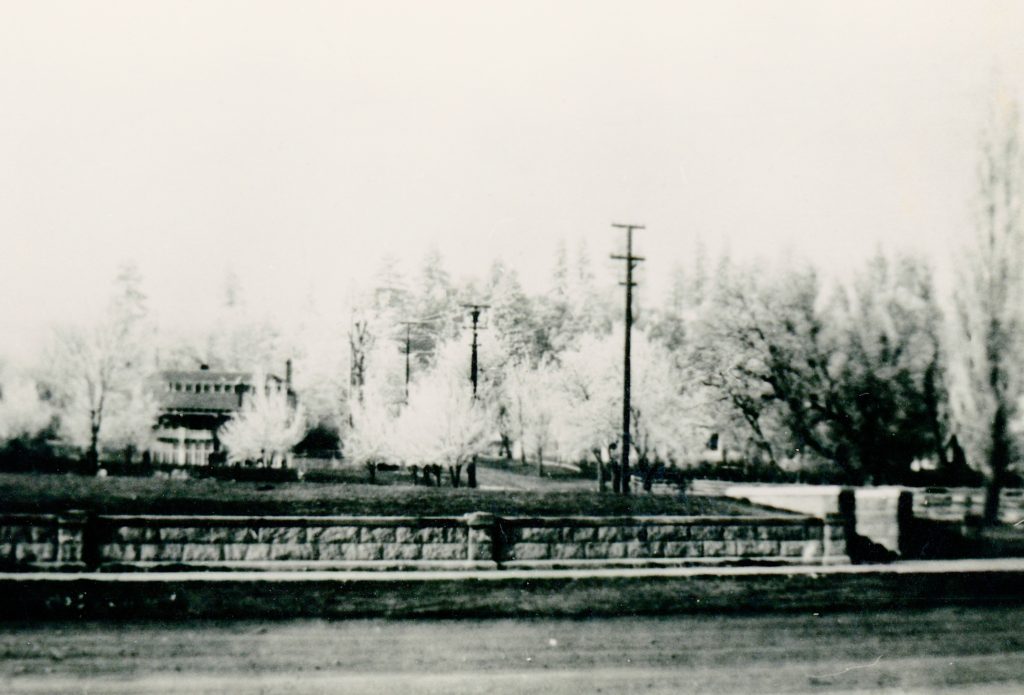
North side of the Lassen County Courthouse during a pogonip. Notice the trees are coated with ice crystals due to the freezing fog.
The term pogonip loosely translates into “white death,” for many Indians caught pneumonia and died. Pogonips vary in severity. A mild one might linger a few days or a week.The worst variety is when it turns into a literal ice fog, coating everything. The first day can be spectacular with ice crystal formations on everything. After several successive days of those bone chilling temperatures, it quickly loses its appeal. The pogonip of 1859 was one of severest on record in the Honey Lake Valley. The heavy cold fog lasted six weeks. So much frost accumulated on the grasses that cattle could not eat it. In addition, since the first settlers had been accustomed to mild winters, very little hay was put up, and a great many cattle starved to death that winter.
This is one the earliest pogonip on record in this territory. Long range weather forecast indicate no storms through mid-December. Time well tell when the pogonip breaks up. Hopefully, they are wrong, and the fog lifts by Sunday.
Dining Room, Folsom Ranch, Willow Creek Valley, circa 1900. Courtesy of Mary Dale Folsom
I wish every one good tidings and hopefully you enjoy holiday surroundings with family and/or friends.
I have not encountered any historical Thanksgiving observance of late 1800s in this region. It should be noted that there were a lot of New Englanders settled in Lassen County. The above photograph of Folsom Ranch, now the Willow Creek Wildlife Refuge just north Susanville was an example. Orman Folsom, the patriarch, settled in Willow Creek in 1871. He was a native of Maine. Ben Leavitt, the father of the Susan River Irrigation System, also hails from Maine. Two other notables from Maine: John Doyle, an early settler of Long Valley and for whom town Doyle for and Capt. C.A. Merrill the original promotor to tap Eagle Lake for irrigation to reclaim the sagebrush lands of Honey Lake Valley.
For the trivia minded, it was on October 31, 1939, that President Franklin Rosevelt signed a proclamation that designated the fourth Thursday of day of Thanksgiving. Prior to this, each region or states held their observance at different dates.
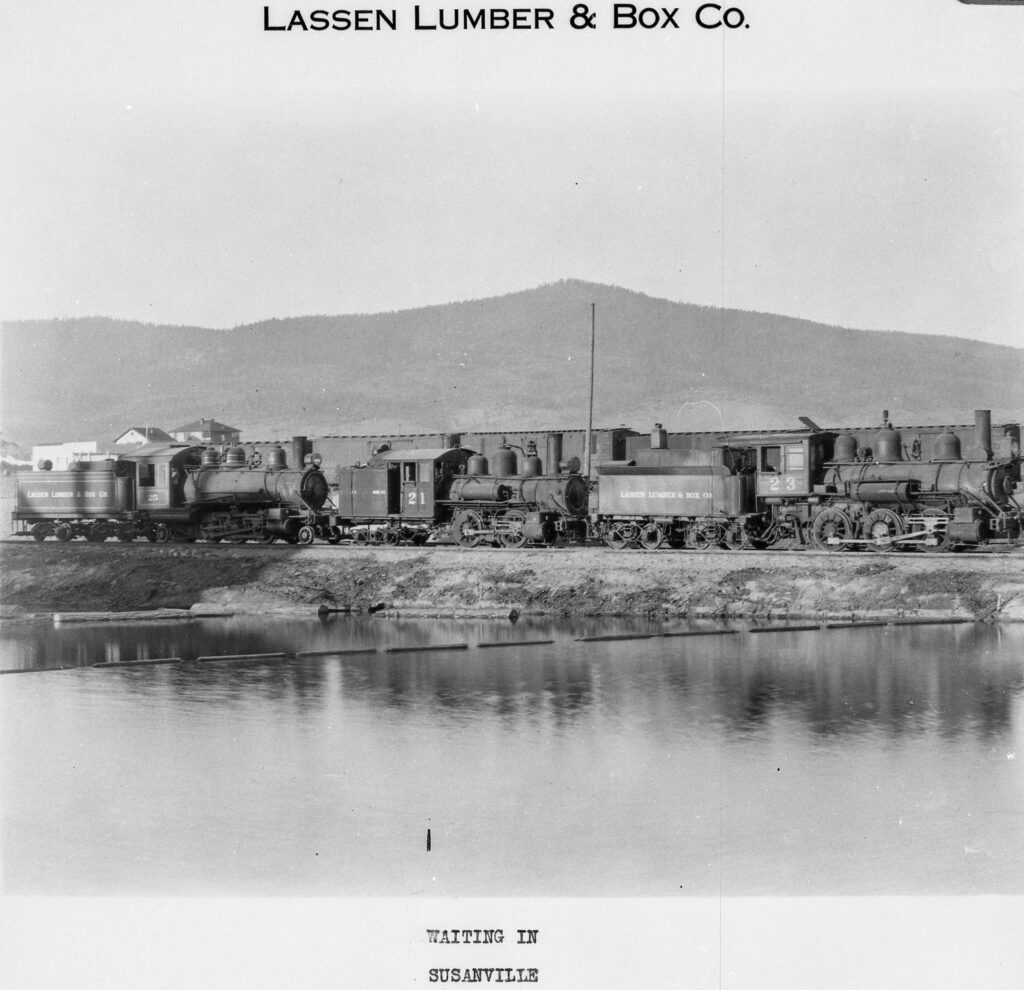
The three locomotives lined up at Lassen Lumber & Box Company’s mill, 1923
In 1923, Susanville’s Lassen Lumber & Box Company hired a professional photograph to produce large leather bound photograph albums showcasing their entire operation. This was a common practice then. The purpose to attract investors.
Lassen Lumber was a much smaller operation as compared to its neighbors Fruit Growers and Red River. Due to its small size, Lassen Lumber only had three railroad locomotives, which are showcased in the above photograph.
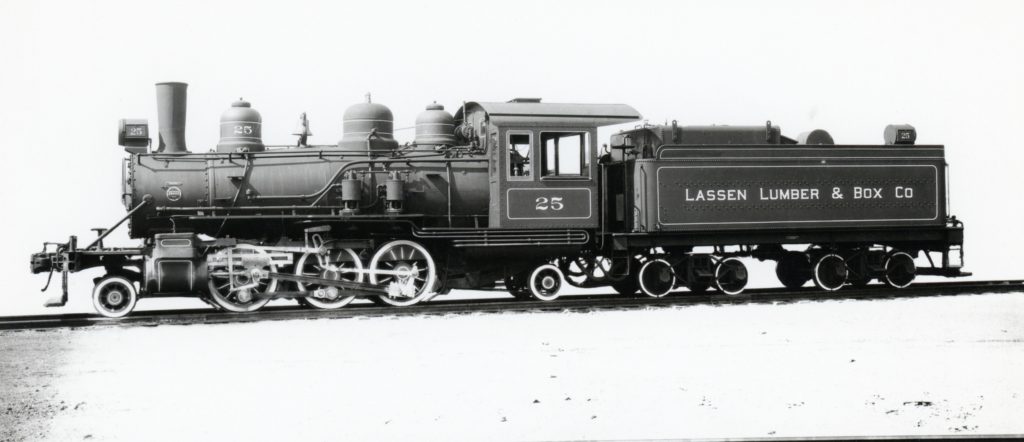
Lassen Lumber & Box Company No. 25—-Tom Armstrong
Lassen Lumber’s railroad logging operations was short lived and ceased at the end of the 1929 logging season. The No 25, depicted above, was sold to Red River. In 1938, Red River sold it to Modesto & Empire Traction Company. What became of the other two locomotives, I do not know.
There is a certain segment of population that will be traveling on the highways, byways, lest we forget freeways for the Thanksgiving holiday. A century ago, the California Highway system was still in its infancy. It took nearly twelve years to construct Highway 36 from Red Bluff to Susanville.
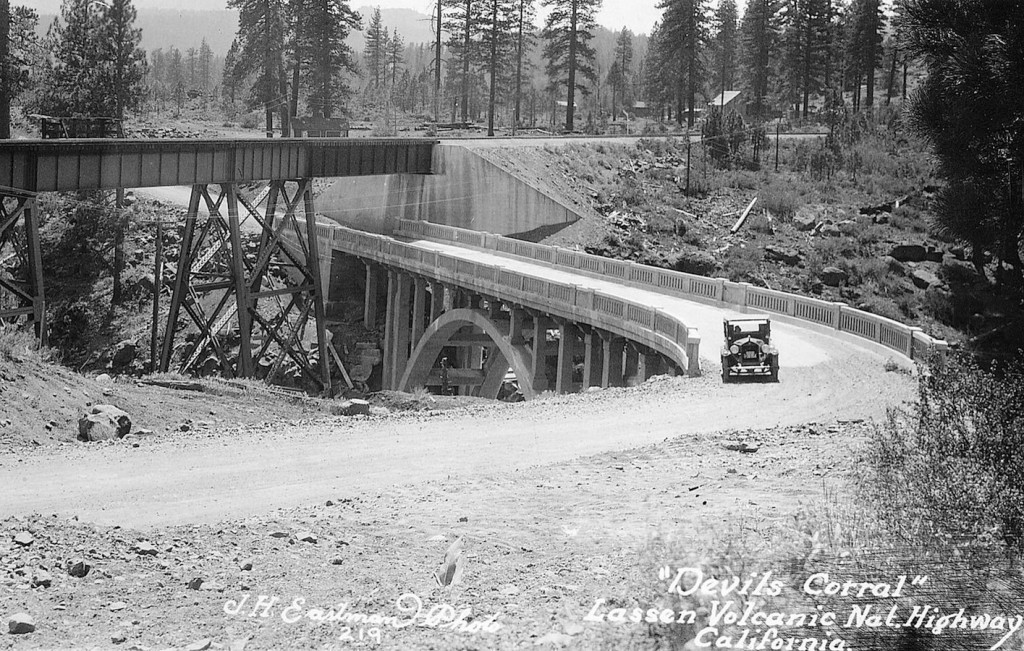
One of the major accomplishments occurred on November 25, 1923 with the dedication of the Devils Corral Bridge over the Susan River, some six miles west of Susanville. The $45,000 concrete span made travel a lot easier. In 1966, it was replaced with current bridge.




 Dave’s aunt, Mabel Brubeck was the first person buried in the Amedee Cemetery. After the family sold their holdings and moved to Concord, one member would return, William. Will Brubeck had a small homestead across the highway from the wild horse corrals. Of course he had numerous cousins in the region. After all, Litchfield was named for his aunt and uncle (Mary Grass and Andrew Litch). One of the more interesting cousins, who happen to marry in the George Wingfield family was the intrepid explorer,