Category Archives: History

Diamond Mountain Guest Ranch

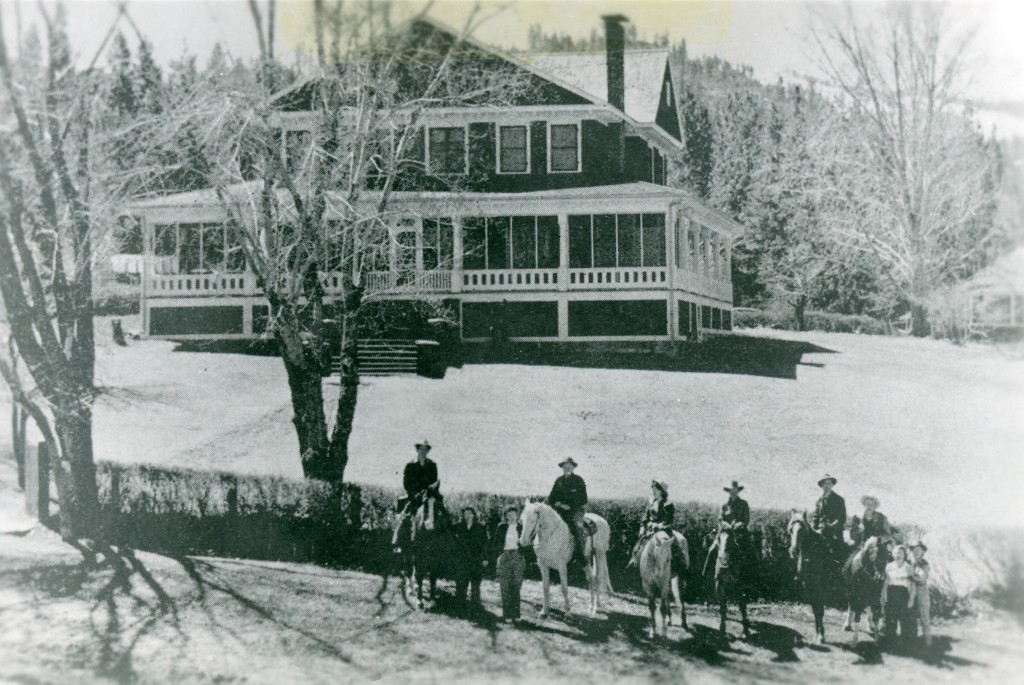
The Wingfield property as it appeared in the 1950s.

George Wingfield’s original summer home had many reincarnations. In 1946, three Carson City investors acquired the property eight miles south of Susanville and known to many as Ellena’s Mountain Meadow Ranch. They incorporated as the Diamond Mountain Guest Ranch. They envisioned transforming it into another New Mexico Vermejo Club or Colorado’s Rio Blanco Ranch.

J.E. “Jack” Hauskins was hired as manager/promoter. It was their original intent to offer 150 one-acre homesites on the property under a 49-year lease agreement. The first 50 sites were offered at $2,000 each, approximately $25,000 today, with an annual fee of $20 for maintenance.  They also proposed to build an elaborate clubhouse just east of the original Wingfield home, where numerous events would be held, the least not being, “A good lively dance every night with excellent string music. Never any raucous nerve-racking noise by our so-called orchestras.” Needless to say, this enterprise was not a success.

Never miss a story, click here.
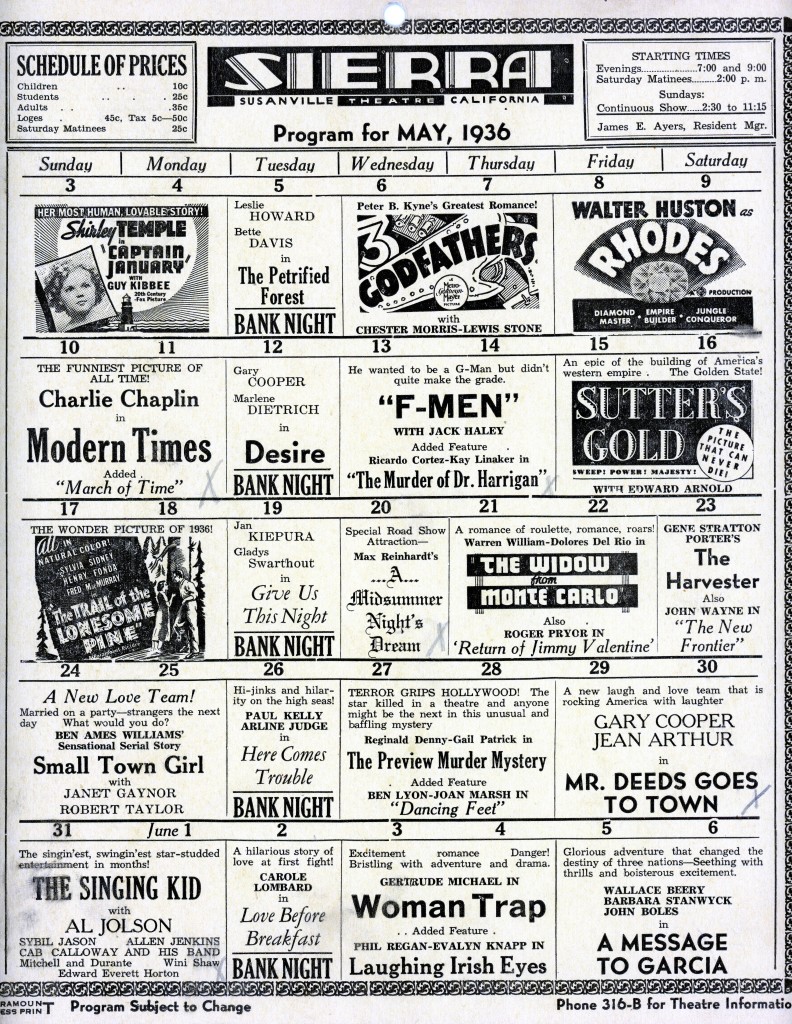
 

Susanville’s Sierra Theater – Preview

Monthly Preview Sheet, May 1936. Courtesy of Jim Chapman

Well, I had hoped to had this ready by now, but I still need to finish up some research. To be honest, I got sidetracked when I reviewed the Lee Zwiebel file, a manager of the theater during its early years.

Of course, there were some controversies that arose from the theater over certain films shown. Whatever the case may be, if anyone would like share their stories about Sierra, by all means contact me.

It is never too late, subscribe today and enjoy tomorrow with daily notifications. You can also surprise someone with a gift subscription

The Shinn Family

Shinn family plot, Susanville Cemetery, November 19, 2015

In my previous post about the Shinn Ranch, I promised a follow up concerning the children of Oliver & Louisa Shinn.

James Oliver Shinn, the eldest child pursued a career in newspaper business. He first gained experience working for Susanville’s Lassen Advocate.  Along with his brother, Al, they launched the Mountain Review on November 12, 1879. The newspaper continued until his untimely death the following summer. Continue reading The Shinn Family

Susanville Street Names

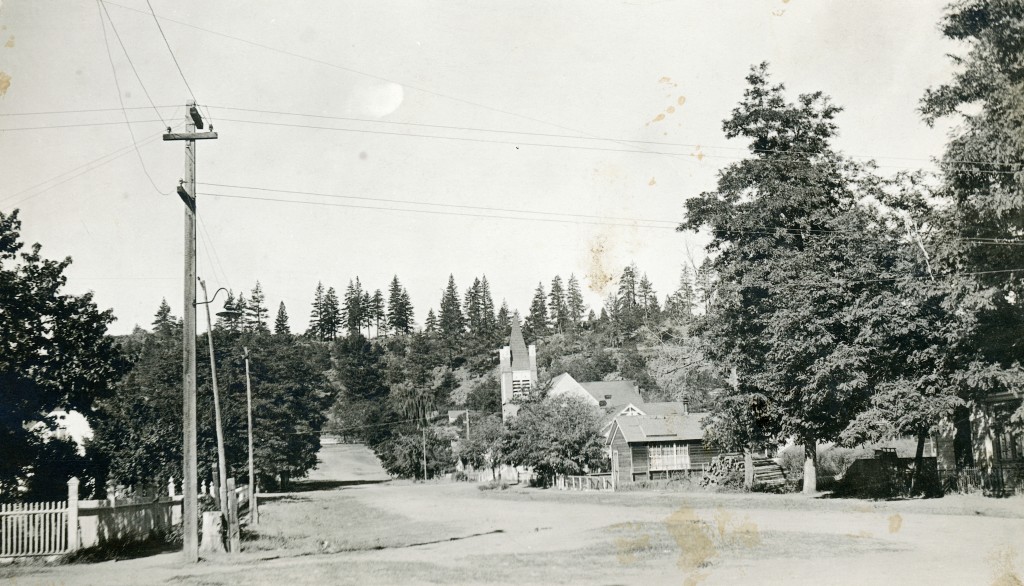
A serene Cottage Street scene, circa 1906. Courtesy of Betty Barry Deal

It is interesting to note that when the first town plat of Susanville was surveyed only three streets were named after individuals–Lassen, Roop and Weatherlow.  Fast forward to 1912, when the town’s largest adjoining subdivision, Lassen Townsite, was laid out nearly all the over half of the streets were named for individuals. Those streets such as Alexander, Knoch, Pardee, Minckler, were named for the investors.

In future posts, we will delve into the history of the street names, and who were these people. For instance, Mark Street was named for Mark Arnold, the seventeen-year-old son of Alexander and Susan Roop Arnold, who died in 1898.

Never miss a story, click here.
 

Coyote Scalps

Coyote Scalp418
rec

In 1880s and 1890s, California began offering a bounty on coyotes at the insistence of the livestock industry. By 1894, the price per scalp was five dollars. The whole procedure was handled through the county clerk’s office.  For some individuals it was a lucrative deal, and could actually make a living at it. Many Native Americans partook in the program, instead of working as a laborer for a rancher. Once the county clerk received reimbursement from the state, the clerk would take the scalps and burn them.

Never miss a story, click here.
n

The Magnolia Saloon

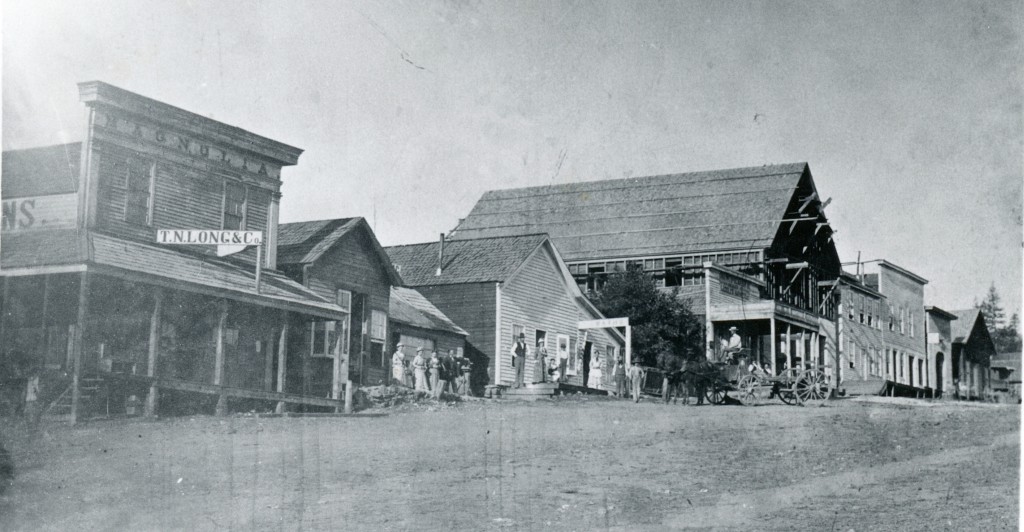
Susanville's 800 block as it appeared in 1870s, with the Magnolia to the far left. Courtesy of Verna M. Wood
Susanville’s 800 block as it appeared in 1877, with the Magnolia to the far left. Courtesy of Verna M. Wood

In the summer of 1862, T.N. Long and Al Leroy constructed a story and half building on the southwest corner of Main and Union Streets, the current site of the St. Francis Hotel. It housed the Magnolia Saloon, and at the time of construction was most pretentious structure in Susanville. In 1864, the saloon also housed Lassen County’s first courtroom. As the court only was in session during the first few days of each month, it did not interfere with the saloon trade. In 1867, with a new Lassen County Courthouse, the Magnolia was no longer needed for judicial purposes. Over the years, it housed numerous entities and was destroyed by a fire in 1882.

Never miss a story, click here.
St. Patrick’s Cemetery Tour

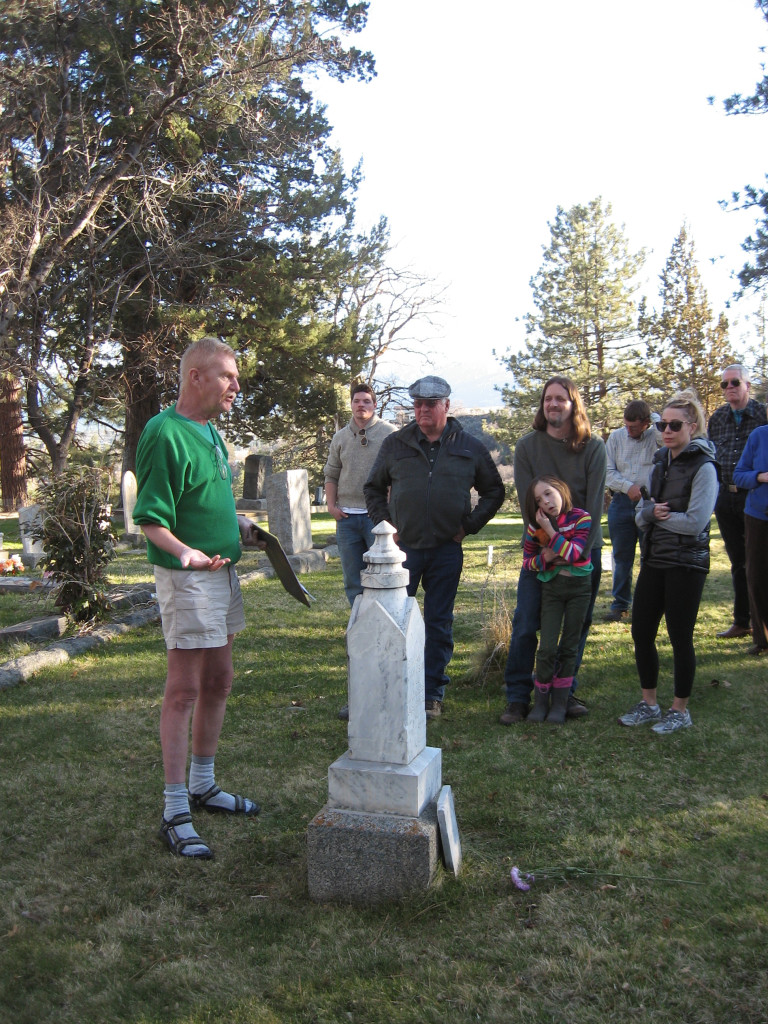
The graves of Richard and Margaret Thompson

The saga of Richard and Margaret Thompson was one of many tales featured on Thursday’s St. Patrick’s Cemetery Tour at the Susanville Cemetery, which was established in 1860.  This couple were among the very early settlers arriving in 1858. On April 6, 1866, their only daughter Sarah married Thomas Mulroney, and they were not happy, they being protestant and Mulroney a catholic. On March 12, 1867 in a drunken domestic dispute over the daughter’s marriage, Richard attacked his 65 year-old wife with a hatchet and killed her. This is only the beginning of this tale. Thompson was found guilty of first-degree murder and sentenced to hang at San Quentin. The case was appealed to the Supreme Court which upheld the verdict and he was sentenced to hang on December 12, 1868. However, two months earlier a number of Honey Lakers petitioned the California Governor to commute his sentence to second degree murder, which the penalty would be life in prison. The Governor agreed. End of story, not so fast. In 1872, Thomas Mulroney asked the Governor to pardon his father-in-law citing while the murder was done in a crazy fit of intoxication and that it was inexcusable, Thompson’s age and failing health, and as a model prisoner, should spend his remaining final days with his only daughter. Again, the Governor agreed and in 1874 Thompson was pardoned. He returned to the Honey Lake Valley to make his home with the Mulroneys. His health greatly improved he lived for another 21 years! His great-great-granddaughter, is Patty Gomez, who still resides on the original Mulroney ranch.

If you want to attend the next event, the Inspiration Point Tour, this is a good time to subscribe now, so you will not miss on this and other forthcoming excursions.

Finally, thank you Lassen Ale Works for your hospitality at the end of the tour.

Buried Treasures

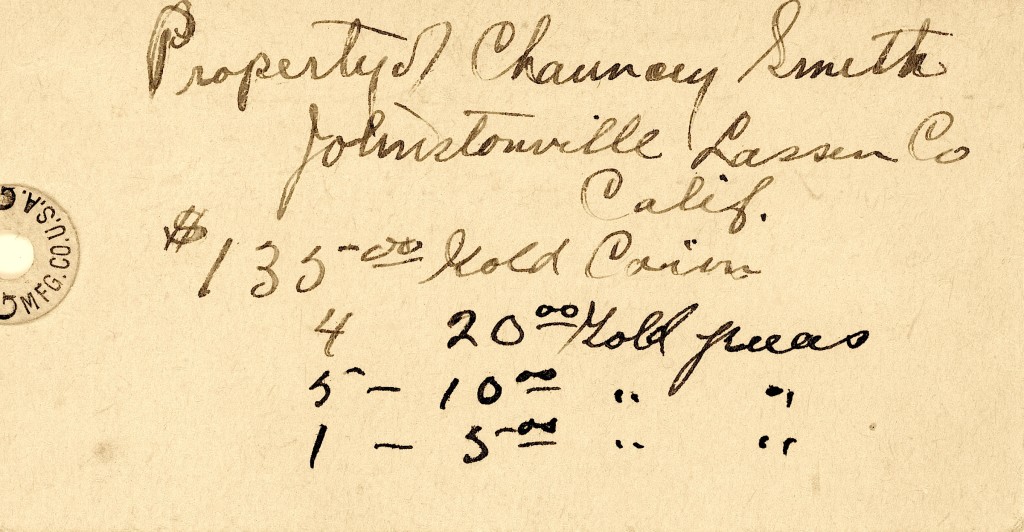
Receipt of one of cans of money that Chauncey Smith buried.
Receipt of one of cans of money found  that Chauncey Smith buried.

From time to time, someone will approach me about buried treasures.  Some stories have been embellished over the years, especially that of Harry Gordier’s gold and the Holden Dick Mine.

Then there are the lesser known tales, which are actually true,and not folklore. In the book Untold Stories, I relate the story of Chauncey Smith, since only a portion of his hidden cache of money was ever found.  There is, of course, the great Westwood bank robbery, that to this day the money has never been recovered. In August, 1926 a portion of Red River’s monthly payroll shipment consisting of $45,000 never made it Westwood from the Reno bank. One theory was the money was stashed along the mountainside between Doyle and Milford. In June 1927, Red River thought they had found thief, in one A.A. Bruce who formerly worked for the railway express offices in Reno and Westwood. Bruce was arrested and his Reno home searched. However, when a preliminary hearing was held in Susanville, Bruce was released from custody as there was insufficient evidence to charge him with the crime. No one was ever charged, and the money never found.

Never miss a story click here.

Bartlett Said, A Vagabond’s Journey

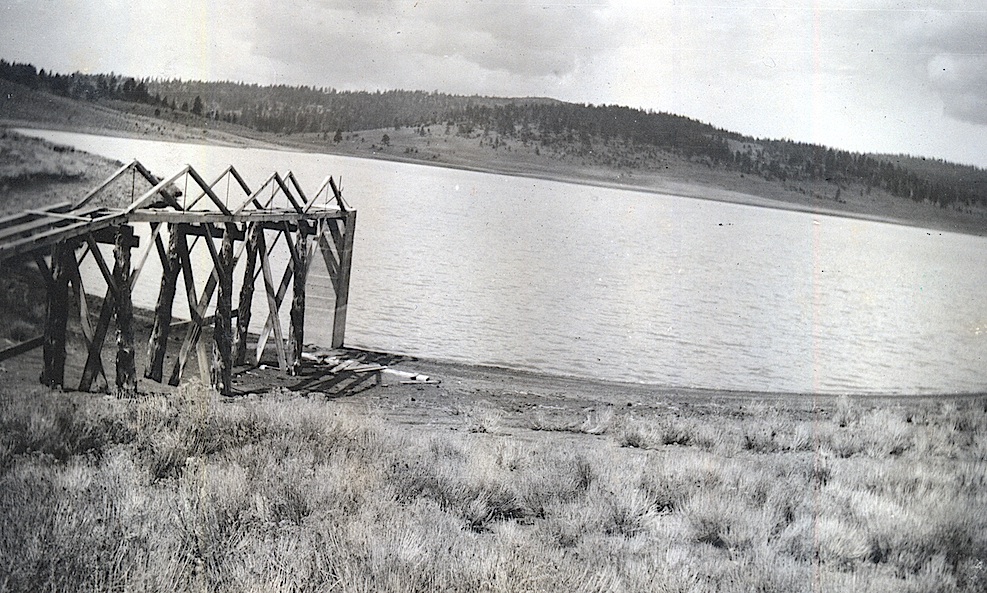
Said Valley Reservoir, 1921. Courtesy of Lola L. Tanner

Approximately some 40 miles north of Susanville, along Highway 139, there lies a small, non-descript place known as Said Valley, or when there is water Said Valley Reservoir, the latter was actually good fishing when it retained water.

It was named for Bartlett Said, somewhat of a free spirit in his day. Born 1813 in Kentucky, Said with his family migrated to Placerville, California in 1850. From there they moved to Rich Bar, Plumas County. His wife, Mary, not fond of her husband, disposed of him. Bartlett, then took solace with his daughter’s family Nancy Jones, who operated Summit House in eastern Plumas County.

One of the reasons for Saids wonderlust was mining. When news circulated about the discovery of gold in northern Lassen County, Said went to check it out. He located in the northern extreme of Grasshopper Valley, that in time became known as Said Valley.  After several years, he ventured over to Horse Lake.  From there his prospecting adventures took him to Long Valley, in Lassen County, where various relations resided.

Said, like so many others, struggled to make a living at mining. In 1896, the family had the elderly patriarch committed to the Lassen County Hospital, which also served as a poor folks and old folks home. He died there in 1904, and lies buried in the Susanville Cemetery in an unmarked grave.

Never miss a story, click here.


Barry Reservoir

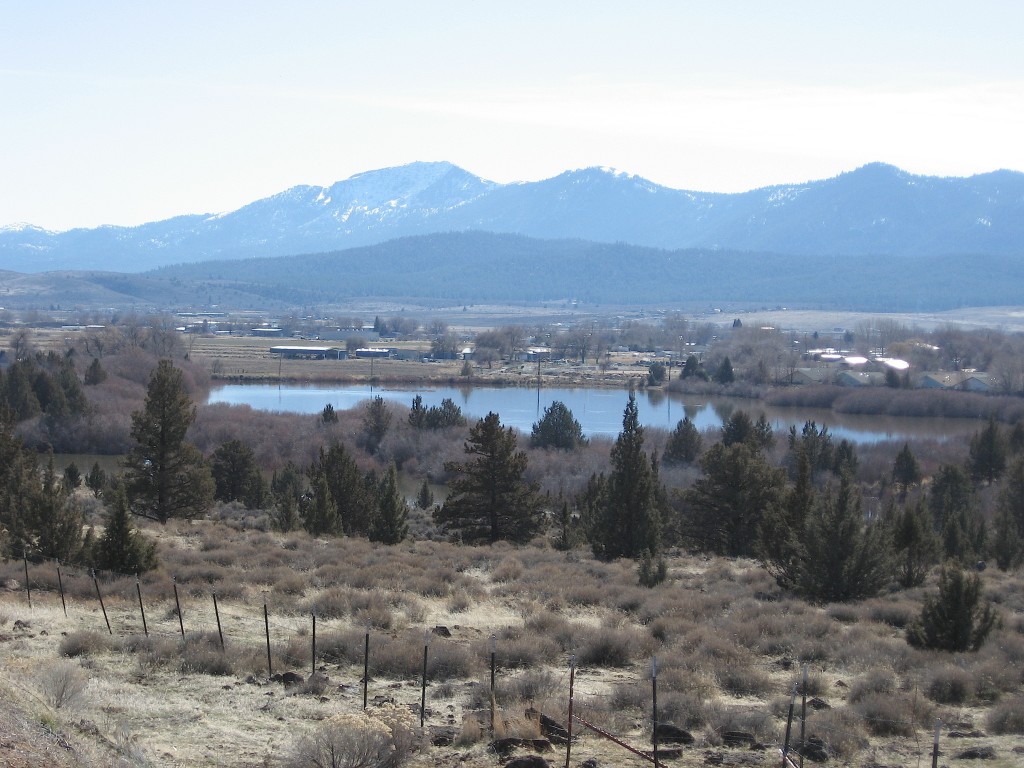
Barry Reservoir from Skyline Drive, February 13, 2016.

Some people may and others may not know the name of this reservoir, which as rule goes dry by the end of summer. After all, it is an intermittent stream as its source of water. In 1902, Mary Jane Hall claimed rights to the stream, that is since known as Barry Creek, and had a small reservoir constructed at the site of the current one. In 1909, Mardis Barry purchased the property from Hall. The enlarged reservoir was constructed in the fall of 1940. It was the first such project of its kind in Lassen County that was constructed with funding from the United States Farm Security Administration.

Never miss a story, click here.