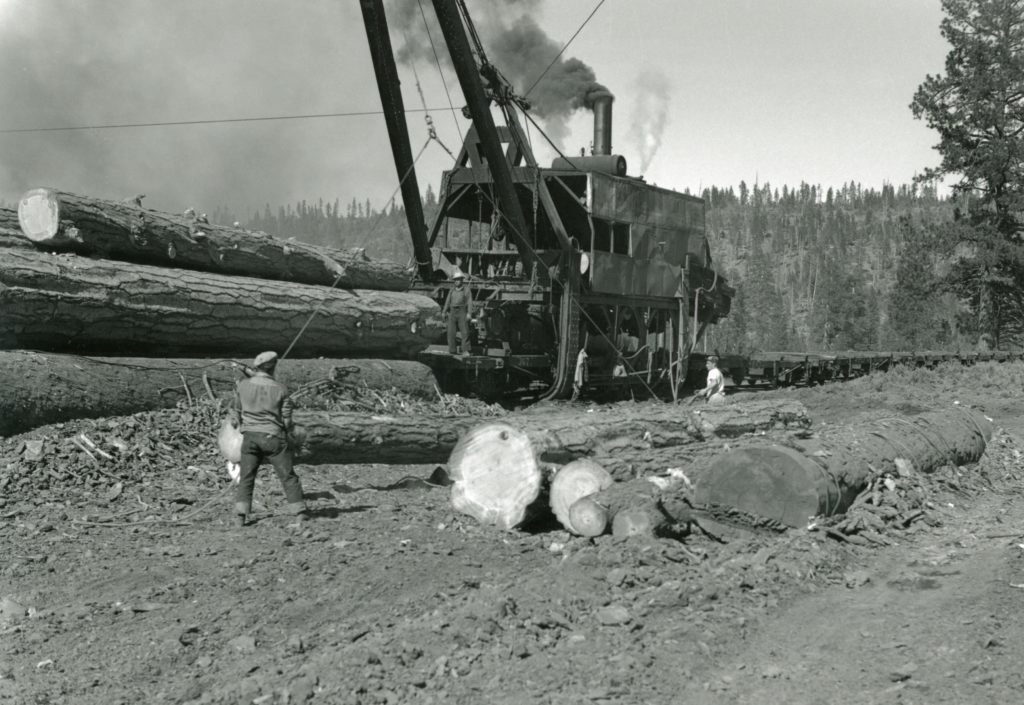
Loading logs with a McGiffert, at McCoy Flat, 1952.
While many are familiar with McCoy Flat Reservoir along Highway 44, there is another McCoy Flat in Lassen County, This too, was named for another Tehama rancher, Leo Lewis McCoy (1850-1936) who used this area for summer pasture from 1874 to 1913. When he retired in 1913, he sold his ranch of 27,000 acres to Alden Anderson for $150,000.
For the record, this McCoy Flat is located along Pine Creek, just east of Eagle Lake. In 1952, it was the scene of the last of the railroad logging operations of the Fruit Growers Supply Company.
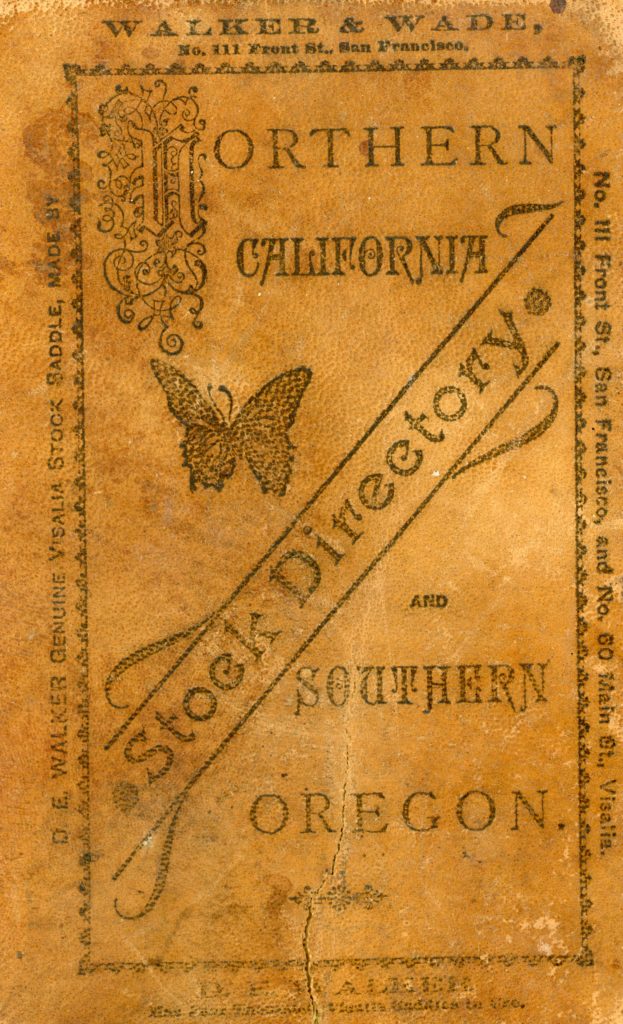
In 1887, two Modoc ranchers, Frank C. Dean and Wilson S. Bayley published a comprehensive 371-page brand directory entitled the Northern California and Southern Oregon Stock Directory. It was an admirable job and in the introduction, they wrote: “All Stockmen are aware that each winter, in every small section of the country, a number of stock remain unclaimed, and on the other hand a number are unfound.Continue reading 1887 Brand Directory→
Postmaster Elmer Winchell with Ben Curler at the inagural airmail flight at the Susanville airport on May 19, 1938.
In the mid-1920s an impromptu airstrip was developed at the north end of Spring Street. At first Red River Lumber Company, owner of the property had no objections. That changed with their intentions of the proposed Piute railroad logging line. Continue reading Susanville Airport→
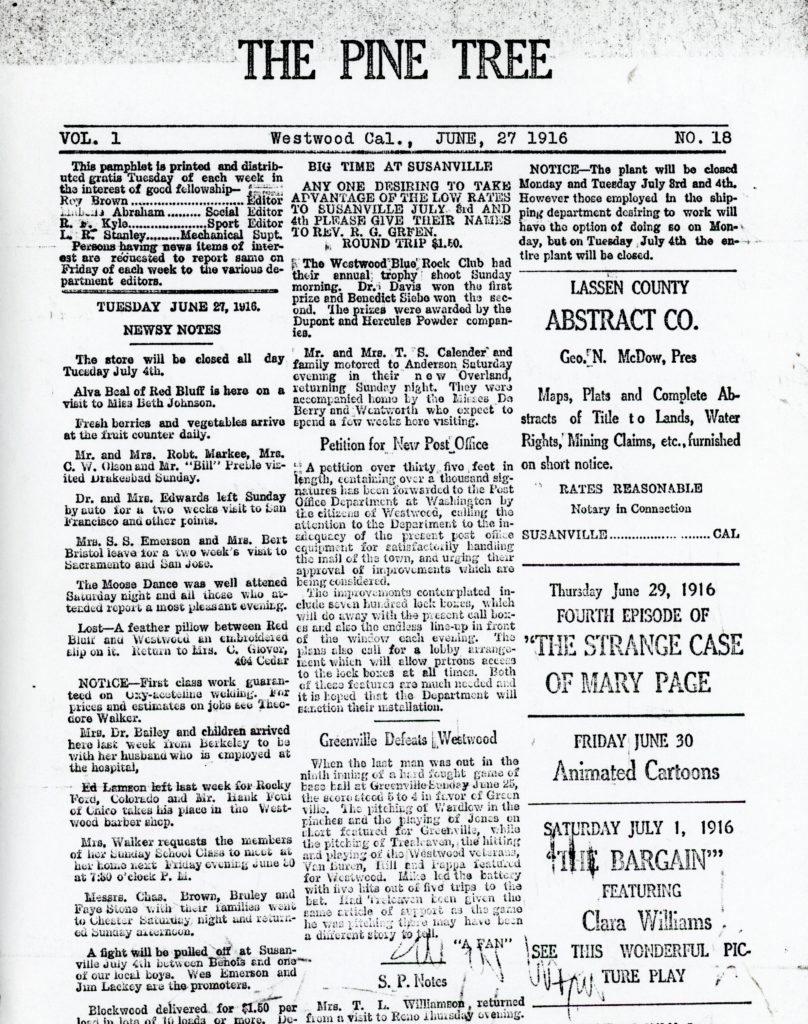
A portion of the front page, and only known copy that was found in the T.B. Walker papers at the Minnesota Historical Society. As a reminder, you can click to enlarge the image.
On March 21, 1916, Westwood’s first newspaper The Pine Tree made its debut. It was a weekly paper that was distributed for free. Leon R. Stanley who was in charge of production, had a background with newspapers in Modoc County. Very little is known about the paper and when it ceased publication.
On August 17, 1917, The Westwood Independent succeeded The Pine Tree. This paper under the helm of G.B. Morrow, who also served as the justice of the peace remained in operation for three years. Stanley again was in the forefront when The Westwood Sugar Pine which eventually became known was Sugar Pine Press succeeded The Westwood Independent.
Wendel has had many names over the years. In the 1860s, it was referred to as Upper Hot Springs to distinguish from the Lower Hot Springs. In 1890, when the Nevada-California-Oregon Railroad (NCO) extended its line to Amedee, the Lower Hot Springs took on the name of town established next to it. Upper Hot Springs simply became known as Hot Springs. In 1899, the NCO extended its line further north and at Hot Springs established a new station named Boyd. When T.F. Dunaway became General Manager of the NCO in 1900, he renamed the Boyd station to Smithon. Two months later, in January 1901, he again renamed it to Hot Springs. It would be another fourteen years before the place became known as Wendel.
Tunnel Bay, Eagle Lake, 1917. Courtesy of Lola L. Tanner
While a lot of folks are familiar with the Bly Tunnel, some of the earlier tunnel attempts were north of that one. What was deemed Tunnel Bay was Captain C.A. Merrill’s preferred tunnel location. However, in the early 1880s, Merrill focused on the Willow Creek side of Eagle Lake with his tunnel construction. In 1891-92, Susanville attorney and promoter, E. R. Dodge, formed the Eagle Lake Land & Irrigation Company and took over Merrill’s operation. Dodge had worked done at Eagle Lake with the construction of an inlet, and also limited tunnel excavation. Some people now referred to this as Dodge Bay. It was at this location, that a pumping plant was constructed. It was Dodge’s contention that this plant would provide water for irrigation in the Honey Lake Valley and in turn generate revenue until his tunnel was completed. Water was pumped from this location and transported by various ditches, along with Willow Creek being one of the conduits that Eagle Lake water flowed all the way to Amedee in the Honey Lake Valley in the fall of 1892, and a portion of 1893. However, the nation’s financial crisis of 1893, put a halt on everything at Eagle Lake, and eventually the pumping plant was sold off as part of a liquidation process.
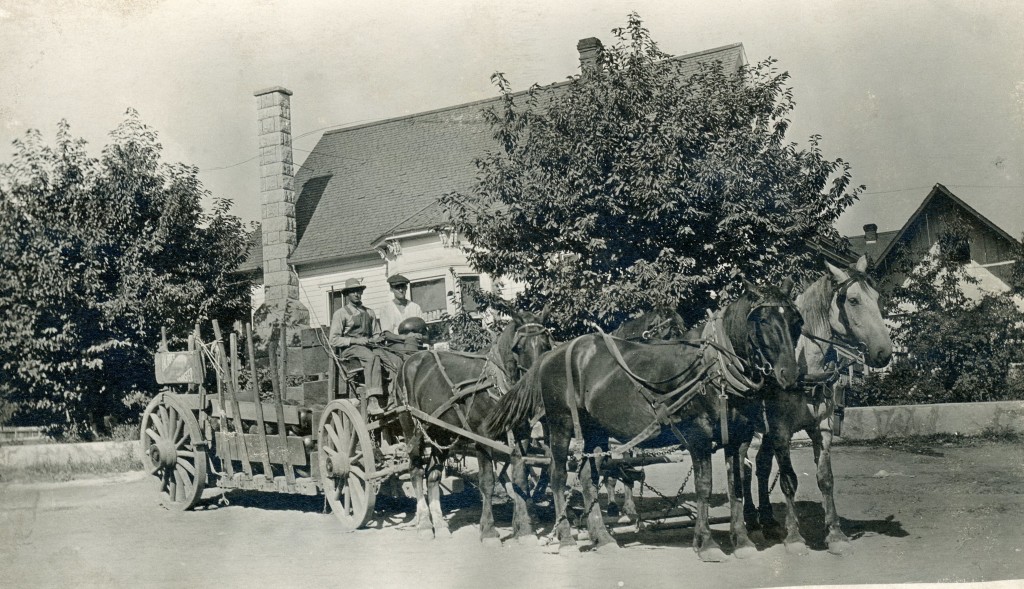
Talbott’s freight team, Union Street, near Cottage, 1914. Courtesy of Leona F. Byars
During the Civil War of the 1860s, communities in support of the North, applied Union to street names, squares, etc. Susanville was a perfect textbook example.
Typical of the era, map makers were one dimensional. Susanville’s original plat, shows Union Street extending beyond Cottage and connecting Weatherlow Street at the Richmond Road bridge. There were two problems. First the proposed street would dissect the block that was home to the Susanville School District. The other was the physical restraint of the hillside for Union to connect with Weatherlow. During the messy title problems of the 1870s, caused by the town’s founder, to rectify this particular situation, that segment of Union to Weatherlow was abandoned.
Lassen College on the Lassen Union High School campus.
Back in 1989 I briefly corresponded with Jerry King, a 1950 Lassen College gunsmithing graduate. He wanted to know what became of C.W. Frost. He wrote, “At that time Mr. Frost was the only gunsmithing instructor and had been since he and one student began the program in 1945 . . . I think it is only fair that Mr. Frost be recognized and Harlan Fritts be recognized for their part in founding the gunsmithing program.”Continue reading Lassen College Gunsmithing Program→
A week ago, I challenged reader’s minds with the latest Where are we? Only one person, Jim Chapman came up with the correct answer. However, it should be noted Jim’s first answer was a toss up between Hog or McCoy Flat.
This small man-made lake is located approximately two miles east of the Eagle Lake Summit. In the late 1940s, the Paul Bunyan Lumber Company began logging operations in the region including Gallatin Peak and Round Valley. One of the company’s employees, Jim Coleman constructed a small dam on Piute Creek, near its headwaters. The small lake supplied the water used to wet down the logging roads, controlling the dust. It should be noted some maps have it spelled as Colman Lake.
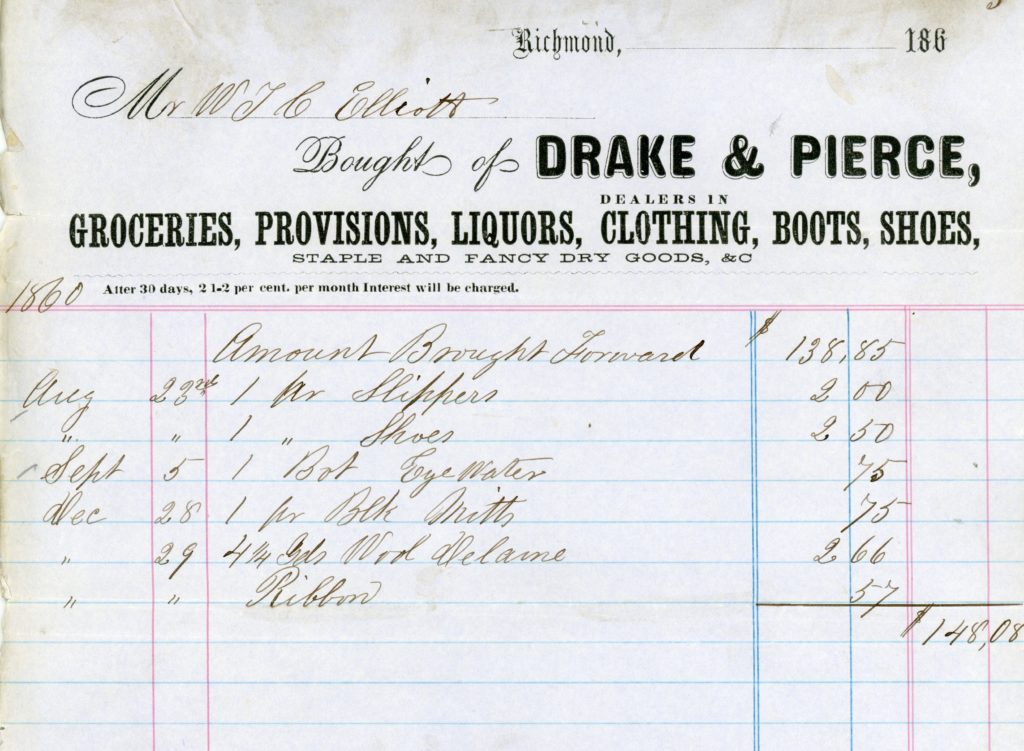
Drake & Pierce’s Richmond mercantile store, was for a time, the largest in the Honey Lake Valley.
The Susanville Post Office was established in 1859. A little known fact, it carried the postal cancellation of Susanville, U.T., as in Utah Territory. Nevada had not yet been created and Utah’s western boundary was that of California.
The biggest problem for the new post office was receiving mail for distribution. On March 3, 1860, Susanville resident wrote to Col. F.W. Lander in Washington, D.C. about the state of the postal affairs: “There is an effort being made to have a daily mail established from Oroville from the first of June to the 30th of November, and semi-weekly for the balance of the year. Now Sir, if you could get the same service continued on through Indian Valley which needs a P.O. having about three hundred inhabitants through Richmond to Susanville with a P.O. at each place you would confer a great favor on the people here about five hundred in number and constantly increasing (There having been rich mines discovered here since your departure.
“There was three routes established last year, one from Shasta, one from Oroville (the route you went down) and another from LaPorte all arriving at Susanville. There was however been no service on either of them and if we could get the above route from Quincy it would answer us better than all three of those which were recommended by Judge Crane without knowing the actual wishes of the people.”
During the 1860s witnessed improvements with the Idaho-California Stage Company that had the mail contract from Chico to Idaho via Susanville. In 1869, conditions for receiving mail was stabilized with the completion of the transcontinental railroad.