Category Archives: History

Susanville’s First Golf Course

A view looking at the former Ridenour property with the Sella dairy in the foreground, 1950s. Courtesy of Wendell V. Loughead

After World War I, a new sport captured the nation and Lassen County got swept up in that craze. Golf. It was A.G. Breitwieser of the Lassen Lumber & Box Company, C.W. Hallowell of the local hardware store and James Christie of the furniture store that became the main instigators.

In the spring of 1924 they negotiated a lease with S.D. Ridenour for a portion of his ranch three miles south of Susanville for a 9-hole golf course.  In a short time, their group became formerly known as the Susanville Country Club.

On May 11, 1924, the golf course was opened, hours sunrise to sunset. The fee 75 cents a day.
It is never too late, subscribe today and enjoy tomorrow with daily notifications. You can also surprise someone with a gift subscription

Eagle Lake Water Levels

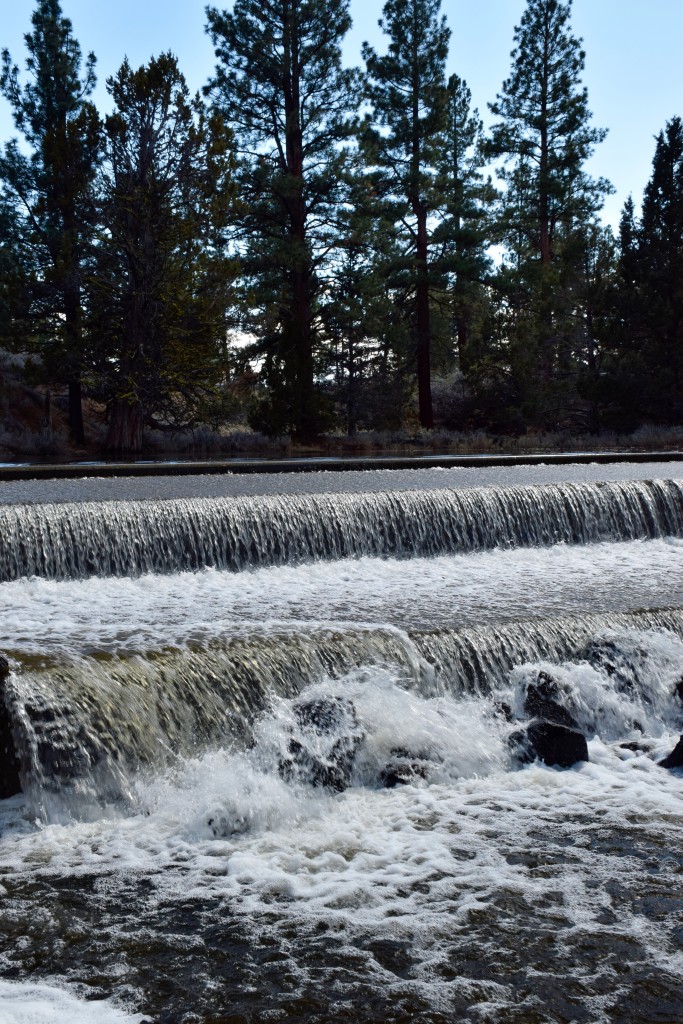
Pine Creek, April 2, 2016. Courtesy of Annie Henriques Blank

Remember last fall how the weather gurus were predicting a “Godzilla” like El Nino? While the water flows into Shasta and Oroville lakes have been spectacular, the same does not hold true Eagle Lake. You may recall, last October I attended the Eagle Lake Interagency Board meeting, and of course, water levels were discussed. You can review that post here. While the water flow in Pine Creek has been impressive, the lake level has not risen that much. The current lake level as of April 1, 2016 stood at 5092.56. When it reached its historic low last October the level was 5090.60. There you have it the level of the lake so far has only risen two feet.

Never miss a story, click here to subscribe and support.

Shirley’s

Shirley's, Hall Street, Susanville. Courtesy of Hank Martinez
Shirley’s, Hall Street, Susanville. Courtesy of Hank Martinez

Shirley’s was a bar on the north end of Hall Street, the current site of the Juniper Apartments.  Established in the 1930s after the repeal of prohibition, by Jean “Shirley” Tilton, and its distance from town on a road heading to points northward was similar to the roadhouses between Susanville and Westwood. *

It was quite the interesting watering hole,  “Shirley”  a former nurse, was confined to a wheel chair, but remembered for her generosity. She was also a madam, and cabins behind her establishment took care of certain needs of her clientele. Then there was her friend, gay piano man, and member of Sacred Heart Church’s choir, that assisted her, until he committed suicide in 1938. When she died in 1954, Gene Garayoa and Steve Arainty transformed it into the Juniper Inn.

*Ash Street, was not in existence.

Never miss a story, click here.

Pioneer Traits

The Lassen County Library bookplate used several local iconic features representing the pioneer era.

One subscriber inquired about the traits of the original argonauts who settled California. Back in the early 1970s, I worked with Eleanor Vandeburgh at the William H. Pratt Memorial Museum in Susanville. Eleanor commented that the weak in mind never contemplated to endure the hardship to travel west; those who were weak physically died along the way and only those of a strong mind and physical traits survived. It is an interesting concept. Eleanor, however, left out another factor. Continue reading Pioneer Traits

Westwood LDS Church

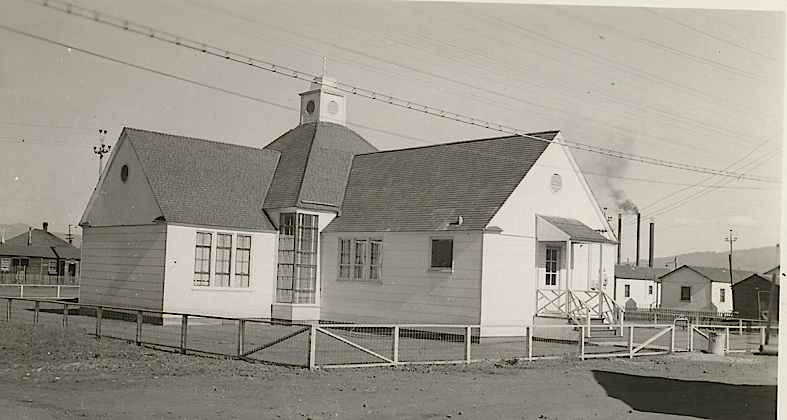
Church of the Latter Day Saints, Westwood, June 14, 1943

On March 9, 1940 the Church of the Latter Day Saints held groundbreaking ceremonies on corner of Ash and Fifth Streets, in Westwood. This was the last house of worship to be constructed under Red River Lumber Company’s tenure at Westwood.

The church  was designed Caldwell and Richards, Los Angeles architects. After World War I, the LDS Church began to implement standardized plans. This particular church was the first to use this particular layout. The $9,000 church was built by volunteer labor and completed in four months.

In 1986, its congregation had grown, wherein they bought property in nearby Clear Creek and built a new church. In 1991, their old our church was acquired by Our Lady of Snows Catholic Church which they converted into a parish hall. However, with their new Lake Almanor church, it will be just a matter of time when this is placed on the market, and only time will dictate its fate.

Never miss a story, click here.

Lassen Union High’s Block L

The "L" as it appeared on the mountainside in 1947. In the foreground is the Paul Bunyan Lumber Mill, now the area of WalMart, etc. Courtesy of Fred Lendman
The “L” as it appeared on the mountainside in 1947. In the foreground is the Paul Bunyan Lumber Mill, now the area of WalMart, etc. Courtesy of Fred Lendman

On February 18, 1928 the Lassen High Block L Society formed, that was the boy’s athletic organization. One of their first activities was the painting of the “L” on Susanville Peak. In 2008, Betty Jo Buckles Coplen provided me with this behind the scene account: “In 1924, my father, Maynard Robert “Billy” Buckles accepted a position teaching at Lassen Union High School, and we moved to Susanville. Four years later, members of the new Block L Society came to my Dad. They asked him to help them plan a Block L for them to lay out on the hillside. He helped them to design a letter L with the proper classic proportions (200 yards long). He also warned them that a letter of that size would be difficult to keep whitewashed. The Block L boys persevered and constructed the letter on the hill, moving rocks into the outline to be painted white. For decades as planned the freshman boys painted the letter each year, but eventually that practice died out.”

While the Block L Society no longer exists, the Lassen High Alumni Association has from time to time maintained it, the last time was done in 2008.

Never miss a story, click here.


Roseberry House

Roseberry House412
An early day advertisement that Mrs. Roseberry dubbed her operation, the Green Tree House.

Located at 609 North Street, Susanville is the stately Roseberry House constructed in 1903 and is the community’s only bed and breakfast operation. However, a hundred years earlier, its owner then, also took in tourists.

The house was constructed for Thomas and Viola Roseberry. When Lassen Peak came alive as a real live volcano in 1914, area residents flocked to the mountain to take a look first hand. For Thomas Roseberry it was a fatal mistake for in August 1915, while climbing down the peak he died from a heart attack. Another tragic event occurred earlier in the month when the Emerson Hotel, located only two blocks from the Roseberry home was destroyed by fire.

These circumstances forced Viola into action. She made some remodeling changes to her home and began to take in travelers and boarders alike, which she would do so for another decade.

Never miss a story click here.

Sacred Heart’s Rectory

Rectory
An early day photograph of the rectory. Courtesy of Sacred Heart Church

When the Sacred Heart Parish was established in 1912, it had a church, but it did not provide housing for a priest. When Father O’Reilly arrived to take care of the pastoral duties, he boarded initially at the Emerson Hotel. When that hotel was destroyed by fire, he purchased a small cottage.

In October 1922, Father Patrick J. McCarthy became O’Reilly’s successor. McCarthy spent his first three weeks sleeping in the organ loft of the church.  It turned out to be unseasonably cold, and as many an old time parishioner recalled  that church was cold and drafty. As a result McCarthy came down with pneumonia, and required hospitalization. Once discharged from the hospital efforts were underway to build a rectory next to the church. Within in a month’s time it was completed with lumber donated by Fruit Growers and Lassen Lumber and parishioners volunteered to construct it.

Never miss a story, subscribe and support, click here.

William S. Brashear

W.S. Brashear. Courtesy of Marge Hansen

William Samuel Brashear arrived in Lassen County in an unexpected way.  In 1863, he helped fellow Southerner John M. Kelley retain his original land claim of 1200 acres. When the U.S. Government surveyed the Honey Lake Valley, one could only file claim to 160-acres. Thus, nucleus of southern sympathizers claimed property around Kelley and the region became known as the Tule Confederacy. Continue reading William S. Brashear