Lassen College on the Lassen Union High School campus.
Back in 1989 I briefly corresponded with Jerry King, a 1950 Lassen College gunsmithing graduate. He wanted to know what became of C.W. Frost. He wrote, “At that time Mr. Frost was the only gunsmithing instructor and had been since he and one student began the program in 1945 . . . I think it is only fair that Mr. Frost be recognized and Harlan Fritts be recognized for their part in founding the gunsmithing program.”Continue reading Lassen College Gunsmithing Program→
A week ago, I challenged reader’s minds with the latest Where are we? Only one person, Jim Chapman came up with the correct answer. However, it should be noted Jim’s first answer was a toss up between Hog or McCoy Flat.
This small man-made lake is located approximately two miles east of the Eagle Lake Summit. In the late 1940s, the Paul Bunyan Lumber Company began logging operations in the region including Gallatin Peak and Round Valley. One of the company’s employees, Jim Coleman constructed a small dam on Piute Creek, near its headwaters. The small lake supplied the water used to wet down the logging roads, controlling the dust. It should be noted some maps have it spelled as Colman Lake.
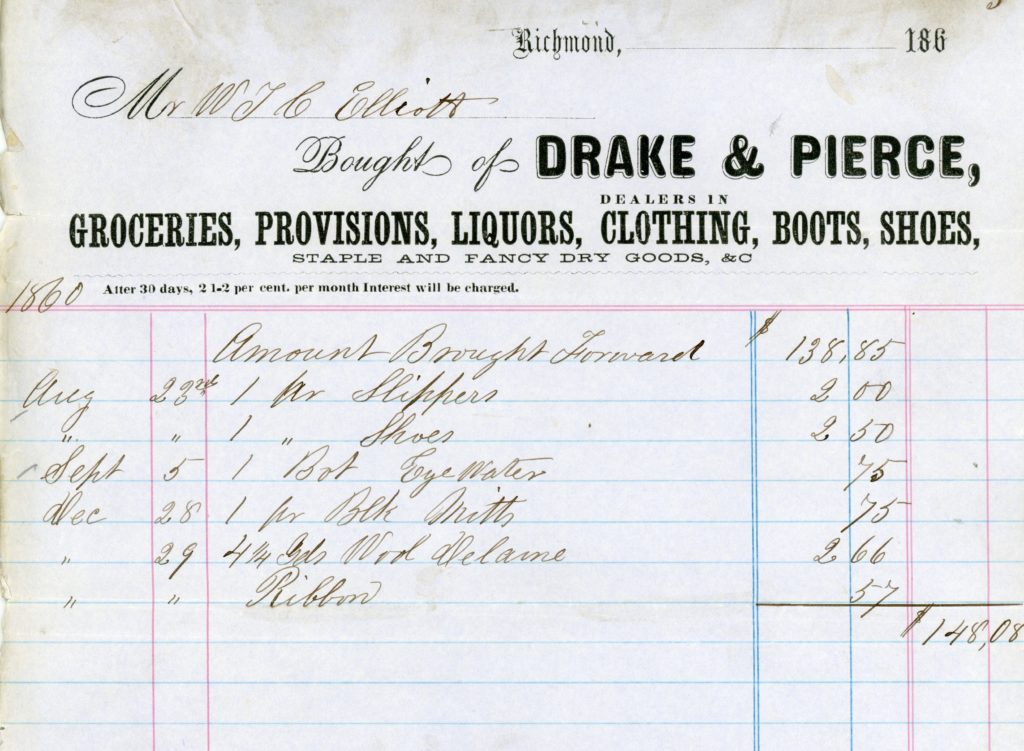
Drake & Pierce’s Richmond mercantile store, was for a time, the largest in the Honey Lake Valley.
The Susanville Post Office was established in 1859. A little known fact, it carried the postal cancellation of Susanville, U.T., as in Utah Territory. Nevada had not yet been created and Utah’s western boundary was that of California.
The biggest problem for the new post office was receiving mail for distribution. On March 3, 1860, Susanville resident wrote to Col. F.W. Lander in Washington, D.C. about the state of the postal affairs: “There is an effort being made to have a daily mail established from Oroville from the first of June to the 30th of November, and semi-weekly for the balance of the year. Now Sir, if you could get the same service continued on through Indian Valley which needs a P.O. having about three hundred inhabitants through Richmond to Susanville with a P.O. at each place you would confer a great favor on the people here about five hundred in number and constantly increasing (There having been rich mines discovered here since your departure.
“There was three routes established last year, one from Shasta, one from Oroville (the route you went down) and another from LaPorte all arriving at Susanville. There was however been no service on either of them and if we could get the above route from Quincy it would answer us better than all three of those which were recommended by Judge Crane without knowing the actual wishes of the people.”
During the 1860s witnessed improvements with the Idaho-California Stage Company that had the mail contract from Chico to Idaho via Susanville. In 1869, conditions for receiving mail was stabilized with the completion of the transcontinental railroad.
Make sure to click to enlarge. Courtesy of Dolores Gasperoni
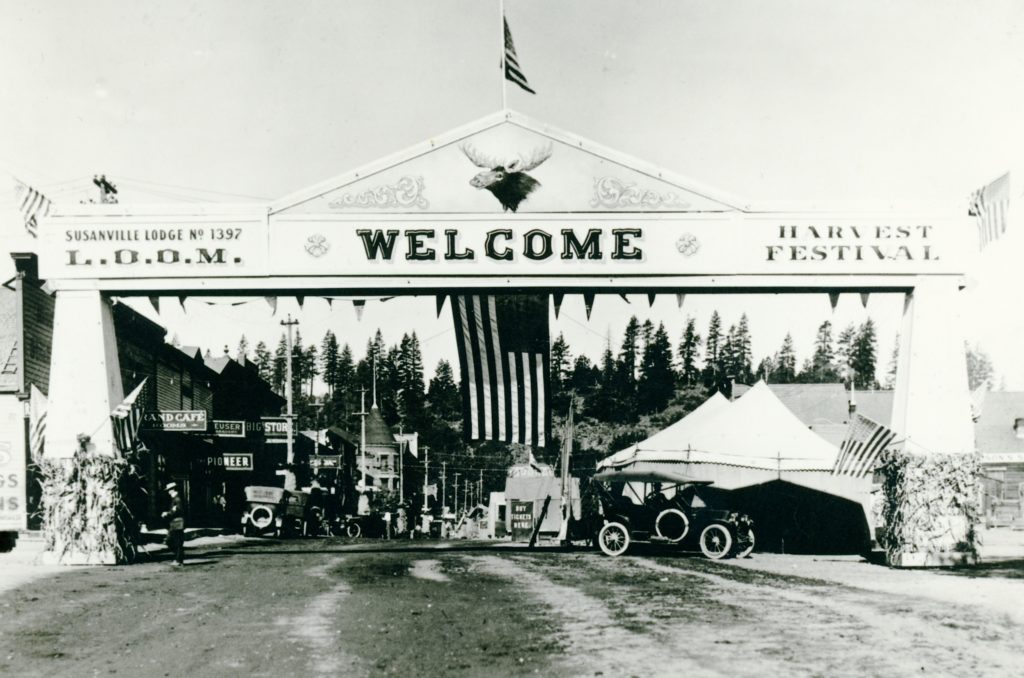
In 1913 a new fraternal organization was organized–Susanville Lodge 1397, Loyal Order of Moose, commonly referred to as the Moose Lodge.
The following year, the lodge decided the town needed a celebration. The Fourth of July was the only regularly celebrated event. The annual county fair had not been established. So the Moose Lodge decided on a harvest festival. In July 1914, they announced their intention to hold a four-day festival to commence on California’s Admission Day, September 9.
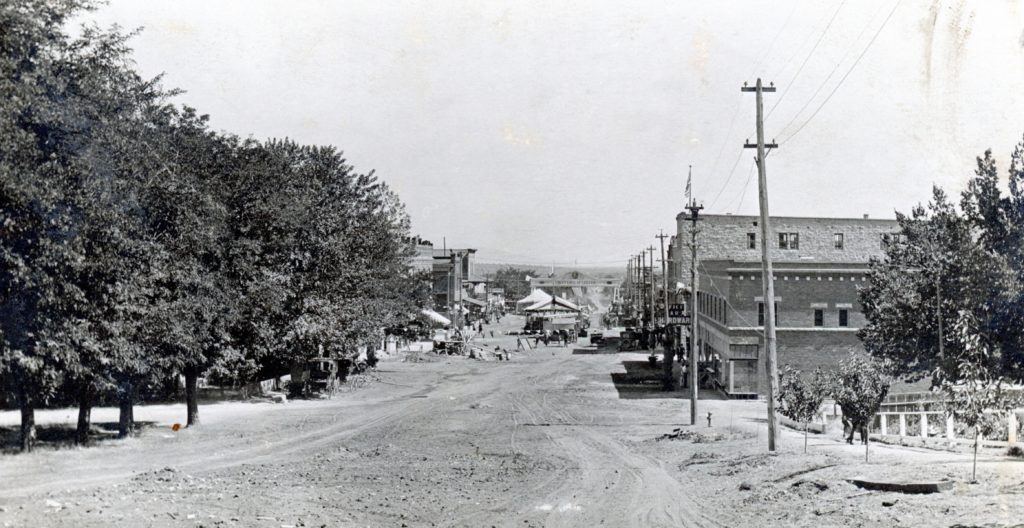
On the northwest corner of Main and Gay Streets (now the Bank of America parking lot) an open air pavilion was constructed. Also at Main and Gay , the lodge constructed an arch over Main Street.
The arch was a temporary affair, and a windstorm two weeks later, blew it over.
A one block segment of Main Street, between Lassen and Gay was transformed into a street carnival. There were popular concessions such as a mirror maze, glass blowers, a musical show with six chorus girls, three comedians and a wheel of fortune. The farmers of Honey Lake Valley displayed specimens of their crops. Fehr & Worley of the Big Store (now Margie’s Book Nook) took the opportunity to show off their line of farm machinery.
Saturday evening was the climax of the festival. It was complete with a confetti battle and the merriment of locals dressed up for the “Parade of Horribles.” Some of the costumes were outlandish, but more important, it was an opportunity to have fun. A case in point Charlie Emerson playing the role of a blind organ grinder, and Dr. J.S. Wren as his monkey.
The Moose Lodge later reported while it was not a financial success, but that it was a successful venture as everyone had a good time.
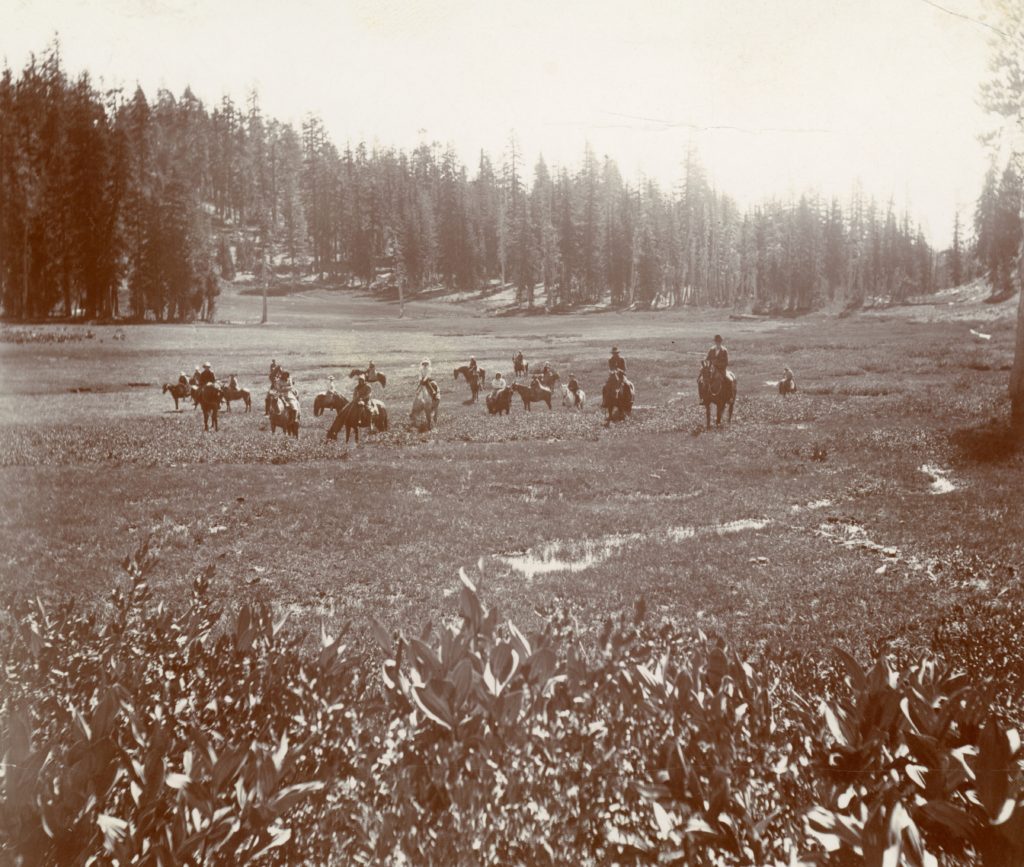
Desmond Meadows, 1906. Courtesy of Betty Barry Deal
On January 22, 1859, Malcolm S. Scott claimed the meadows along Piute Creek, west of Susanville, that he named Spring Valley. Scott later abandoned his claim and the claim was taken over by Emanuel Brannon during the following year. Interest in the meadows fell by the wayside until 1873, when Robert M. Bean took possession of the meadows. Somewhere along the banks of Piute Creek, between Desmond Meadows and Susanville, Bean established the first brick kiln yard in Lassen County. In the year 1878, Bean manufactured 130,000 bricks. Hard times quickly fell upon him. Because of his creditors and the death of his wife, Alice, Bean sold the meadows to Jonathon Lovell, a Susanville blacksmith. Ownership of the meadows changed hands numerous times during the early 1880s. In 1886, it was purchased by John and Hannah Desmond from M. C. Bishop for $1,500. Married life for the Desmonds was not pleasant. In 1890, the couple separated and Hannah remained at the meadows. For the next ten years, to support herself and her family, Hannah operated a firewood business. The County of Lassen was one of her major customers, purchasing eighty cords annually at a $1.50 per cord. On November 19, 1900, Desmond sold the meadows to Anton Bantly for $2,000.
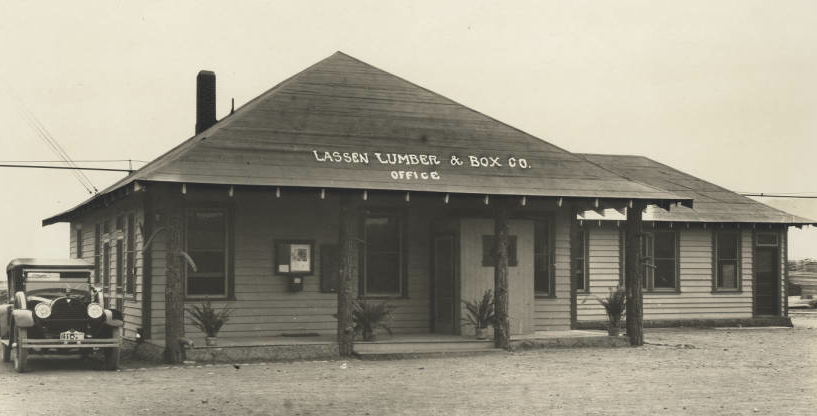
The Lassen Lumber & Box Company’s office on Alexander Avenue, Susanville, 1923. Courtesy of Ivajean Wheeler
The Lassen Lumber & Box Company (Lassen Lumber) was the smallest of the big three lumber companies, the other two being Fruit Growers Supply Company and Red River Lumber Company. It was also different than the other two, as their source of supply for timber was the Lassen National Forest.
This time the citizens of Susanville were eager to court this new company, having lost out to the Red River Lumber Company and the smaller Western Timber Treating Company. As an incentive they offered the company 40 acres, with water rights and $8,000 cash. They accepted. Construction began on the sawmill and box factory in the spring of 1918 and on July 27, 1918 the first logs arrived at the mill.
For Susanville the payoff was big, during the summer season Lassen Lumber employed upwards to 450 men with a monthly payroll of $65,000. The mill would operate until 1953 when it was closed. More about the history of the company will appear in future posts.
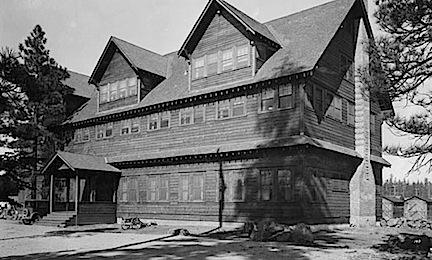
The American Legion Hall was one of Westwood’s tallest buildings.
On July 15, 1918, Westwood resident Clyde A. McKea died in combat in France, making him the first casualty from Lassen County of World War I. In the fall of 1919 a new national veterans organization was formed—The American Legion. Continue reading Westwood’s American Legion Hall→
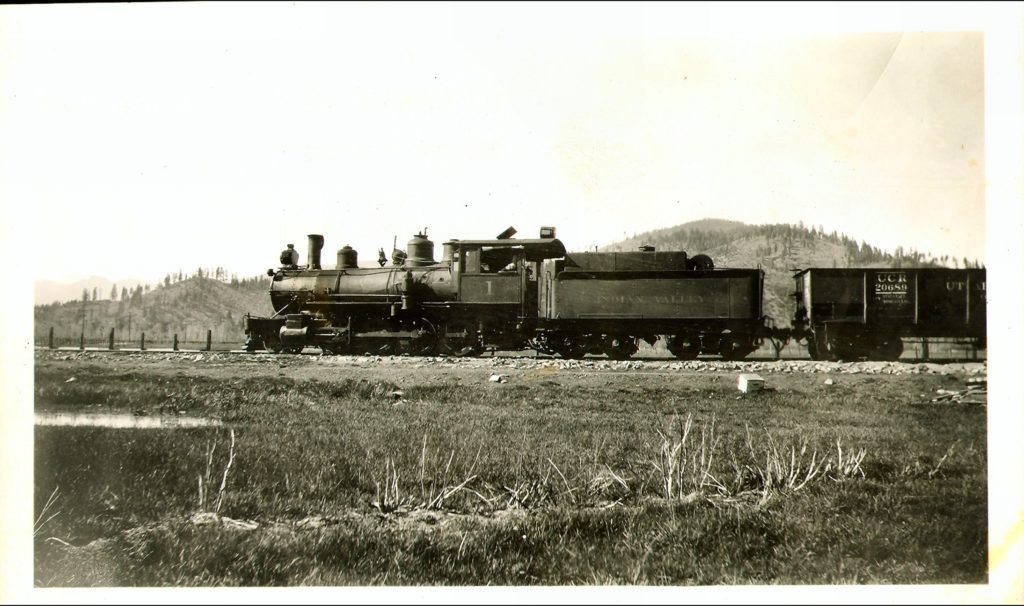
Indian Valley Railroad. Courtesy of the Plumas County Museum
One of the biggest issues T.B. Walker had against the Red River Lumber Company’s location at Westwood, was it lacked a railroad link directly to California. For a time there was a glimmer hope with the Indian Valley Railroad.
On June 30, 1916, the Indian Valley Railroad (IVR) was incorporated to build a line from Paxton on the Western Pacific Railroad to the Engel Copper Mine near Taylorsville–a distance of 21 miles. Sixteen months later the rail line was completed. It should be noted, that it was originally proposed as a narrow gauge line, but Willis Walker of the Red River Lumber Company objected. After all, Walker was keen enough to see the possibilities for a link to Westwood, and with that would force the Southern Pacific Railroad to be more competitive in their rates.
Early on the IVR had its sights on Westwood. In 1918 a survey to extend the line to Westwood was conducted, There was speculation that the IVR would extend its line to Westwood, and in 1918 the IVR did survey a line to that place. With Red River’s main branch railroad logging extending along the east shore of Lake Almanor to Canyon Dam, there was not much territory separating the two lines. In 1927 a request was sent to the Interstate Commerce Commission to put in this proposed line to be known as the Northern California Railroad. It was rejected. However, in the works was the Western Pacific and Great Northern Railroads to connect their respective lines with a new railroad from Keddie, Plumas County to Klamath Falls, Oregon. This was approved in 1930, and Red River Lumber Company would finally have a second railroad connection it had always sought.
In essence this is one of those instances where history repeats itself. During the 1850s Congress passed several bills for a transcontinental railroad and wagon road to connect California to the Union. Numerous routes were surveyed, though most ended at California’s eastern border, with the assumption the State of California would decide the best route. The Honey Lake-Fredonyer-Deer Creek route was deemed one the best, since there was no high elevation summits to cross, thereby reducing the problems associated with winter, i.e., Donner. In 1859, with the discovery of the Comstock Lode in Nevada was a game changer. Politics and the influence of money the Donner Pass route was selected, a costly one at that.
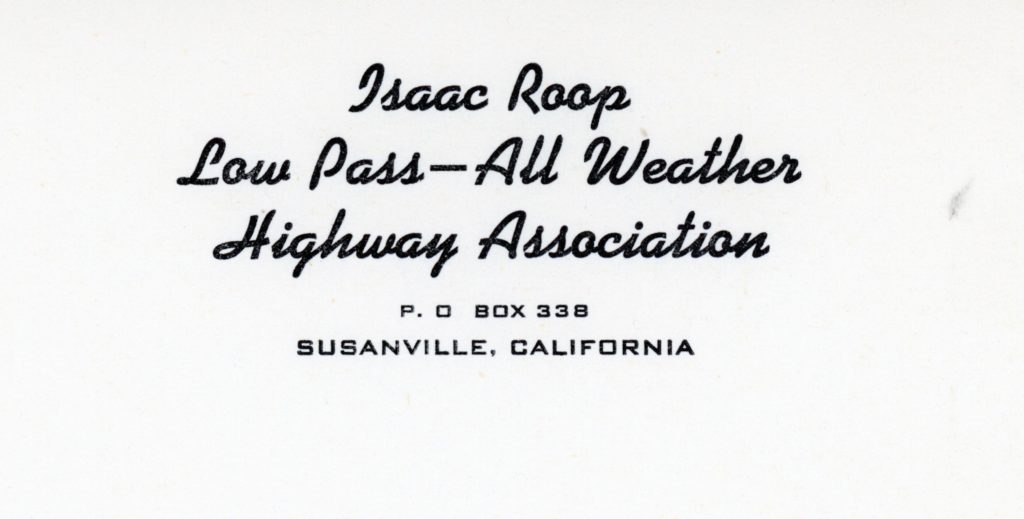
Fast forward a hundred years later. In June 1956 Congress approved the Federal Highway Act, also known as President Eisenhower’s Interstate and Defense Highways. In 1957, Susanville resident F.W. Loosley saw an opportunity and proposed the Isaac Roop Low Pass All Weather Highway, as a viable alternative to Donner Pass. One of the most obvious was it would reduce construction costs and even more importantly annual maintenance, especially where snow removal was a concern. The proposed Roop Highway would go from Winnemucca, Nevada to Viewland, Lassen County, California via Gerlach. There it would merge initially with U.S. Highway 395 to Johnstonville and then connect with State Highway 36 over Fredonyer to Red Bluff. (This should not be confused with the Winnemucca to the Sea Highway.) It received widespread support in California and Nevada. The wheels of commerce, those along the then Highway 40 put pressure because the proposed interstate would bypass them, and they won.
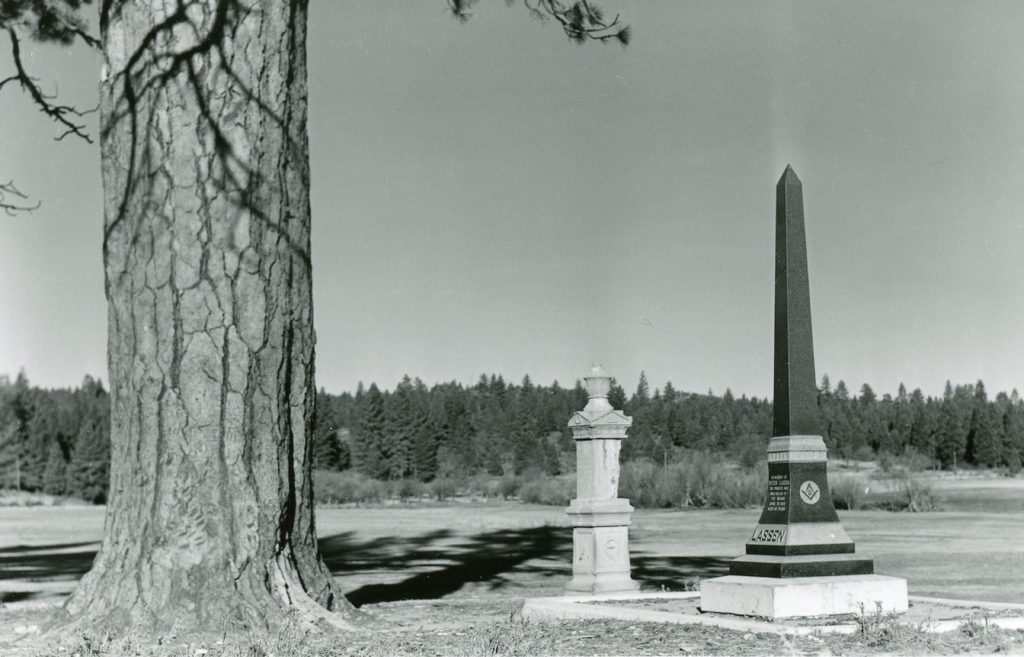
In April 1952, Hannah Hulsman gave a unique gift to the community, though it would several months later when it became publicly known. Without further adieu, the following is the editorial from the Lassen Advocate of July 17, 1952: Lassen’s Grave. “A long-time hope of many people of the area has been achieved with assurance of preservation of Peter Lassen’s grave for posterity.
“The entire community owes Miss Hannah Hulsman a genuine vote of thanks for her generosity on donating this historic spot to the Native Daughters of the Golden West. It is a public spirited move for which she will long be remembered.
“The Native Daughters are an appropriate organization to assume charge of the beautiful and history laden spot. It is a scene of beauty–the old and new monuments beneath the thriving pines, green meadows before and dark mountain range behind. Although the giant ponderosa pine on the property is dying and apparently must come down, the smaller pines around will still have a beautiful setting.
“The Native Daughters no doubt will have community cooperation if they need it, in helping make this grave site into an attractive picnic area. The Masons have a particular affection for the memory of Peter Lassen, because he started the first Masonic lodge in California. The monuments were erected by them. And the entire community is interested in such a memorable service project.
“Again many thanks to Miss Hulsman and the Native Daughters for making history continue by preserving one of its major California shrines.”