Category Archives: History

Susanville’s Halltown

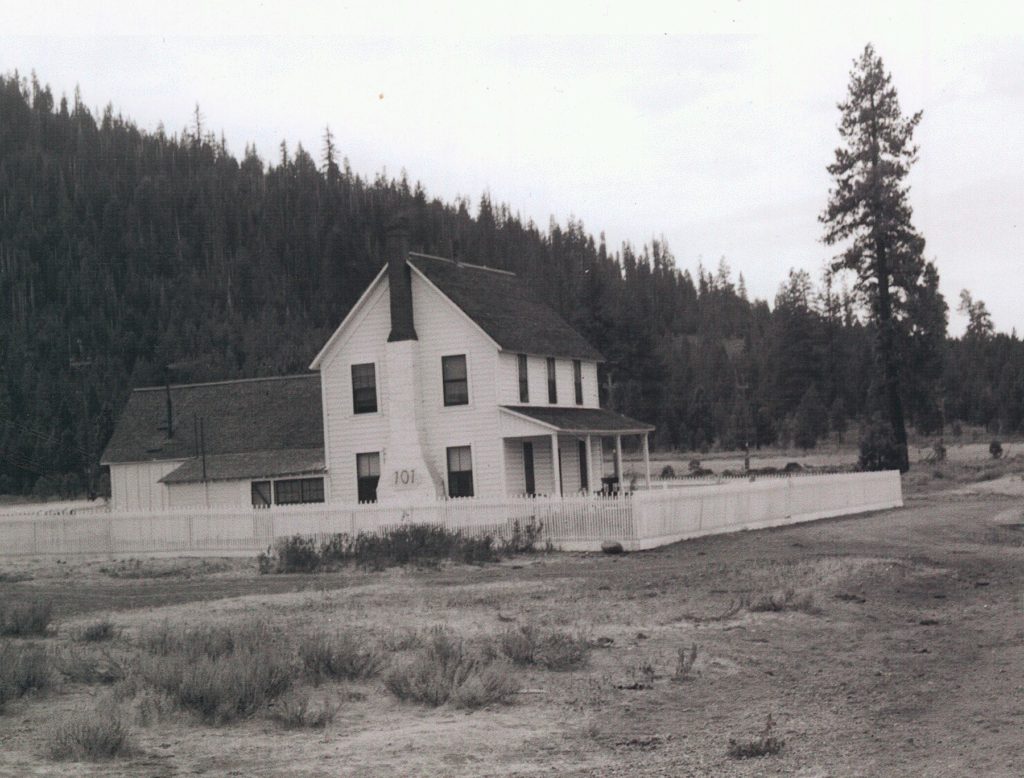
The Hall residence, 1895. Today, the location is the 1600 block of Susanville's Main Street, the current location of Grocery Outlet.
The Hall residence, 1895. Today, the location is the 1600 block of Susanville’s Main Street, the current location of Grocery Outlet. Courtesy of Howard Hall.

Wright Patrick Hall is known for many things, especially that as a long serving Lassen County Clerk, and also that as the Lassen County Treasurer/Tax Collector. He first came to Susanville in 1860, and then moved to Nevada for a brief stay before returning.  On May 22, 1877,  he  purchased 480 acres one half mile east of Susanville from Heiro K. Cornell for $700. In 1885, Hall began selling lots with Main Street frontage. In 1895, Hall hired surveyor William D. Minckler to plot 160 acres known as Halls Addition, but everyone called it Halltown. The bottom land of Piute Creek separated Halltown from Susanville. It was not until the 1920s that the two communities slowly grew together.

Support by subscribing.

The other Tunison

Tunison Ranch, Willow Creek Valley.
Tunison Ranch, Willow Creek Valley, known today as the Hagata Ranch.

In the past I have wrote about Tunison’s which was a road house between Susanville and Westwood, and which the lone chimney near Goodrich Creek, is the last remnant of that establishment. It should also be noted that William “Bill” Tunison, was one of the longest serving Lassen County Board of Supervisors whose served from 1936-1964. Continue reading The other Tunison

Camp 10 – Cookhouse

Camp 10, Cookhouse, December 15, 1950.

Recently, I sent a  email to subscribers with the attachment of a photograph of the Fruit Growers Supply Company’s cookhouse at Camp 10, which is depicted above. Several people indicated they wanted to know more, so without further adieu  . . .

Fruit Growers operated ten railroad logging camps in the region west of Eagle Lake.  In 1928, Camp 10 was established at the northern end of Pine Creek Valley and was not only its largest camp, but also in length, for it remained in operation until the end of the logging season of 1952. In the summer, its population could swell to 200, and by winter reduced to one lone caretaker.

On August 29, 1950 at around 2:00 a.m. the camp was awakened by a fire–the cookhouse engulfed in flames. In addition, it spread to the commissary, warehouse, office and oil shed. Fortunately, there were no winds where the fire could spread further. When all was said and done, Camp 10 timekeeper, George Farris commented, “It was the most spectacular fire I had ever seen.”

Subscribe!


It is a Long story.

Known today as the Susanville Ranch Park, for many years it was the John T. Long Ranch.

Most of the topics I have been writing deal with places, and not so much the people.  Well, I am working on providing a better balance. Thus, herewith is the brief introduction of the many Long families of Lassen County.  Of course there are many geographical names in the area that have the “Long” attachment, the majority are attributed to dimensions, and not a surname.

On the other hand, there were several different Long families in the the Lassen area, and not related, though many had shared first names, which at times caused confusion.  After all, there were occurences when a message was sent in 1910 for George Long the stage operator to pick up a railroad passenger at Wendel, or was it the other George Long, the butcher, who was courting an out of towner? Whatever the case may be, they both showed up, but the precious passenger, did not show.

Support by subscribing.

A bit of Lassen High history

The Grizzly Growler was the long standing student newspaper.

Lassen Advocate – 26 October 1944. New High School Paper to Appear Soon. A new high school paper to be called the “Cub Bark” is being issued at the Lassen Union High School this week under the sponsorship of the Journalism class. The new project is an attempt to take advantage of the high school students’ interest in news writing and will come out once a week. The traditional “Grizzly Growler,” parent of the smaller and more energetic publication, will assume new dignity by more careful edition plus the advantage of being printed in the Advocate print shop instead of being a mimeographed paper.

“The new “Growler” will endeavor to support itself by advertising. It is the intention of the administration of the paper to make it stand on its own worth of over five hundred readers and potential customers rather than on a donation basis by generous merchants. The business experience given to the students who publish is felt to be an invaluable and good education.”

Subscribe!

Eagle Lake – Bly Tunnel Question

Blasting at the inlet of the Bly Tunnel, 1921. Courtesy of Lola L. Tanner

To the naked eye, today’s photographs does not look like much. For me I find it puzzling and I hoping someone can explain and/or give me some type of geology lesson.

The photographs were taken in 1921/22 at the inlet of the Bly Tunnel. The smoke depicted, in the above photograph, is from the blasting. What intrigues me is the tailing pile, which is composed of sand!  The tunnel was constructed through lava rock. So  where did the sand come from? By all means, please share this post to anyone who can enlighten me, and everyone else who would like further insight.

More sand. Courtesy of the D.M. Durst Collection

Subscribe.

Bagwell aka Fruit Growers Spring

The springs are located on the mountain side behind the ranch house compound. Courtesy of Hank Martinez

A subscriber wanted to know more about Fruit Growers Spring, also known as Bagwell Springs. These springs are located north of present day Susanville Ranch Park.

The springs were named for James Washington Bagwell, who located on 160-acres that included the springs. In 1893, he sold out to George W. Long for $300.  In 1901, William Black Long claimed rights to this spring that he designated as Bagwell. In 1919, the Fruit Growers Supply Company purchased the property for its water rights. For a number of years the spring was known as Fruit Growers Spring. It appears with that designation in the decree of Fleming v Bennett—the adjudication of the Susan River watershed. In 1935, Fruit Growers sold the spring to the Republic Electric Power Company, who purchased it as an additional water source for Susanville. Thereafter, the spring was once again referred to as Bagwell. The springs are now owned by the City of Susanville, which are used in conjunction with the city’s water system.

Subscribe!

Spoonville – Then and Now

Spoonville
Unfortunately, not the best photograph of Spoonville, back in its heyday. Courtesy of Spoonville native, M. E. “Mul” Mulroney.

This district some three miles or so east of Janesville was orginally known as Missouri Bend, due to the fact that a large percentage of the original settlers came from that state. The community has seen better days, and now falls under the proverbial category of a “wide spot in the middle of the road.” The town once boasted a two-story hotel, two stores, blacksmith shop, creamery and a school. The only original buildings is the residence of E.C. Brown and the Missouri Bend Schoolhouse.  For those who want to do a drive through, it is located today near the intersection of County Road A-3 and Cummings Road.

Spoonville, September 27, 2016

Subscribe!

Roxie Peconum

roxie-p
Roxie Peconum, 1954

The Peconom family is one of the better known Maidu families. If you noticed that I highlighted the name in bold, there is a reason. The family name has been misspelled for years with a um instead of the proper om. Of course, the name spelling was brought to light, during the proposed name change  of the first branch of Willard Creek to Roxie Peconum Creek to commemorate Roxie Yoanna Peconum (1851-1958), well-known member of the Maidu tribe, who gathered roots and berries in the region.  However, some thought the name should be for the Peconom family, and not an individual family member. If it was to be the latter, the name should be Yoanna Creek for Roxie. Whatever the case may be, on February 11, 1993  U.S. Board of Geographic Names approved the name change to Roxie Peconum Creek.

Subscribe!