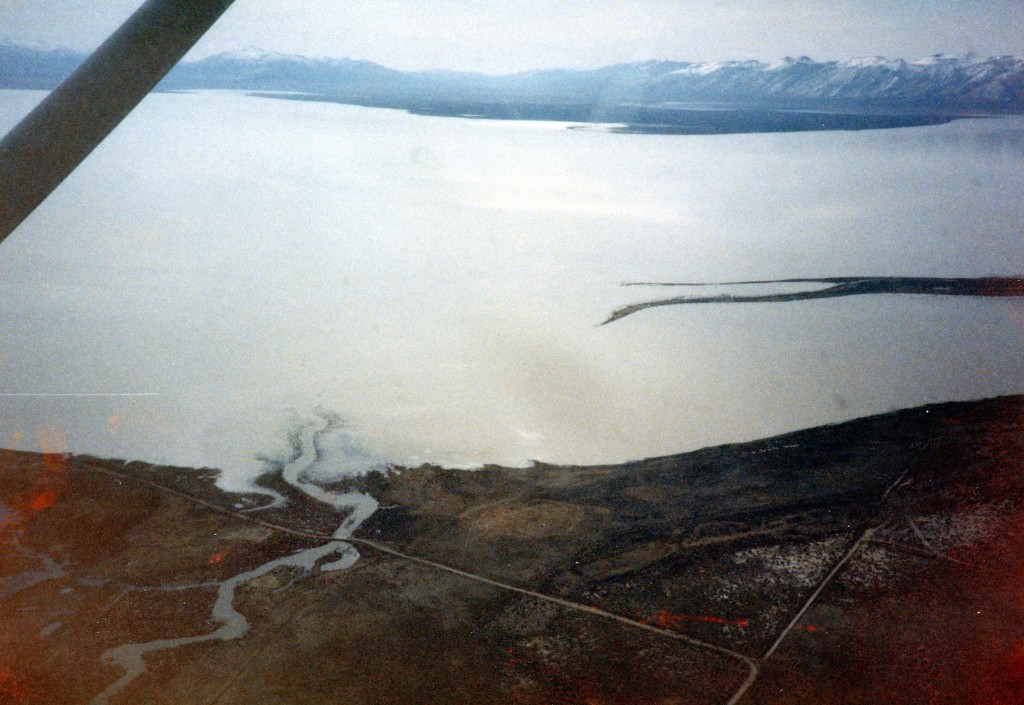
Honey Lake, February 1984. To the right is the Hartson Sand Ridge. Photograph courtesy of Bob SorvaagThere is no question that there is a lot of water in Honey Lake. For some it might seem something like a novelty, since the lake has been dry for so long. While levels of Eagle Lake are taken on a monthly basis, that is not the case with Honey. Anyhow, Honey Lake has been a lot higher, than it is presently.
The winter of 1906-07 ushered in a notorious wet cycle. March of 1907 was rather dramatic with over 12 inches precipitation—sometimes in the form and rain, and other times as snow. In January 1911, witnessed the first of two “big snows” wherein Susanville received 8 feet; Standish five feet, Wendel 8 feet. The lake flooded vast sections of land past Standish. This prompted B.F. Gibson of Litchfield to propose a canal from Honey Lake to Pyramid Lake as way to rid the area of excess water.
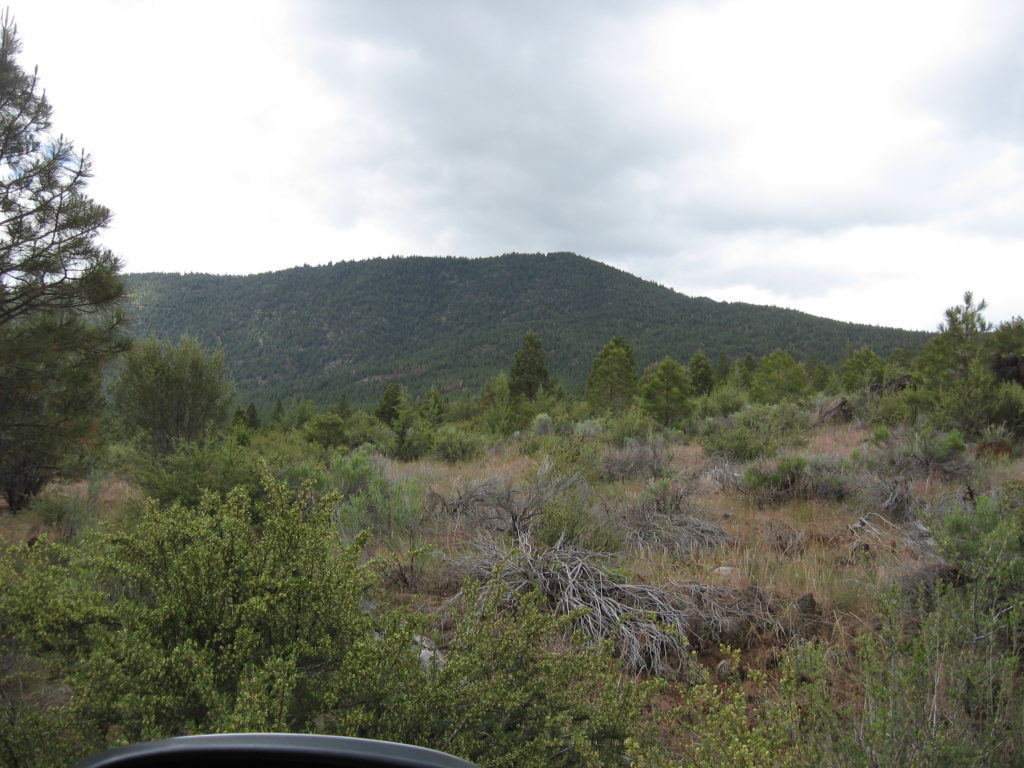
June 9, 2017This mountain not far from Susanville was a popular spot among deer hunters before there were zones, and one moved freely from one location to another in search of game.
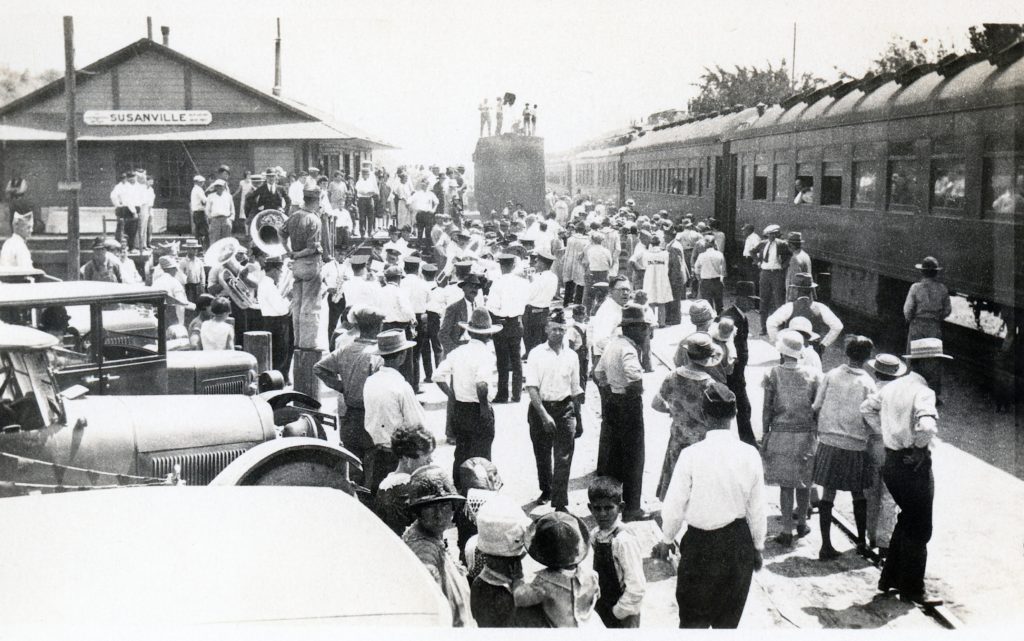
Convention delegates arriving at the Susanville Depot. Courtesy of Nellygrace Stoll.The old time Honey Lakers were a resourceful lot. When they made up their minds to do something, they did it. In the near future, we will examine some of things they had taken on. One of the “biggies” was how a local bunch of legionnaires with the community support was able to land the California American Legion Convention in Susanville. This was no small feat and the competition was fierce. To this day, one can see many of the legacy’s from that 1926 convention.
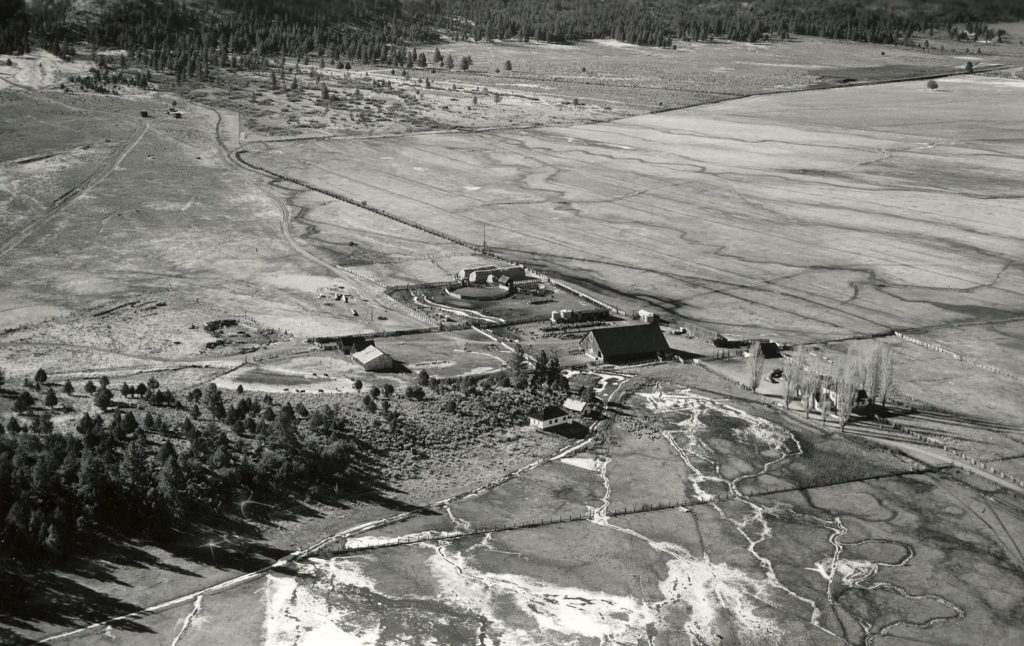
Five Dot Ranch, Willow Creek Valley, 1958. Courtesy of Wendell LougheadHeadquartered in Willow Creek Valley, this ranch, like so many others has a storied past. For the most part of the twentieth century it was known as the Lonkey Ranch. In 1939, the Lonkey’s found a buyer, W.C. Anderson, a banker from Galt, California. The ranch would change ownership several times and in the spring of 1949, two cousins, Ben Dyer and Arlyn Hughes from Gridley, California purchased the Lonkey Ranch. The two men needed financial assistance and brought in three partners: Marvin Kirk, Jack Hughes, and B.B. Hughes. They named their new enterprise the Five Dot Land & Cattle Company, with Arlyn Hughes operating the ranch. The partnership was brief and the ranch was placed on the market in 1958. In 1959, the Swickard Brothers, Jack and Tom of San Jose, purchased the Five Dot Land & Cattle Company for a reported $300,000.
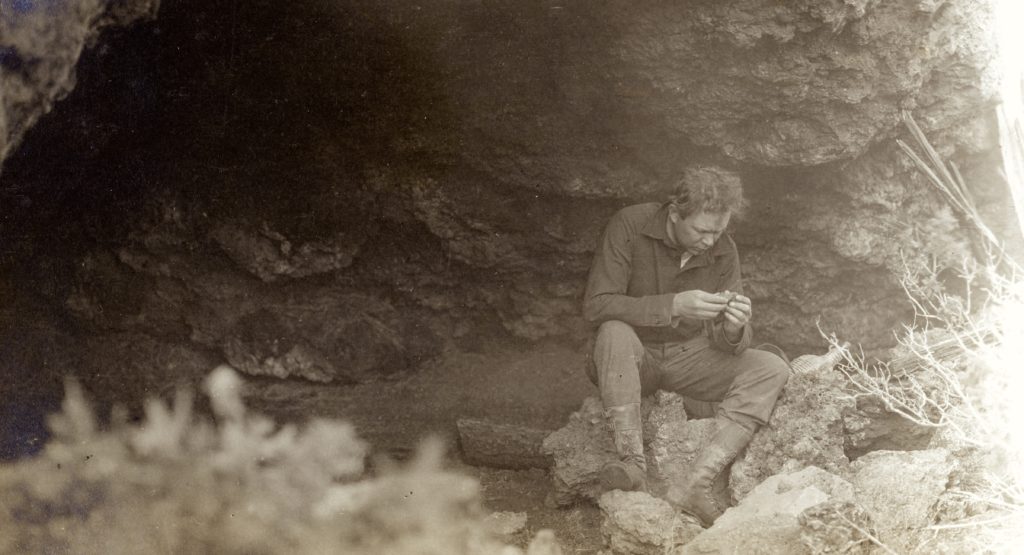
An Eagle Lake ice cave, circa 1916. Courtesy of Wyn WachhorstThis spring I wrote about the pamphlet entitled Lucky Land of Lassen that was produced and distributed at the Panama Pacific International Exposition that was held in San Francisco during 1915. At that time, I mentioned that we examine the material, and with that in mind, here is the first of two installments concerning Eagle Lake. The following is the earliest account concerning the lava beds and ice caves.
“To the west of Spalding lies what is known as the ‘Lava Bed county,” about seven miles long and three or four miles wide. This is the wildest region in this section, and excepting the vegetation, it is almost as when the lava first cooled. It is full of caverns, wells and cracks, one of the latter being five miles long and three to twenty feet wide. In one place it has been sounded to a depth of 160 feet and no bottom found. In this crack there is an ice cave where plenty of ice may be obtained any year until August and some years throughout the entire summer.”
When the Fruit Growers Supply Company gave serious thought in locating a second mill in Lassen County they were initially perplexed as to where to locate it. The timber they examined was to the west of Eagle Lake. They wanted a mill in the center of the timber to reduce the freight costs. Continue reading Pine Creek Millsite?→
Lassen County Times, April 7, 1979.In the early 1920s, chain stores began to make their appearance in Susanville. Reactions, or course, were mixed. Many a consumer enjoyed the new shopping experience with not only a wider selection of goods, but they found the price right, too. There were the loyalist crowd, that remained with their old independent pioneer merchant, who took care of the, through good and bad times, the latter that merchant would provide a line credit. However, changes were inevitable, one either adapted or perished.
These new stores also changed the appearance of the town. In the spring of 1940, Cliff Gledhill, moved a historic 1870s residence from 30 South Roop, to the farthest end of that street. Shortly thereafter, construction began on a small concrete building on the vacant lot he created. On May 22, 1940, Gledhill opened the doors there to his new enterprise, a Western Auto Store. Over the years, the building has had many occupants. Seasoned residents will know it as the office of Dr. C.I. Burnett, and for the past few decades it has been the CPA office of Carol J. Curry.
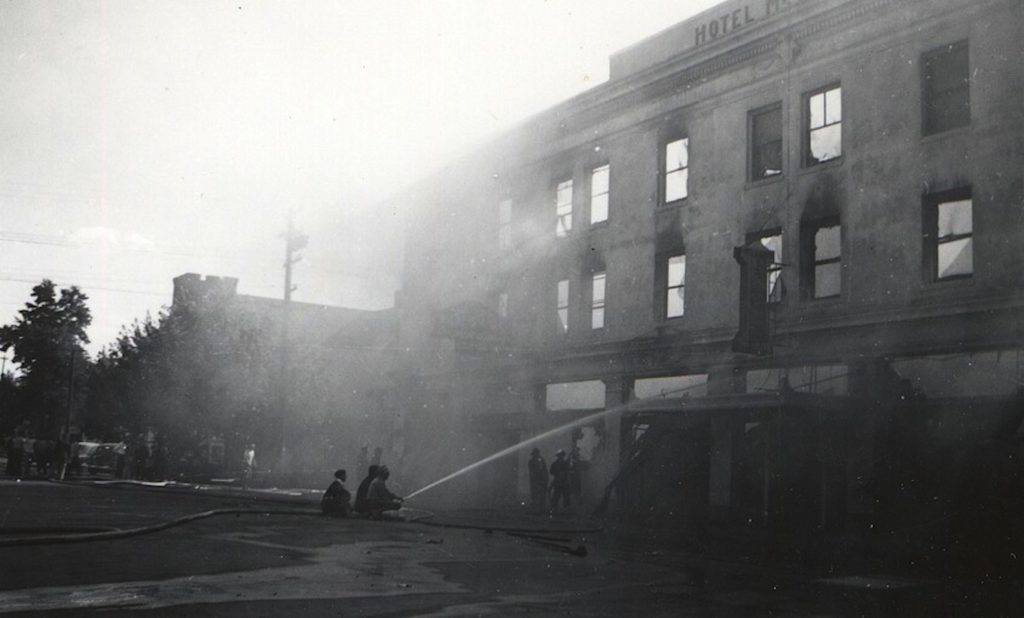
The aftermath. Courtesy of Margaret A. PurdyIt was seventy years today when the Hotel Mt. Lassen in Susanville was destroyed by fire. In 1902, Susanville passed an ordinance that all future buildings constructed in the business district be built of fire-proof material, whether brick, masonry or native stone. In time, this greatly reduced major fires. For nearly twenty years, the district did not experience any major fires, until one broke out in the basement of the Hotel Mt. Lassen on July 24, 1947. The building was completely gutted, two employees perished in the blaze and with damages at $700,000. It was the costliest fire to date in Susanville.
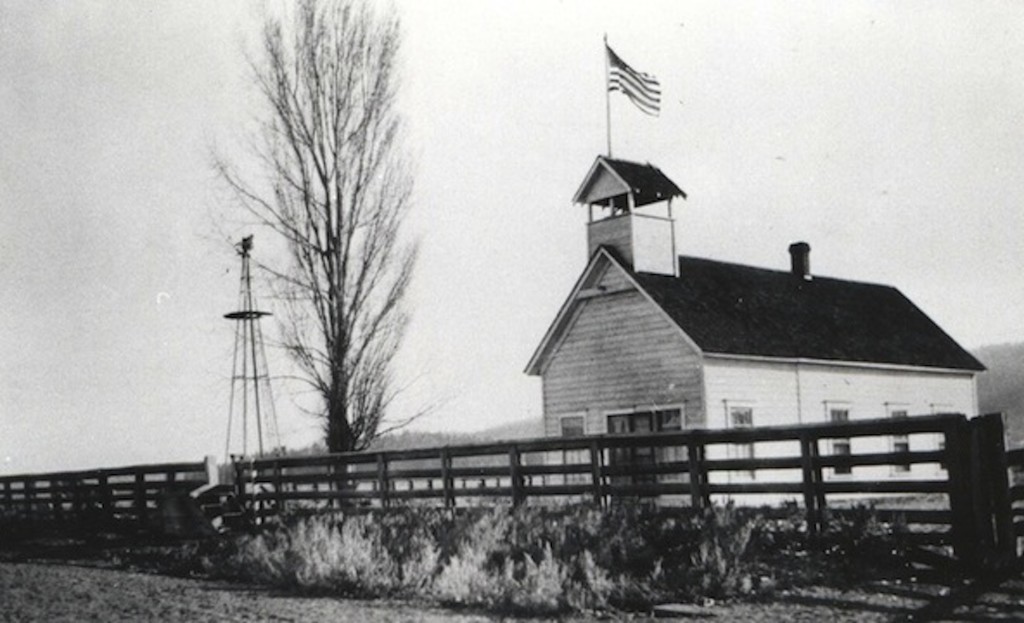
Willow Creek School, 1921. Courtesy of Lola L. Tanner
Just a follow up on some documentation. As noted in the post of the Eagle Lake School, it closed in 1937. It was not until 1940 when the school was annexed to nearby Willow Creek School District. That school closed in 1946, and in 1950 all that territory of the two districts were annexed to Susanville.
Over the course of time the region has seen a wide variety of barn styles. Some had lasted through time and others not, for one reason or another.
In 1864, a German immigrant, Jurgen Jensen located in Susanville, where entered into a partnership with William Brockman, to operate a blacksmith shop. In the ensuing years, the two men, went off on their own, each locating on property along Johnstonville Road.
In 1891, Jensen had a large three-story barn built on his ranch. On September 11, 1923, the barn was destroyed by fire and it was believed to be caused by spontaneous combustion. Stored inside was 200 tons of hay, valued at that time around $3,500. The barn was insured for $1,500, but it was not enough to cover the cost to replace it.