Category Archives: History

Pine Grove School

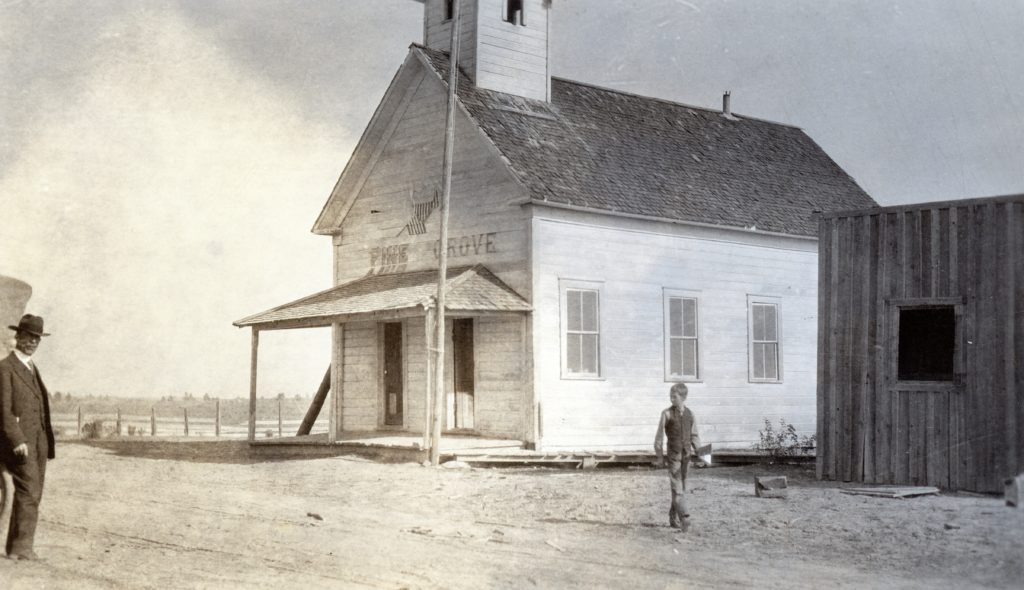
Pine Grove School, 1916. D.m. Durst Collection
In the 1880s, Big Valley saw a major increase in population, thus more schools were needed. It did not take much to create a school district then. The residents needed to be more than five miles from the nearest school house and have ten school age children in a proposed district. The Pine Grove School was established in February 1888, from sections of the Cedar Run and Pioneer School Districts. On March 17, 1888, an election was held at the residence of J.M. Bassett to approve both a bond measure for $500 and a site for a new school. The voters, all eight, approved the bond measure, though the records do not indicate anything about the school site proposal. On August 3, 1925, the Board of Supervisors approved Pine Grove’s petition to consolidate with Bieber. The residents requested that the abandoned school not be sold, torn down or removed from its site. What became of it, I do not know.

Subscribe!

Ramhorn Springs

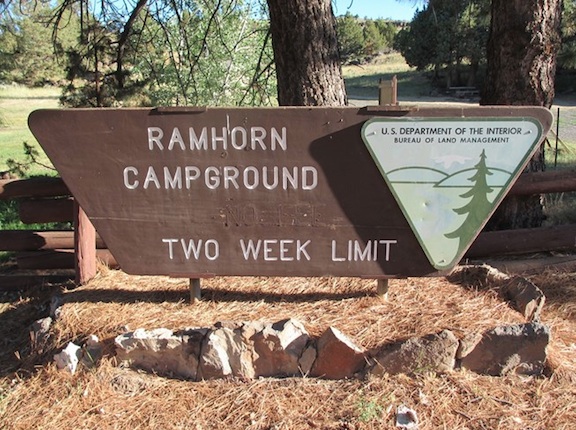
Entrance to Ramhorn Campground
Ramhorn Springs and Campground is located a sort distance east of Highway 395 between Secret Valley and the Madeline Plains. I was told recently, and I do not know if it is a fact, that the springs dried up in the recent drought. Anyhow, bighorn sheep once roamed much of eastern Lassen County. In 1881, Lum Roberts killed one on Skedaddle Mountain that weighed 200 pounds! In the early 1920s, only one band of sheep, consisting of about forty head, remained on Observation Mountain, not that far from Ramhorn Springs. The majority of that herd perished in the winter of 1922. Lassen County Game Warden, C.O. Fisher, noted that only six sheep were still alive at Observation in 1927 and by 1931 it was deemed that the sheep were extinct in the region.

Subscribe!

Grasshopper Valley – Lassen County

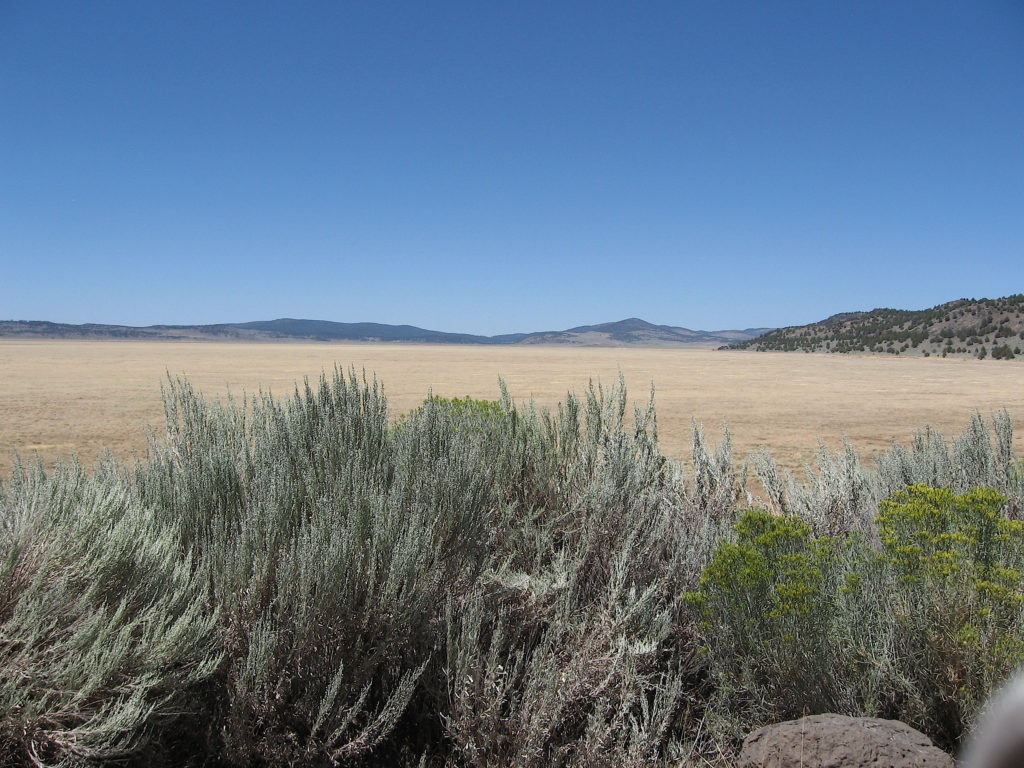
A view from the southern end of Grasshopper Valley, August 4, 2016.
The following is a brief account compiled years ago by Lina Goumaz Brownell Barclay (1883-1972) when her father Philip Goumaz operated a ranch at Grasshopper Valley.

The Philip Goumaz ranch was located five miles north of the J.C. York place in Grasshopper Valley. He bought it from Charles McClelland and moved his family from Susanville to here in the spring of 1888.
At the foot of the hill, in back of the house was a fine cold spring. The mail and passenger stage went from Susanville to Bieber in one day and back the next. In later years the change of stage horses were kept at the Goumaz ranch and the driver and passengers ate the noon meal there.
One year the grasshoppers were so thick, a person would kill several taking one step. They ate the leaves off the willows along the creek. When they began eating the standing hay, my father cut it earlier than usual. They ate quite a lot of the hay, so we found out why the valley was named Grasshopper.
There were several other ranches located in the valley. About one mile north from us was the Shanklin ranch. In later years, it was sold to Antone Gerig. Adjoining the Shanklin ranch was the Frank Loveland place. Philip Goumaz sold his place to Bailey, DeWitt and Theodore of the Honey Lake Valley in 1905 and returned to Susanville.

Subscribe!
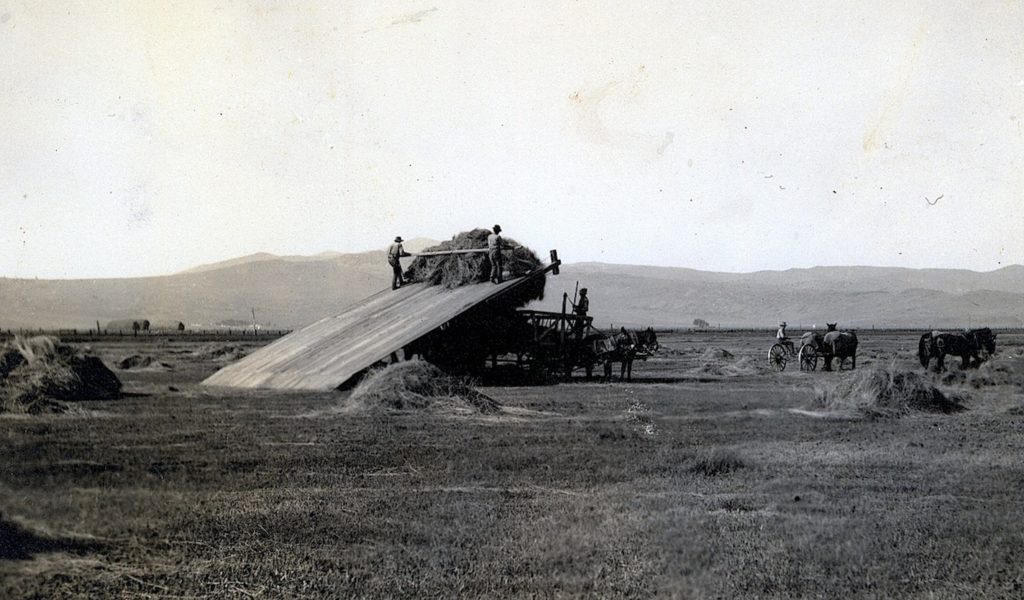
Willow Creek Valley, 1915

Haying York Ranch, Willow Creek Valley, 1912. Courtesy of Hazel Moller
This is a continuation of excerpts from spring the pamphlet entitled Lucky Land of Lassen that was produced and distributed at the Panama Pacific International Exposition that was held in San Francisco during 1915.

“Willow Creek Valley is situated about ten miles north of Susanville and contains some 15,000 acres of agricultural and meadow land. Here is an abundance of water for irrigation, derived from Willow Creek, which heads hear Eagle Lake and flows through the valley on its way to Honey Lake and from Round Valley Reservoir, situated in the mountains south of the valley. Its principal industry is stock raising, although considerable grain and alfalfa is grown and on the north side in the rich peat land vegetables grow to perfection.”

This is a continuation of excerpts from spring the pamphlet entitled Lucky Land of Lassen that was produced and distributed at the Panama Pacific International Exposition that was held in San Francisco during 1915.

“Willow Creek Valley is situated about ten miles north of Susanville and contains some 15,000 acres of agricultural and meadow land. Here is an abundance of water for irrigation, derived from Willow Creek, which heads hear Eagle Lake and flows through the valley on its way to Honey Lake and from Round Valley Reservoir, situated in the mountains south of the valley. Its principal industry is stock raising, although considerable grain and alfalfa is grown and on the north side in the rich peat land vegetables grow to perfection.”

The Honey Lake Homestead

Amedee during its heydays in the early 1890s. Courtesy of Grant and Lena Trumbull
This could be close to being considered a phantom newspaper. In March 1910 this Amedee newspaper made its debut. It received good reviews from the neighboring press for a brief moment. In the second issue of the Homestead an editorial account drew scathing remarks, as the Homestead was not going to endorse local candidates if they did not advertise with them. While fate of the duration of the newspaper is unknown, its doubtful it never saw election day. Who was behind the newspaper, is not known, and there are no surviving copies.

Subscribe!

A wordsmith’s tale

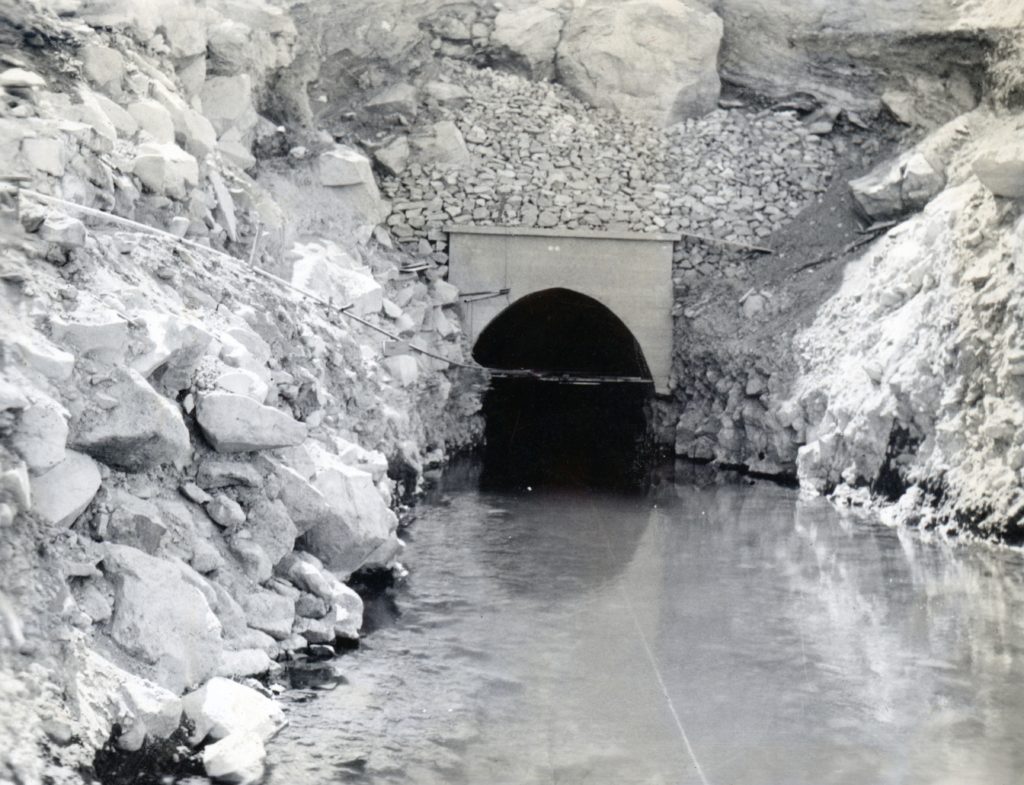
Bly tunnel inlet, July 1924. Courtesy of Wyn Wachhorst
In 1933, the Baxter Creek and Tule Irrigation Districts sought funding from the Civil Works Administration to lower intake at the Bly Tunnel at Eagle Lake. There was a problem since Malvena Gallatin and Jim Fritter had filed an injunction to prevent lowering the lake from the irrigation districts. At a CWA hearing J.A. Pardee who represented the districts in his argument stated “It is a most worthy project and complies in every way with the terms of the CWA, but there is an injunction in force against lowering Eagle Lake. We are not asking to lower the lake,” said Pardee, We only want to lower the intake.”
After a long pause the CWA director threw up his hands and said “You win,” smiling he continued, “You get what you came after.” The bottom line, the districts use of lowering the intake, did not necessarily relate to lowering the lake. With that the government gave the districts $25,000 worth of labor and materials for lowering the intake.

Subscribe!
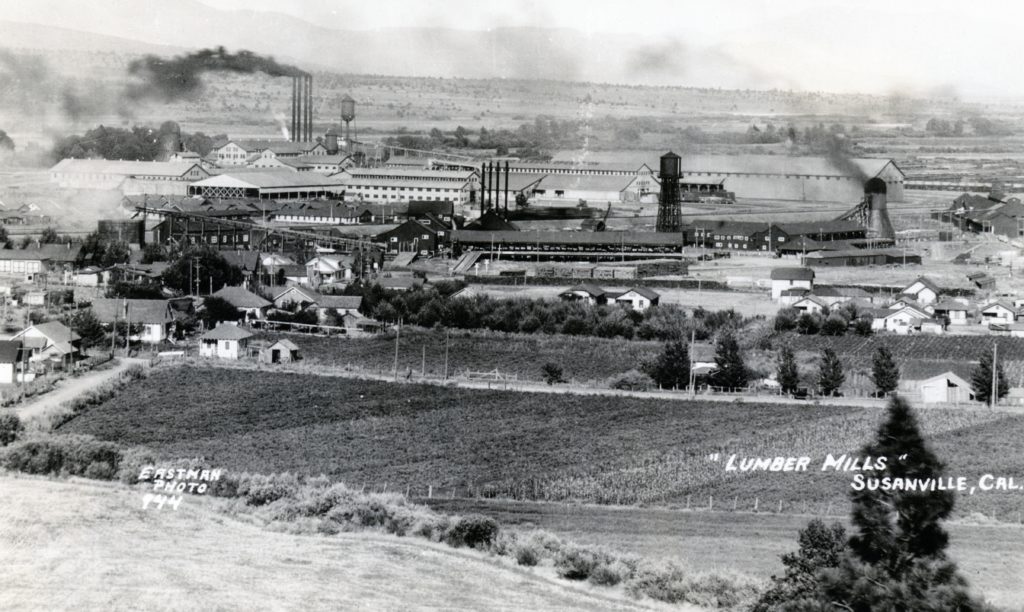
Changing Times

Fruit Growers and Lassen Lumber in their glory days.
Lassen Lumber & Box was the first large scale lumber company established in Susanville in 1918. Forty-five years later, it was history. The economic depression of the 1930s took a toll on the company, and never truly recovered. In 1951, it began the liquidation process and its neighbor, Fruit Growers Supply Company, purchased it and when the last logs were milled, it shut down. Fruit Growers purchased it for the water rights, as they thought about converting their nearby sawmill into a paper/pulp plant. After all, in 1955 Fruit Grower’s co-operative members would switch entirely from wood to cardboard, except for picking boxes.

This added fuel to the debate that the area’s economy needed to diversify, for one day the sawmill industry would become a thing of the past. This opened the subject for debate about attracting a state prison to the area.

Subscribe!

Westwood Theater

Westwood Theater. Courtesy of David Zoller
In February 1925 groundbreaking occurred on the corner of Birch and Fourth Streets for the Westwood Theater across the street from the Opera House to the north. The majestic three-story Tudor style building was built in a mere two months, and became Westwood’s tallest building. On Wednesday evening, April 22, 1925, the Westwood Theater opened its doors for its gala opening. All 1,100 seats were sold out for the viewing of the featured movie “The Sea Hawk.”
The Westwood Theater was not entirely dependent upon films originating from Hollywood. On occasions, the local residents were able to see themselves on the big screen. In the spring of 1921 the Anita Stewart Company had a contract to film the Great Western Power Company’s operations at Butt Valley. The film company while there used the opportunity to film Red River’s operations. In August, Stewart’s film of Red River’s activities made its debut at the Opera House. As one reviewer duly noted: “The film is a good reproduction of the many plant activities and the town of Westwood in general. It may need a little censorship before it is ready to go to the general public. One street scene shows the block wagon pounding along, evidently on a hurry-up trip to keep home fires burning. A little behind is the garbage wagon doing its part to make Westwood a rival of spotless town. These little details have been already enjoyed by the “home folks” but when it comes to a general public proposition it is not desirable to give undue prominence to these very necessary activities.”

Subscribe!

Bank of Lassen County

Bank of Lassen County
Bank of Lassen County at Main and Gay Streets

Established in 1892, it was Lassen County’s first financial institution. Wells Fargo operated infrequently, mainly during the 1870s and 1880s, in Bieber and Susanville, but their services were limited.  During the late 1800s, Susanville’s Jewish merchants, such as Marcus Nathan, David Knoch and William Greehn, lent money to those in need and the loan was secured usually by a property mortgage.  It was a wide array of citizens who saw the need for a bank, including the aforementioned merchants. Its first office location, was unique, located in the Pioneer, a local saloon established in 1863, and still in existence today. It was simple logic, as Susanville’s business district was prone to devastating fires, and the saloon owned the largest fire proof safe in town.
Continue reading Bank of Lassen County