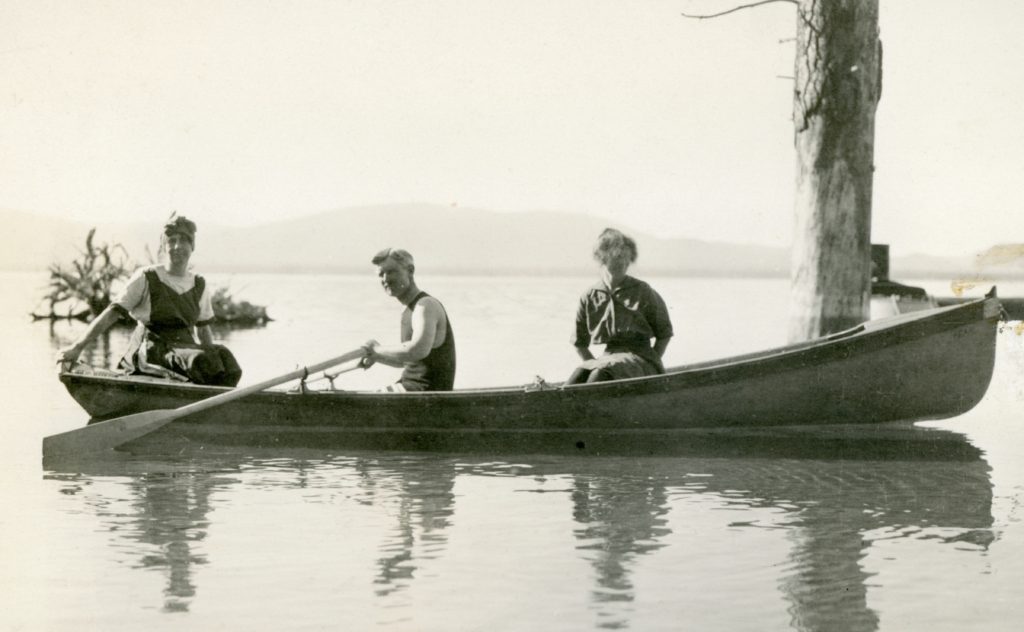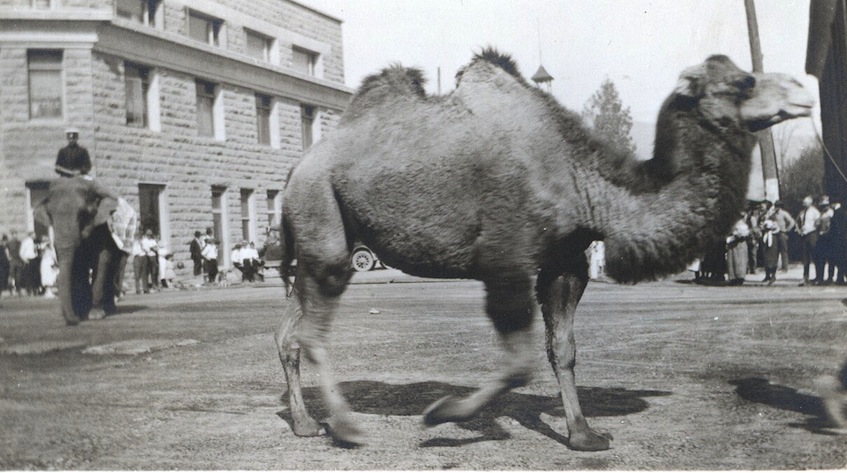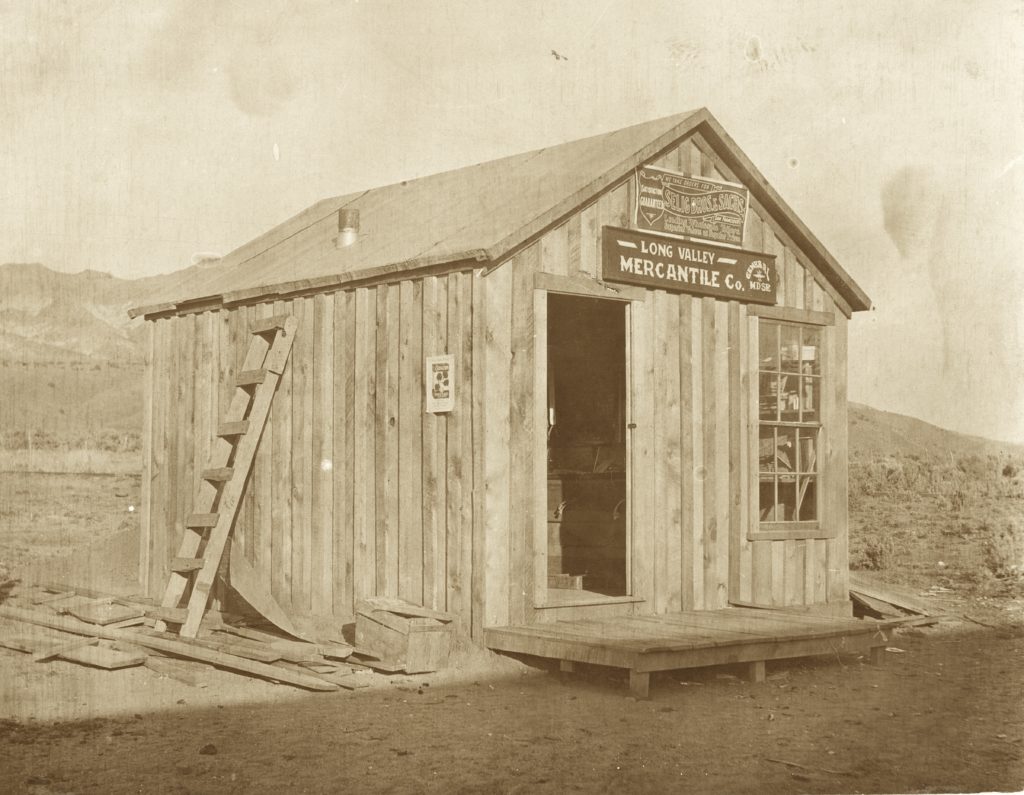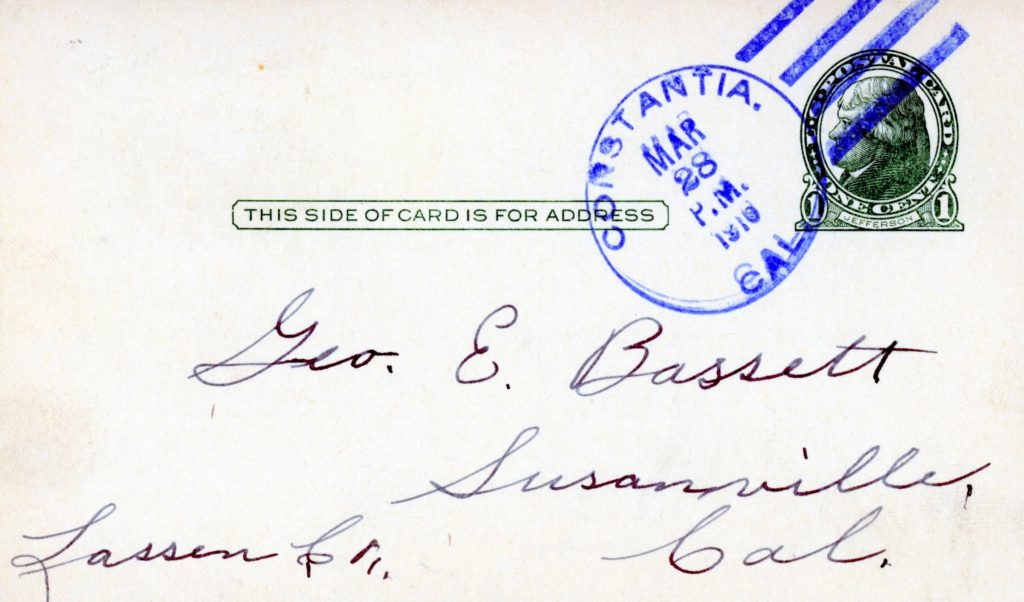
Eagle’s Nest is located in a small cove on the east side of the lake, about three miles north of Gallatin House. In 1956, the Lassen National Forest opened a small subdivision for summer home development. There are forty-two lots with long term leases with the forest service. In September 1956 the forest service held a random draw as the selection process to allocate the lots, as they had received 226 applications.
This happens to fall under the year’s end clean up category. While the quality of the photograph has a lot to be desired, there are two items of interest. First it was taken in the late 1920s, either December or January when the area experienced a pogonip, notice the frost on the trees. In the 1930s, tennis courts were built on the site of the Courthouse Annex. It should be noted the current occupants of that structure prefer the high falutin name of Administrative Building.
The 101 as it appeared in 1941. Courtesy of Dina Matteucci
On November 19, 1935 T.S. Walker of the Red River Lumber Company announced the end of an era that Westwood be a “wet” town as a liquor store concession had been given to Aronson and Taylor.
In a prepared statement, “Heretofore we have aways tried to run a dry town. Before prohibition this practicable due to the distance to neighboring towns and deplorable conditions of the roads. During prohibition it was a relative simple matter for obvious reasons. Since repeal, however, it has been a different story. With fine pavement to neighboring towns, with various resorts operating not far from town and with the great number of automobiles, liquor has been and is readily to all who desire it, whether we like the situation or not.
“This being the case, the directors of the company have decided that it is useless to longer refuse to have liquor sold in Westwood. It is also felt that a better quality can be made to such employees as are determined to have it anyway than is now available from bootleg sources.”
The truth be known, Red River was losing money by not providing alcohol for sale, when they needed every cent during their financial crisis.
The way the local Native American community bickers amongst each either, puts most family feuds to shame. Two topics of discourse is territorial boundaries and the contentious who was here first. Of course, not just from a historian standpoint, but as I have blood related cousins who are part of the local Native American community, it is just plain amusing to watch the antics.
Both the Maidu and Paiute have done a fantastic job concerning “over reach” with federal agencies, even concerning lands not within boundaries that they had in the past never claimed. A classic example is the south end of Eagle Lake—the Maidu in recent years have claimed Papoose Meadows as “sacred.” What perplexes me then, the victims of the 1866 massacre there were Paiute.
While today we are fortunate to have the Susanville Symphony, it should be noted that in the past there had been other venues. In the 1930s it was the Susanville Symphonietta Orchestra. During the 1960s and 1970s it was the Susanville Community Concert series. It just goes to show that there has always been a lot of talent in the community.
During the 1920s, Susanville’s two newspapers, Lassen Advocate and Lassen Mail published elaborate Christmas editions extolling the virtues of Lassen County. Concerning what the lumber industry meant to Lassen County, the Lassen Advocate provided this profile of the Red River Lumber Company in 1921: Continue reading What Red River Meant to Lassen County→
Looking toward’s Lawrence’s grave from Lassen’s Monument.
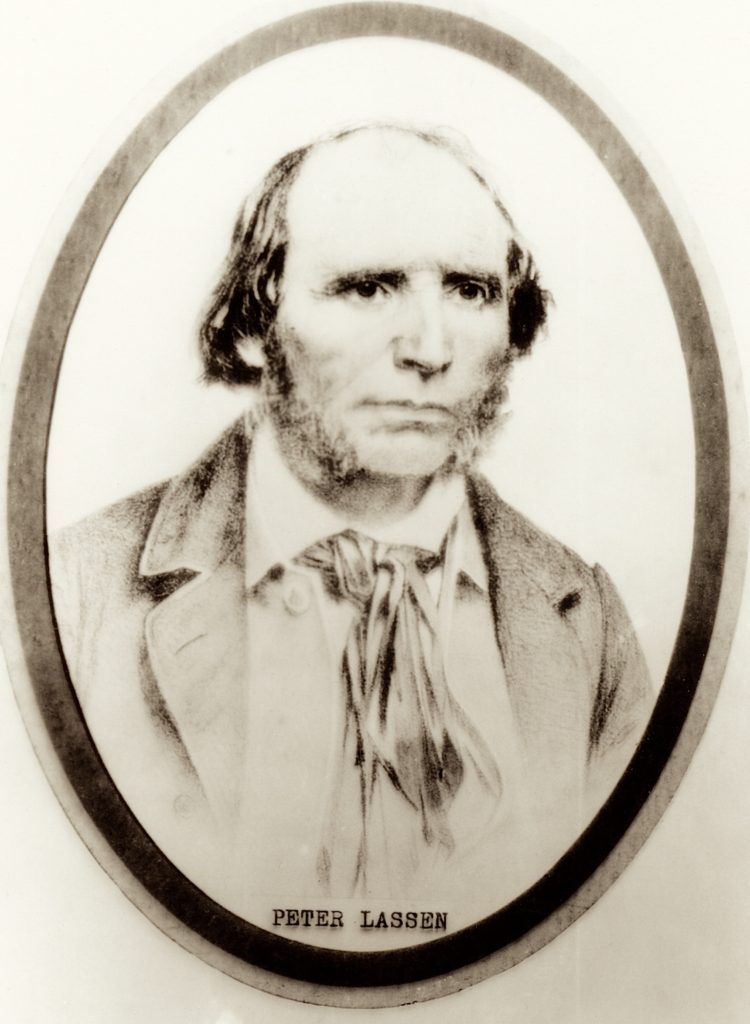
He is a little known figure in the early annals of Lassen County. He was one of six men to spend the winter of 1855-56 at Peter Lassen’s newly constructed a cabin. Prior to his arrival in the Honey Lake Valley, Lawrence had spent considerable time in Butte County where he earned the nickname “Commanche George,” though the circumstances behind the episode is not known. Like many prospectors he roamed the region, though never finding what he was looking for. In 1864, Lawrence and B.F. Murphy established the Buffalo Salt Works in the Smoke Creek Desert. In 1868, he was residing with the David Titherington family, who purchased Lassen’s ranch from the estate. On December 22, 1868, Lawrence died from small pox, that had become an epidemic in the area.. He was buried a short distance north of Peter Lassen’s grave, with no marker.
With the winter solstice upon us, I have been looking back when the days were longer and warmer. On an excursion to the east side of Eagle Lake provides for an interesting setting of the geology of Eagle Lake. This, of course, I am indebted to Michael Clynne of U.S.G.S who enlightened me. Continue reading Eagle Lake Geology 1.0→
Earlier this year, Tim Stienmeier, while at the Los Angeles County Fairgrounds in Pomona sent along this photograph of the Climax No. 3 locomotive that the Fruit Growers Supply Company used at their Hilt Operation. It should be noted that Fruit Growers discontinued railroad logging at Hilt in 1933. For many years the No. 3 was parked along an old freight shed. In 1954, the Southern California Chapter of the Railway Locomotive Society became aware of this relic and inquired about its status. Fruit Growers agreed to donate it to the Society on the condition that organization would have the burden of the costs to move it from Hilt to Los Angeles. Once the mission accomplished the Climax No. 3 once cleaned up was put on permanent display at the Los Angeles County Fairgrounds, though it kind looks a bit neglected these days.
140 N. Roop Street, Susanville, circa 1911. Courtesy of Dick & Helen Harrison.
Constructed in 1906, it was the first house built on the west side of the 100 block of Roop Street. The home was built for Abel and Ella Bunnell. Two years later, his brother L.W. Bunnell had the house built kitty-corner from them. The home was passed down to Abel’s daughter and son-in-law, Georgia and Bert Jensen. At about noon, on Saturday, June 21, 1928, the Jensen’s nearly lost their house to fire. Bert, and his two sons, Jud and Abe, were away working at the family ranch, a few miles east of town. Fortunately, neighbors and onlookers began hauling out the furniture while waiting for the fire department to arrive. It was estimated the fire caused $5,000 worth of damage. The Jensen’s continued to make it their home for several decades. It has since been converted into three apartments.