Category Archives: History

Susanville – Alexander Avenue

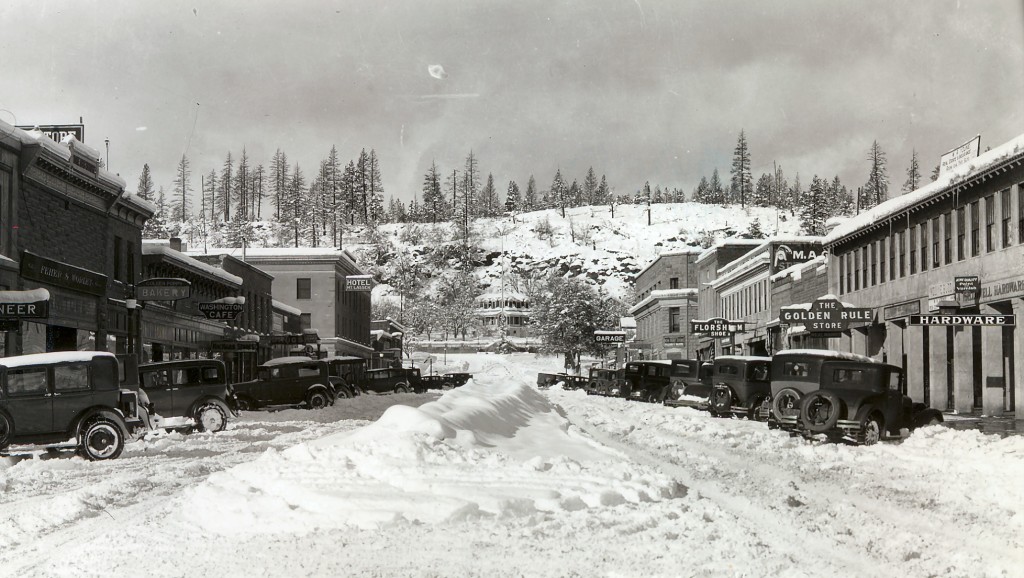
This view shows the proposed realignment.

Alexander Avenue came into existence in 1912 as part of the Lassen Townsite subdivision. It was named for Jules Alexander who came to Susanville in 1877 and eventually became a successful merchant. He left that field, and became involved in banking until his death in 1935.  Alexander was also a major investor in the Lassen Townsite Company.

Alexander Avenue is one of those handful of city streets that witnessed a major realignment. In the early 1970s, the street was straightened between Main and Cornell, thus moving Sherman’s Texaco Station to the other side of the street, as Alexander had separated it from Walker’s.

Then there is the lingering issue, will Alexander Avenue be extended all the way to Richmond Road, as has been suggested in previous planning documents.

Subscribe

Modoc Line – Biscar Reservoir

Biscar Reservoir

Last week, we featured the Horse Lake Siding on the abandoned Modoc Line, now a recreational trail. One of the favorite segments of the Modoc Line is that from Karlo to Snowstorm. One of the many interesting features along the route is Biscar Reservoir, as this water oasis standouts among the high desert countryside.

The reservoir was so named for Secret Valley rancher, Pierre “Pete” Biscar, (1881-1947) a native of France who settled there in 1904. In 1909, he constructed the first reservoir at the mouth of Snowstorm Canyon. In 1915, it was washed out by a flood and subsequently rebuilt. Today there are two reservoirs that are a part of the 550-acre Biscar Wildlife Area.  It was initially purchased in the late 1940s by the California Department of Fish and Game as part of a long range plan to obtain water for the department’s Honey Lake Wildlife Area.

Subscribe

Ski A Volcano – Part II

Supan’s Sulphur Ski Works

In 1982, the park granted California Guest Services a twenty-year concession to operate Lassen Ski Area, as it was formally known. This time there was a surprising catch. The contract carried a stipulation that when expired, downhill skiing would be phased out. The termination of downhill skiing came sooner than expected. In the spring of 1993, John Koeberer of California Guest Services contacted the park and asked if it would consider canceling the contract. Koeberer cited financial losses over the previous nine years. A contributing factor to the situation, was for the last five years due to low snow falls. The few cases of heavy storms arrived on weekends, discouraging use by the skiing public. The park obliged, although many regional ski enthusiasts were upset with this abrupt closure. Continue reading Ski A Volcano – Part II

Ski A Volcano

Mt. Lassen Ski Club, 1930

Lassen Volcanic National Park is known for many things, whether  be its wondrous hydrothermal features or that a large segment of park is left in its primitive wilderness state.  Lassen Peak and its surrounding territory is known for its tremendous snowfall. After all, it should be noted that Lassen has an average of over 600 inches of snowfall annually and has some of the highest snowfall accumulations in California.

The 1920s witnessed some dramatic changes to the American lifestyle. Two contributing factors were the affordability of the automobile and development of highways to promote travel. By 1930, Lassen Park was a benefactor of those factors. The first and foremost saw the completion of State Highway 36 that skirts the southern entrance of the park. Equally important came the announcement from the State of California that this route would remain open during the winter months. In the past it was closed whenever it snowed. Continue reading Ski A Volcano

Lassen Airplanes?

During World War I witnessed an increased demand for airplanes for the war effort—a first. The preferred wood was the Sitka spruce found along the coastal regions of Oregon and Washington. There were numerous problems associated with not a only a limited supply, but problems with labor unions in that region.

In January 1918, a representative from the war department arrived  in Westwood for purpose of selecting sugar and/or yellow pine timber for building a fleet of government airplanes. Early tests indicated that California pine was superior to Oregon fir for the purpose intended. The government official was to select 300,000 board feet of Lassen County timber to be processed by the Red River Lumber Company.  Whether this transpired, the record is not clear, due in part of the censorship of certain types of news during the War.

Donate

Lassen High School, 1928

Lassen Union High School, 1922.

Lassen County voter’s can be a stingy lot when it comes to passing local bond measures. During the 1920s, Lassen High School was overwhelmed by the increase of the student population, due to the tremendous growth from the lumber mills being established. By 1926, Susanville Elementary School District had built three schools in six years. The Lassen High School Trustees was in dire need to expand its facility, but were keenly aware the voters had no appetite to finance another bond measure. What to do? The most pressing need was to find a solution to the overcrowding. After all, classes began at 8:00 a.m. and lasted until 5:00 p.m. as a heavy rotation schedule was in place to meet all the needs of the students.  The remedy was to build an east wing addition to the current structure. At the November 5, 1928 meeting, the trustees at the high school approved to construct the $33,000 east wing addition. They had a budget reserve of $6,300 that would be the initial down payment. At this time, they were only spending 69 cents of assessment funds, though the maximum was at 75 cents. The following year, they would raise the cap to 75, that provided an additional $12,000 for the building fund and it would remain until the project was paid in full.  Work would not begin until May 1, so not be disruptive during school operations and was completed in time for fall classes.

Subscribe

T.B. Walker’s Philosophy

In the early 1900s, whenever Red River Lumber Company’s founder, T.B. Walker, made an appearance in California it drew widespread attention. This was especially the case as he acquired more and more timber land and speculation was rampant. In 1909, on a visit to Redding , Walker visited with the local press. He stressed one of biggest obstacles he faced was the lack of railroad access to his vast holdings. However, he provided the following insight of his future intent:

“I will make my timber a perpetual resource of Shasta County, and I want to have the people with me. When I begin to manufacture lumber, my saws will cut timber only as fast as nature reproduces it.” This, of course, raised the question, why he did not take the same kind of action in Minnesota. Walker explained, “Conditions are far different in Minnesota. There the excessive taxation forced me to cut the timber as fast as possible. Minnesota land is worth considerable for agricultural purposes after the timber has been cut off, though it is not so valuable as was first estimated. In Shasta County the timber land is not worth 50 cents an acre after the timber is cut off. It is really more valuable for grazing purposes with timber than it would be without timber.” In conclusion, Walker noted that he can conserve the timber supply better than the government.

Donate

Paul Bunyan Statues

Akeley, Minnesota, 2007

Now, a part of American folklore is that of Paul Bunyan and Babe his Blue Ox. The story behind him, could possibly been lost to time from its origins in the logging camps in the Great Lakes region. It was William B. Laughead who brought Paul to life as part of Red River Lumber Company’s advertising campaign for its California expansion.

A variety of communities over time adopted the mythical lumberjack, and statues were erected in his honor. The first one constructed was at Bemidji, Minnesota in 1937. When I visited there, it was undergoing restoration.  My next stop after that on this research expedition was Akeley, Minnesota, the location of Red River’s last Minnesota mill. This quiet community is dominated by a Paul Bunyan statue. Of course, locally, Westwood would erect one, long after Red River was gone.

Subscribe

When an opportunity arises

The advertising symbol of the eruption was found eveywhere.

In 1914 when Lassen Peak blew its top, so to speak, it became a media spectacle, not just locally, but a national and international sensation. Of course, the surrounding communities/counties of Lassen Peak took full advantage of the free publicity made available.  Of course, Susanville/Lassen County was of no exception, especially since the county and the peak shared the same name.  Examples where when the Lassen Industrial Bank used a photograph of eruption on their checks, while the Susanville newspaper the Lassen Advocate incorporated it into its masthead.

A little bit of irony back in the 1950s when the Lassen County logo made its debut, shows Lassen Peak in the background.  It should be duly noted that Lassen Peak is located in Shasta County.

Subscribe