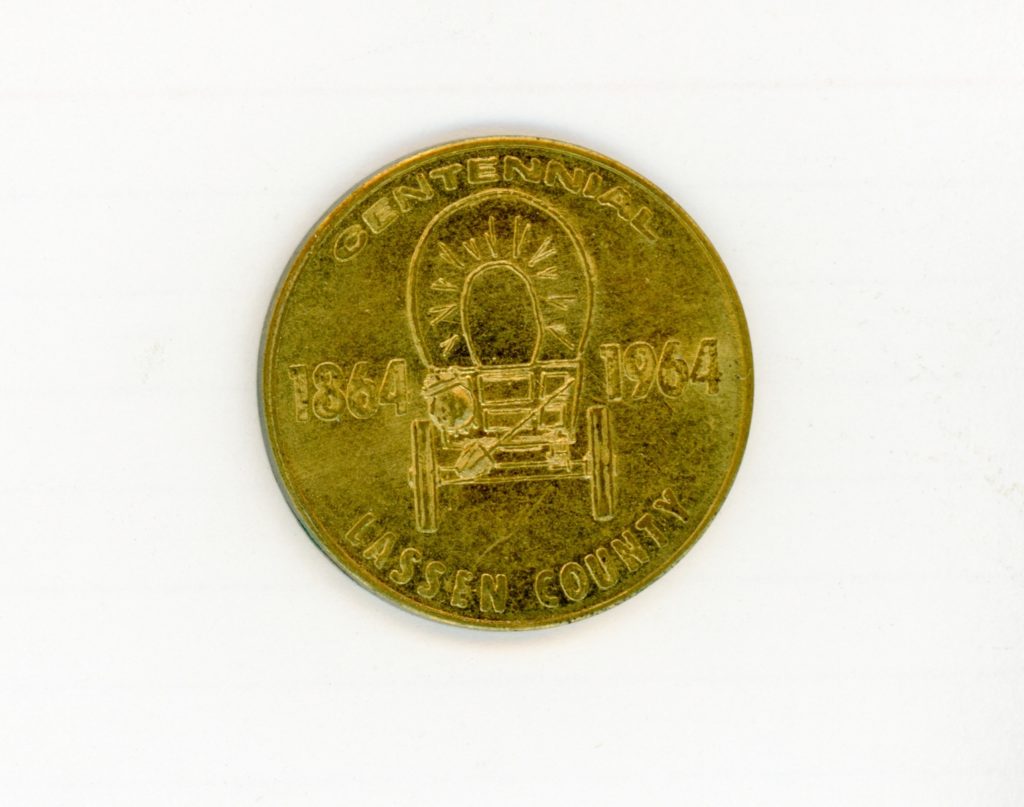
In 1964, Lassen County celebrated its centennial in a big way. Throughout the year a wide variety of events were held from a reenactment of the Sagebrush War to a Pony Express Ride. Just prior to July 4, 1964, the Lassen County Chamber of Commerce distributed to retail stores, hotels, restaurants and a commemorative centennial coin. Believe it or not they actually had a value of fifty cents towards any local purchase. It was the chamber’s opinion few people would redeem, and keep them as a souvenir. Whatever the case may be 10,000 were made.
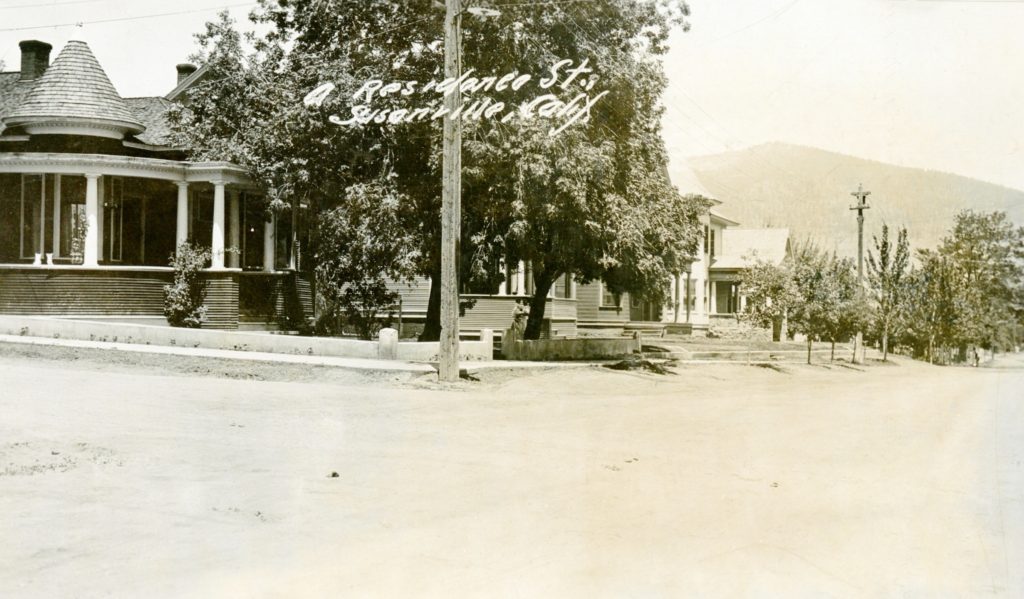
The west side of of the 100 block of North Street Street contains five Victorian style homes. The houses were constructed between 1906 to 1911. This is unique, since many of the residential areas in the original section of Susanville are quite an electic mixture.
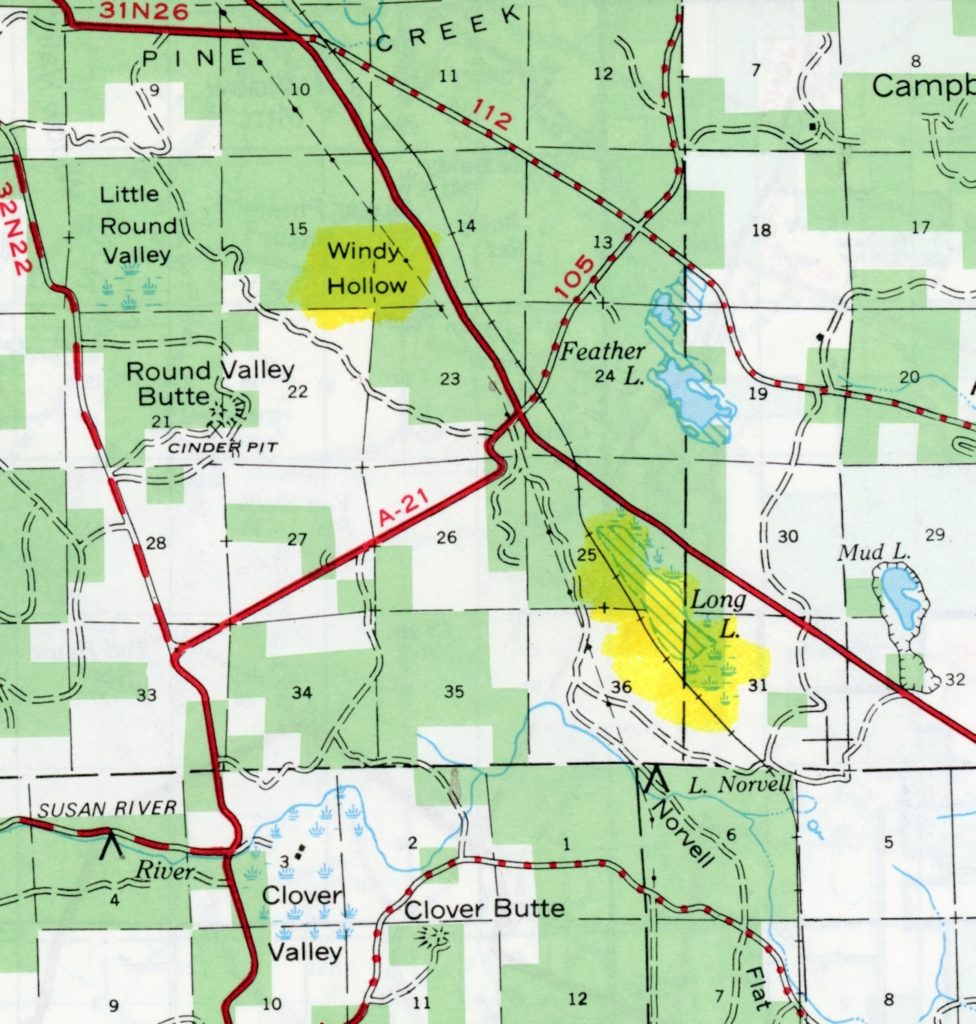
A 1971 Lassen National Forest Service in which both features are highlighted in yellow.
A reader raised concern about the location about an earlier post about Windy Hollow and its close proximity to Long Lake. Long Lake, which is an intermittent body of water is just south of where Highway 44 and the Western Pacific Railroad crossing, while Windy Hollow is just north from the same crossing.
Long Lake prior to 1900 was known as Anna Lake. George Best Long (1868-1925) had a homestead in the vicinity, hence its current name. He sold that property in 1925 for $500.
On May 4, 1961, the Stone family sold their Eagle Lake ranch to the Five Dot Land & Cattle Company. They did retain ownership of their shoreline property on the northwest end of the lake. In October 1961 they began subdividing property into 244 lots.
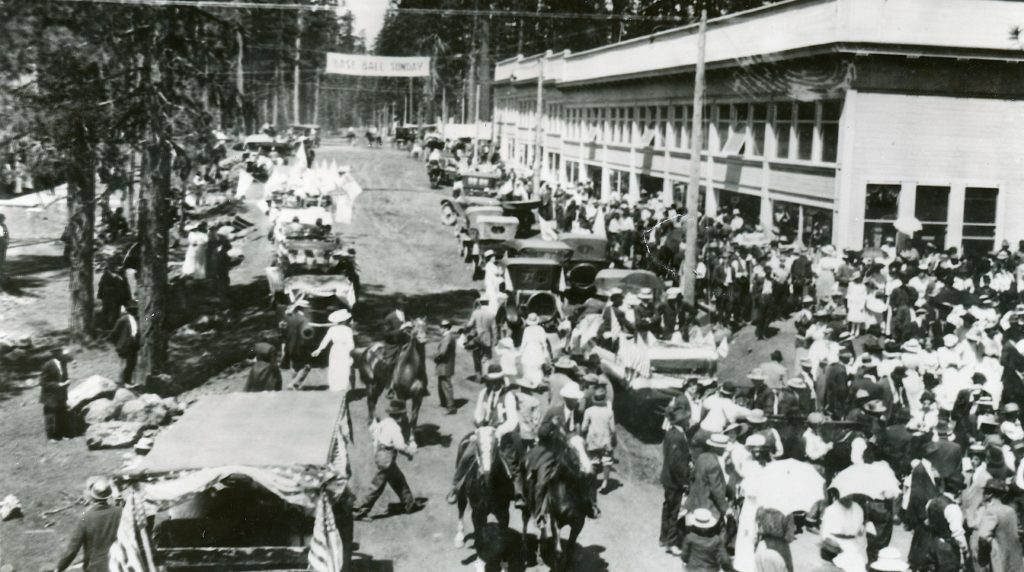
4th of July 1915 celebration at Westwood. Courtesy of the Nevada Historical Society.
This was unlike other patriotic events taken place across the nation that particular year. In 1914, after the completion of the Fernley & Lassen Railroad to Westwood, the Red River Lumber Company was eager to host an event to its neighbors to showcase their new town. However, it always turned out as a logistical nightmare, as other events prevailed. Instead of attempting to do something hasty in the short term, the company focused its attention on July 4, 1915. It was a grand success. A special train came from Susanville to Westwood for the day and those who traveled by car, allowed for thousands to attend not only traditional activities associated with the Fourth, but to sight-see and explore the new town.
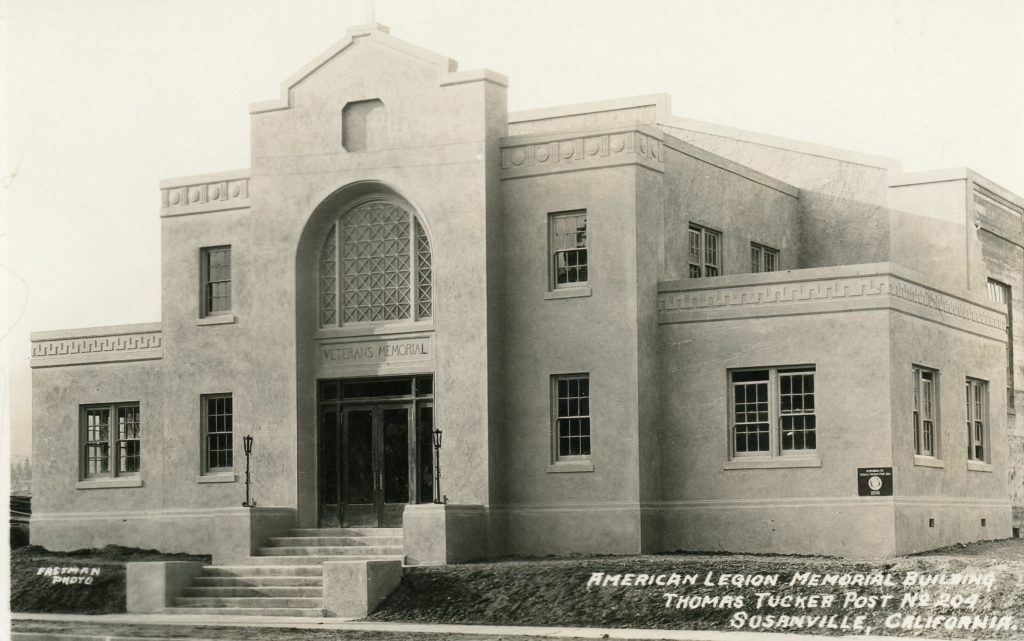
Something a bit different today. Some may not realize that it was not until in 1931 when the Star Spangled Banner was made the national anthem. In September 1936, there was a nation wide movement by the American Legion Auxillary to have the national anthem played as many venues as possible. Locally, it was Maud Lund, the music chairman of the Thomas Tucker Post American Legion Auxillary duty launch a local campaign to have the anthem played at local events.
While the residents of Susanville were adjusting to the automobile, they were interested in the novelty of aviation. For the Fourth of July festivities of 1912, E.H. Thompson aka “The Birdman” and his “flying machine” were scheduled for the three-day festival. To date, no airplane had flown over Susanville. Thompson offered flights for fifty cents for those so inclined. On July 2 he experienced problems with inferior gasoline and on one attempt was able to lift off about only twenty feet off the ground. Some people were disappointed, others disgusted and another segment thought it was fake to begin with. For Thompson it was an expensive undertaking. The plane had not been flown there, but it was shipped by rail and freighted to Susanville, at his cost. Since he could not offer rides, he was not able to recoup any of his losses.
While the last two days were focused on Sylvester Daniels rodeo observation, it was duly noted that his sole purpose to be in the Honey Lake Valley was to see if this climate versus Iowa would be beneficial for his health. It was not long after the gold rush of 1849, that California possessed many virtues other than minerals—weather being one. For Daniels, he was a firm believer. After only spending a year in Northeastern California, he returned to Iowa, to move his family to Lake City, Modoc County. Daniels passed away at Lake City on January 20, 1908, at the age of 79.
There were others who were not so fortunate. For example, J. St. Clair Riesenmen. This Pennsylvania native was lured to California, in 1914, to the Lassen County town of Amedee, known for its hot springs and their supposed healing qualities, coupled with the dry climate would be beneficial. What he found was romance. On August 14, 1915, Riesenman married Alda Callahan, whose parents owned the Amedee Hotel.
In 1920, they moved from Amedee to Wendel and owned and operated the Wendel Cash Grocery. By 1922, whatever his health infliction had returned. He carried on for several years with a sunny disposition. Riesenman died on March 18, 1927 at the age of 39.
High Rock Ranch in eastern Honey Lake Valley was a popular gathering place for rodeos in the late 1800s. Courtesy of Madelyn Mapes Dahlstrom
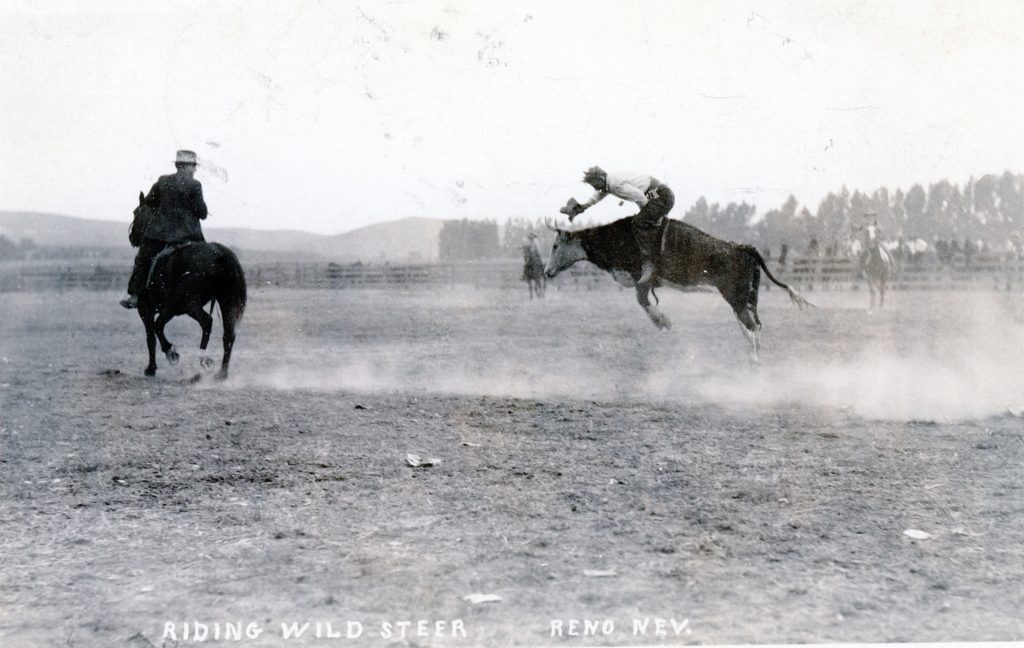
Three days later, June 22, 1874, Daniels was able to witness his first rodeo and wrote: “They take wild colts, throw a rope over their neck and choke them down. Then they put a blind on them. They use a halter called a Hackamore, with a long rope to it. They don’t put on any bridle and the blind is a broad piece of leather with strings to tie it on so they can slip it down over their eyes or up so they can see. After these two things are on, they are let up. Then they slip the blind over their eyes and put the saddle on. The rope is tied so as to make a rein to hold on to. Then they are taken out of the corral and there is three to five men mounted to ride at each side and behind to keep them from running into the fence or any other bad place. One has a big whip, when the rider mounts the blind is raised and the show begins and it is a considerable show. One would think the horse would be tired out before the rider gets on, after all the horses had all ready been run through a round up and all. But they buck, pretty tall, and it takes a good rider to stay on. It jolts a man awful. The men did well today, none got thrown. They make them buck all they can. When they quit that, the fun is over. It is broke and turned out and another caught and the same performance again, with but little variation.”
It was interesting to note Daniels final observations. The reason for his attendance was his brother-in-law, Elisha Parks, was in search of stray livestock. Daniels noted that Parks’ three colts had been separated in the corrals, but never broken. Parks thought they could just drive them home. Daniels, wrote that did not happen, and the scenario was like driving deer, and the animals fled to the mountains.
Finally, Daniels was amazed about the difference in hospitality between Honey Lakers and those in Iowa. He noted the host of event fed everyone for free, and he recokened there were nearly forty men there. In summation, Daniels wrote, “Not many would do that in Iowa.”
Rodeos, like so many other events have evolved over the years. For instance, in this region, during the late 1800s, they usually occured in late spring to round up livestock that were allowed to graze freely during the winter months.
In May 1874, Sylvester Daniels arrived in the Honey Lake Valley from Iowa, to spend time with his sister, Polly Parks and her family, to see if the change of climate would be beneficial to him.
Daniels kept numerous descriptive journals during his stay. When one journal was finished, he would send it back to his family in Iowa to provide them with insight of what life was like on this new frontier.
On June 18, 1874, Daniels wrote: “Jerry Leaky came here and stayed last night. He is herding stock on the other side of the valley. It seems they have a great time every spring, Rodeoing, they call it. A lot of men having stock out together, camp out, sometimes as many as 150 men. They go around from one to place another and have all the stock gathered together that are in reach. Separate each man’s stock from the rest, get them in the yard (or corral as they call every place that they yard cattle or horses). They mark all of the calves, colts and stock that has changed owners. They have their Buccaroes, men with the Lasso to catch and hold the stock while they operate with hot irons. I should like to go and see the thing done, then I could tell more about it.”