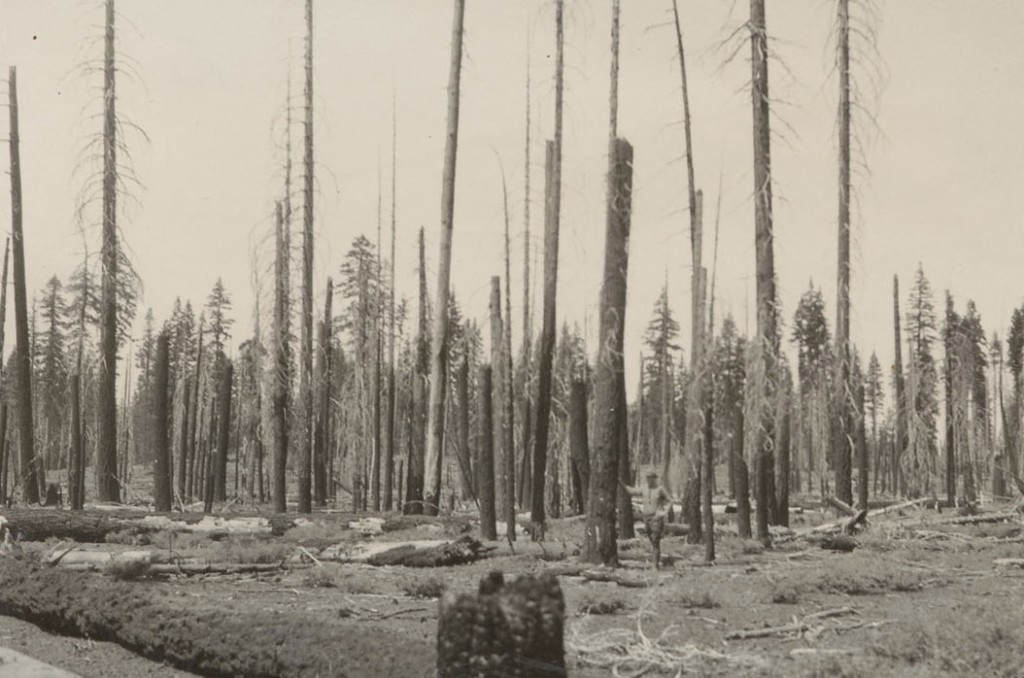
In the 1920s, Red Riverbed began extensive logging in the Lake Almanor basin. It would be just a matter time that logging activities might spark a fire. On July 27, 1926, a fire started at Butt Valley west of Lake Almanor,.
The fire started from sparks of a steam donkey engine which spread rapidly over the recently logged over lands toward the west shore of Lake Almanor. For a time the fire threatened the Lake Almanor Inn at Prattville and the various cottages adjacent to it, requiring the evacuation of seventy-five campers. The fire burned over 16,000 acres, and destroyed three abandoned logging camps and several miles of railroad ties. Red River estimated its loss at $23,000.
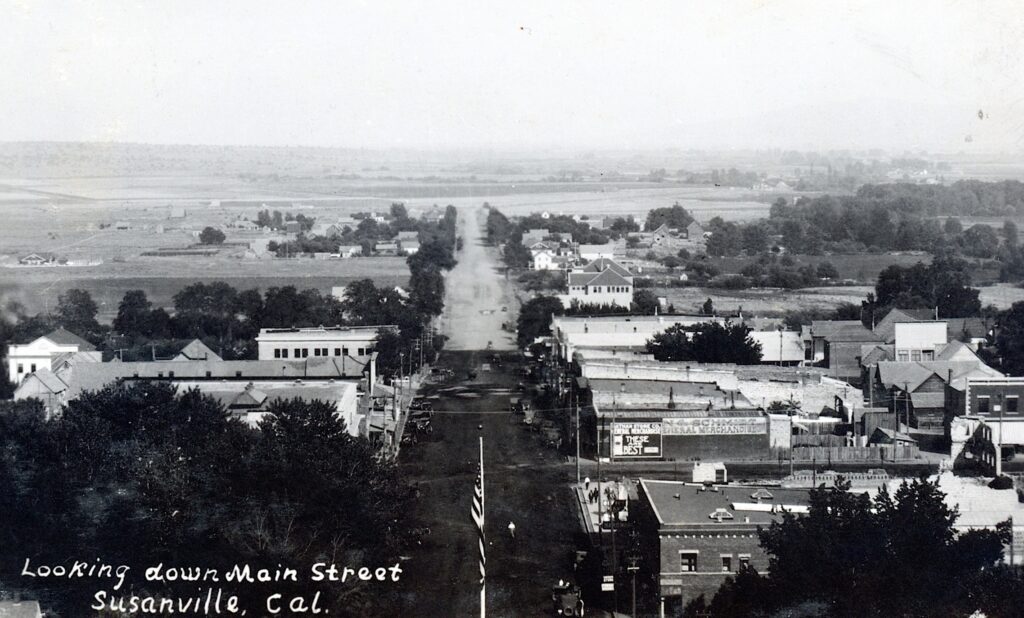
When Susanville was incorporated in 1900 as a municipality the city faced the daunting challenge of infrastructure, with limited financial resources. While the city would from time to time in its early years asked voters to approve bond measures to make civic improvements a reality. The voters, on the other hand, routinely rejected them.
Street maintenance was a costly and severe strain on the town’s limited budget. Winter storms, of course, wreaked havoc on the streets, which each spring needed to be repaired and graded. City desired to have pave streets and cement sidewalks. That would be a giant hurdle to overcome. There was alternative and a temporary solution. In 1916, the city began oiling the streets. That may not seem like a big deal, but it eliminated two major problems, mud in the winter and dust in the summer.
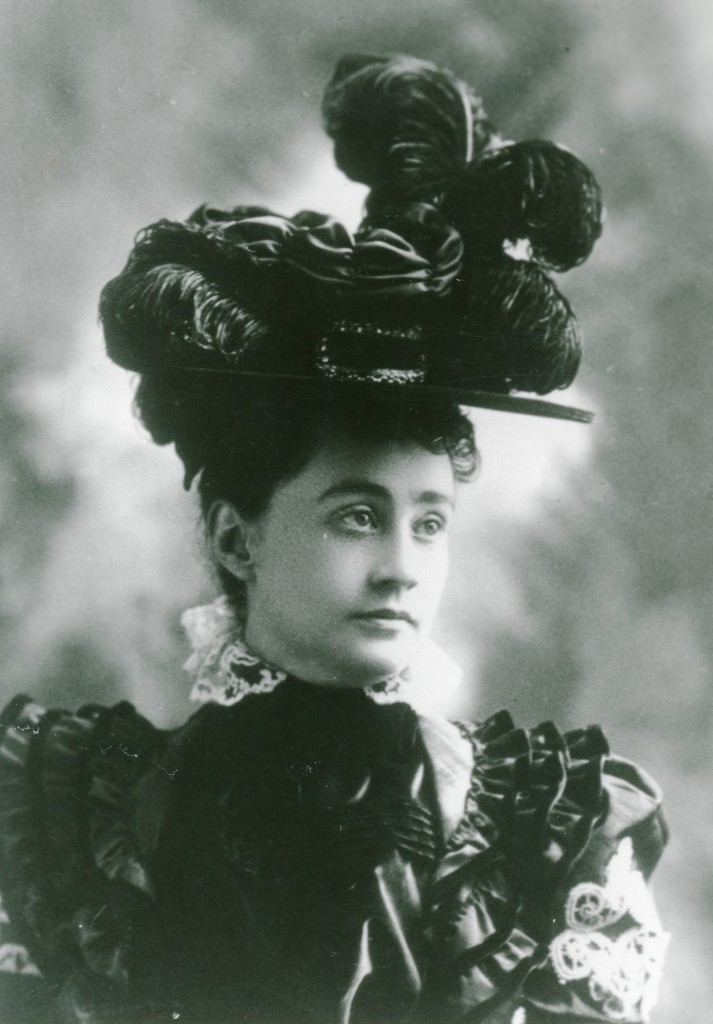
In 1884, Malvena Robin married the divorced Albert Gallatin. To this union they had one child, Leta. In 1905, Albert Gallatin passed away at age of 69, and the bulk of his estate he left to Malvena. At the time of his death he owned 4,962 acre of land surrounding Eagle Lake. It was purely economical for the land used for livestock grazing.
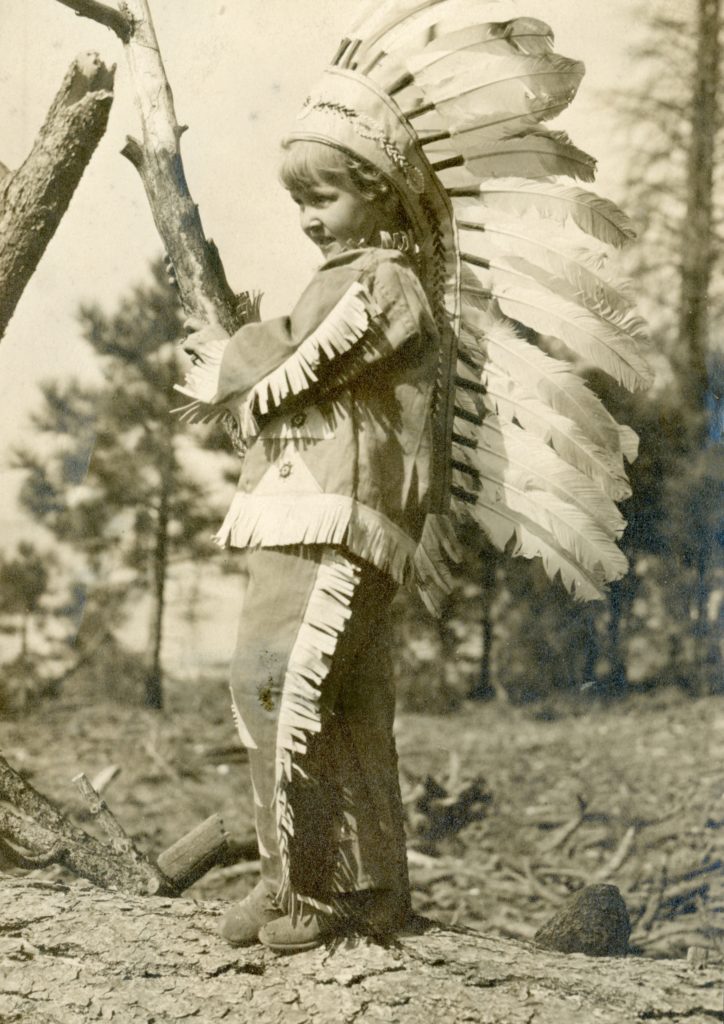
Norma Harvey at Eagle Lake. Courtesy of Wyn Wachhorst
In 1910, Malvena became a grandmother to Norma Virginia Harvey. Norma had a big impact on Malvena, to say the least. In 1913, Malvena had a summer home constructed at the southeast corner of the lake. Beginning in the summer of 1914, Malvena and her family entourage, with special guest of honor, Norma, spent the summers at Eagle Lake for nearly a decade. In this same time, period, Malvena was approached by different parties to subdivide the south shore for summer home sites. She declined the offers. However, she did allow the public to camp on her property, the most popular spot would became known as Gallatin Beach.
Time changes and the Gallatin clan became infrequent visitors to the lake. So much, they hired J. Burt Christie as a caretaker for the summer home. In 1944, Malvena’s granddaughter, Norma Harvey Wachhorst died. Deeply saddened by this loss, Malvena returned once more t Eagle Lake, to spend a quiet Christmas at her summer home.
In 1946, Malvena sold all her Eagle Lake holdings except a 1.96 parcel that included her summer home. She wanted that parcel with her home to go to her only great grandchild, Wyn Wachhorst.
During the late 1940s, the Red River Lumber Company was in the process of dissolution. They came to the conclusion the shoreline property they owned at Lake Almanor would be better for resort development and subdivisions that the expensive task for reforestation. To make the decision was a lot easier than to implement.
It was finally decided that they should sale to a developer than to undertake it themselves. Harriett Walker Henderson and Theodore S. Walker were designated by the family to sell the shoreline property at Lake Almanor, consisting of some 2,500 acres. They succeeded in quick order. On June 9, 1950, the property was sold to Lake Almanor Development Company for $160,000. The company was comprised of Seattle investors Warren Orr, Paul Block and Edward Clifford. In 1953, witnessed the initial development on the peninsula as the Lake Almanor Country Club.
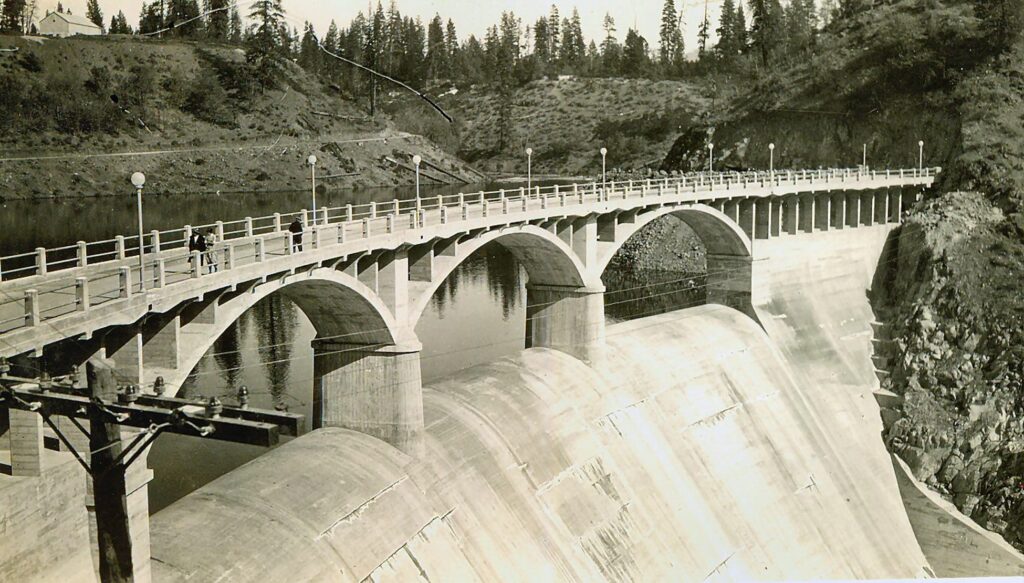
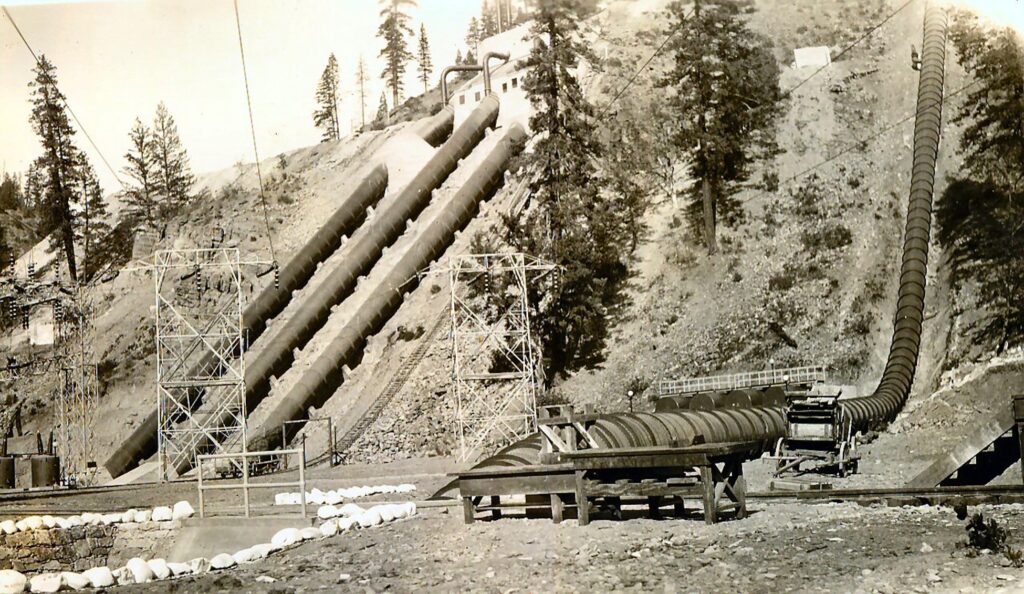
In 1919, Pacific Gas & Electric Company announced an ambitious $100 million project to construct five dams and powerhouses on the Pit River in eastern Shasta County.
Pit No. 3, 1925 -Lola Tanner
In 1923, construction began on the Pit No. 3 Powerhouse with an estimated cost $13.5 million. On July 18, 1925 dedication ceremonies were hold upon its completion. As was customary in the morning an assortment of dignitaries gave speeches, When they were done Miss Bernice Downing a newspaper woman from Santa Cruz threw switches and the power plant was in operation. After that, the guests were escorted to the construction camp and treated to an elaborate lunch.
The dam, of course, created Lake Britton. It was named for then PG&E’s Vice President John Britton.
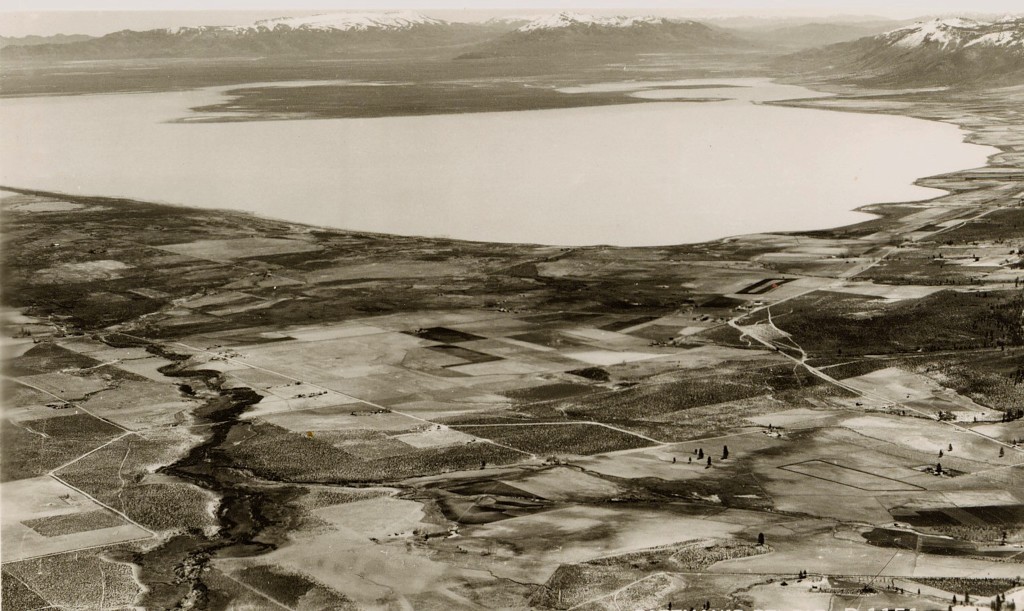
On July 20, 1850, Peter Lassen while leading a group of prospectors through region named this body of water–Honey Lake. It was so named after. a sweet dew substance found on the wild grains in the early mornings. A member of this property,, J. Goldsborough Bruff thought differently. On October 5, 1850 he named it Derby Lake for his friend George H. Derby, a United States topographical engineer, who at the times was surveying Southern California. The name, Derby, never stuck.
If you happen to be traveling along Highway 36, between Mineral and Susanville, one of notable features is the Chester Causeway. Travelers be forewarned as its is undergoing highway rehabilitation this summer (2025) and expect road delays. The following is how the causeway came to be.
In 1925, Great Western Power Company announced its plans to enlarge Lake Almanor. The raising of the dam would flood a large portion of Chester Flats, thus flooding a number of roads, and also Red River Lumber Company logging railroad network. Controversy arose when Great Western informed the Plumas County Board of Supervisors that the road across Chester Flats would be re-routed to follow the high water contour. The residents of Chester and Westwood were furious, for such a proposal would add an additional seven miles between the two communities. They wanted a causeway in which the current route would remain the same. Great Western balked at the idea. After all, a causeway would cost Great Western $220,00, while to re-route the road would only cost $50,000. To make a long story short the opponents bypassed the Plumas County Board of Supervisors and had the State Highway Department intervene. In 1926, an agreement was made between the State and Great Western that a causeway would be constructed.
1405 Main Street, Susanville—Courtesy of George Sargent
In July 1925, Harry Riddell began construction of a home on the northeast corner of Main and Grand. The estimated cost was $8,000, a very expensive residence at that time. Instead of hiring a contractor, Riddell used day laborers to construct the house in various phases. The first item of business before actually construction of the house, was the building of a curved cement retaining wall.
In August 1938 Steve and Helen Sargent, proprietors of the Grand Cafe purchased the Riddell home. After some minor remodeling the family moved in on September 1, 1938. The home still remains in the Sargent family.
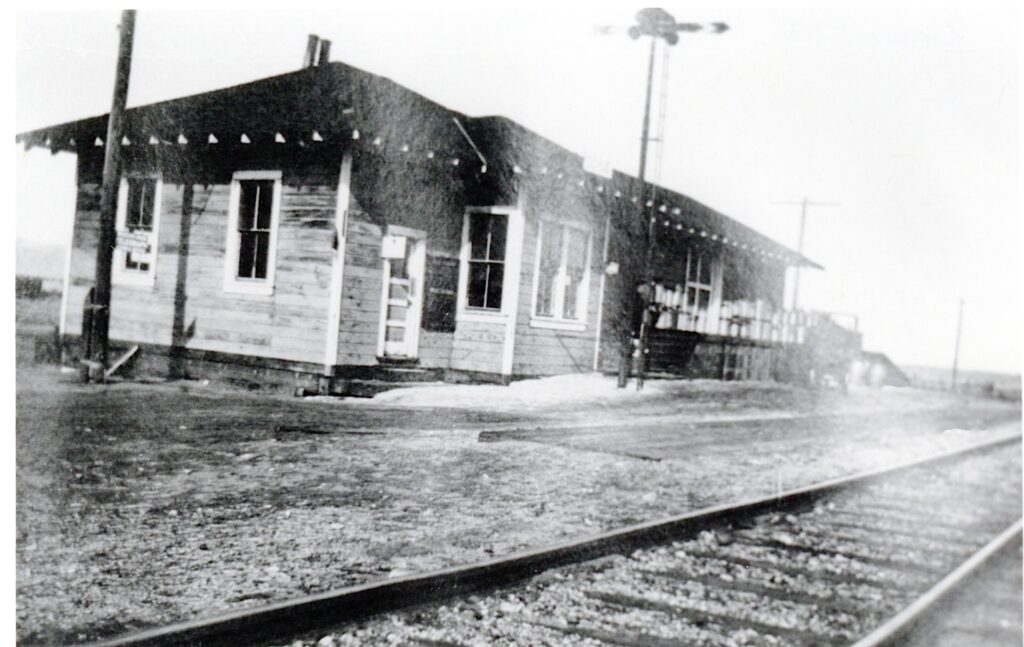
Western Pacific’s depot at Doyle, 1921-Courtesy of Lola Tanner
Personally, I have almost no information about this depot. Kerry Cochran, Archive Manager for the Western Pacific Railroad Museum provided the following:
“The Depot was located at Mile Post 362.55at an elevation of 4,301 feet. The Western Pacific had the 22 X 70 foot depot built in 1910. The station was retired as a train order station in 1952. In 1956 the WP filed a notice to reduce the station to non-agency status and the depot was officially retired in 1957”
If any one has additional information and/or recollections, that would be great.
Lassen County Fair, 1922. Courtesy of Lola L. Tanner
In the summer of 1922, Bert Jensen, Russell Brownell, C.E. Lawson, L.E. DeForest and H.H. Riddels formed the Lassen County Fair Association. It had been sixteen years since the last fair, and these ambitious men were not only going to correct that, but make the county fair an annual event.
They wasted no time to put together a fair, but a permanent fairgrounds as well.. Twenty acres of land were acquired which is still the present Lassen County Fairgrounds. In July the Association announced its plans to construct a substantial grandstand, along with a race track. There was plenty community support for a fair as merchants and the agricultural community raised $4,000. In early August Susanville contractor, J.J. Woodward was hired to build the grandstand for $3,256.44.
On Friday, September 29, 1922, large crowd assembled for the opening day of the fair. A lively time was had by all. However, it was not a financial success, and faced a nearly $4,000 deficit. The Association was optimistic since future fairs would be spared the cost of the fairgrounds as well as the grandstand. In 1925, the Fair Association approached the Lassen County Board of Supervisors for some financial aid at the tune of $2,000 and the board obliged.
In 1930, the Lassen County Fair Association was disbanded due to the nation’s economic crisis. In 1935, T.S. “Stan”Brown . Lassen County Farm Advisor brought the fair back to life. This time the County took over the operation and the Fair Association donated its fairgrounds property to the county.