Category Archives: History

Peter Lassen National Park

Manzanita Lake, 1914—National Park Service

No, this is not an April Fool’s joke in August and no the name of Lassen Volcanic National Park has not been changed. It was on this date in 1916, that the park was created with the signing of the bill to create it by President Woodrow Wilson.

By the 1890s dialog had been created to make Lassen Peak and its various hydrothermal features a national park. On May 6, 1907 Lassen Peak and Cinder Cone became national monuments. Things changed when in November 1910 John Raker was elected to represent California’s First Congressional District. On February 23, 1912 Raker introduced H.R. Bill 19557 to create an 80,000 acre Peter Lassen National Park. It went nowhere, just as his previous legislation to create a Redwood National Park. One of the hurdle’s for his Lassen Park was that hardly anyone knew of Lassen Peak outside of his district.

With the sudden eruptions of Lassen Peak in the summer of 1914, everything changed with national exposure. At this time, it was suggested to rename Raker’s proposal as Lassen Volcanic National Park.

Spread the word, and encourage a friend to subscribe

A Freak Accident

Tunnel No. 1, Susan River Canyon, 1974.

The most challenging portion of the construction of the Fernley & Lassen Railroad came in the summer and fall of 1913. From Fernley, Nevada to Susanville there were no major obstacles. Everything changed with the terrain of the Susan River Canyon which would require the construction of numerous trestles to cross the Susan River as well as two tunnels.

In June 1913 work began on Tunnel No. 1 which required heavy blasting. It even required locating the construction camp out of harms way. The workmen, of course, were warned to seek a safe place before a blast was discharged. William Denham took the advice and positioned himself across the river some two hundred yards distance. Above him was a rocky ledge, and the force of the blast was so great that a rock was thrown passing Denham, but striking the ledge above him, causing it to loosen. A mass of rock rolled onto Denham, Initial reports had Denham’s leg horribly mangled and broken, but actually he was only severely bruised with no broken bones.

Support

Millpond Madness

A 1964 Map of Susanville showing three milllponds.

While researching one item, I stumble across material that catches my eye and inevitably get sidetracked. This recently happened when working on an article about the Never Sweat Hills and related topics. Anyhow, while reviewing a 1964 Susanville Centennial publication, I examined the map of the town. In this particular instant what caught my attention was a map. There within a close proximity where three millponds—Lassen Wood Products, formerly Lassen Lumber & Box Company, Eagle Lake Lumber Company, formerly Fruit Growers and Paul Bunyan Lumber Company. Not only are these lumber mills gone, but so are there millponds, once an integral part of the operation. One facet of the millpond that I enjoyed while growing up, was watching a load of logs being dumped into the pond. There was one feature that I did not like—the stench from the millpond in the summer months.

Millpond, Lassen Lumber & Box Company, 1922

Support

Constantia Church – Then & Now

Constantia Church
St. Mary’s Chapel as it appeared in 1971. Courtesy of Robert Williams

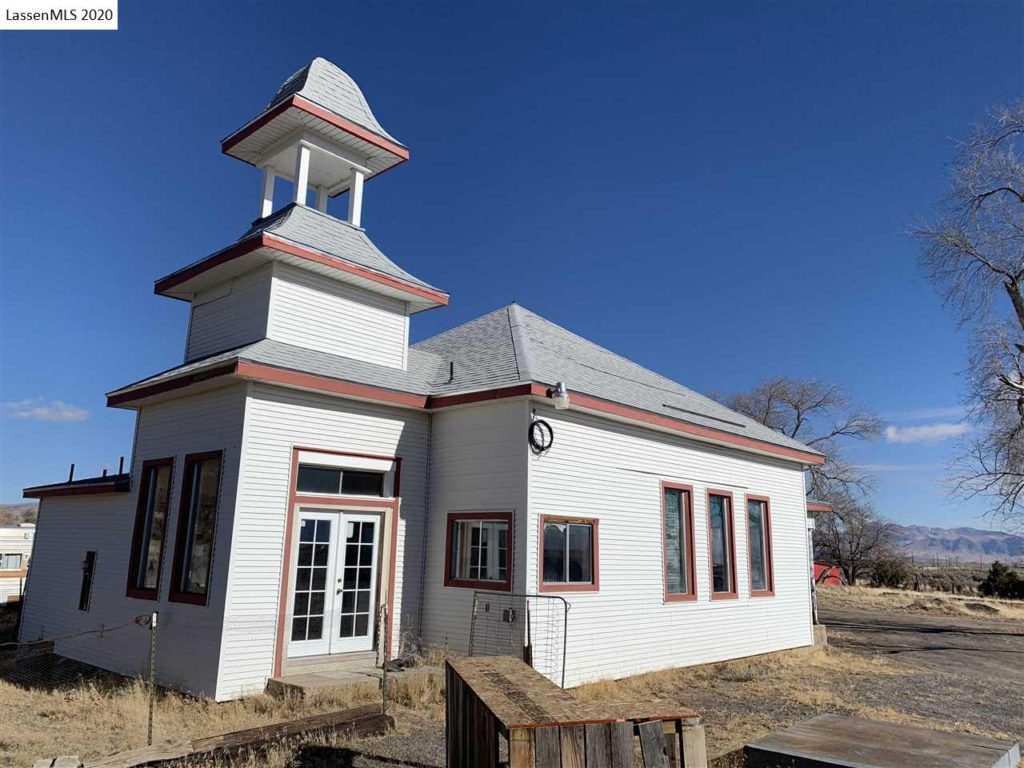
In 1898, Henry Butters purchased the Albert E. Ross ranch in Long Valley, about five miles south of Doyle. Butters made many improvements to the property, including having a small church built next to his home—St. Mary’s Chapel. Butters named the property Constantia. Butters ownership was brief and he sold it in 1904. Catholic services were held at the church whenever a circuit priest was in the area, but this practice ended in the 1920s. In 1994, the abandoned church was moved to Doyle next to the Long Valley Cemetery.

The church at Doyle, January 25, 2020.

Subscribe

Pigeon Cliffs & Highway 36

Pigeon Cliffs
Pigeon Cliffs, 1972

These cliffs are located just west of Susanville and Highway 36 passes right over it, so the casual road traveller would not even be aware of it. There was a time one could pull off the highway and look over, but the highway department put up a barrier to discourage visitors. For those walking the Bizz Johnson Trail and look up at the cliffs, one will notice a tremendous amount of rock debris below the cliffs nearly all the way to river. That was not Mother Nature’s doing. In the summer of 1916 a state prison camp was established on the site occupied today by the California Division of Forestry. A tremendous amount of rock blasting had to be done between there and the city limits, which would be the new entrance into Susanville. All that blasted rock debris was pushed over the cliffs.

Pigeon Cliffs, 1899
Susan River Canyon, looking towards Pigeon Cliffs, 1899

Spread the word, and encourage a friend to subscribe

Labor Strife at Lasco

Camp Lasco, 1923.

During 1930-31 when the Western Pacific Railroad was engaged in the construction of the Northern California Extension, aka the Hi-line from Keddie to Bieber, most everything went smoothly. In early August, 1931 Western Pacific officials gleefully reported that rails had reached Bogard and that they were placed at a rate of 8,000 feet per day! Things suddenly changed on August 20, 1931 60 laborers walked off the job, including the head gang of steel layers. The railroad officials summoned Lassen County Sheriff Leavitt to Camp Lasco to make sure the men did not start any violent confrontations. At dispute was the foreman had been fired on the spot. He was replaced by what the workers deemed a “foreigner” and they would not have an illegal alien as their boss. That evening the men left Camp Lasco and spent the night in Susanville. They returned back to the camp next morning to collect their pay and went their separate ways. It was a temporary setback for the Western Pacific, yet it being the depression there was a large pool of unemployed to recruit from.

Spread the word, and encourage a friend to subscribe

Buntingville Improvement Company

A portion of the Articles of Incorporation

While Buntingville, just south of Janesville, appears today to be a mere wide spot in the road, it was not always that way. Like so many communities the residents desired to have a public hall. On January 1, 1911 five residents—Chester Toombs, Edwin Jellison, Theo. Gross, W.E. Agee and Birt Hostetter—led the movement by incorporating as Buntingville Improvement Company. Their goal was to raise $2,000 by selling stock with a par value of $5.00 each. The men quickly learned like those in neighboring communities, there just was not enough support to make a go it and the venture faded as quickly as when it was first proposed.

Support

Susanville Roundhouse Revisited

The Southern Pacific Roundhouse, Susanville, 1947. G. Dunscomb Collection

When I first wrote about this in 2015, I knew nothing about it. Since then I have gained more knowledge. The roundhouse was built in1914, and what was rather unusual it was a mile east of the Susanville Depot. Normally, it would have been much closer to the depot. However, things were complicated since all the surrounding property, though undeveloped was part of the Lassen Townsite subdivision. It must have looked extremely out of place when constructed as there was nothing in that area, since it was before Lassen Lumber and Fruit Growers.

From 1925 to 1929, Fred Abbey was foreman of the roundhouse with a crew of four It was equipped with four stalls to service and to conduct minor repairs to locomotives. Any major work was taken to Sparks, Nevada. The whole operation was short-lived as it closed down in 1930, and the railroad did not dismantle it until the 1950s. In a sense it was a fluke, as it was built on the pretense that the railroad line would be built to Klamath Falls, Oregon, but the furthest it was built to was Westwood Junction.

Spread the word, and encourage a friend to subscribe

Jacks Valley, Lassen County

Jacks Valley, 1921
The cement water trough at Jacks Valley, 1921

Jacks Valley, is a non-descript place on Highway 139, ten miles north of Susanville. Its best known feature was a cement water trough, which weary travelers a century ago truly appreciated.

It had its humble origins in 1865, when John C. Wright located on the abandoned homestead of Thomas Pearson, who had perished in a snowstorm there on New Years Day 1865. Wright was known locally was Coyote Jack, and hence the name of Jacks Valley. In 1869, he left for parts unknown. By 1880, this had become a crossroads for travelers as five different roads converged in the valley. Frank Fluery took advantage of the opportunity provided by this unique junction and established a saloon. In 1884, as one of Fluery’s patrons noted: “. . . for ten cents he will give you enough to make you happy to cause you to forget all your trials, troubles and tribulations for a time.” In 1889, Fluery sold to A. J. Conklin who operated the saloon for a number of years. In 1907, Conklin ventured into the lumber business and built a sawmill that had a daily capacity of 15,000 board feet. In 1920, Conklin sold the sawmill to William Johnson. Johnson operated the mill for three years and then sold to the Red River Lumber Company who immediately closed it. In August 1926, a forest fire ravaged the region that encompassed some 20,000 acres.

Jacks Valley, not to scale.

The following year, the Red River Lumber Company established logging Camp 70 to salvage the burnt timber. This was one of that Company’s earliest truck logging camps. While those enterprises have long since faded into oblivion, a cement water trough remains and is still a recognized feature to travelers. In 1913, Thomas Hill and the County of Lassen constructed the water trough. For early motorists, it was a wonderful blessing, a source of water for overheated automobiles making the trip up Antelope Grade.  For the next 80 years it was popular stop to drink the water and take a break, though it appears the water line has been disconnected.

Support