Well, it is the dog days of summer. California is the birthplace of so many things, and motels just happen to be on the list. It was Pasadena architect named Arthur Heineman who coined the name motel–a combination to motor and hotel. In the fall of 1925, he built the first motel in San Luis Obispo,
Main Street, Janesville, January 25, 2020
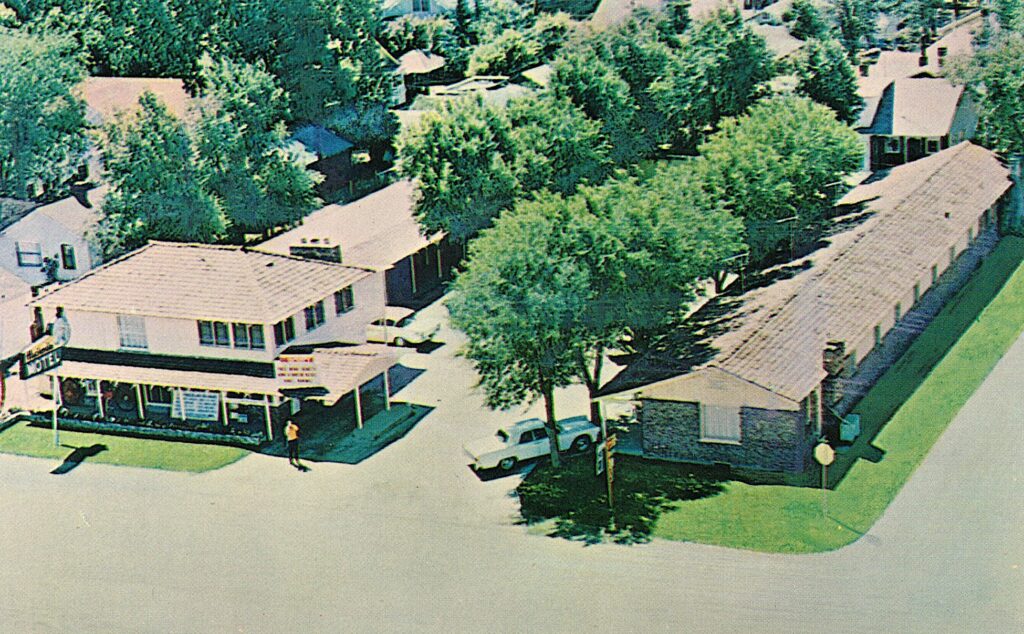
After World War II, the kitchsy roadside motels were quite the rage. Janesville resident, Clyde Knox, was on all board as the wig wam theme that proved popular elsewhere.. While Knox never completed them, they are an architectural gem for that town.
Riverside Hospital, Susanville, 1940 courtesy of Betty Barry Deal
Personally, this is a historic day for me. It was on this date, ten years ago, at Renown Hospital in Reno, Dr. Bray of Reno Orthopedic Clinic point blank said to me “You are going to die.” He abruptly left my room, and I never saw or heard from him again.
What happened. On the evening of August 15, I had shattered my right hip. An interesting tale to say the least. The next morning Dr. Bray was my surgeon. Twenty-four hours after surgery, he visited me, and was disgusted because I could not walk. It should be noted, that he hollowed out my femur and inserted and stainless steel rod, connecting to myknee. For the next three weeks I was not able to put any weight, per Reno Orthopedic doctor’s orders, on the injured leg.
Every quarter, for a year, I would have follow up appointment at Reno Orthopedic. Dr. Bray assigned an intern to me. The intern criticized me for walking with a limp. Fast forward several years later, it was revealed to me that during the hip surgery Dr. Bray performed, he shortened my leg by two inches, and never told me about it. Hence, that explains why I have a balance problem while walking.
Oh well, it’s water under the bridge, but ten years later Dr. Bray’s prediction never came to fruition. So here I am still conducting research and writing about the regions past. One positive benefit as a result from that accident, is I have sixty days of post scheduled, just in case of an emergency. At the moment, I am working on the wild horse issues of yesteryear, scheduled for November 7.
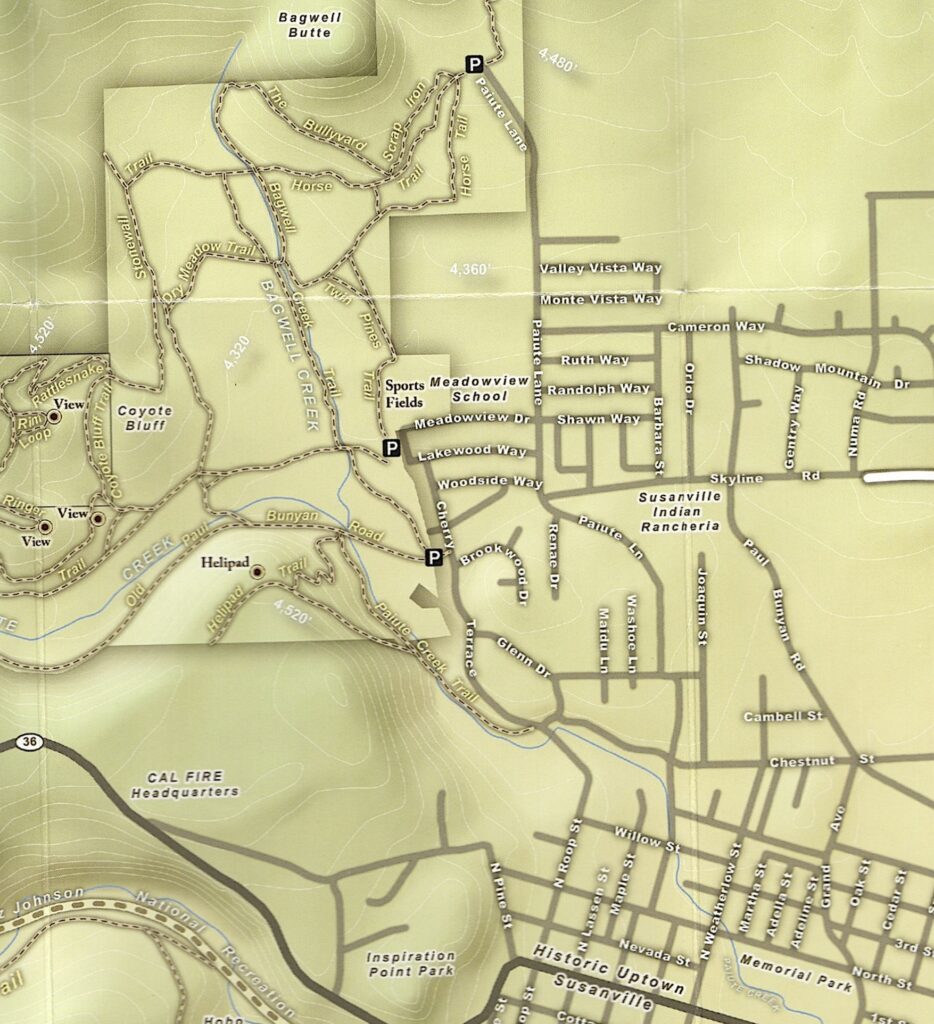
Partial Map of Susanville Ranch Park,showing the helipad.
Since, I do want overlook any unturned stones, so to speak, I am reaching out to the readers for assistance. In July there was a question regarding the Ask Tim post. Some one wanted to know about the helipad located on the rim of the Paiute Creek Canyon, overlooking Susanville Ranch Park, and a short distance from the California Division Forestry (CDF) headquarters.
It is one those crazy research challenges. To begin with the concrete helipad was located on private property belonging to the California Pacific Utilities, later to be known as CP National, the local power and water company. I could not find any recorded agreement between the company and the CDF or any other fire fighting agencies. In 1984, when CP National donated what is Susanville Ranch Park to Lassen County, there was no reference as to the helipad.
The helipad was constructed in the 1960s. CDF has a photograph that it was used ever so briefly in the early 1970s. Does any one know some one, who may have worked as seasonal firefighter during that time? On the other hand, may be some one who worked at the power company at the time. I need to ask George Sargent about that,
It should be noted that in 1987 Lassen Municipal Utility District purchased CP National, but since the latter company had operations elsewhere, they probably retained their records.
Whatever the case may be, I am open for suggestions. Some times, I have been known over think the topic at hand, and overlook the obvious.
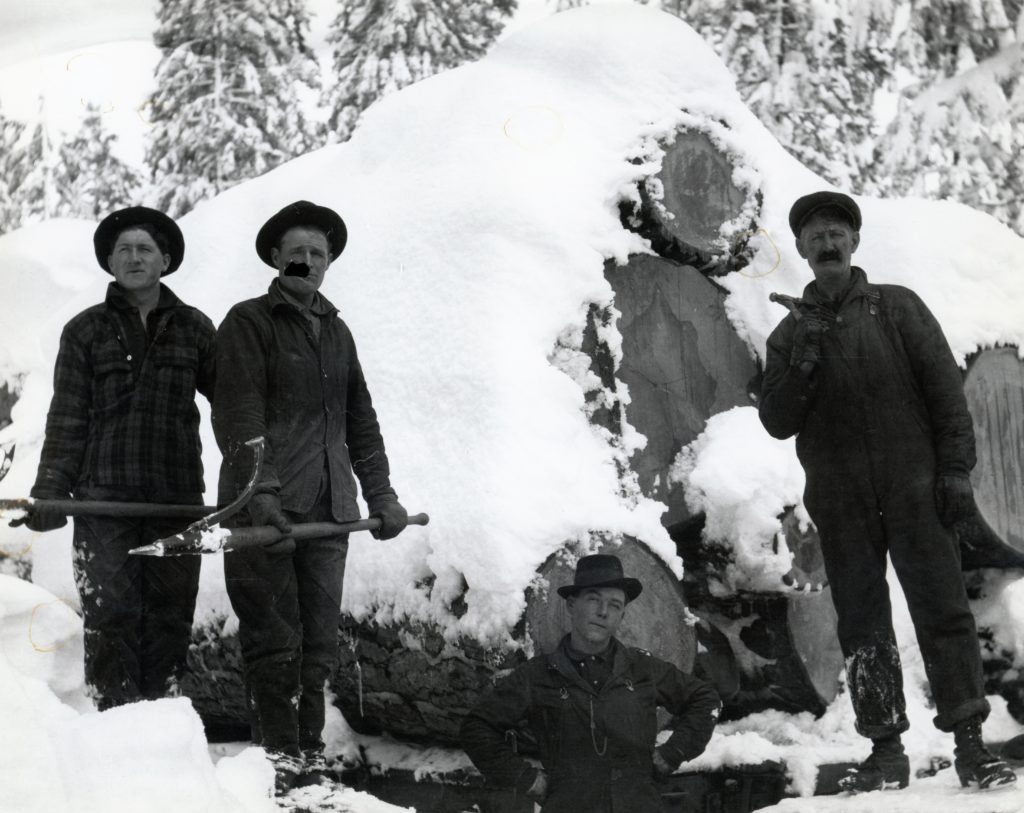
A winter logging crew, 1916. Courtesy of Hank Martinez
When T.B. Walker, founder of the Red River Lumber Company, made his westward expansion from Minnesota, it was the set the foundation for his five sons to operate it. Things happened and it did not quite had the desired results he had imagined. Family partnerships are fraught with their own set of obstacles, the Walker sons was a perfect example.
The earliest dispute was selection of the site of Westwood. T.B. attempted to be referee, but to no avail. There was a fallout when son Clinton objected, that he would he leave the company. Fletcher, another son, if site had chosen to be Westwood, Fletcher won out, he would became the resident manager of the Westwood.
It was Fletcher’s goal to operate Red River year round, much to the chagrin of his father. On February 25, 1915, T.B. wrote to Fletcher criticizing him for running the mill during winter storms, and that he should just shut it down. T.B. commented: “I have never expected that we could run all year in the mountains of California. I had in mind when I was securing the millsite where you built, that this would likely be about a nine or ten month’s milling job.”
A steam donkey being pulled through Westwood, 1916.
Fletcher questioned his father’s judgment on the ease of operating a winter mill in Minnesota, and remarked, “I never discovered that it was an easy operation to get through four months of cold and snow.”
The following year T.B. again requested Fletcher to shut down the logging operations in the winter as it was just plain too costly. Fletcher agreed the winter operations operated at a loss. However, his justification was that outfits such as McCloud River Lumber Company that called it “quits” in the sawmill operation on November first, placed Red River at an advantage by having a ready supply of lumber. In summation, Fletcher wrote, “In place of our figuring from this end on closing down, we have been figuring carefully the pros and cons of taking advantage of the bulging market to produce a bunch of timber of lumber this summer and make a real killing.”
Fletcher suspended winter logging during World War I. In 1920, Red River resumed winter logging briefly, only terminate it finally in 1924.
Yes, that is right folks, the City of Susanville even had its own jail. For the casual observer of local politics the County of Lassen and the City of Susanville has through years been a frosty relationship. It has been ongoing since 1900 and personally I do not think it will ever change, or least in my lifetime.
Initially, when one committed a misdemeanor crime in Susanville, the Lassen County Sheriff would obliged to house the person in the county jail. When the County built in a new jail in 1911, it would no longer accept the City’s inmates. A temporary solution was found. The County offered to rent the City its old jail for $17.50 a month. How long the City could use the facility was unknown, since it had been condemned once by the State. In the summer of 1914, Guy P. Jones of the California Department of Public Health arrived to check out the sanitary conditions. He said overall conditions in Susanville were good, except for one–the City Jail. Jones found it deplorable, and wrote, “To confine any human being in such a horrible place is nothing short of inhumane.”
In 1915, the State condemned the City’s use the old County Jail.. This forced the City to build a jail, one that would have to be approved by the State. First, a site had to be selected. The City purchased a small lot behind the City/Fire hall from William D. Minckler. In January 1916, the City hired George C, Sellon as the architect, as het met State qualifications. Sellon was in Susanville to oversee the construction of his latest project, Lassen County Courthouse. The State specified the building be of masonry. It was decided that the exterior would constructed with native stone.
Lassen County Courthouse and Hall of Records, 1908–David Zoller
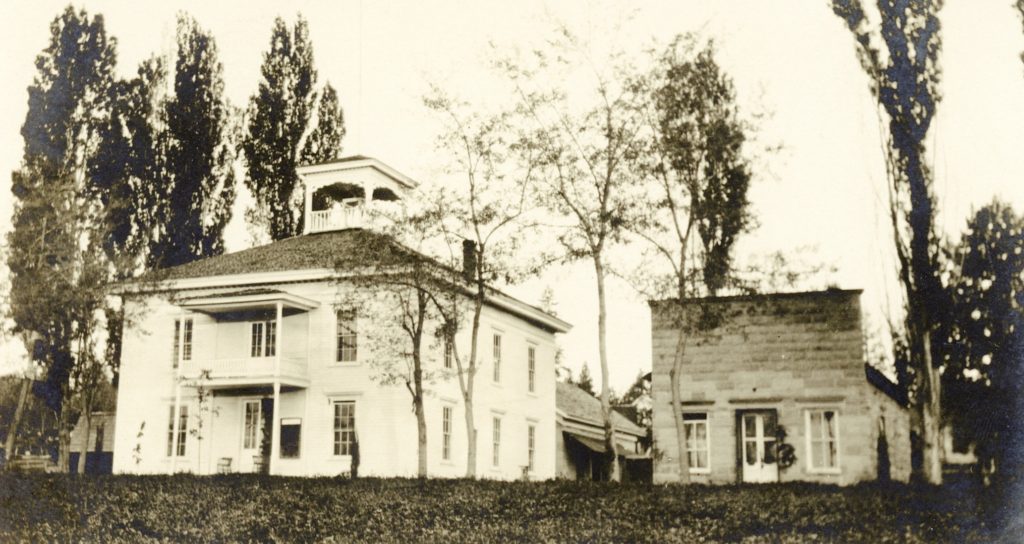
The City did get a good deal for the stone.In 1887 the County had a small native stone building constructed next to the courthouse. It was known as the Hall of Records. This building had to be demolished to make way for the new courthouse. The County offered the stone from that building to the City for free. The County’s old Hall of Records was recycled into the City’s new jail.
On August 5, 1917, Henry Krueger was awarded the contract to construct the City Jail for $907. The City urged him to build it as quickly as possible, since they were without jail and the County would not let them to use their jail. Kroeger started on the jail the next day. In December 1917 the new jail was completed and furnished–it consisted of two beds and a stove.
In the mid-1950s, the City Jail was closed. The structure was converted into a garage, and later used for storage. In 2001, it was demolished to make room for the new addition to City Hall. If any one has a picture of the structure, please let me know.
Bunnell’s rebuilt 1899 hotel that later became the annex. – Courtesy of Holly Blackburn
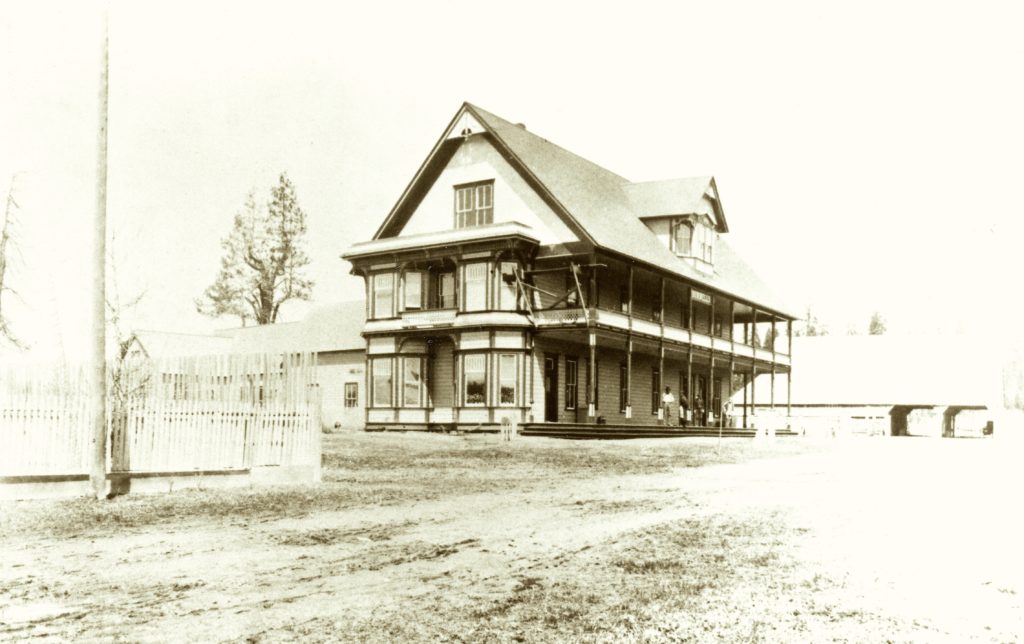
In 1855, native New Yorker, Luther Wellington “Wells” Bunnell settled in Butt Valley, Plumas County. He soon connected with William H. Miller and they operated a trading post. In 1867, they parted ways and Wells relocated to nearby Big Meadows, known today as Lake Almanor. Like many in the region he had a dairy cows. He noticed when his neighbor Dr. Willard Pratt, who opened the first hotel in Big Meadows, met with great success. After all, those who could escape the heat, ever so briefly in the summer months from the Sacramento Valley, flocked to places like Big Meadows,, after all this pre-air conditioner times. Wells, decided to establish his hotel for summer visitors. All went well, until on June 10, 1899 it was destroyed fire, the cause a defective flue. The loss was stated at $15,000 and the insurance paid Bunnell $7,144 a week after the fire.
Bunnell’s, 1903. Courtesy of Philip S. Hall
Bunnell contemplated whether to carry on with the resort business, after all he was approaching 70 years age. Rebuild that he did. Then, in 1901, Wells expanded his resort and a built a second one–the most elaborate structure ever to adorn Big Meadows.
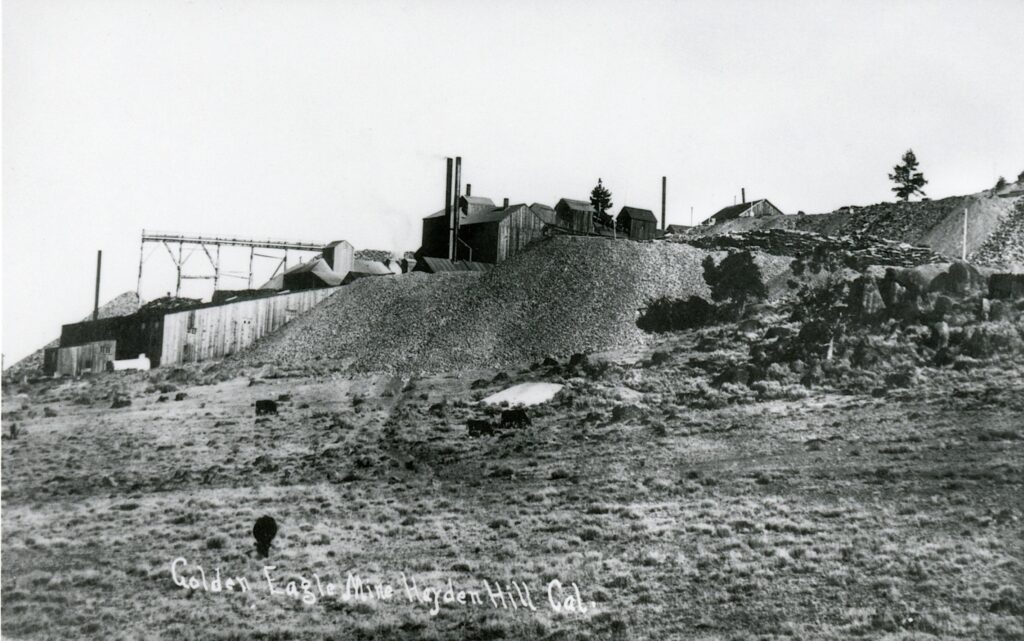
Golden Eaglr Mine, Hayden Hill December 9, 1909—-Dallas & Joyce Snider
Mining is a tricky business and Hayden Hill was no exception. One of difficulties that plagued mine owners was water seepage. There was on one occasion that black damp occurred in one of mines there.
In late August 1917, J.M. Sutton quit his job at the Golden Eagle Mine. He cited the cause of the condition of black damp–a combination of noxious gases that form from the lack of ventilation which can be deadly. Sutton was not alone in his exodus, as many as fifty of his co-workers left. It was reported that only six men were still on the payroll, because of the offer higher wages as an inducement. Company officials stated they were working diligently to correct the problem to “raise the poisonous gases to the surface.”
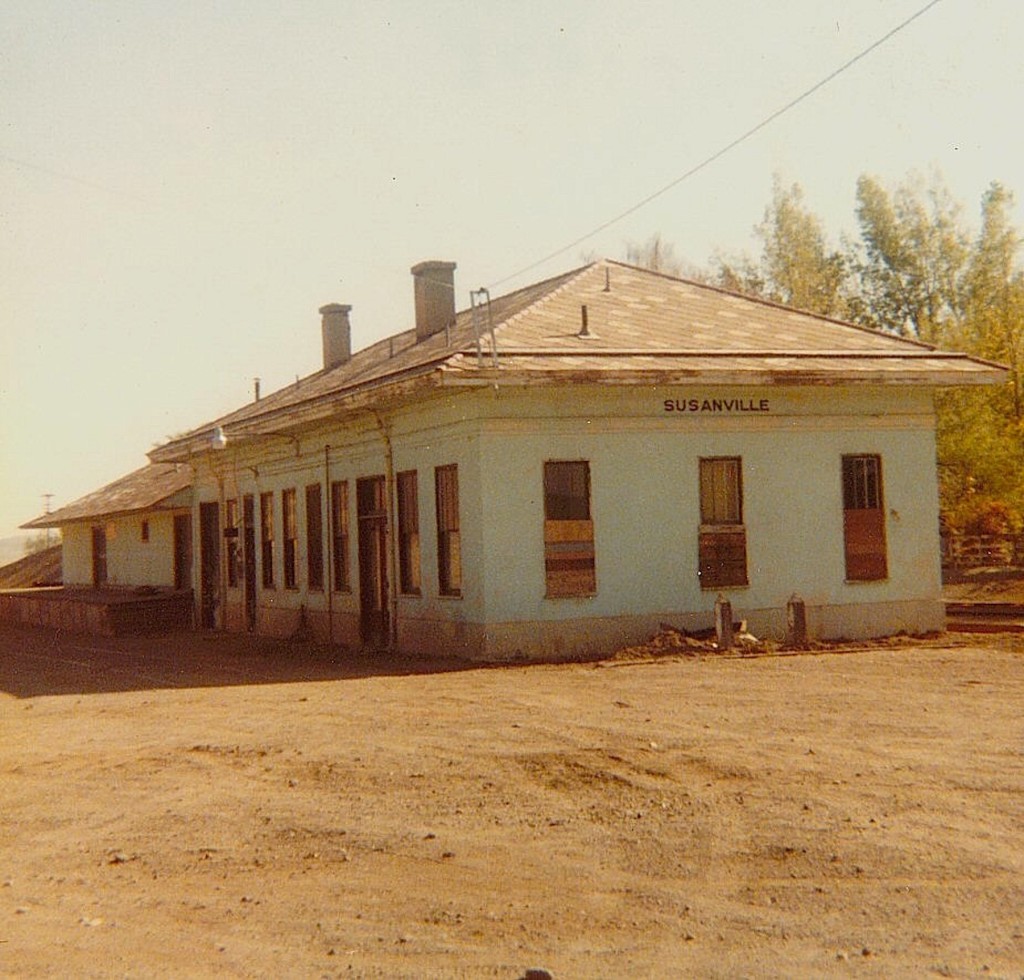
In 1979, the Southern Pacific Railroad Depot at Susanville closed its doors. In the ensuing years, the Susanville Fire Department deemed the abandoned building a public safety hazard. In June 1987, Susanville Fire Chief John Malmquist entered into an agreement with the Southern Pacific to torch the. building as part of a firefighting practice session. When the matter was revealed to the City Council, concerned citizens voiced their concerns. The City Council gave the building a reprieve to August 3, to allow those to come up with a solution. Malmquist reminded everyone the Southern Pacific had no intention of relinquishing the property, and it would be costly to move the depot to another location. That did not prevent the concerned citizens in their effort to save the depot. In November, 1988, a Memorandum of Understanding had been agreed by the Trust for Public Lands and the Southern Pacific to transfer the property to the Trust. Restoration began slowly and in 1994 a grand reopening of the Depot was held. In 2001, the Depot gained landmark status when it was placed on the National Register of Historic Places.
The July, Ask Tim post only generated two inquiries. May be it is so-called dog days of summer. Here is the first question and I am working on the next, stay tuned.
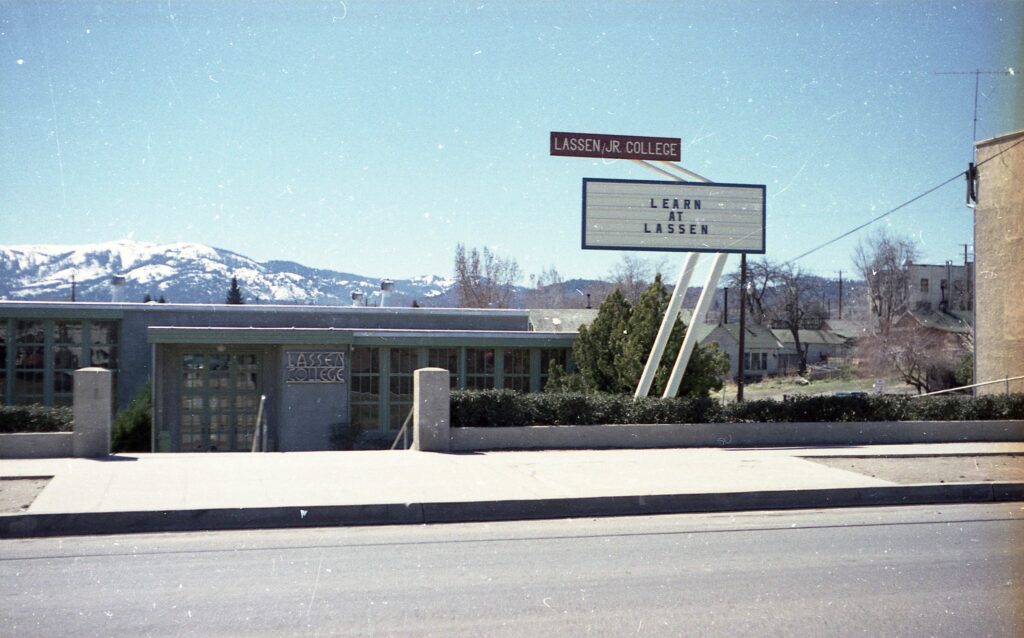
Lassen College Graduation Photographs. Were there any pictures taken of the last Jr, college graduation in the quonset-hut on the Lassen High School property?
It has been my experience that historical documents and photographs of Lassen College’ are rarer than the proverbial “hen’s teeth.” It should be noted that I served on the Lassen College board from 2011-2020. Towards the end of my tenure, it was relayed to me by college personnel that there was secret cache of old college annuals and photographs that had been discovered. I was not privileged to examine those records. In May of this year marked the 100th anniversary of the college’s founding, but the administration ignored this historic milestone. If anything surfaces, I will let everyone know.
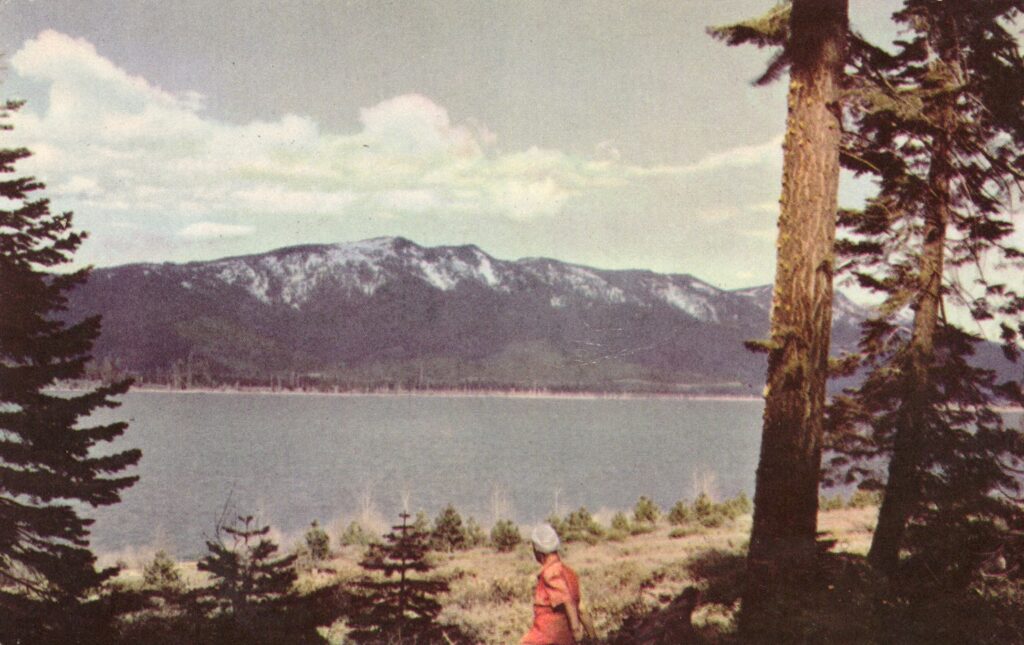
Awhile back when rummaging around for calendar photographs I came across this vintage circa 1960 Lake Almanor postcard. It was a mass produced by the Union Oil Company in a series “Natural Color Scenes of the West..” On reverse of the card at bottom, was an advertisement ” Tour the West with Union 76 Gasoline.” Since it was not a common one available locally, I thought that some might be interested.