Category Archives: History

Lassen Park’s Juniper Lake

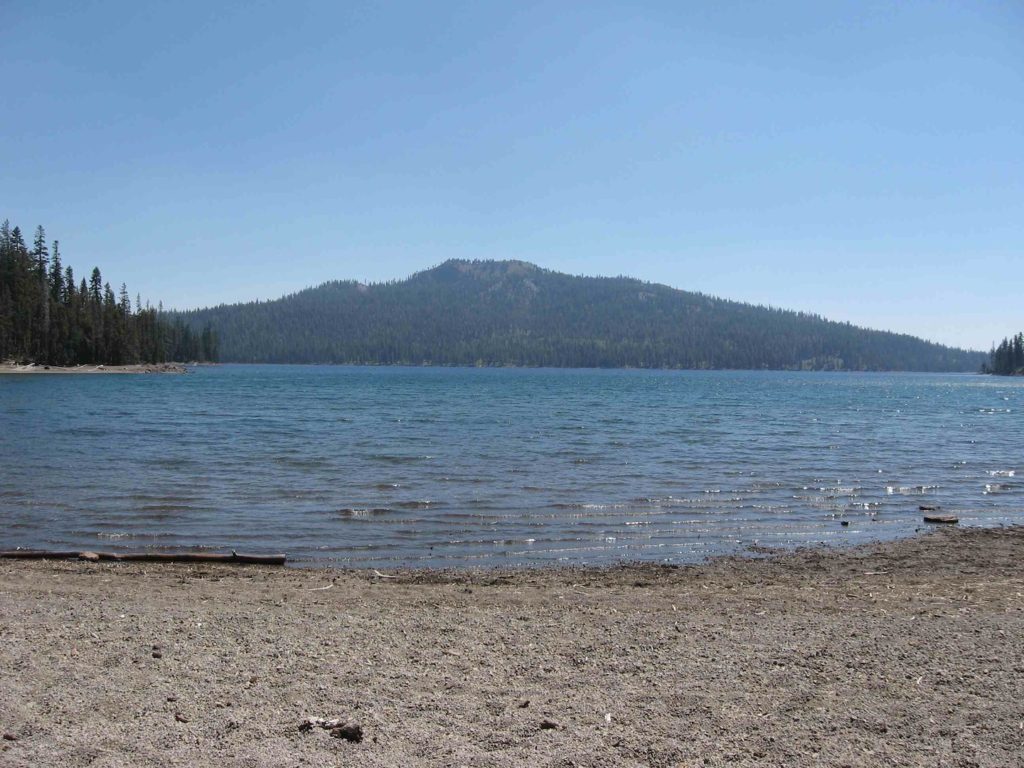
Juniper Lake

Juniper Lake, at an elevation of 6,753 feet, covers an area of some 592 acres, making it the largest lake in Lassen Volcanic National Park. Interestingly the lake has a maximum depth of 234 feet. In the 1870s, the California State Geological Survey named it Lake Louise, but others had applied Juniper to it, and the latter won out.

Early day visitors to the lake were few. Its remoteness, along with its heavy winter snowfalls, usually did not make it accessible until June. By October, as a general rule, the snow returned, again making the place inhospitable.

In 1889, a San Francisco speculator, Elbert Dodge, appeared on the scene and filed a 475-acre claim to the northwest shore of the lake. He did nothing with it, and another San Franciscan, J.P. Frenna, later acquired Dodge’s preemptive claim. The actual owner was the State of California, which designated it as school land. In 1892, Frenna purchased it from the state for the nominal fee of $1.25 per acre.

Juniper Lake has a long sordid story of summer home development, that never came to full fruition, due to its remoteness and short summer season. I understand that the Dixie Fire (2021) ravaged the area. I have not been back there or the Warner Valley, because I do not have go that far, to see the burn scars of that fire, and others.

Tim

The Defunct Almanor Railroad

The Almanor Railroad’s No. 106

In the early 1900s, the  founders of Collins Pine Company amassed some 60,000 acres of timberland in the greater Lake Almanor Basin.  It was not until the late 1930s, that they gave consideration to establish a mill there. In the fall of 1940, after much negotiations the Red River Lumber Company offered a mill site adjacent to Chester, along with thirteen miles of its main line railroad from Chester to Clear Creek Junction where it connected with the Western Pacific Railroad, which Red River estimated its value at $80,000.

Thus, the Almanor Railroad was born. Collins Pine changed it from a private line to a common carrier, should anyone in Chester desire to use it. Collins Pine had a lot of work to upgrade the railroad line. It also needed motive power, as it decided not to purchase any of Red River’s locomotives. At its Grande Ronde operation, it had discontinued its railroad logging in favor of truck logging. There it had at its disposal a Heisler geared steam locomotive, the 104, and it was put into operation on the Almanor.

The winds of change occur, and Almanor Railroad was abandoned, The railroad bed has been converted into a recreational trail

Subscribe

A Hay Derrick Question

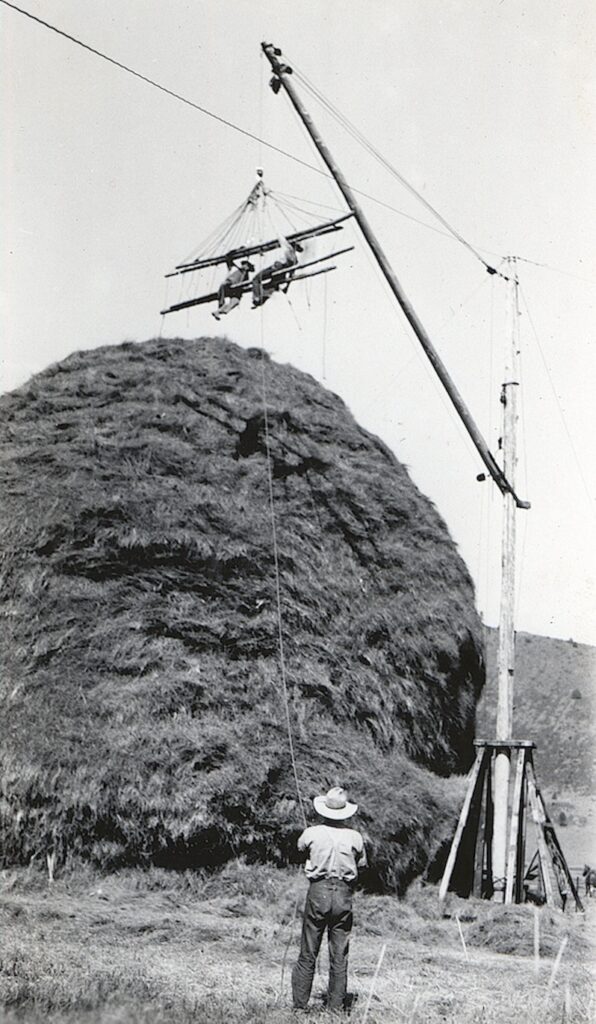
Hay scene, Murrer Ranch, Willow Creek Valley, 1926-Lola Tanner

Linda Hartwig had a few questions of hay derricks. She stated her family homesteaded in Klamath county starting in 1892. She wants to write up some of the family stories for a children’s series and wants to be accurate about the process. For a refresher see my post about the topic here.

Linda wrote: “I have a picture from the family archives of a hay stack being built with a hay derrick and what looks like a hay net. It is rounded on the bottom and is a huge ball of hay, so doesn’t look like it could be a Jackson fork. I need enough information on how it was released so the hay could fall onto the stack.”

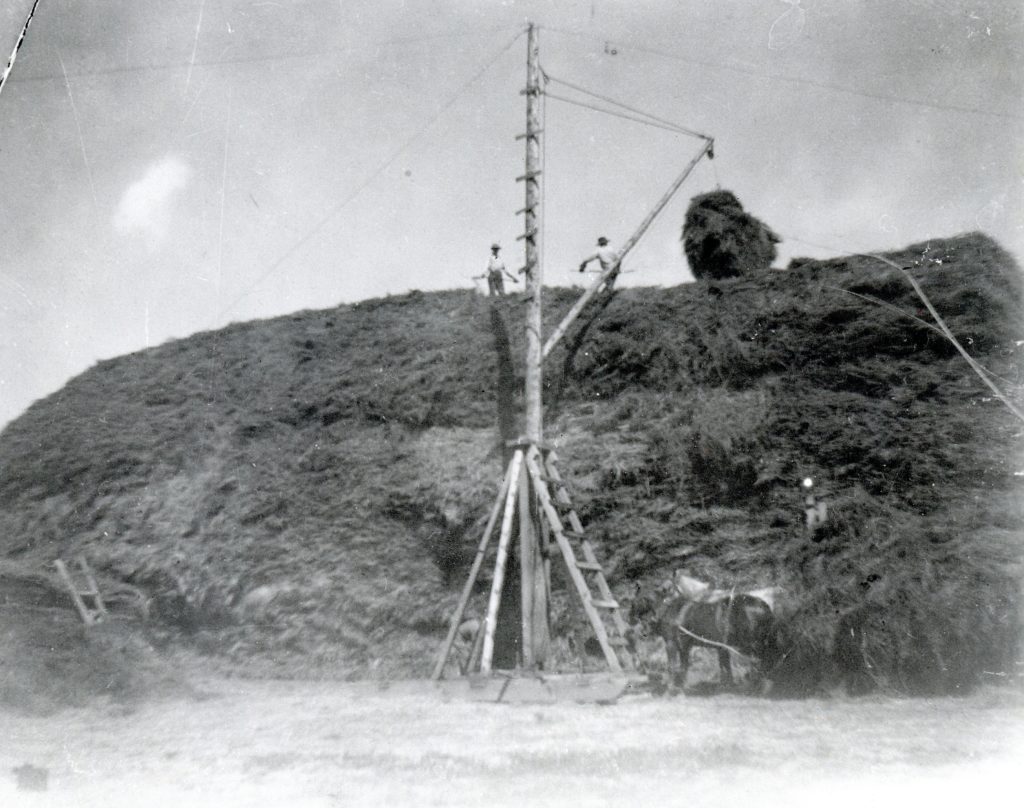
The film includes a scene of the hay derrick (above) in action. This photograph is the hay stacking at the Titherington Ranch, near Standish, 1908. Courtesy of Betty Gorbet

There were usually two men on the hay stack and their job was to evenly distribute the hay, once the hay net was released. There was a man on the ground, who had control via ropes and pulleys to release the hay. An interesting process indeed. As a matter of fact in 1939, the entire operations of the Vic Christensen ranch near Likely (Modoc County) was filmed, and I believe it had short clip of the hay derricks in use. The film named The Cattleman, was done in part of Encyclopedia Britannica’s educational films of the era. I have it onVHS tape. I did have it converted to a CD. However, I lent the CD to some one, and they never returned it.

A hay stack and derrick, Tanner Ranch, Honey Lake Valley, 1935-Lola Tanner

After World War II there tremendous advances in motorized hay mowing machinery and baling of hay. In the early 1960s, the Bill Brothers of the Standish district were the last to do mowing of hay with horses and to use hay derricks.

If anyone has additional information about hay derricks in general, you are more than welcome to enlighten us.

Tim


The End of the Line is Near

Susanville’s Southern Pacific Depot, 1929—Hank Martinez

On July 6, 1925, J.H. McClure in charge of the Southern Pacific’s district freight and passenger service headquartered in Reno was a guest speaker at the Lassen County Chamber of Commerce monthly banquet meeting. Just days’ prior to the meeting he had come to Susanville to do an inspection of the region. McClure was not pleased.

As to the passenger service he said, “Running a five car train with buffet observation car and the very best equipment, that the train would and many days carry but three or four passengers and not receiving that should be accorded it. While the stage lines between Susanville and Reno were loaded each trip.”

When asked about the tonnage, McClure was critical of the agricultural community. He stated the farmers should get “busy” with some real farming instead allowing so much of their acreage to provide wild hay that had no market value.

McClure’s assessment  would never improve. In 1933, the passenger train service was discontinued.

Tim

Tuesday Tidbit-The Gables

The Gables

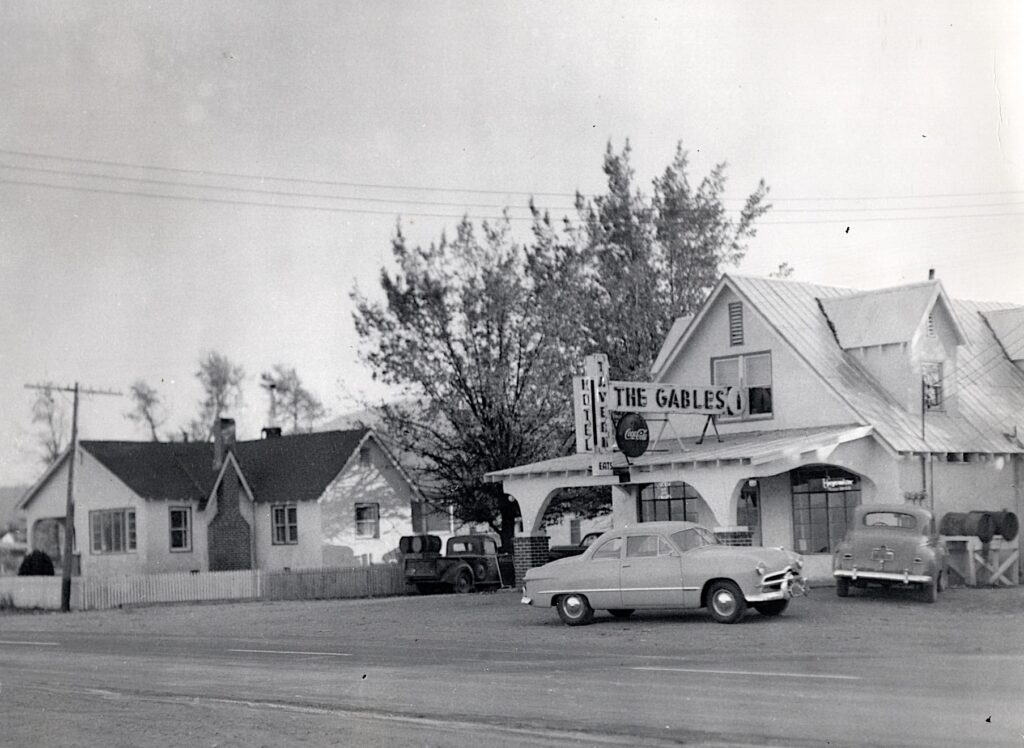
The Gables, was a  popular restaurant/bar near Johnstonville, then along Highway 36 (now Johnstonville Road) during the 1950s and 1960 and eventually closed in the 1970s. Every now and then individuals tried their hand to resurrect it, but invariably met with little success.

Tim

Big Valley City, Lassen County

Nubieber, 1949

This falls under the category of dreamers and schemers. In 1930/31 there was great excitement with the arrival of a railroad in Big Valley. Actually it was two railroads, the Great Northern and Western Pacific which would link two miles southwest of Bieber. What to call to this soon to be hub of activity was open for debate. For a moment it was the general consensus to name it West Bieber.

Enter Byron Greenwood, who had other thoughts. Greenwood saw the potential of the railroad connector and he subdivided the. property there. He named his enterprise Big Valley City.  When the Postal Department received Greenwood’s petition for a post office for the town, they denied the name. The Department had adopted a policy against three word names. In the meantime, the Great Northern  designated their new station as Bieber, even though it was not in Bieber.

As the naming debate continued. it was suggested to call it Nubieber. On July 4,1931, a patriotic celebration was held.   Mrs. A.W. Peterson, President of the Ladies Pioneer Club, gave a brief speech and then introduced Miss Vivian Goddard who christened the townsite of Nubieber by breaking a bottle of wine over the entrance sign.  Nubieber, like so many speculative railroad communities, never reached the expectations of its promoters. In 1940, Greenwood traded all his unsold lots, (the vast majority of the town that encompassed 250-acres), along with his adjoining 630-acre ranch, to E.L. Robertson of San Francisco, for a 60-room apartment building in San Francisco.

Donate

The Deadly Baxter Creek Water Dispute

William Leith, 1900-Courtesy of Vivian Hansen

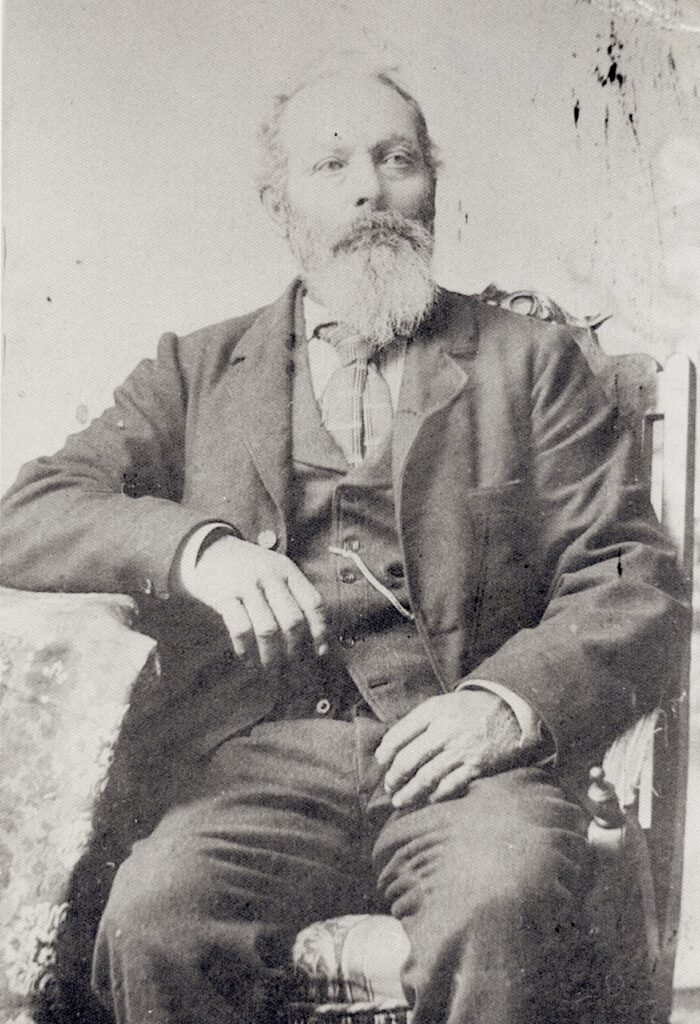
On May 27, 1867, Robert C. Hayden purchased 160 acres from John Baxter, adjoining Baxter Creek, just east of present day Buntingville. There was a tragedy in the making. On the morning of May 19, 1876, three men were killed in the worst water dispute in the annals of Lassen County history. That morning, Robert C. Hayden, aged 55, went to inspect the west end of his property along the creek. There he found his neighbor, William Leith, his son, William Leith Jr. and John Thayer in the process of constructing an irrigation ditch through his property. The construction of the ditch had been an ongoing quarrel. Hayden hold them to stop digging, but they continued. Hayden warned them he would return with his “crowd.” Hayden came back with his son, Robert D. , aged 32 and Edward Bartlett, aged 67. The elder Hayden was the only one in his party with a musket. All members the Leith party had firearms. Hayden told the Leith party to stop or to shoot to b damned. Leith Sr. fired a shot at the elder Hayden, who fell to the ground and died. The younger Hayden rushed to pick up his father’s musket, charged against the Leith party and was shot by all three pf them, and he too, died on the spot. The elderly Bartlett attempted to defend himself with a grubbing hoe. Bartlett was struck over the head with a rifle, either by one of the Leith’s or Thayer. The record is not clear and Thayer died three days later from fractures to his skull. The thee men were charged with murder, but only Leith Sr. stood trial. He was found guilty and the case was appealed to the California Supreme Court. That court cited problems: confusion as to who actually fired the fatal shots, and also criminal intent. The Supreme Court reversed the guilty verdict and remanded for a new trial. A new trial was never held and the case was closed.

Baxter Creek,near Janesville

On a final note, in 1904, Leith Sr was deemed insane. The court’s examining physician cited Leith suffered from delusions, proclaiming to have murdered three men! Leith died in 1906, at the age of 79, at the Napa State Asylum for the Insane.

Support


Bunnell Retires

Bunnell's
Bunnell’s Resort, Big Meadows. Courtesy of Philip S. Hall

In 1901, when L.W. Bunnell built his second hotel at Big Meadows (now Lake Almanor)  changes were on the horizon Quietly, behind the scenes in that same year Great Western Power Company with plans to transform Big Meadows into a massive reservoir as part of its hydroelectric power system. Agents for the company, at first were buying up properties at Big Meadows, though no one knew what was exactly going on. When Great Western Power Company contacted Bunnell he was agreeable, after all he was 76 years old.

June 6, 1914 burning of Bunnell’s-Courtesy of Holly Blackburn

On April 11, 1906, Bunnell sold his properties to Great Western Power for $35,000. He continued to operate the resort for the 1906 season and the following year he moved to Susanville. Great Western then took possession and abruptly closed the resort. The company, however, did use it as their local headquarters. In 1914, with the dam nearing completion and the flooding of Big Meadows to become a reality, on the evening of June 6, 1914 all the buildings at Bunnells were set ablaze for demolition.  

A somewhat lasting legacy of Bunnell’s remains in its name which was applied to tip of the Lake Almanor peninsula–Bunnell’sPoint–near where where the resort once stood.

Support


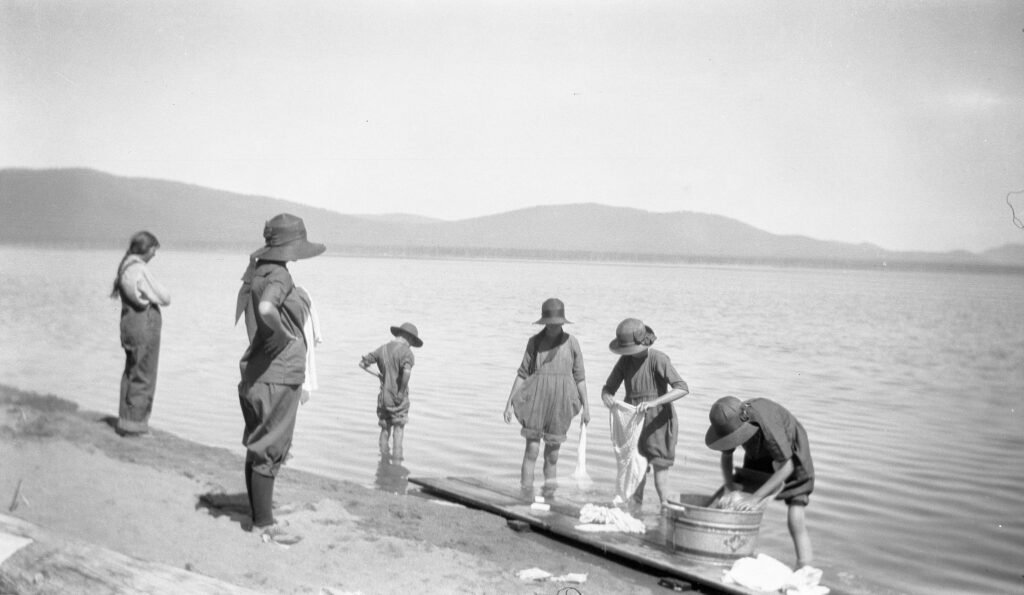
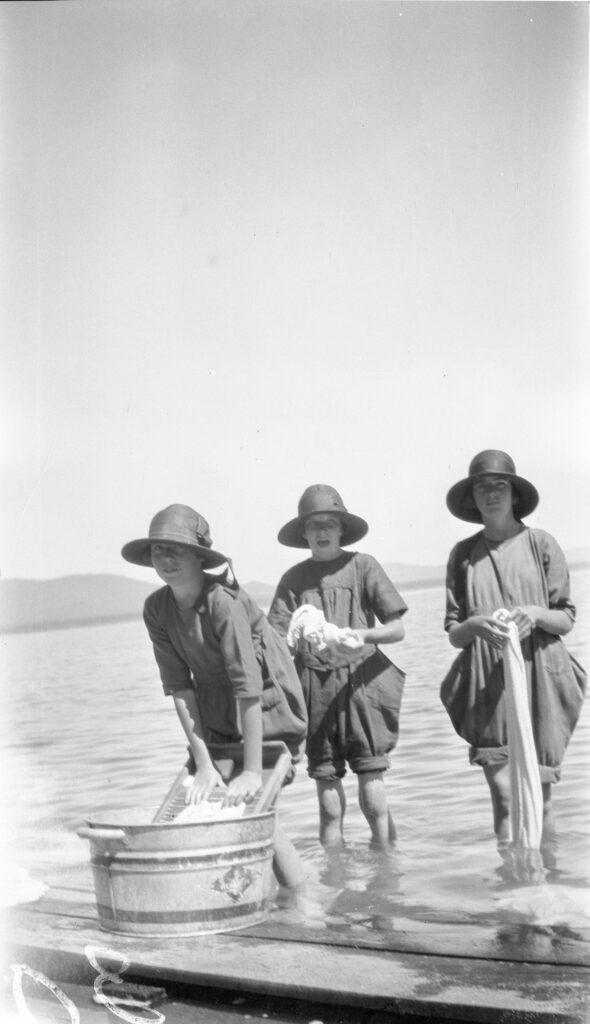
Camper’s Wash Day

South shore Eagle Lake, circa 1922-Mary Fern Nutting

It is mid-August and because schools start earlier these days the summer camping season starts to wane. While camping may be the perfect opportunity to get away from it all, one can not escape from mundane tasks. This was especially true in the pre-RV era. Take for example, in the 1920s families would camp for a week or maybe two. It took a lot go work to prepare, pack and then navigate unknown road conditions.

Wash day at Eagle Lake. – Mary Fern Nutting

These images of a wash day at the south shore of Eagle Lake were taken by Susanville resident Mary Fern (Long) Nutting (1896-1957) Alas, I do not the particular story behind them, but I did want to share them.

Tim


City Of Susanville Turns 125 Today

Main Street, 1901
South side of the 700 block of Susanville’s Main Street, 1901

On August 20, 1900, the City of Susanville became an incorporated municipality. After the devastating fire of June 6, 1900, residents gathered to discuss to incorporate the town as means to have control of fire suppression. They petitioned for the Lassen County Board of Supervisors to hold a special election, which the board obliged. On August 15, the voters approved the measure  for incorporation by 61 to 20. Five days later the City became a reality.

Elected to serve as the first Trustees (now Council) were Charles E. Emerson, John E. Humphrey, Howard W. Meylert, Julien E. Pardee and John. Riley. Also elected were W.H. Edwards, Town Marshall, W.T. Masten as Clerk and M.F. Schmidt, as Treasurer. The first meeting was held on August 28, 1900, and Pardee was selected as President (now mayor).

Subscribe