Category Archives: History

A Milestone Birthday

John Cahlan
John Cahlan, President of the Bank of Lassen County in his office.

Today, is Arthur Cahlan Mathews 100th birthday! Art was born in Susanville on June 5, 1922, the only son of Arthur and Lena Cahlan Mathews. Upon his debut, he had an older sister, Ellen, and later on a younger sister Marcella. Art has many fond memories growing up in Susanville, and after he graduated from Lassen Union High School in 1940, he ventured out of Lassen Land.

His grandfather, John Cahlan came to the Honey Lake Valley in 1873, where he went into a partnership with W. Wallace Scholl in a buying a ranch near Johnstonville. It was not long after that, he married Lottie Farley.  The marriage would be brief, she died unexpectedly in 1876.

In 1877, an interesting opportunity came Cahlan’s way with the formation of the Farmer’s Co-Operative Association in Reno which he became manager. 1882 was a pivotal year, for Cahlan remarried to Reno school teacher, Charlotte Warren. Not much later a fire destroyed the co-op store, and the newlyweds returned to Cahlan’s former ranch, in which he bought out his partner Scholl. The couple would have two daughters—Lena who married Arthur J. Mathews and Neva who married R.H. “Hi” Browne. In 1908, Cahlan who was now 68 years old, decided to retire from ranching life and sold out to  Frank and S.F. “Duck” Bangham.

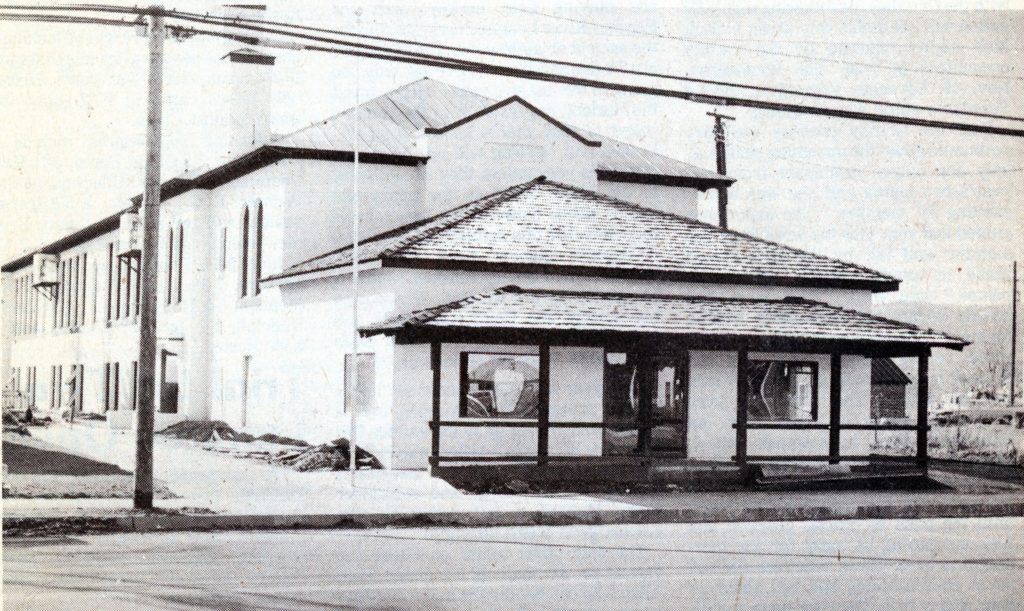
1415 North Street, Susanville, 1955. Courtesy of Wendell Laughead

Cahlan moved into Susanville and purchased the old Moody place on the northwest corner of Main and Roop Streets (now the location of Uptown Cinemas). In 1911, Cahlan had a Dutch Colonial style home built there. This would be the home that his three grandchildren grew up in. In 1955, the house was moved to 1415 North Street, to be replaced with a brick building to be the new home of J.C. Penney.

In 1892, when Lassen County’s first financial institution was formed, the Bank of Lassen County, Cahlan was quite involved. He served for many years as Vice President. After the passing of his close friend Fred Hines, who served as the bank’s president, Cahlan was appointed as Hines’ replacement. Unfortunately, he would not remain at the helm very long, for he suffered a heart attack in the office at the bank on September 24, 1912.

Cahlan family plot, Susanville Cemetery, 2016

Art, I hope this finds you well. Wish I could be there for your birthday dinner bash this evening, however, I will have a “Susanville pour” in your honor.

Tim


Prattville’s Sorsoli Hotel

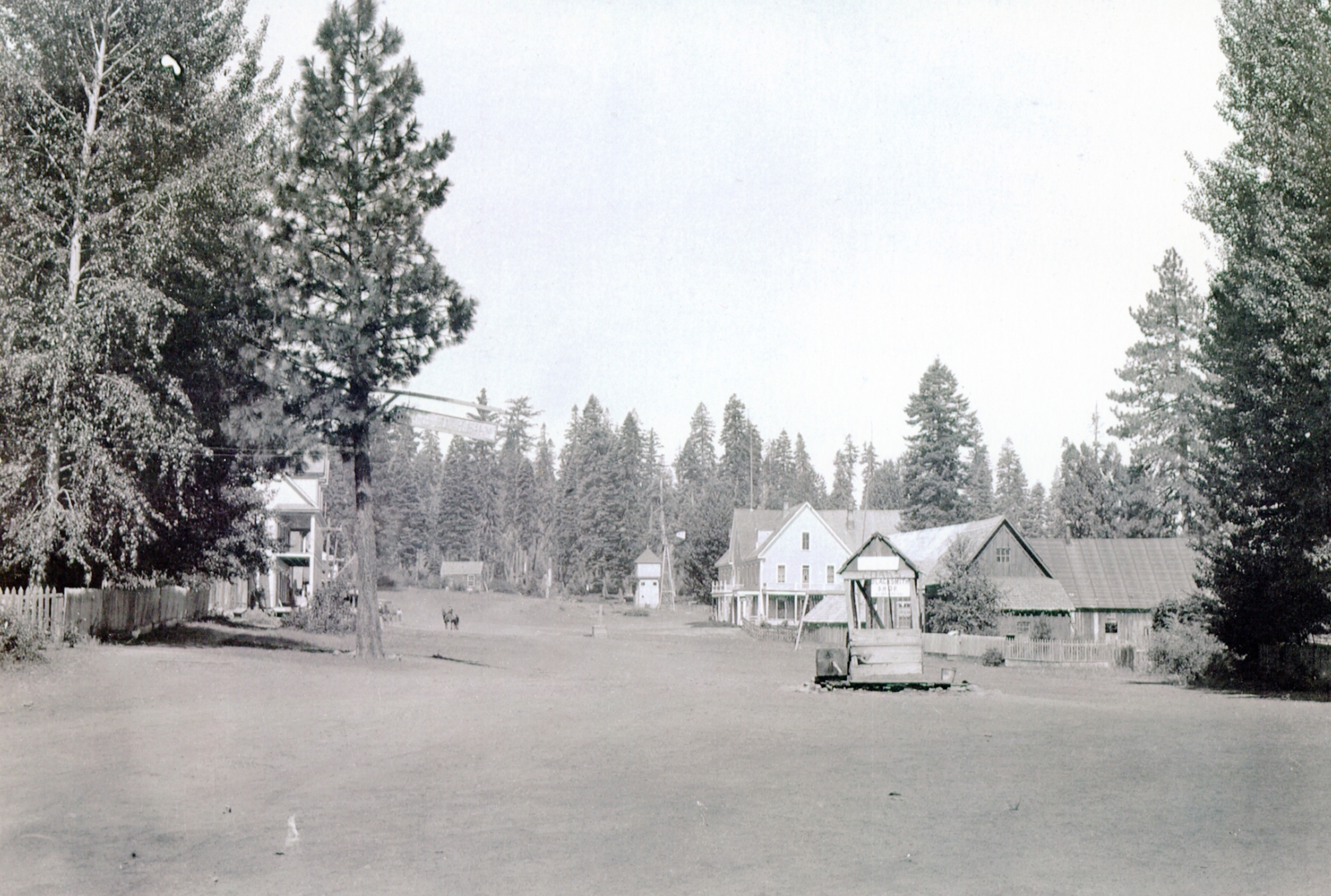
Sorsoli Hotel, 1908. Courtesy of Jo-Al Smith

The original town of Prattville was quite the place prior to being displaced by Lake Almanor. Prior to Lake Almanor, it was known as Big Meadows, and a popular summer hang out, especially those from the Sacramento Valley, escaping the heat, after all this is pre-air conditioning days.

In 1898, Frank Sorsoli purchased Baccala’s Prattville Saloon.  Business was good. There being a lack of hotel accommodations, Sorsoli decided to build one. In May 1908, construction began on Sorsoli’s $10,000 twenty-eight guest room hotel.  But the operation was short-lived. A fire of suspicious origin on July 3, 1909 wiped out most of the town of Prattville, the Sorsoli Hotel was a casualty.

Never miss a story, click here.

An Interesting Honeymoon Prank

Fruit Growers Apartments, 1920s

Lassen Mail, April 30, 1926 – Newly-Weds Elececikicked. Andrew H. Stahl, a saw filer at the Fruit Growers plant and Miss Daisy Fitzgerald of Sonora were married in Reno last Saturday morning and at once came to Susanville where they will make their home. Their “friends” had skillfully wired the furniture in their apartment in such a way that when they sat down they immediately arose again. A big Klaxon horn announced the fact that they had retired to their apartment and it was not until they had bribed the gang that the wires cut and the disturbance ceased.

Tim

Cemetery Trivia

The Thomas Newton Long family plot, September 16, 2017.

One of things I do enjoy about doing tours, which I have been lapsed in doing, is the interesting interaction among attendees. During the St. Patrick’s Cemetery Tour something was relayed to me that I was unaware of and never had given any thought.  In many instances, the graves face to the east. That is certainly the case in most Lassen County cemeteries. Traditionally, the husband is usually buried to the left.  In addition, some churches make it a point for the altar to face to the east. I just never know what I will learn next.

Tim

Smoke Creek’s Military Cemetery

graves
Soldier’s graves at Smoke Creek, March 15, 1964. Left to Right: Frances Amesbury, Mary Morrill and Gil Morrill. Courtesy of Gil Morrill

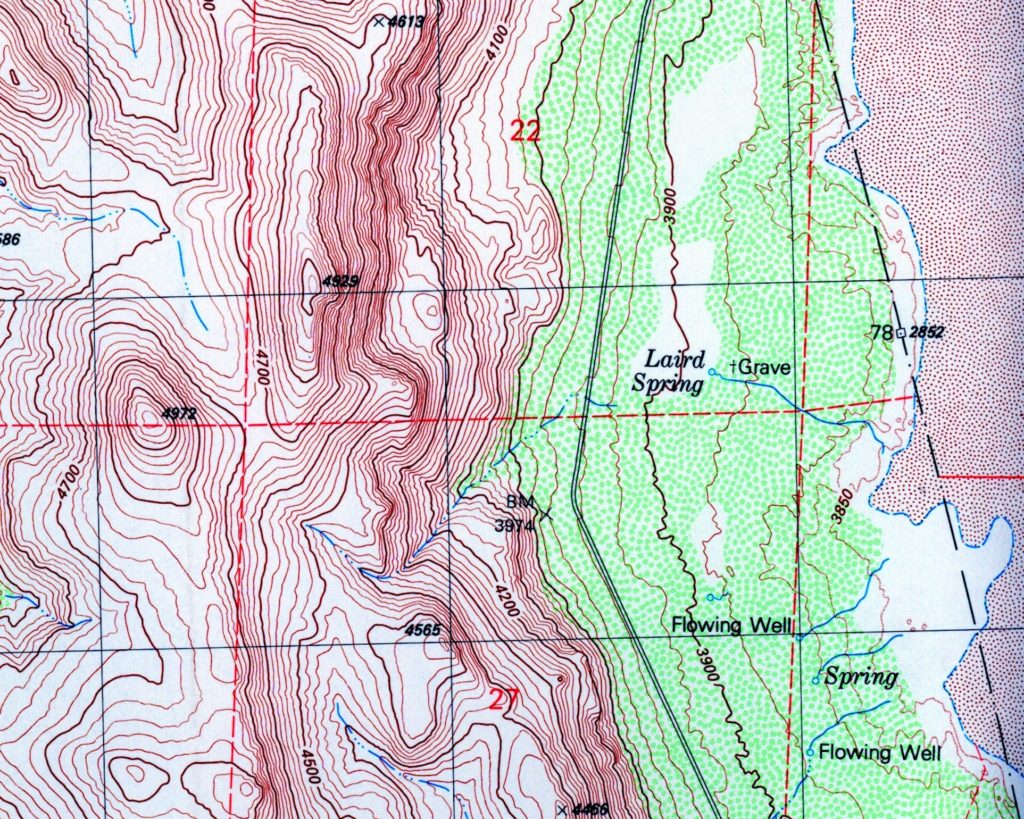
One of the interesting endeavors undertaken by the then newly formed Lassen County Historical Society was to locate the soldier graves at the military encampment known as Smoke Creek, just across the Nevada stateline.  In 1964, on their first excursion they located it. Over time they decided that something needed to be done as a memorial. In June 1968, they ventured again, this time erecting a large cross on the hillside.

cross
Phil Lord and Bob Amesbury at work putting up the cross, June 1968. Courtesy of Gil Morrill

The small cemetery was established on the hillside across the creek from the camp for the four soldiers who died there while in service.  On January 18, 1863, Pvt. John Smith Co C2 Calif Cav died from gunshots at Deep Hole, Nevada, over an argument with his commanding officer Second Lt Henry W. Williams. On November 9, 1863, Pvt. Gustavus W. Platt Co. C2 Calif Cav died of typhoid fever at Smoke Creek. On July 3, 1864, Sergeant William McCoy, age 28, died from an unknown illness. On November 17, 1865, Pvt. David O’Connell Co. B2 Calif. Cav was killed in action at the Pine Forest battle near Black Rock.

Support this site and Subscribe today!

Camp Smoke Creek

Camp Smoke Creek
The camp was located near the cottonwood trees seen in the distance. It is located on private property and is now fenced off.

During the 1860s, the United States Military had a major presence in the region, with numerous military camps scattered around the Honey Lake Valley and Northwestern Nevada—one of which was Camp Smoke Creek just over the stateline in Nevada.

Its origins began on November 9, 1862, when Nevada Territorial Governor James W. Nye wrote to Brigadier General George Wright, Commander of the Department of the Pacific, and requested a Company of troops to protects the emigrants from the Indians along the Honey Lake-Humboldt Road. On November 14, 1862, the troops were dispatched. On December 15, 1862, Second Lt. Henry W. Williams arrived at Smoke Creek with twenty-five men and forty days of rations. On March 28, 1864, First Lt. Oscar Jewett, then in command, received orders from Fort Churchill to abandon the camp and to remove all valuable property from the camp as was possible. Continue reading Camp Smoke Creek

The Smith Brewery Opens Again

Smith Hotel, circa 1880. Courtesy of Verna M. Wood

During the late 1800s, Susanville had anywhere between one to four breweries at any given time. In the fall of 1864, German immigrant Jacob “Jake” Smith* opened his first of many breweries in Susanville. When he opened a particular brewery on May 27, 1879, he was met with some resistance.  At that time, a group of women formed a “temperance society” to educate the young people of the area the “evils of alcohol.” At this same time, Smith along with his wife Sophia, operated a hotel on Main Street, that was destroyed by fire in 1882.

*The actual spelling is Schmitt.

Tim

Where Are We – Dow Butte

May 31, 2021

This a view of Eagle Lake from Dow Butte that is located northwest of Spalding Tract. A forest service lookout was constructed there in 1939. It was removed in 1994, and can viewed at the Eagle Lake Marina.

The relocated Dow Lookout at the Eagle Lake Marina—December 11, 2021

William Dow first settled near present day Spalding Tract in 1875. Shortly, thereafter his nephew, John Spalding also located there. Dow sold out to Albert Gallatin 1886.

Tim

Remember When Lake Almanor Rattled?

Lake Almanor

The region, like most of California is earthquake prone. Actually, on any given week there are small quakes in the region, registering under 3 on the Richter Scale. The tremors are so faint, no one feels them.

However, that was not the case on May 23, 2006, when an earthquake struck the east shore of Lake Almanor at 8:47 p.m. It got everyones attention as it measured 5.7. It was widely felt throughout the region.

In the spring of 1914, a swarm of earthquakes hit the region, a prelude to Lassen Peak’s eruption that May.  At the same time, Big Meadows was being flooded to be transformed into Lake Almanor. Many locals believed that was cause of the Lassen Peak eruption.

Donate