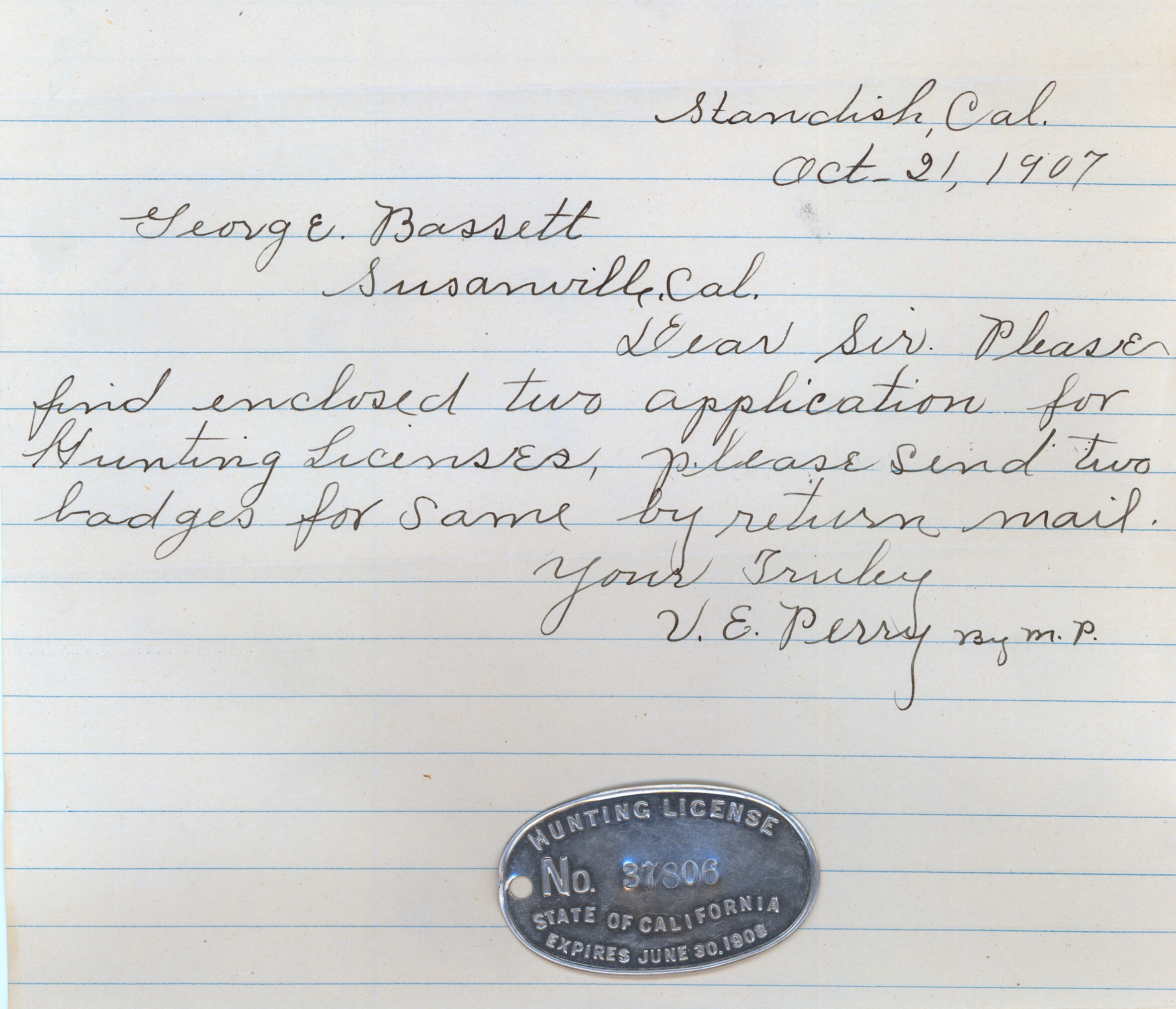
Way back yonder in 1907 was the first year one had to obtain a hunting license in California. To obtain a hunting license one had to fill out an application with the county clerk, or one of the clerk’s deputies scattered around the county. The fee $1.00. The initial license was a small aluminum tag. I am so grateful for my dear colleague Betty Barry Deal who provided me with one.
In 1899, the U.S. Department of Agriculture commissioned a study on water problems in the American West. The Honey Lake Basin was one place selected and William Smythe was hired to author the report.
Smythe was well known for his work on reclamation issues in the West. However, Smythe was well versed in the region beginning in 1897 with his Standish Colony and the Honey Lake Valley Colonial Irrigation System. Smythe did provide some unique observations. Concerning Eagle Lake, Smythe noted the importance of the lake for irrigation. Smythe stressed that the lake should only be used during periods of drought, but that the lake was essential in any major reclamation project for the Honey Lake Valley. Smythe became the first person to go on record questioning Eagle Lake’s water supply. It was widely believed that the lake’s water supply was “inexhaustible” due to mysterious springs in the lake’s bottom. Smythe retorted that it that was true, then why had the level of the lake not increased over the years to flood the borderlands, or to eventually overflow the Willow Creek divide? Smythe finally wrote, “It is question which can never be satisfactorily settled until the experiment of the tunnel is actually made.”
Smythe made it a point to stress the problems of California’s vagueness in water right appropriations and that it was a major hindrance in the development of the Honey Lake Valley. He noted one claim of 4,000,000 miner inches of Eagle Lake and Willow Creek water and sarcastically wrote, “Fortunately for those residents of Honey Lake Valley who could not swim, this enterprise was never carried out.” It should be noted that between 1874 to 1897 there were 14,201,400 miner inches of Eagle Lake water claimed!
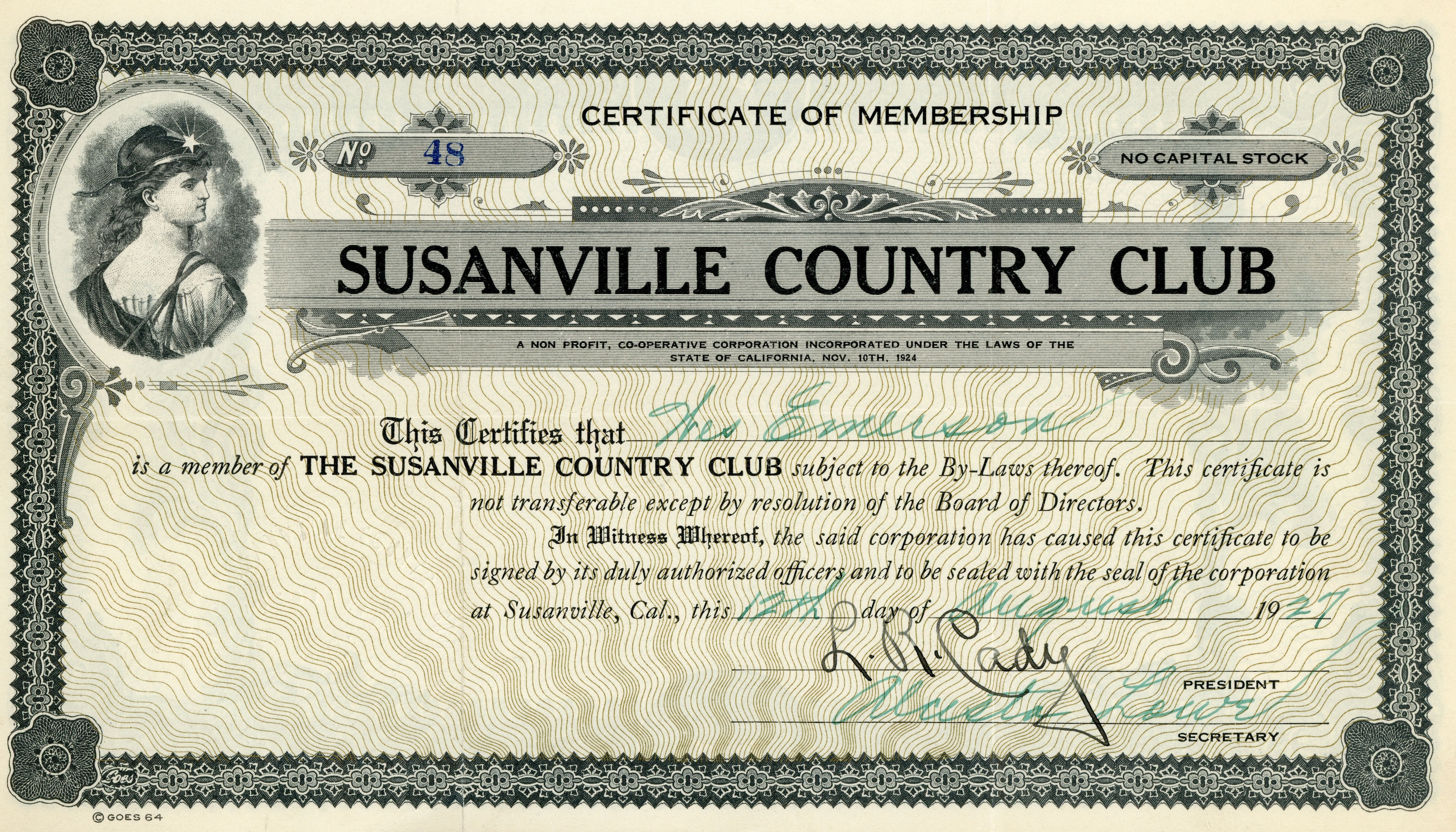
Over a century ago, it did not take much to form a corporation. Many of the Articles of Incorporation consisted of two pages. In the Lassen region numerous small companies incorporated and by today’s standards many would be deemed a non-profit. This was the preferred method then to raise money by the sale of stock. Some ventures succeeded, while others did not.
Take for instance in 1899 a group of local leaders formed the Susanville Hall Association. This they thought was needed since there were no public halls. It was their goal to sell $5,000 in stock. They did not succeed and their initial offering only netted $450.
Stock certificate courtesy of Dick and Helen Harrison
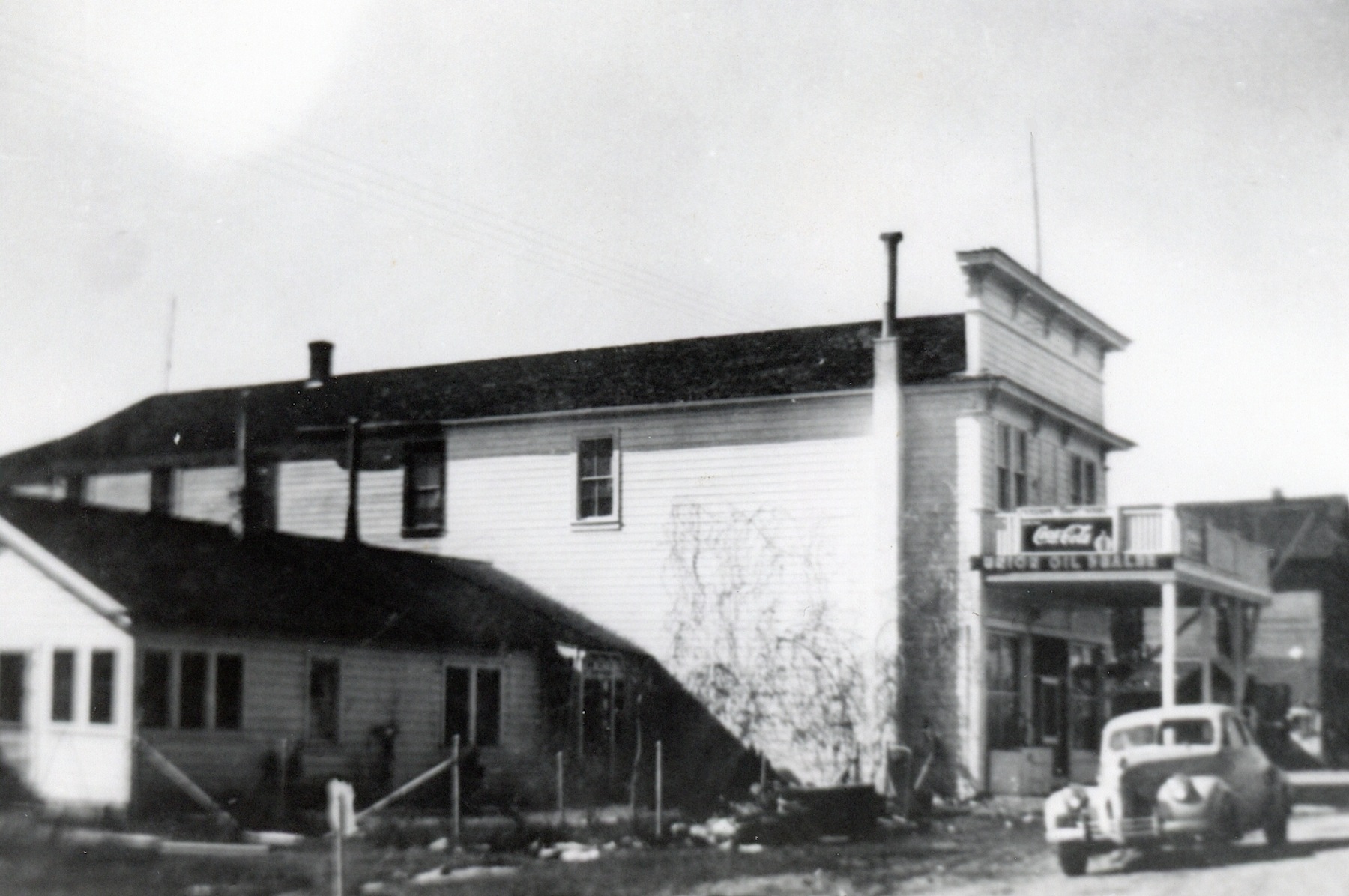
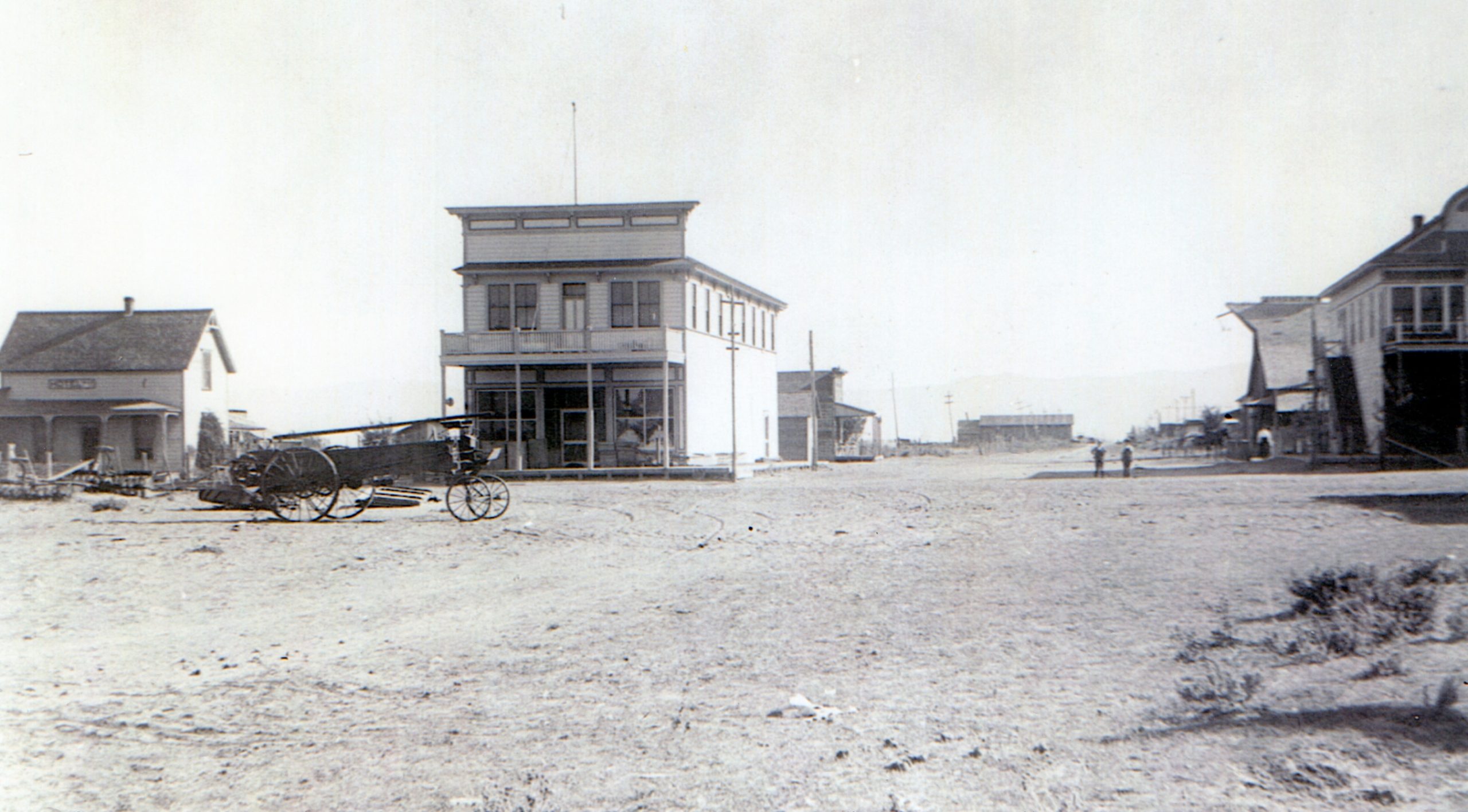
In 1908, the Standish Hall Association was successful. Seasoned residents will know the building as the former Neil’s Mercantile. It is the vacant two-story building on Highway 395 and to the west is the Wayside.
The Standish store, no date. Courtesy of Camilla Moody.
By the 1920s, the practice of forming small corporations was declining. The Susanville Country Club that purchased the Wingfield Estate was successful and then there was the Susanville Hotel Company, i.e., Hotel Mt. Lassen that turned into a messy affair.
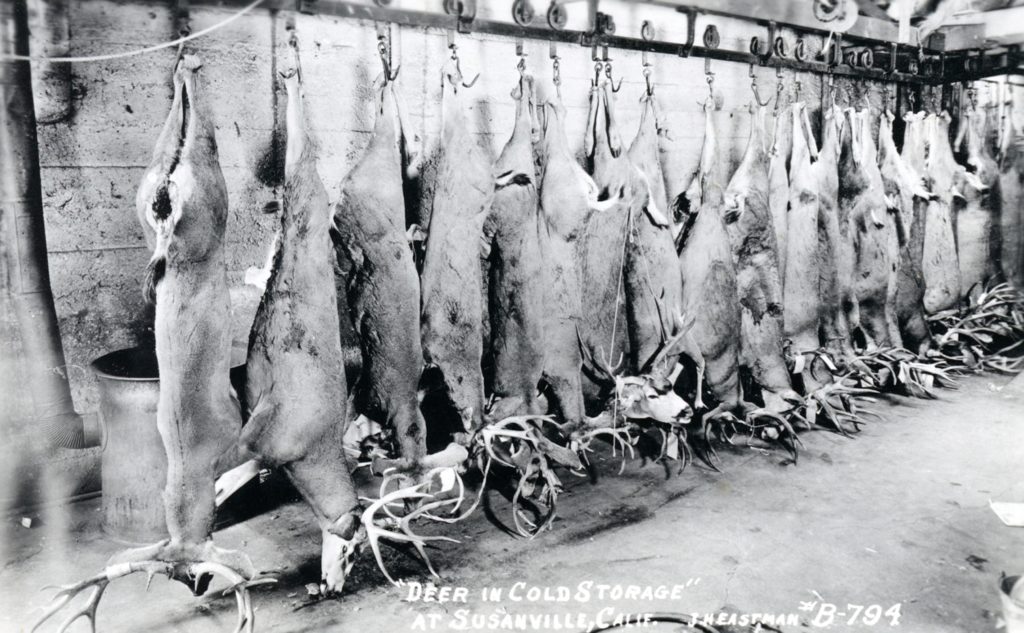
Once upon a time, during deer hunting season the population of Lassen County more than doubled. This was especially true during the 1940s and 1950s.
In September 1946, the Lassen National Forest expected over 20,000 deer hunters. Deer season opened on September 21, 1946 and by September 30, some 14,994 deer hunters had checked in at various points throughout Lassen County.
With that many people, problems occurred. There were four fatalities—two by gun shot and two by heart attack. The gun shot victims were Orin Gerig of Bieber and Columbo Fortino of Oakland, who was shot in the leg at Mill Creek, taken to the Westwood Hospital where he succumbed of his injuries. James Maloney of San Francisco died of heart attack while hunting near Termo, and the same fate happened to Clel Tally of Sacramento near Pine Creek Valley.
Officials were concerned about the fire danger. There were seventeen fires caused by careless deer hunters. Fortunately, none of these fires caused any major damage. No information was released as to how many deer were killed, but all the cold storage meat lockers in Susanville and Westwood were at capacity.
In conclusion, the deer season was even included in Fruit Growers Supply Company’s 1946 Annual Report:
“Much of the country in which Company timber is located is considered to have good deer hunting, and the deer season opens at a time when the woods are in the driest conditions and when the fire hazard is the greatest. The handling of the large influx of people into the general Northern California area during the deer hunting season constitutes a very serious problems to all owners and agencies interested in timberlands. In 1946, hunters and their parties were registered as they entered Lassen County area, and during one week’s time, close to 5,000 automobiles and 13,000 individuals registered as potential deer hunters. Thus more hunters were checked into Lassen County than its normal population. Despite this, the Company was fortunate in its 1946 experience with forest fires.”
Subscribe and support this site for little as $5.00 a month.
While financial depression of the 1930s wreaked havoc in most of the nation, there were pockets, while still hit hard, it was not bleak like so many regions. Lassen County was fortunate, though it did not escape the ills of the depression. On the bright side the big three lumber mills—Fruit Growers, Lassen Lumber and Red River—remained opened, but with curtailed operations. That was a major feat, since sawmills of the west coast were hit hard with some 70-80% closed.
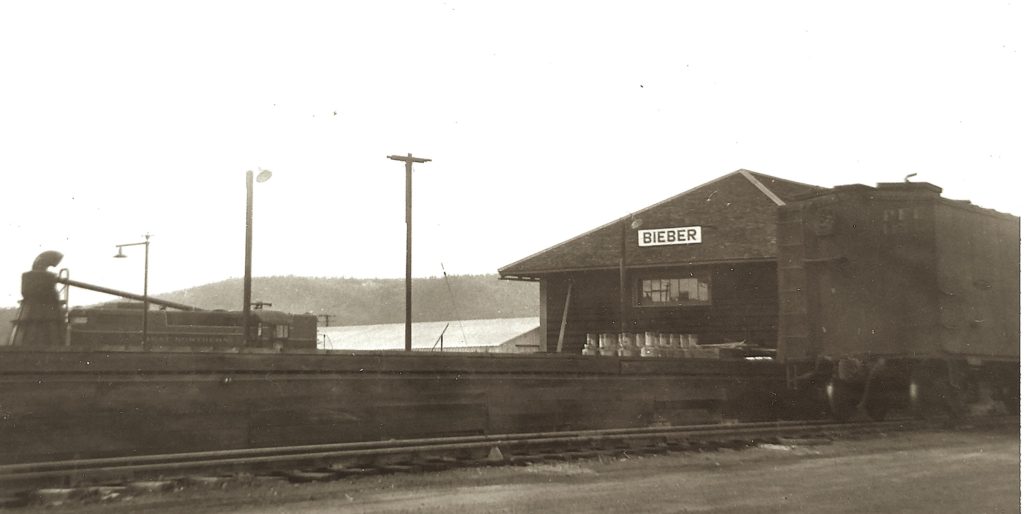
Great Northern’s Depot, Bieber.
The northern half of the county was an interesting tale of boom and bust at the same time. Big Valley boomed, especially Bieber and the newly created Nubieber. This was attributed with the arrival of the railroads, i.e. the Great Northern Extension, Highline, Inside Gateway, etc since it is referred by several names. In 1931, at Nubieber, the Great Northern connected with the Western Pacific Railroad and exciting times were to be had. Its neighboring section to the east, the Madeline Plains did not fare so well. That district’s downfall had already been on the decline in the 1920s and the 1930s accelerated its depopulation. Joining that club the desert homesteaders of eastern Honey Lake as well as Secret Valleys who saw their future wane. Only the hardiest would remain.
Another segment of the agricultural community that took a deep hit were those associated with the Baxter Creek and Tule Irrigation Districts. For many their dreams collided with reality when Leon Bly’s tapping Eagle Lake for a water supply failed for the districts—forcing untold bankruptcies.
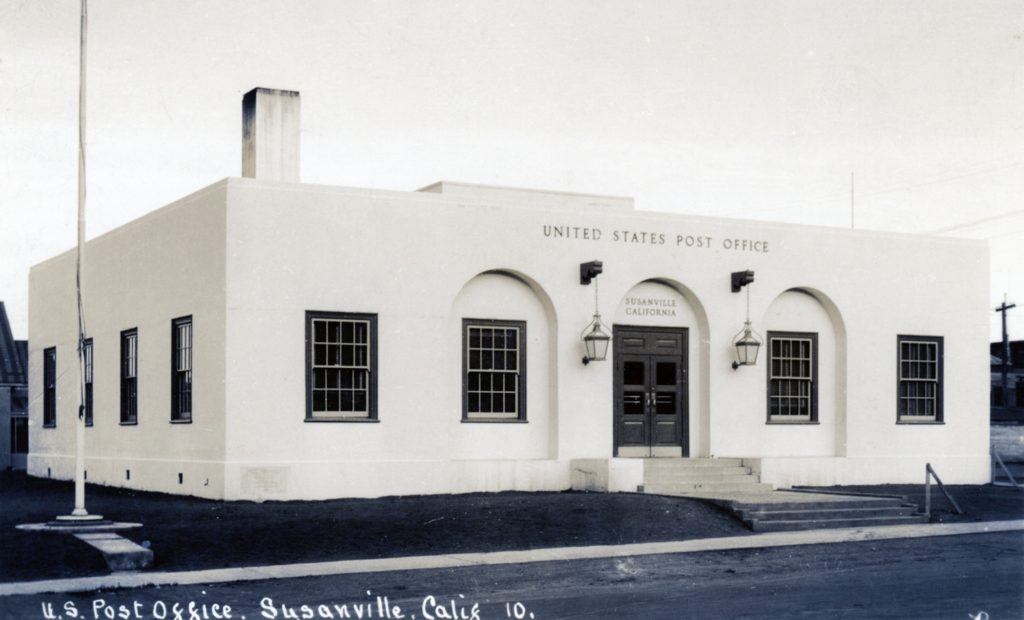
For Susanville it was a very transformative time. From the 1910s and 1920s witnessed an explosive growth and transformation. By the early 1930s it experienced an economic hangover. While it had some struggles, it had modest growth. As a bonus was President Franklin Roosevelt’s New Deal that among things Susanville would be a beneficiary for a swimming pool and post office, the latter still in operation.
Susanville Post Office, circa 1940.
Finally, it should be noted by the late 1910s, rural communities such as Doyle, Janesville, Milford and Standish had already begun a slow decline. The culprit, the automobile and better roads. One could now travel a greater distance thus bypassing the need to stay and for that matter do trade. Fast forward to 2022, and that trends continue with residents going to Chico, Redding and Reno to conduct business.
The following is an interesting description Susanville that appeared in its 1956 business directory. Thought some might enjoy.
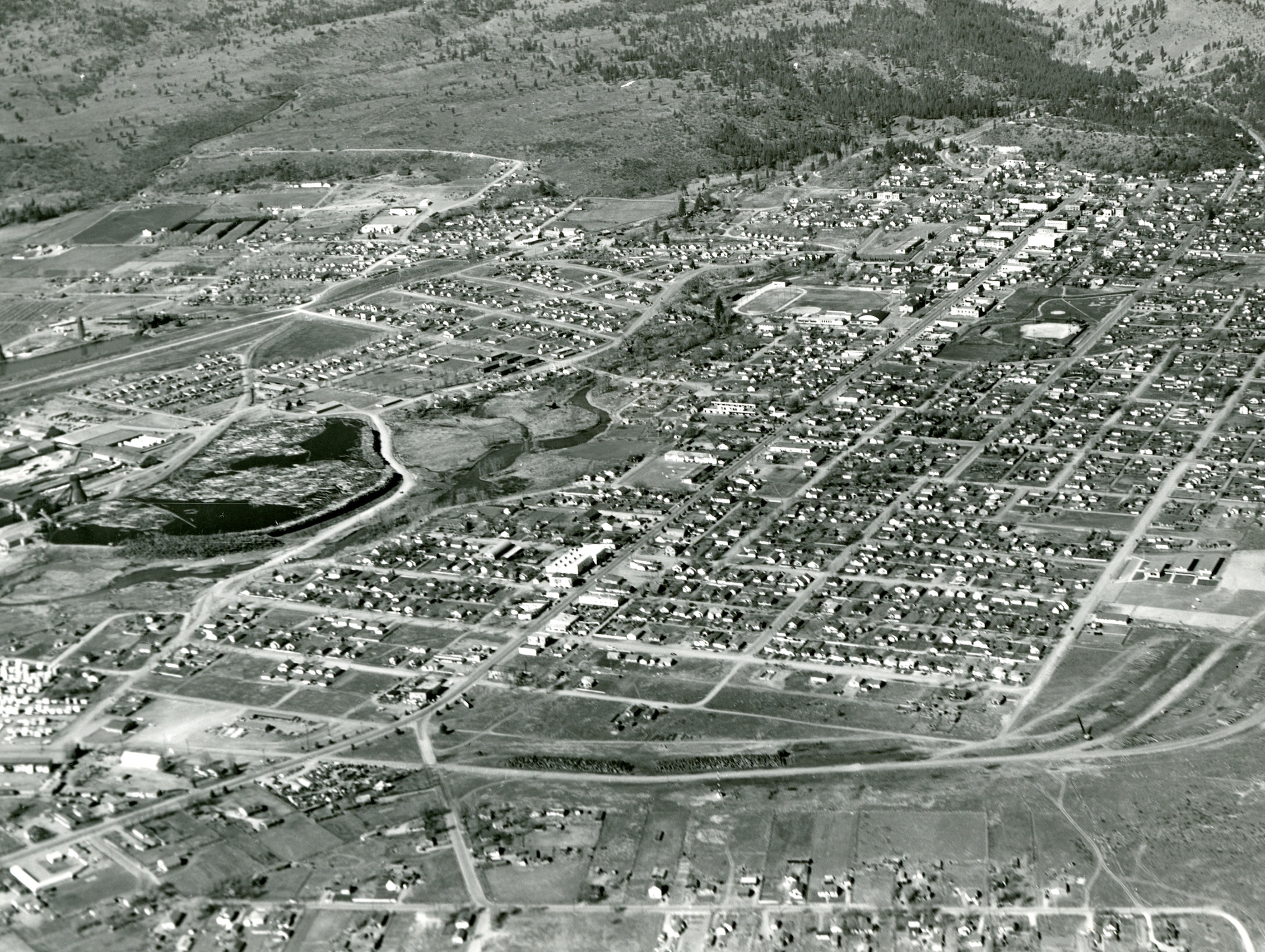
Welcome to Susanville—A City of Uncomplicated Living. A beautiful. modern little town nestling under the bluffs of Inspiration Point, surrounded on three sides by towering snow clad peaks, is bisected by the clear bubbling waters of the Susan River. Located on State Highway 36 at the intersection of U.S. Highway 395, 35 air miles west of the Nevada border and equidistant from the Oregon border and the elbow bend in California.
To the north, south and west of the city is the land that traveled Californians love. All the mystery, legend and folk lore of the romantic, the startling and the beautiful lies just over the hill from Susanville. You don’t have to wait to reach Lassen Volcanic National Park, nor the Feather River Canyon; as the fabulous wealth of breath-taking beauty that abounds in the myriad lakes, streams and timber bordered meadows start practically at our city limits.
To the southwest we have Honey Lake with its miles of green plain, beyond which lies the sage brush country Zane Grey loved to describe. We are doubly blessed with the wide open plains, and wide open mountain roads where we can pull off the road of any favored scenic spot.
Join us in this country where the water tastes like water and not like liquid from the test tube of a disgruntled chemist; a land where your nerves get a chance to breathe, and where your only road reads “Watch for Deer on the Highway.” That’s Susanville, California.
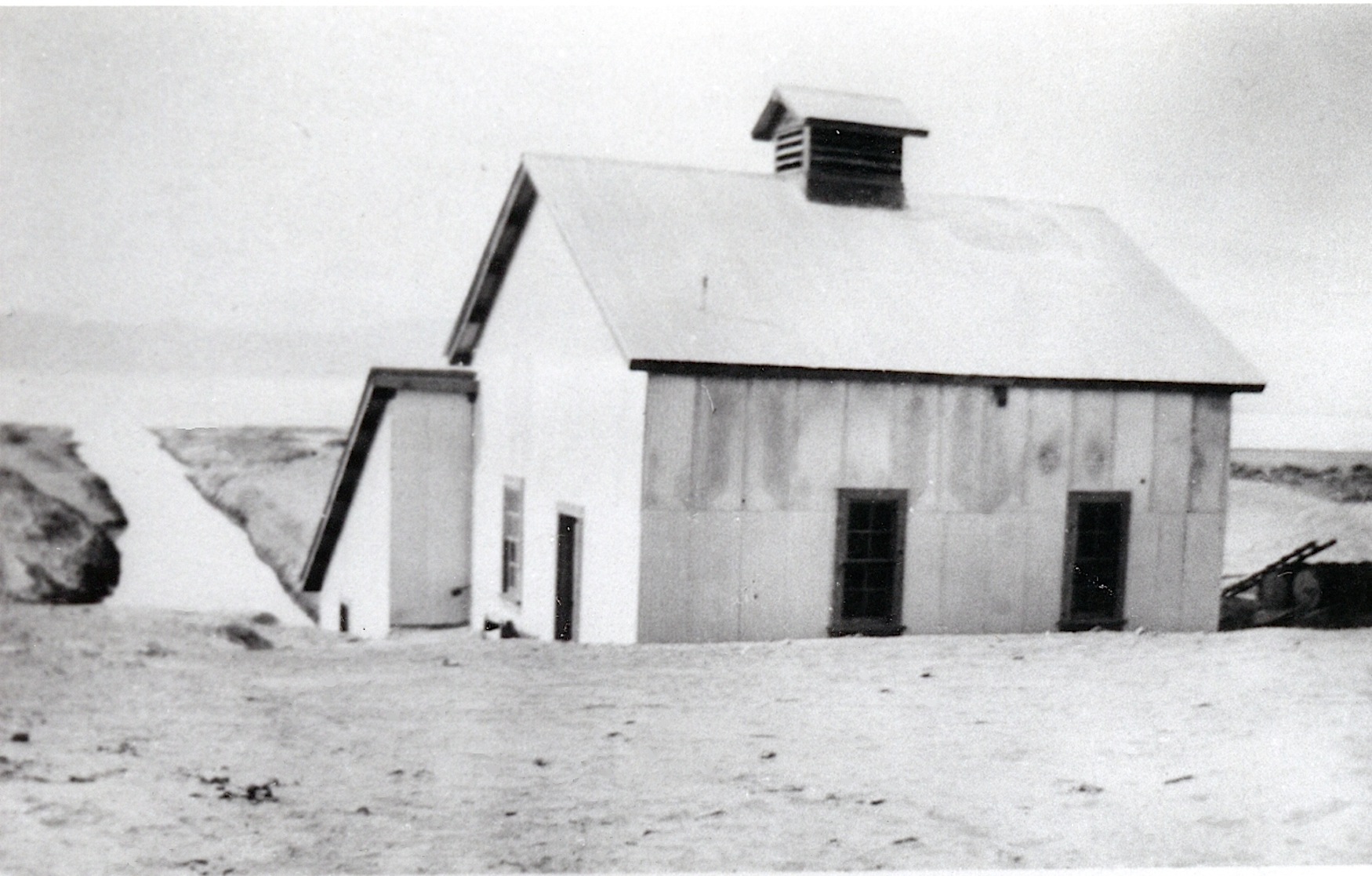
In 1909, the Standish Water Company incorporated with ambitious plans to initially reclaim 4,000 acres of sagebrush lands on the east side of Honey Lake, just south of Amedee. Their water supply—Honey Lake. Not only they intended to construct a pumping plant, they did.
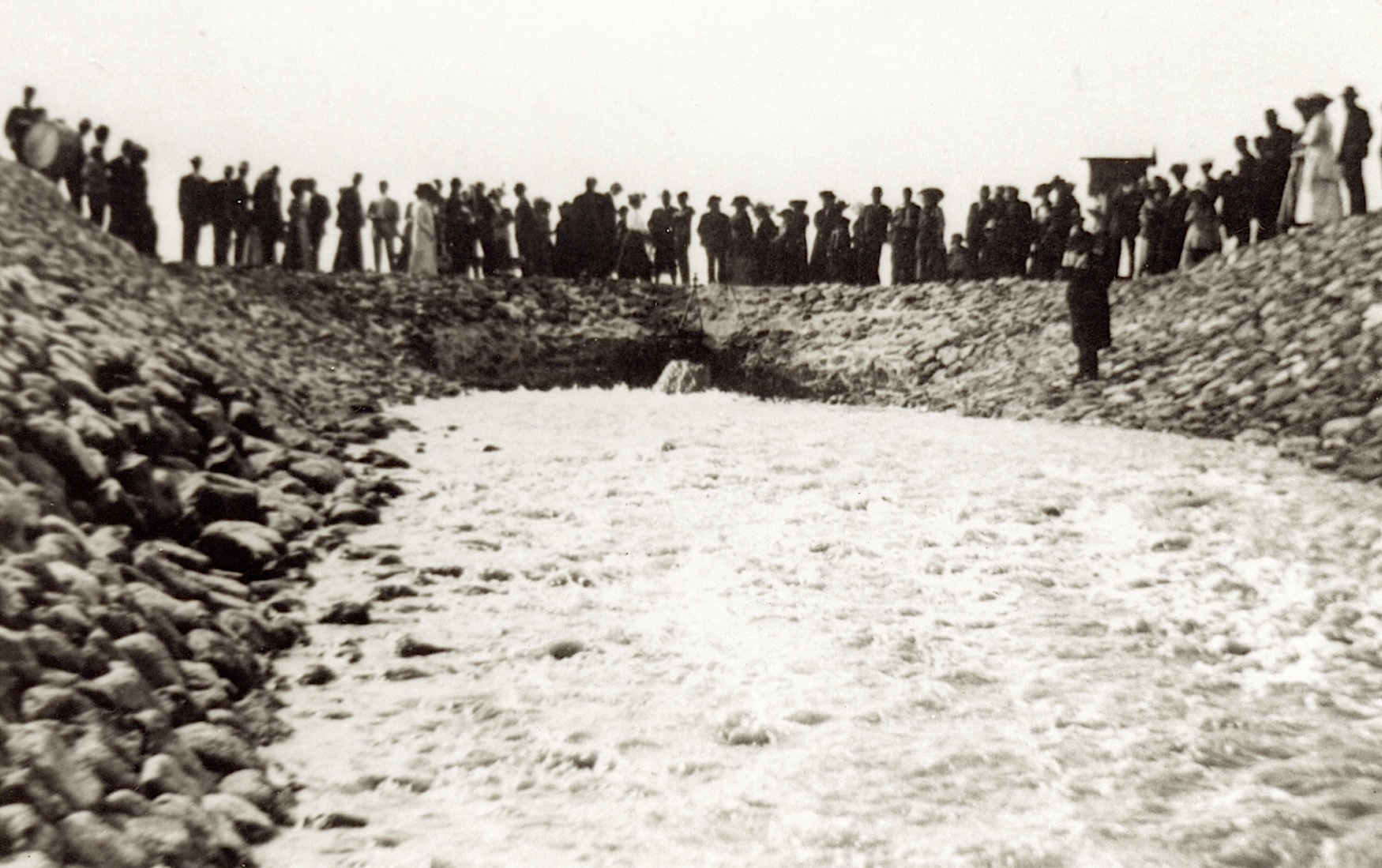
October 4, 1910, a beautiful Lassen County fall day, set the mood for the inauguration of the pumping plant. Early in the morning the crowd began arriving and by noon all parts of Honey Lake Valley represented. The Standish brass band, with their flag-draped wagon, added to the gala appearance of the occasion.
At one o’clock the whistle blew from the engine house of the plant. The crowd of spectators assembled on the banks of the wide canal awaiting the momentous event. The forthcoming water burst from the pipes to fill the canal and send the precious liquid through the parched soil. The historic event signaled a turning point in the reclamation work of Lassen County. The visitors were then invited to inspect the engine house and tour the lands and eleven miles of canals completed to date.
Dedication of the pumping plant, October 4, 1910–Prentice Holmes
In the Company’s first year 1,000 acres had been planted with sugar beets, with a successful harvest. The following year was a success, too. This changed in 1913, in one of those bureaucratic snafus. The Standish Water Company sold water to individuals who were homesteading on federal lands. Once those individuals met the government’s requirements they could acquire the land for a nominal fee. Disputes occurred, usually from neighbors. In this particular instant, Thomas Philbin contested John Ramsey’s request for a final proof for his 160 acre homestead. The United States Government Land Office (GLO) investigated Philbin’s claim, which they dismissed. However, when it was learned Ramsey’s source of water supply was Honey Lake, it raised a concern. The government forced the operation to shut down, until theState of California corrected its vague rules on appropriation of water from lake with no outlet. The Standish Water Company never recovered and in 1915 sold to Rosendal Minster.
By 1900, Standish Colony was not developing the way the founders envisioned. However, Buntingville merchant, Mike Phillips, from across the valley saw potential at Standish. He closed up shop there and moved to Standish.
Phillips first order of business was to open a store at Standish. Then he became the principal figure to organize the Standish Creamery. That was followed by building the town’s first hotel. When Phillips was at Buntingville he established a newspaper Buntingville Breezes. In 1903, he made an unsuccessful attempt to establish a newspaper at Standish.
In 1904, for reasons unknown, he sold his Standish properties. A.E. & Harriet Torrey bought the hotel. It should be noted that Harriet was Standish first postmaster. The creamery and store was sold to Susanville businessman Charles Emerson. Phillips relocated to Reno Nevada and never heard from again.
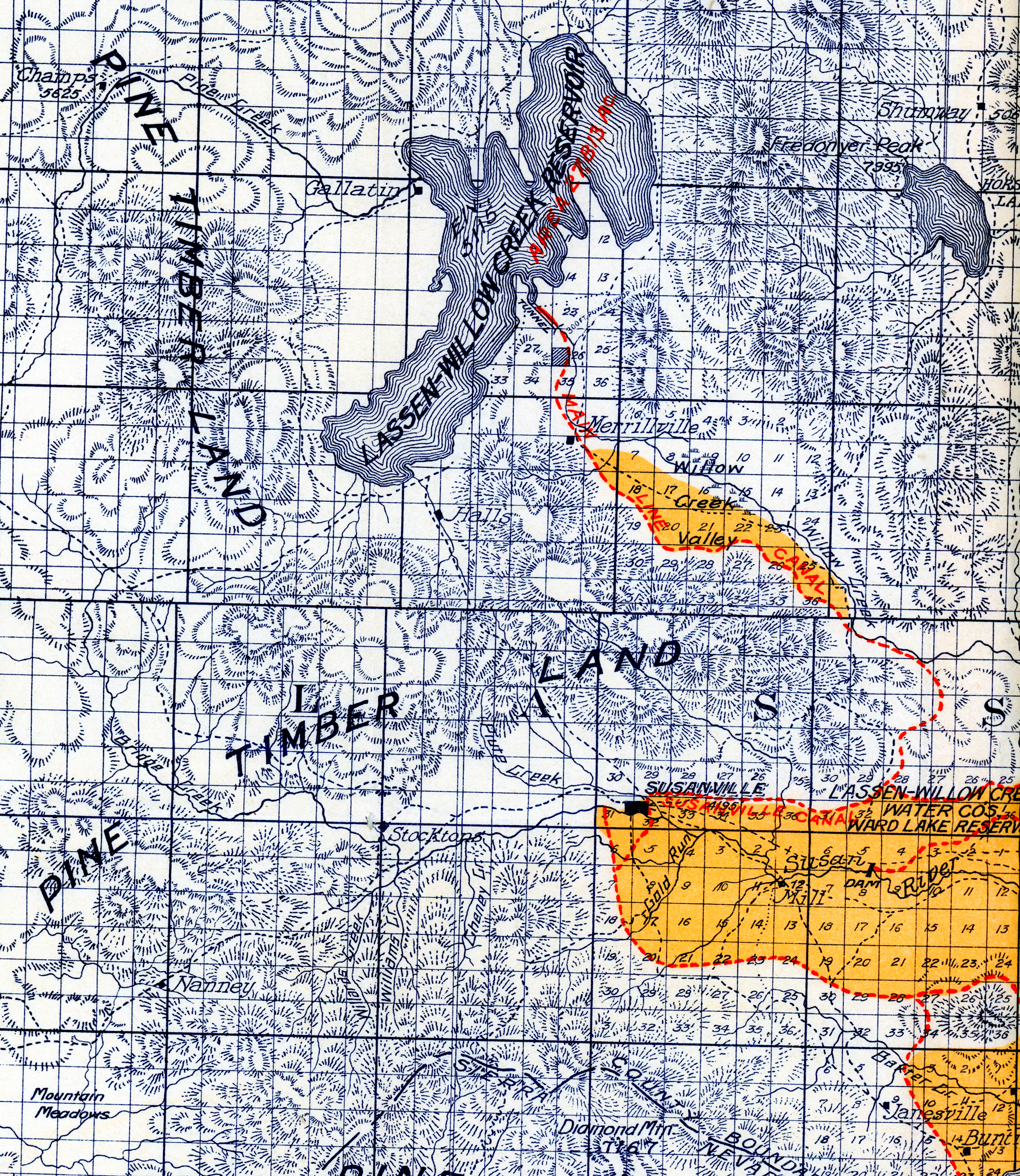
Partial map of Lassen-Willow Creek Water Company’s proposed project. Courtesy of Betty Barry Deal
During the early 1900s, it appeared any attempt to tap Eagle Lake for irrigation were doomed, since previous proposals over water rights etc were being litigated. On the other hand, it did not stop entrepreneurs who dreamed there was incredible wealth to be mde to deliver that water supply.
Enter Lassen Willow Creek Water Company, (LWC) formed in 1905, and its composition of the company were well known locals—Ben Leavitt, W.H. Earl, Charles Emerson, James Elledge and B.F. Gibson. Before they formed, they knew they had a competitor, A.F. Dixon who had filed for tunnel and water rights on December 8, 1904. One of LWC’s obstacles was to obtain a tunnel right-of-way from the Government Land Office to bypass Dixon’s claim. The Company pronounced Eagle Lake as a reservoir and filed for water rights to every tributary and excess flood waters of Susan River. They declared that this water being held in the lake as a storage reservoir.
This ingenious method of LWC to obtain the necessary right-of-way across public land was not to be resolved so easily. The LWC’s application for the tunnel right-of-way was rejected by the Government Land Office, as Dixon’s application had first priority. The Land Office wrote in its decision, “This office is of the opinion that it was never intended that a natural lake which is already a source of water supply. should be appropriated as a reservoir site.” The Land Office gave the LWC sixty days to appeal their decision.
A month later, the LWC filed a new tunnel right-of-way with the Land Office. They called it the Pine Creek Outlet Tunnel. Ultimately, the LWC decided to bypass the Land Office. They relocated their tunnel site, just north of Dixon. They secured the lands owned by the Cartwright Brothers. By mid-April 1906, shafts were being drilled and work was being prepared on the tunnel’s entrance and outlet.
It appears LWC was making great progress. In June 1906 the company announced it had signed a contract with the Granite Rock Company to construct the mile-long tunnel. It was estimated to cost $500,000 and everything came to halt since LWC did not have the funds. LWC’s demise occurred on June 7, 1910 when it sold its records and surveying equipment to E.N. Prouty for $900.
Once upon a time there was an old saying “boys will be boys.” I am not if that is case today with youngsters growing up in the digital age.
The Red River Lumber Company’s Westwood millpond was a scene of several tragedies. The millpond separated the communities of Old Town and Westwood. Old Town designated as such, for it was where everyone resided while the mill and town of Westwood was being constructed. A foot bridge was constructed across the millpond allowing those from Old Town easy access to Westwood.
On Friday afternoon, October 1, 1926, 17-year-old Westwood High School student, Jose Nunez, was returning home in Old Town with other school companions. While crossing the footbridge someone in the group suggested they play “Follow the leader.” Nunez was selected leader. He decided to jump off the footbridge and onto a
log, which rolled and he fell into the water. Nunez was pinned
underneath the logs unable to surface. When he did not immediately
reappear, two of his friends dived into the water, but were unable to
locate him. In the meantime, the call of help was made. Nunez’s body
by this time had been submerged for nearly fifteen minutes. It was
only with the aid of pike poles his body was located and pulled out of
the water. A doctor was present and attempted every means to
resuscitate him, but it was too late.
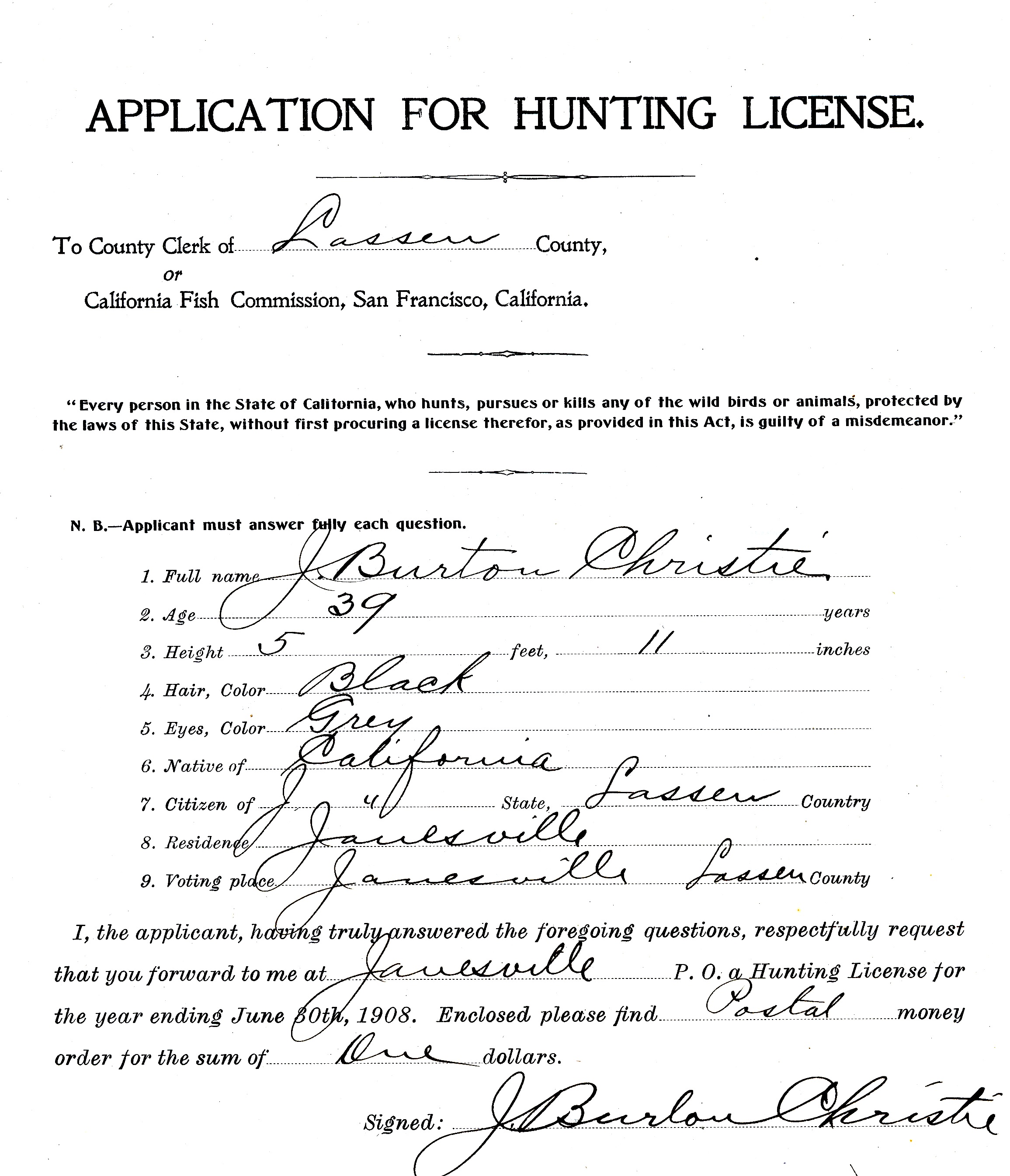 Way back yonder in 1907 was the first year one had to obtain a hunting license in California. To obtain a hunting license one had to fill out an application with the county clerk, or one of the clerk’s deputies scattered around the county. The fee $1.00. The initial license was a small aluminum tag. I am so grateful for my dear colleague Betty Barry Deal who provided me with one.