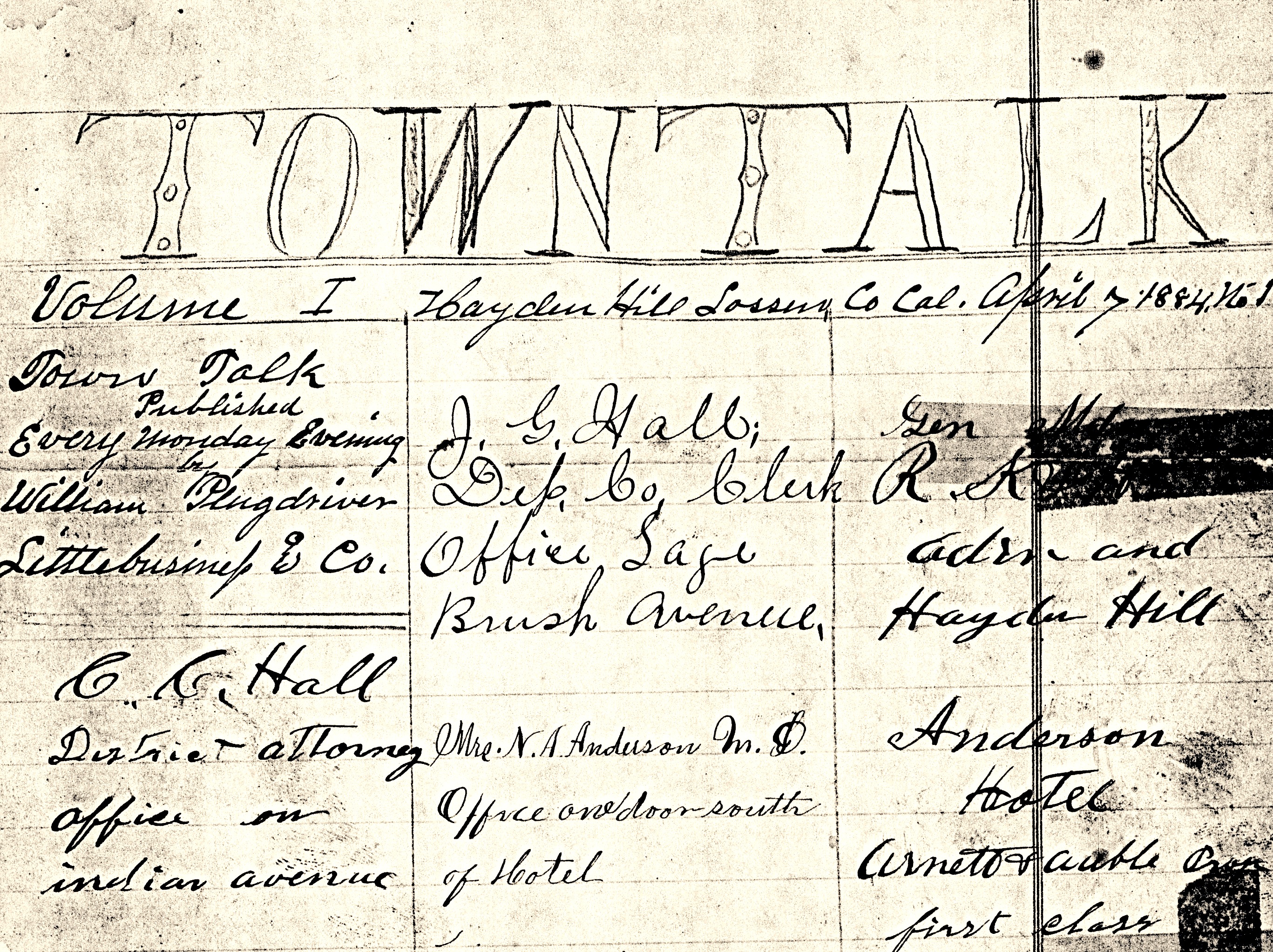
While I have posted about early journalistic endeavors such as the Richmond Times and the Susanville Reporter, I was surprised to learn that very briefly Hayden Hill had a handwritten newspaper. The first issue was named Town Talk that was published on April 7, 1884. The next issue the name was changed to Talk Town, that was published on April 14, 1884.
The contents were rather whimsical in nature. Such commentary as “Snow fast disappearing” and “There was a social at the Hotel last evening. The music both instrumental and vocals was good.”
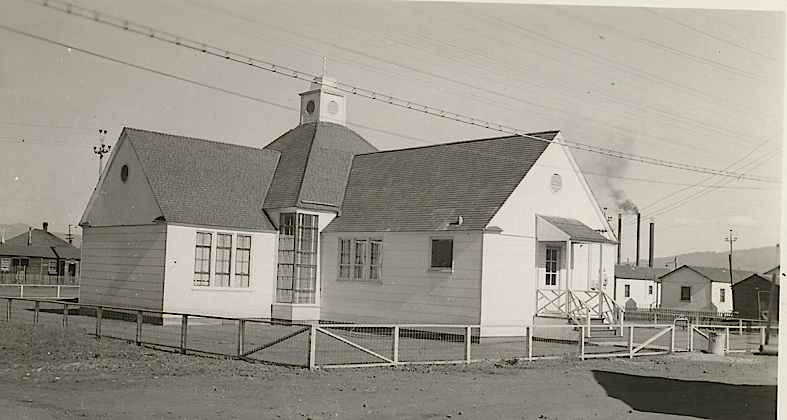
Church of the Latter Day Saints, Westwood, June 14, 1943
On March 9, 1940 the Church of the Latter Day Saints held groundbreaking ceremonies on corner of Ash and Fifth Streets, in Westwood. This was the last house of worship to be constructed under Red River Lumber Company’s tenure at Westwood.
The church was designed Caldwell and Richards, Los Angeles architects. After World War I, the LDS Church began to implement standardized plans. This particular church was the first to use this particular layout. The $9,000 church was built by volunteer labor and completed in four months.
In 1986, its congregation had grown, wherein they bought property in nearby Clear Creek and built a new church. In 1991, their old our church was acquired by Our Lady of Snows Catholic Church which they converted into a parish hall. However, with their new Lake Almanor church, it will be just a matter of time when this is placed on the market, and only time will dictate its fate.
Initially Johnstonville was known as Toadtown. According to Farris & Smith (1882) “Tradition hath it that in the early settlement of the valley, whenever a heavy rain-storm was experienced, the ground was literally covered with diminutive toads.” Lisle Lester, a noted journalist, wrote in 1865: “Toadtown is a mere bit of a hamlet, on the Susan River, notable for its name. I wondered why it was called Toadtown? Roseville would have been more appropriate for the banks of the river was fairly bordered with wild roses.” Johnstonville was named for Robert Johnston who, in 1859, along with his brother-in-law, Eber G. Bangham, traded a cow and calf to William Dow for his property there. At their December 7, 1864 meeting the Lassen County Board of Supervisors ordered the Toadtown Voting Precinct be changed to Johnstonville, and the Toadtown name faded into oblivion. It should also be the school their was originally known as Susan River and the name was changed to Johnstonville in 1877.
Note: This article originally appeared on March 14, 2015. Normally, Tuesday is a wild card day. So this part experimental, as a subscriber, for reasons unknown, is not receiving the notification.
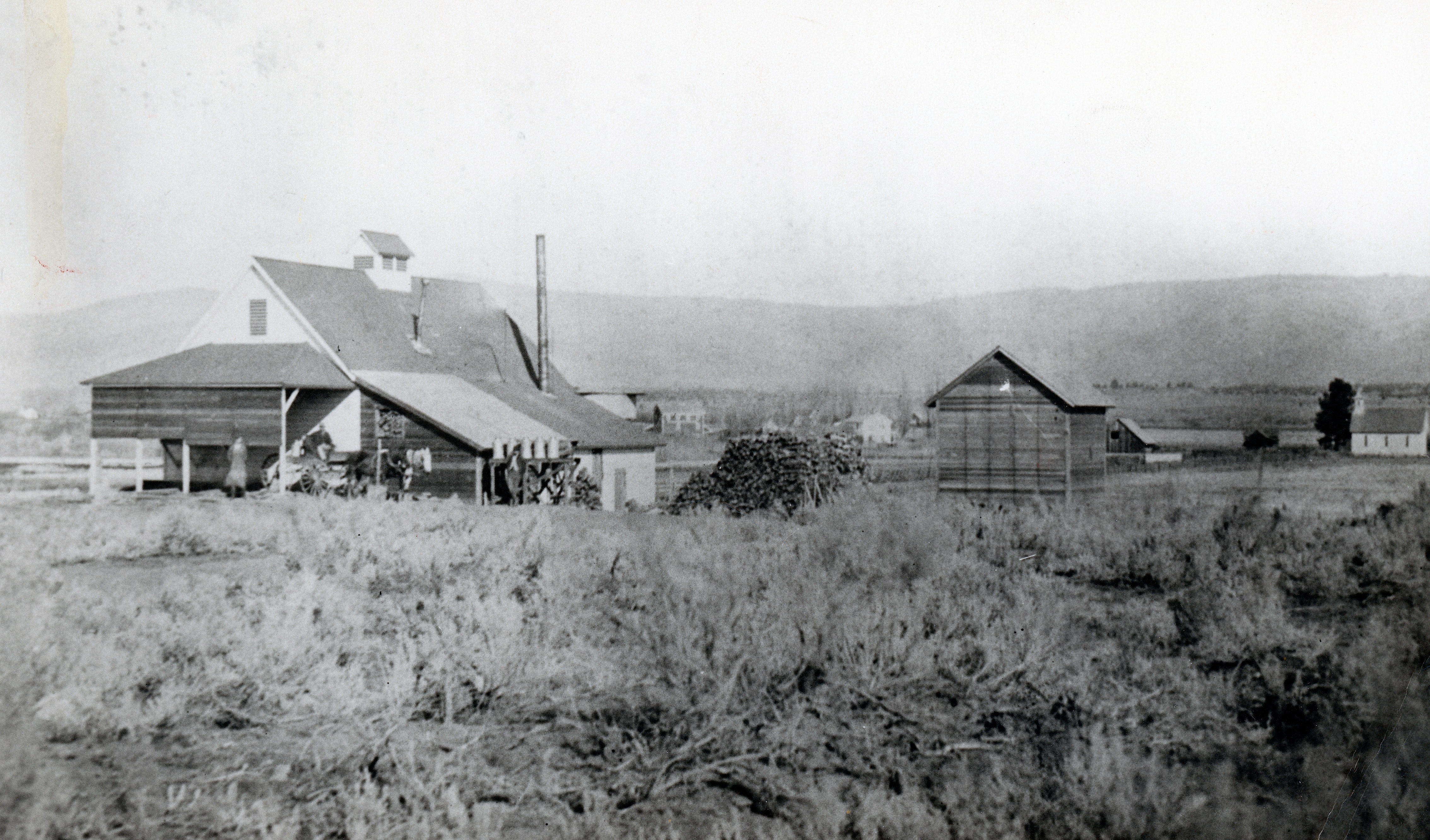
In 1861, Carlton Goodrich settled at Mountain Meadows and would become one of the largest property owners there, as his ranch totaled over 7,000 acres. He located his ranch house just west where the highway crosses Goodrich Creek, approximately across from where the old chimney stands. It became known as Mountain House and was a popular stop for weary travelers. In April 1875, Sylvester Daniels paid Goodrich a visit while touring the region and wrote, “I love these mountain folks. No aristocracy among them.” When Goodrich died in 1886, due to estate issues and the subsequent sale to John Crouch, the popular establishment closed. When the Red River Lumber Company established its Westwood operation, they transformed the old Goodrich ranch into a dairy.
Gold was accidentally discovered there in the fall of 1869 when a group of prospectors camped on the mountain, after an expedition in search of the fabled Lost Cabin Mine. They returned the following spring and named their discovery, “The Providence.” Once word spread of the new gold strike over 500 miners had flocked there. On December 5, 1870, it was decided to form a mining district to keep track of the claims. A leather bound ledger was used to record the claims. Once it was full, it was turned over to the Lassen County Recorder. A second ledger did not receive a lot of use, since basically most of the “hill” had been claimed.
It should be also noted, the area was known as the Providence Mines. When the district was formed, it was decided to name it Hayden Hill, instead of Providence, since Joseph W. Hayden, a veteran miner aged 56, was the oldest miner there, and they honored him with the bestowment. Hayden died there on Christmas Day 1884.
Since we are approaching winter, I thought the above illustration may be of interest to some. What I found of interest, was half of the precipitation occurred in the spring and fall. The additional rainfall in the spring is beneficial for crops, while in the fall is equally important to add needed moisture to the ground before the soil freezes when winter sets in.
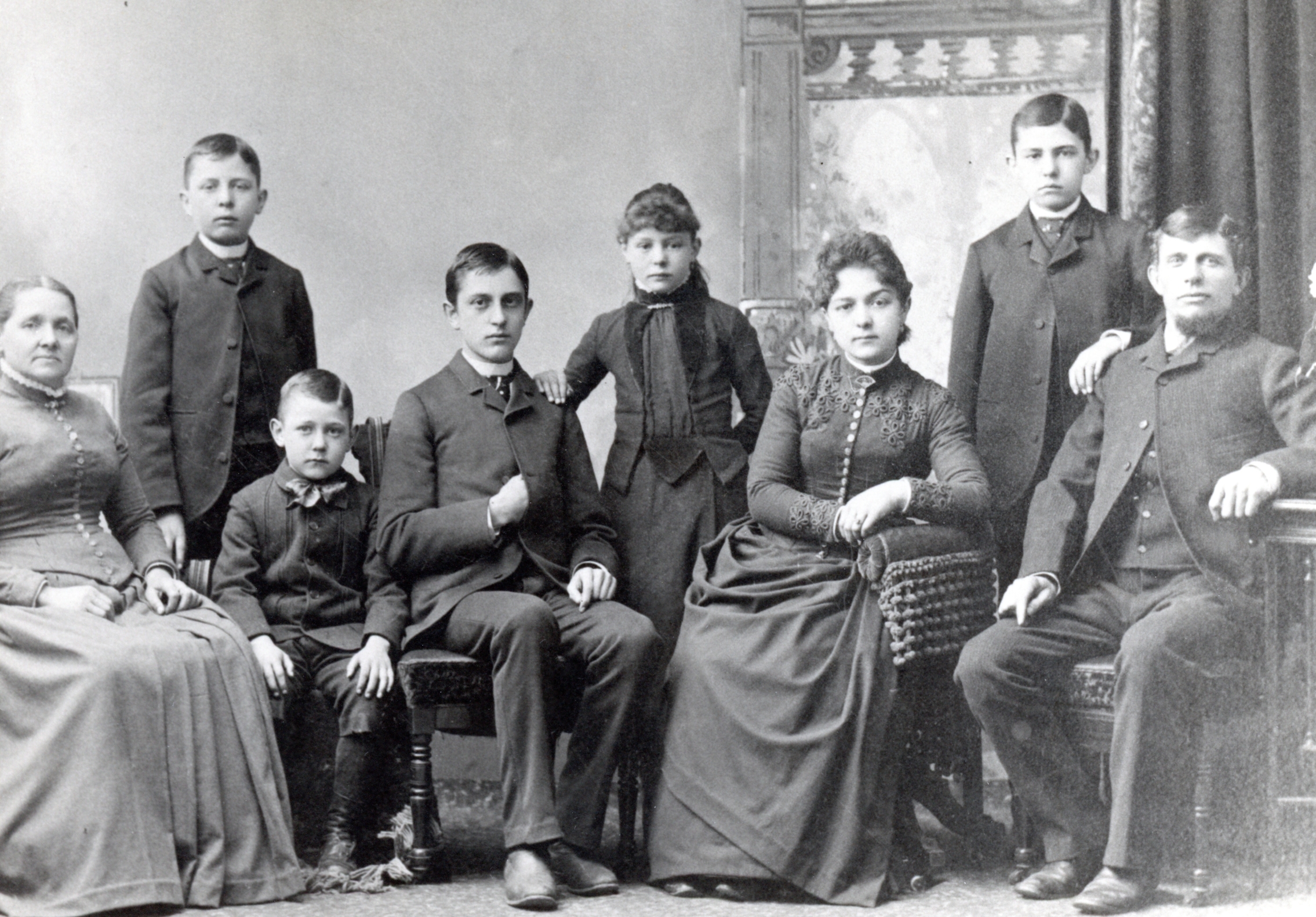
Daniel Dieter Family circa 1890. Left to Right, Barbara Dieter, George William Dieter, Ernest Dieter, Fred William Dieter, Ella Dieter (who married Floyd Hoffman), Luise Dieter (who married Charles Hollfelder), Daniel Martin Dier, Jr. and Daniel Martin Dieter, Sr.—-Carrie Golden
The Lutherans were slow to organize in the Honey Lake Valley. On August 29, 1896, Pastor J.H. Theiss held the first Lutheran service in. Janesville. Like many other religious denominations the minister would ride a circuit so services initially were sporadic. In 1904, the St. Paul’s Evangelical Lutheran Church was established at Janesville. Its initial charter members were Dan Dieter, Sr., William Hoffman, Fred Dieter, George Dieter and Dan Dieter Jr. On July 28, 1907, the Reverand F.G. Gundlach arrived to dedicate to their church located on the Standish-Buntingville Road (A-3) near Sears Road.
During the early years many of the sermons and hymns were in German. By the early 1920s services were also held in Susanville at Fruit Growers Story Club. By 1930, the Janesville church was abandoned, though in 1941 a church was built on the corner of Ash and First Streets in Susanville.
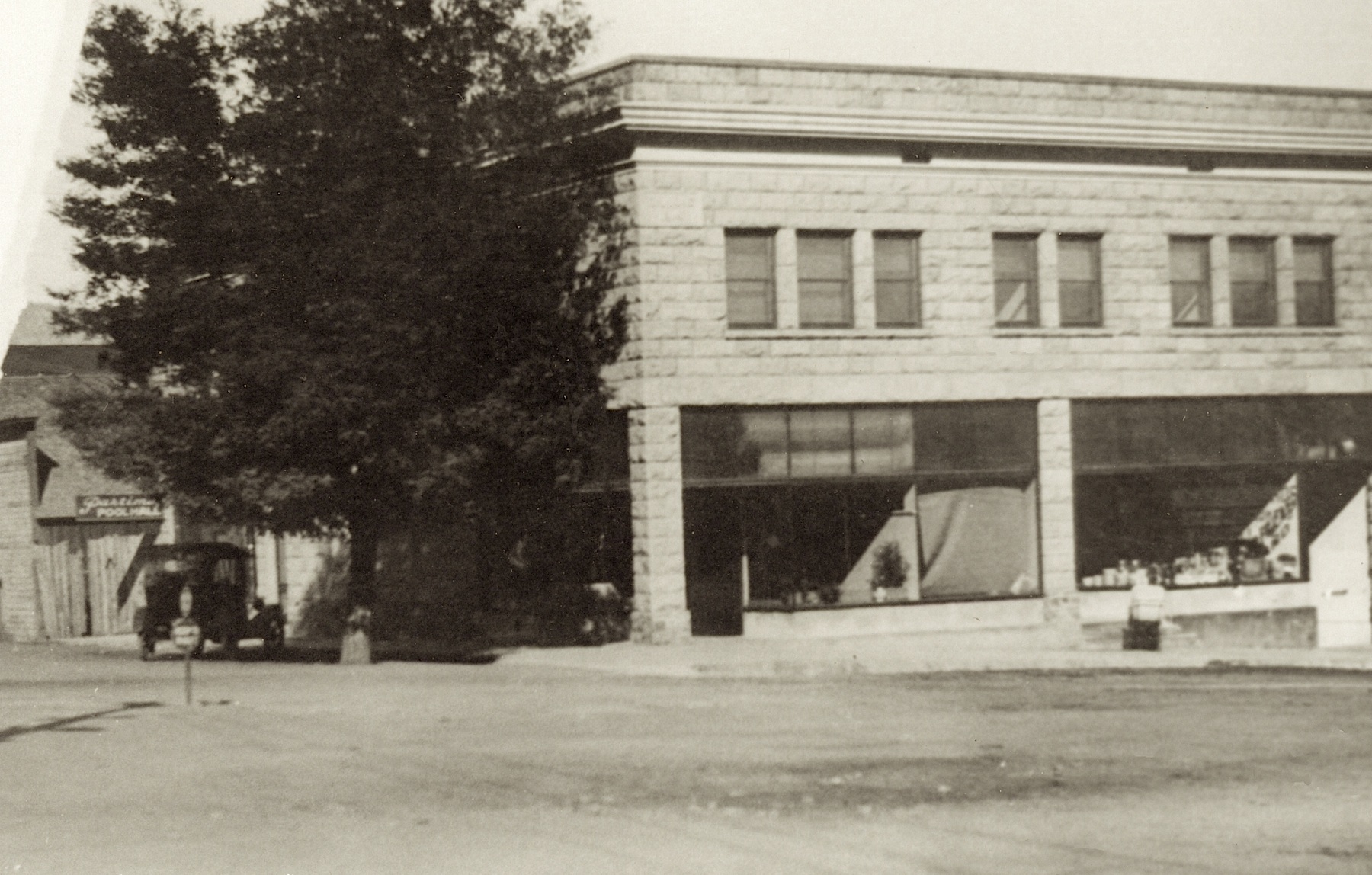
T.H. Long Building aka The Telephone Building. Courtesy of Phil Long
December 1, 1928 was interesting day in Susanville, especially at the intersection of Susanville and North Gay Streets. On this date, Bank of America took over the Lassen Industrial Bank. Safeway opened its store in the telephone building. Safeway would move several times, first to the Del Mar building on the 600 block of Main Street. In 1939, Safeway built its first store at 60 South Roop, known today as LMUD. In 1963, Safeway relocated to the 1600 block of Main Street, now the current home of Grocery Outlet. Then in the early 1990s to its current location.
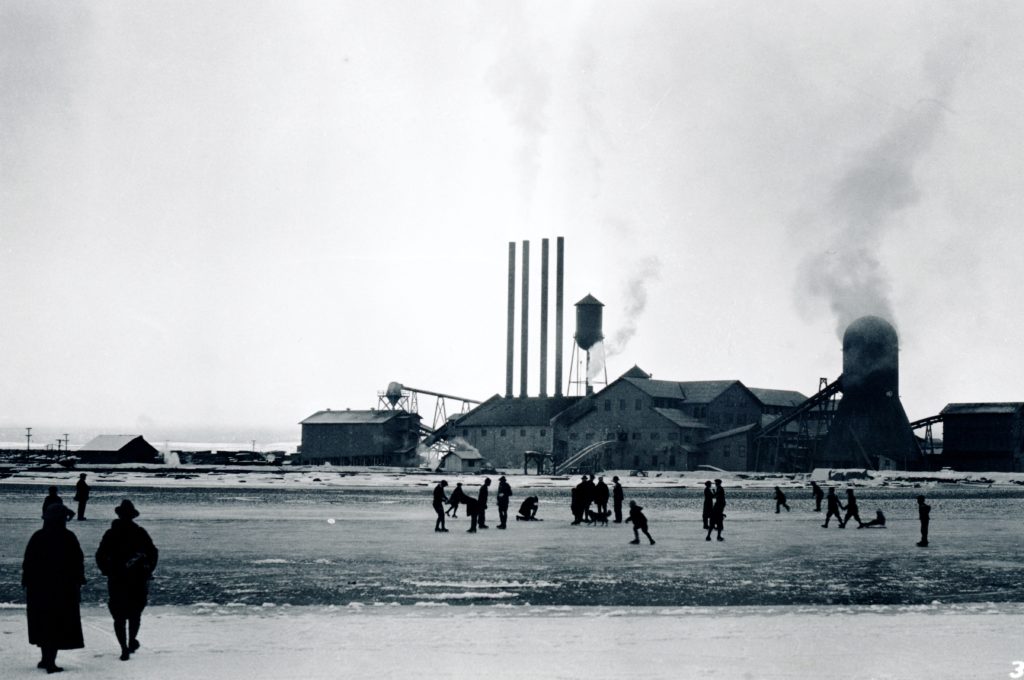
Ice skating on the Fruit Growers millpond, 1921. Courtesy of Ed Standard
Way back in the day, and I am talking over a century ago, the two most popular spots to go ice-skating was Leavitt Lake and Honey Lake. There were on times, in Susanville, where the current Memorial Park is located, it would flood naturally, and with winter conditions freeze and the locals took that opportunity to ice skate there.
When the Fruit Growers Supply Company constructed their mill in Susanville it came with the pre-requisite millpond. In the winter, when the millpond froze, some took advantage to ice skate on the pond. It all seemed relatively harmless. On Monday evening, January 23, 1922, about twenty-five people were skating on the pond. Percy N. Wemple, age 11, ventured too far out, where there was still open water and fell in. O.O. Winn without hesitation jumped into save Wemple. However, Winn struggled to get out. F.L. Shank came to the rescue and both Winn and Wemple were pulled out. They were both rushed to Riverside Hospital. The shock of the cold water, was too great for young Wemple and he could not be revived. After this incident, Fruit Growers prohibited skating or any other activity on the millpond.
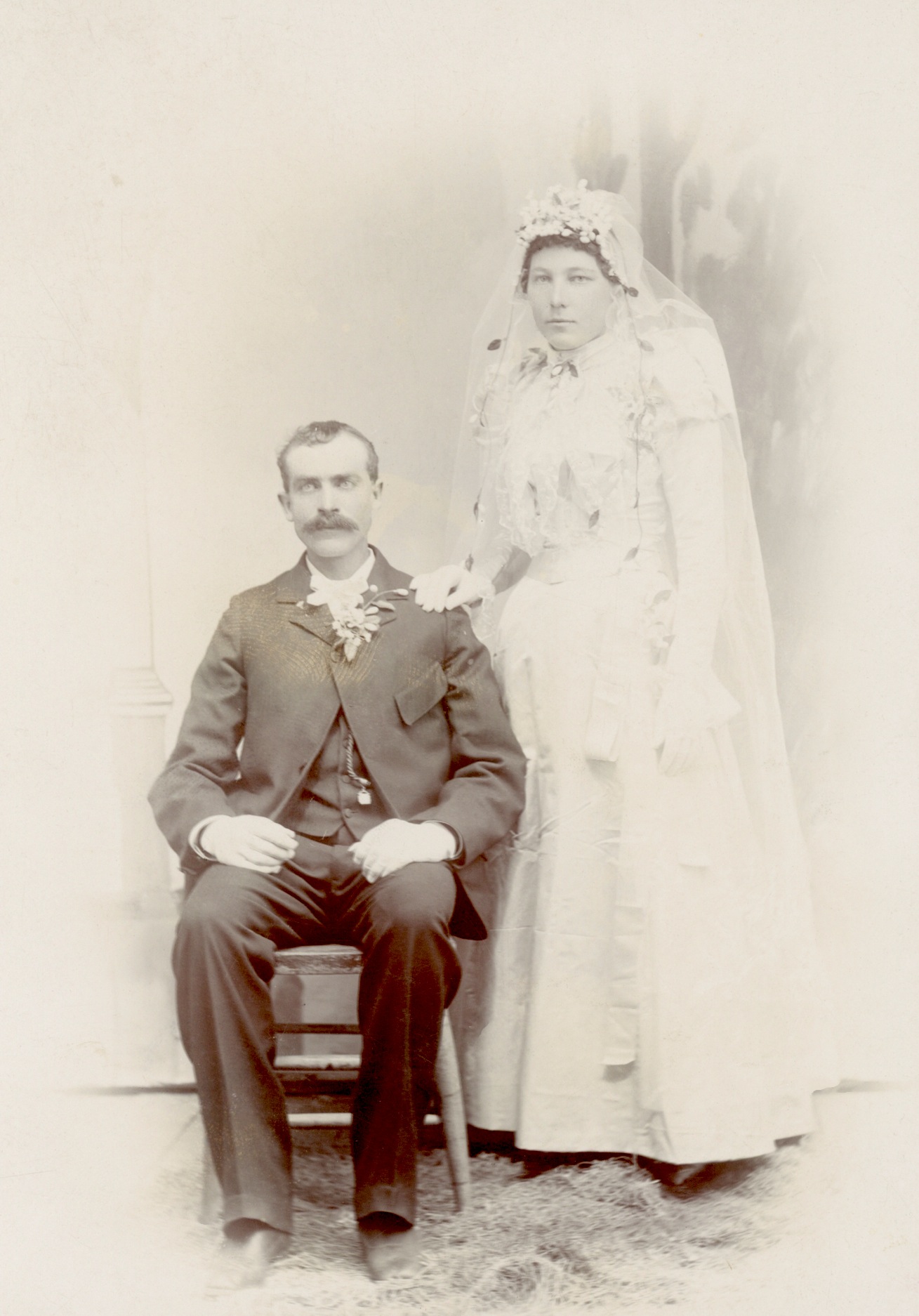
While compiling an article on the naming of Chappuis Lane, for an illustration I scanned the wedding photograph of Ed Chappuis and Nancy Johnston. Then, it dawned on me, that many wedding portraits of the 1890s and early 1900s, the man is always seated and woman is always standing. To me it seems rather peculiar and may be there is story about the custom that I am not aware of.


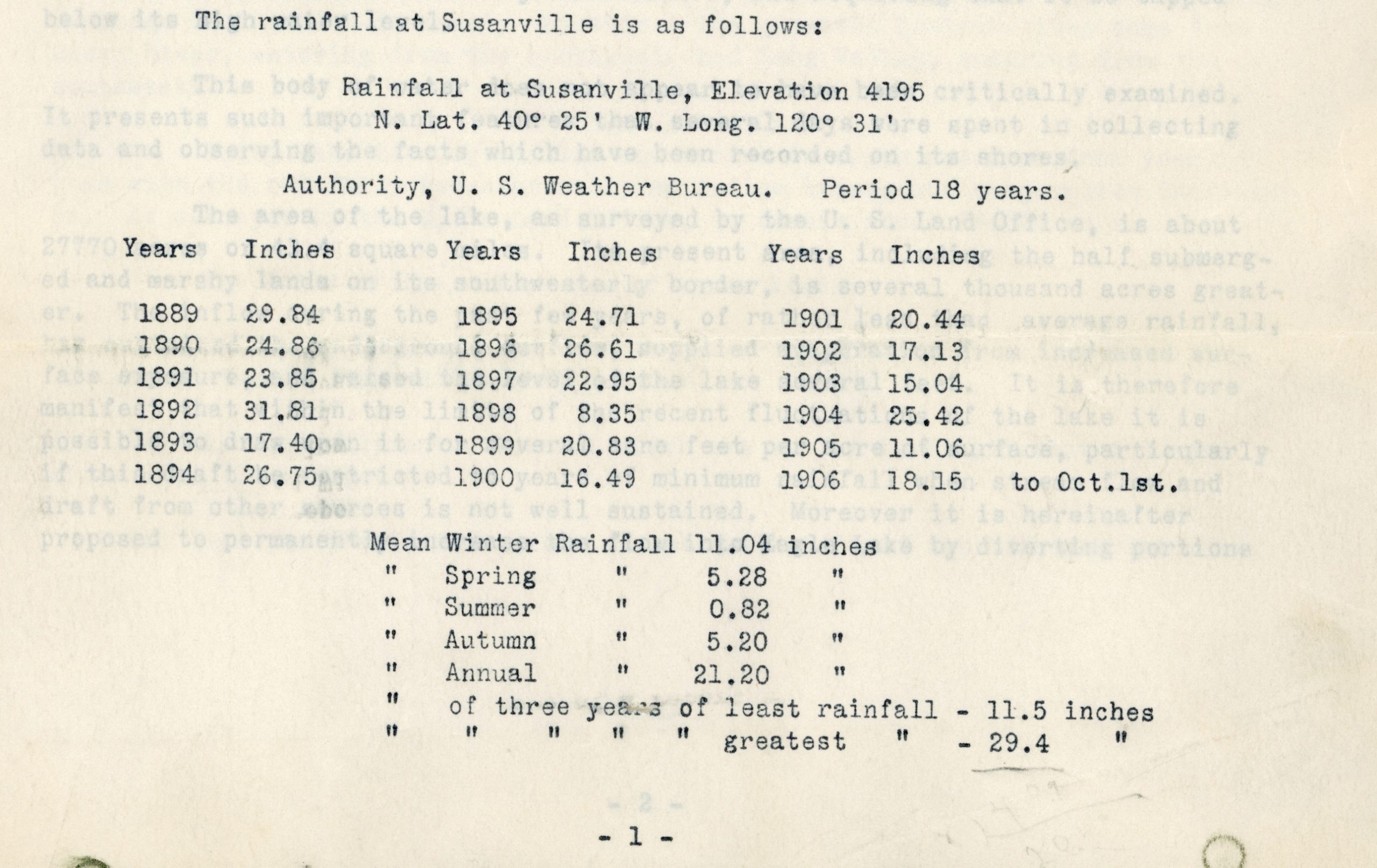 Since we are approaching winter, I thought the above illustration may be of interest to some. What I found of interest, was half of the precipitation occurred in the spring and fall. The additional rainfall in the spring is beneficial for crops, while in the fall is equally important to add needed moisture to the ground before the soil freezes when winter sets in.