Category Archives: History

New Year’s Eve, Susanville, 1934

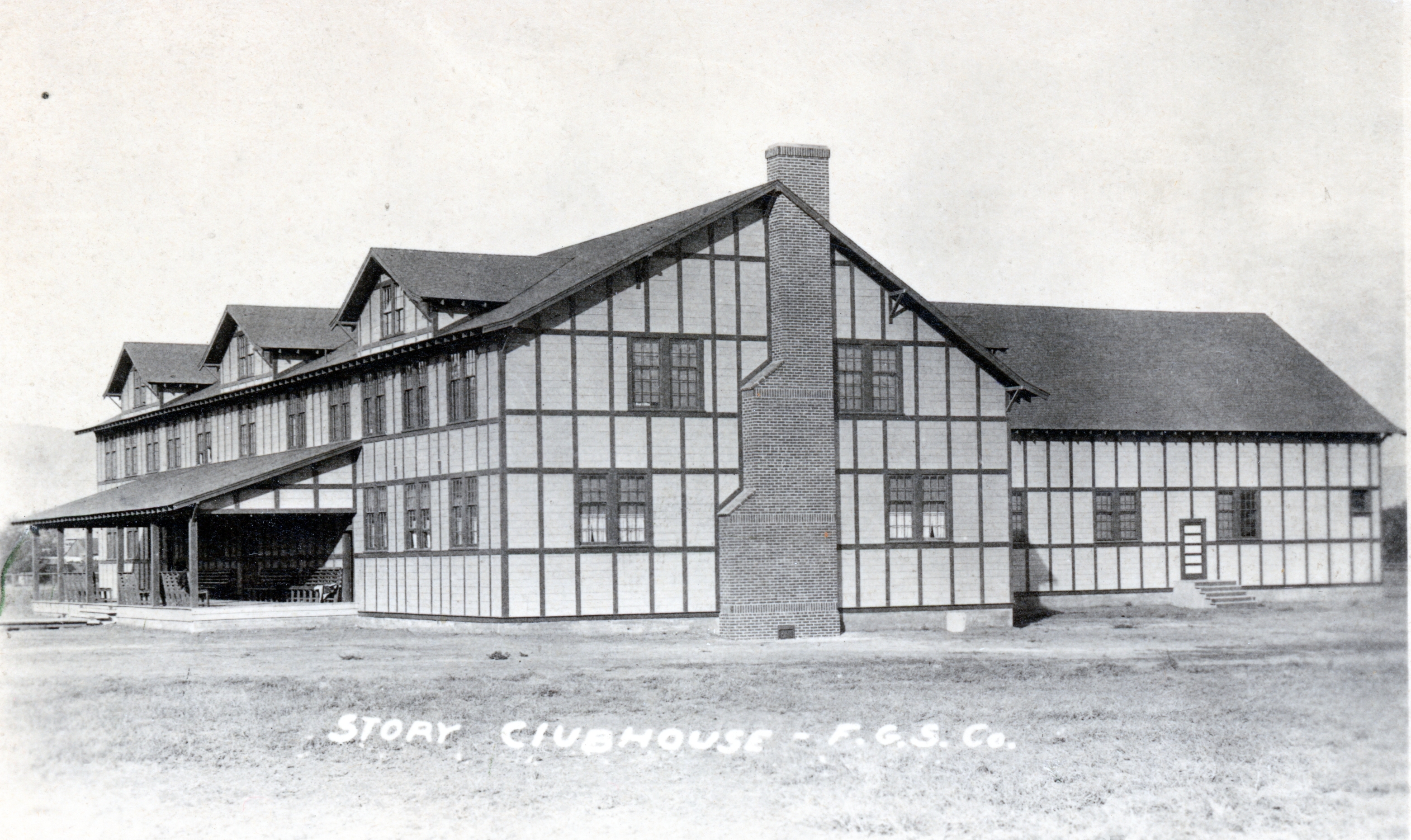
Story Club, 1924. Courtesy of Lola L. Tanner

The following is an account from the Lassen Mail about the local festivities. It included a dance held at Standish, at the Cindercone, which is still standing. The reference to the Story Club, is now the site of Susanville’s Riverside Park.

”Local residents ‘painted the town red’ here Monday evening to usher in the New Year with all the fitting and time honored customs and ceremonies.

”Three dances held, at Standish, the Commercial Hotel and the Story Club furnished ample entertainment to many while many private parties and ‘functions’ were organized to aid in the general whoopee. The public dances at Standish and the Commercial were well attended as was the more formal event of the Elks Ball at the Story Club.
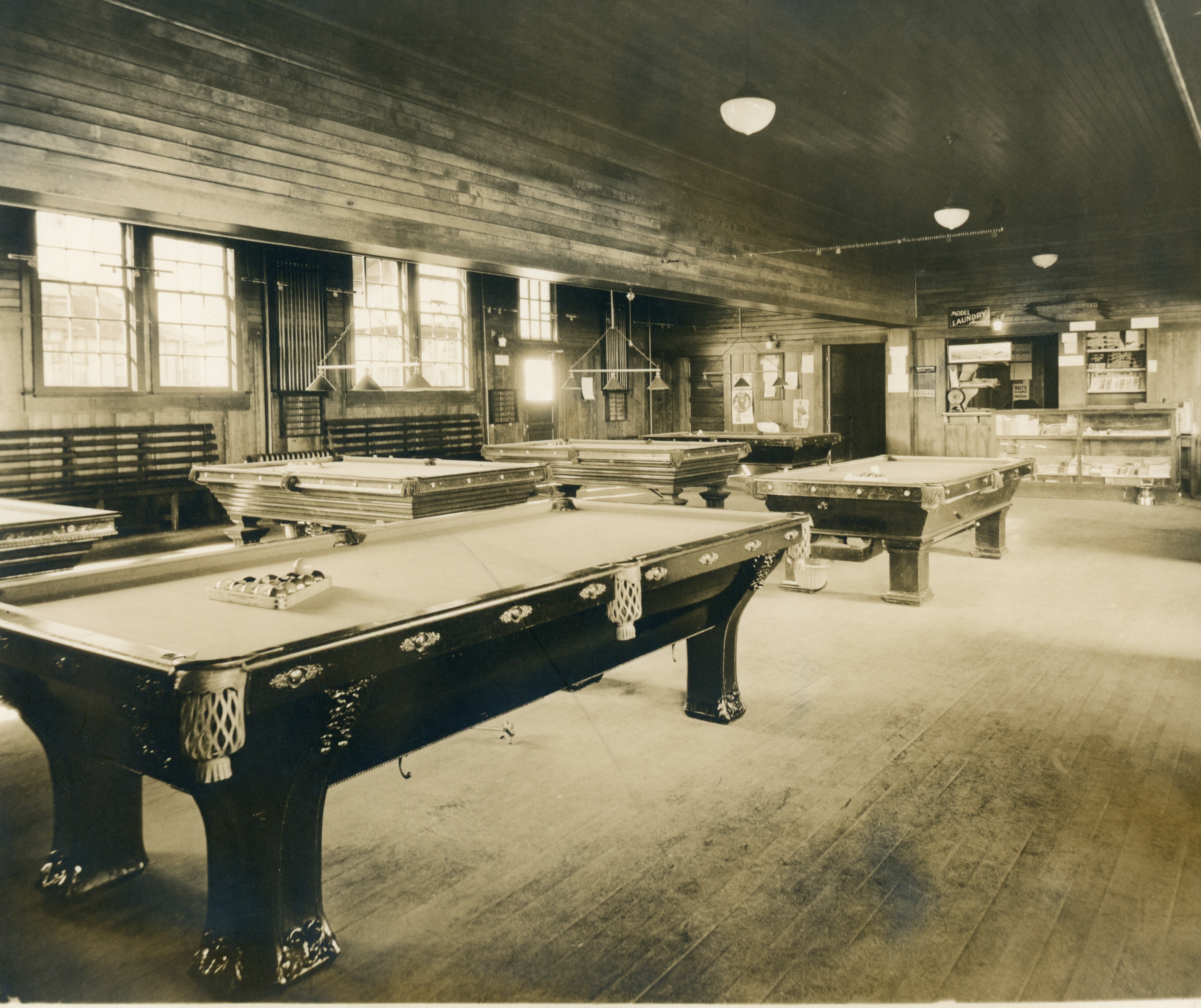
The billiard room, Story Club, Susanville, 1923. Courtesy of the Fruit Growers Supply Company

Revelers were still wandering the streets at six or seven o’clock New Year’s Day but belied the general impression by hanging up a perfect record for sobriety and safety as traffic records can testify.

“A number of ‘prominent citizens’ were overheard in expressions of relief now that the annual celebration is over with, now its time to go back to work.”

Tim
For The Record

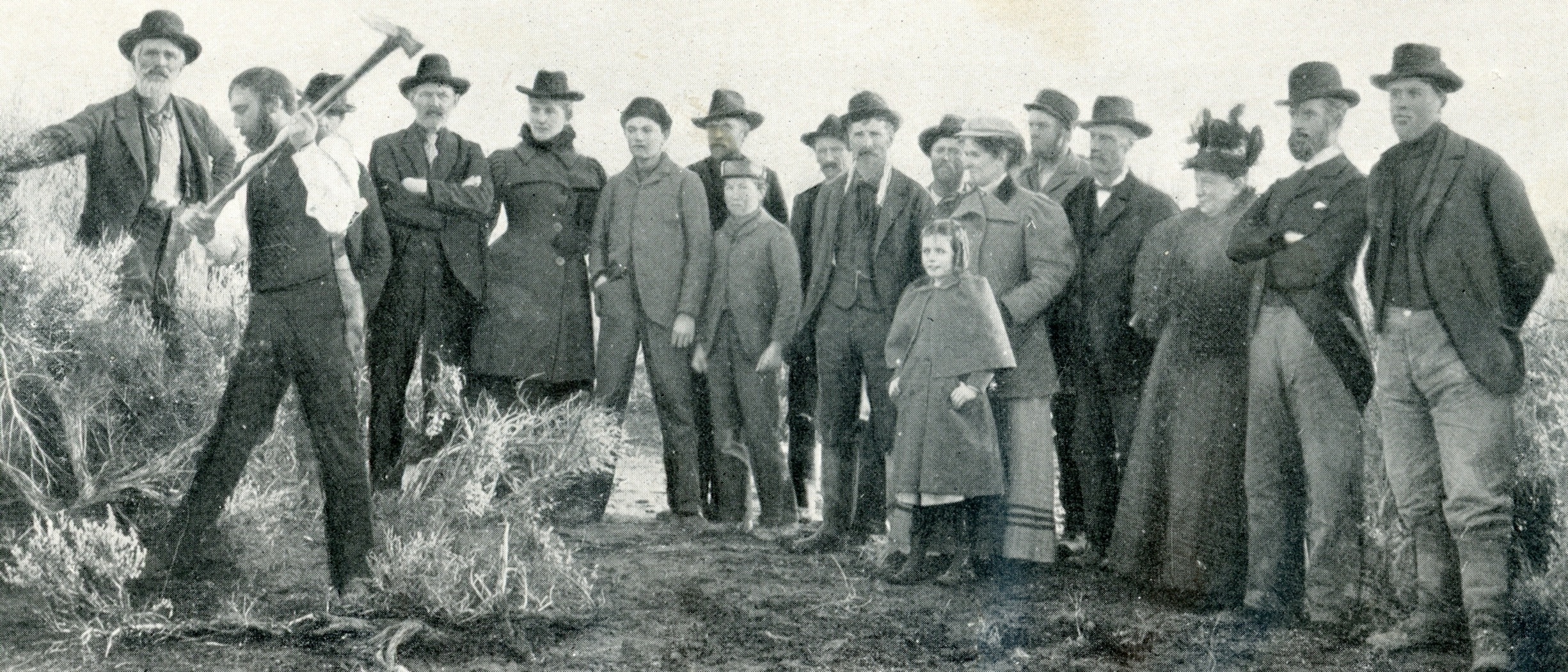
It being the second to the last day of the year, I little “housekeeping” is in order. While earlier in the year I wrote about the Standish townsite dedication held on February 5, 1898.  It was my intent to use the above photograph. Nancy Johnston Chappuis was able to identify nearly everyone of the ceremonial cutting of sagebrush at Standish. So for historical posterity here is that information.
Cutting the sagebrush is William E. Smythe. Standing behind left to right Ben Leavitt, Hi  McClellan, Gertrude McClellan, unknown, Jim Elledge, Homer McClellan, A.E. Torrey, Harriet Torrey, unknown, unknown, Mrs. Dunn, H.R.T. Coffin, and Robert Barham.

Tim

How Deep Is Honey Lake?

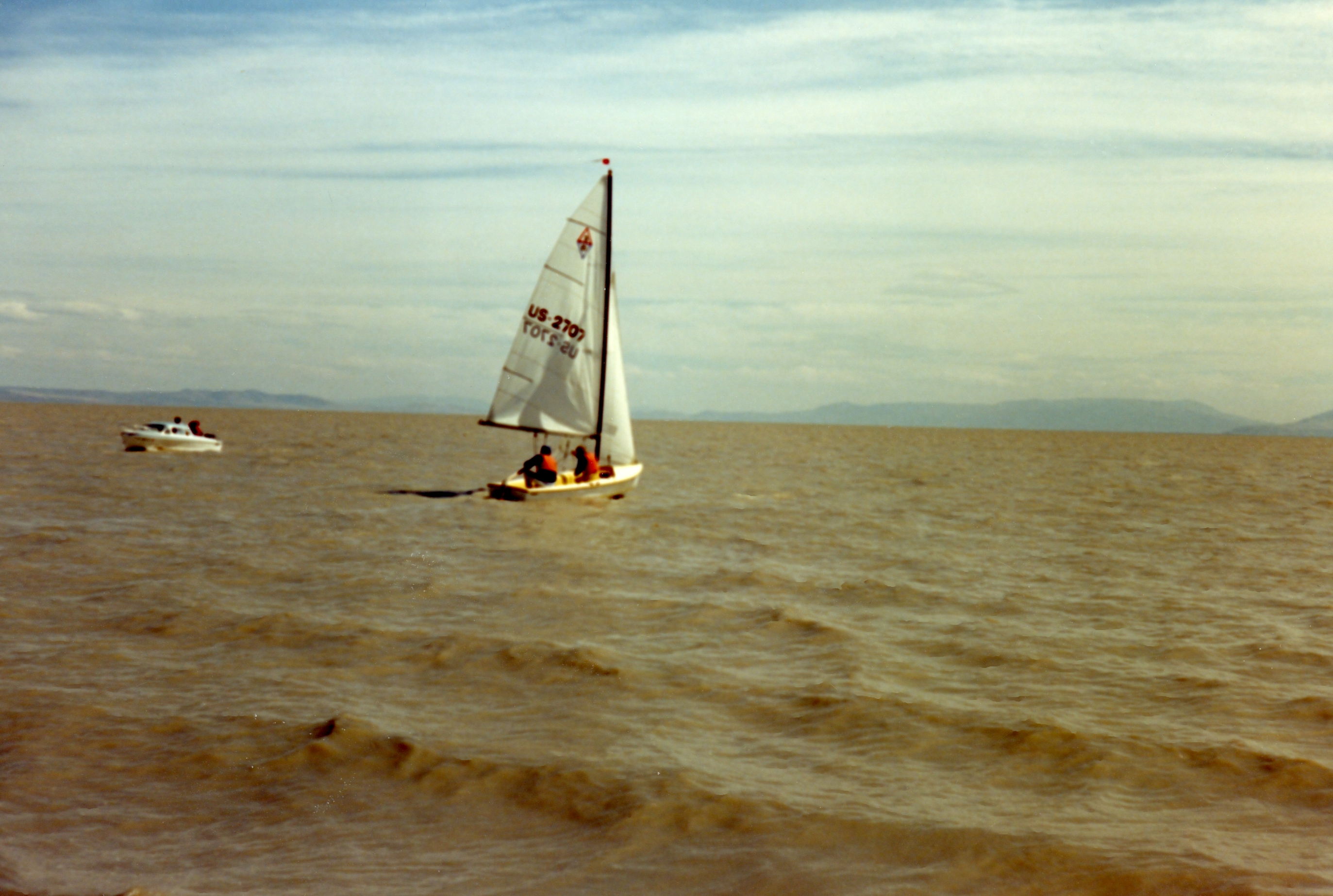
Honey Lake Regatta, 1987

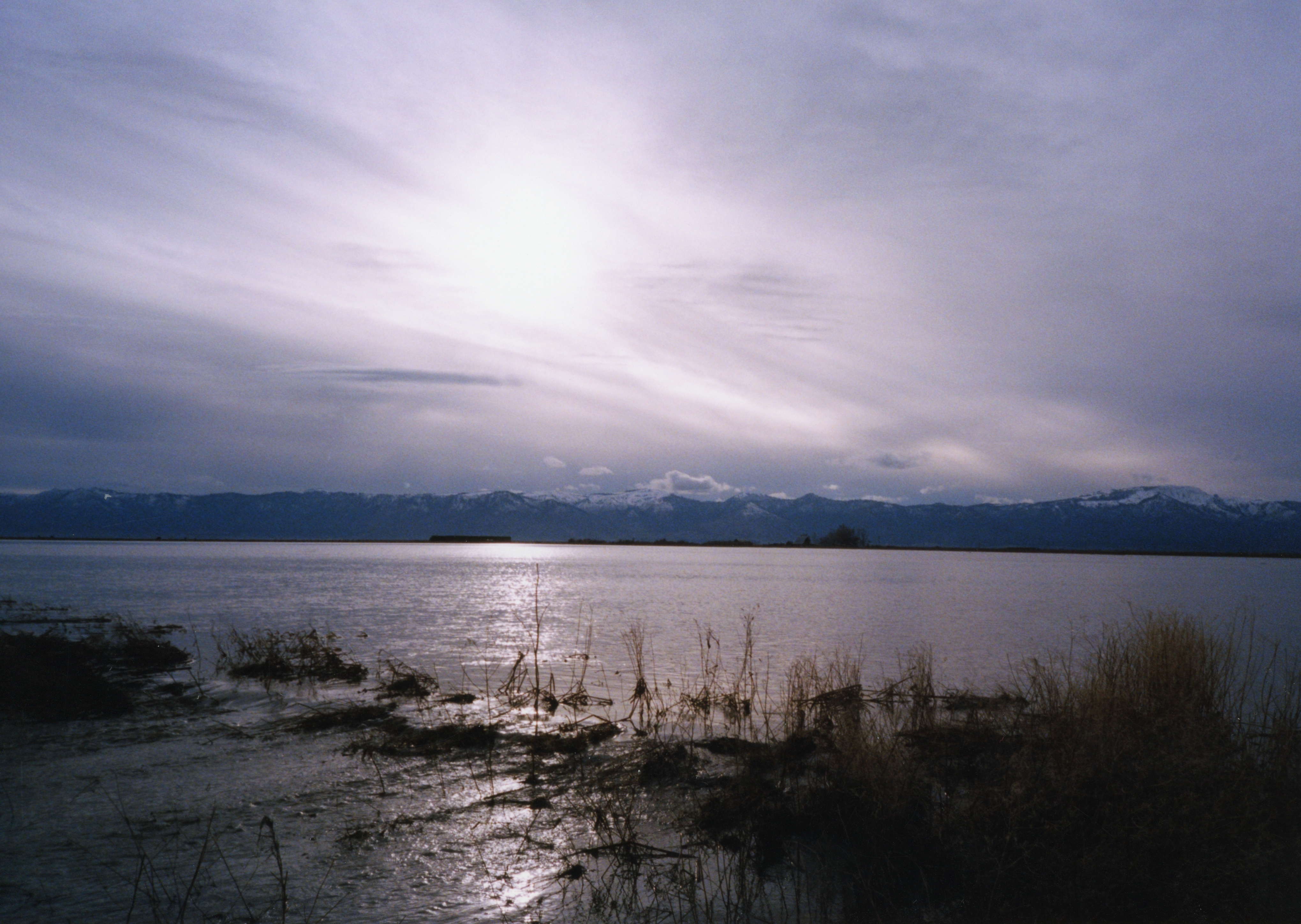
One of the perennial questions concerning Honey Lake, when it has water,  is its depth. It is a relatively shallow lake, known to go dry for extended periods. There are a number of variables about the depth, due to the fluctuation of the level of the lake. The east side of the lake is the shallowest. Carl Caudle a civil engineer who resided near the lake’s eastern shore from 1909 to 1942 monitored the lake level there. On an average he recorded a depth of two feet. However, in the spring of 1914 and 1938, both years of record breaking precipitation, the east shore had a depth of six feet. The west side of the lake has the deepest points up to twenty-five feet during years of heavy precipitation.

Honey Lake, 1997.

In late December, 1940  Asa Brown and Jack Sawyer, state fish and game employees conducted a sounding of the lake. They started at the northwest corner, using a measuring pole took measurements every 300 to 400 yards. They recorded a maximum depth of 10.8 feet, and the shallowest at two feet. The lake on the average varied between four and ten feet. In the spring of 1987, Mark Totten and several others participated in an informal sailboat regatta on the lake. Using a depth finder, the areas traversed on the lake averaged seven feet.

Never miss a story, click here.

The California Highlands

Belfast
Belfast area of the Honey Lake Valley, 1987–Bernard McCallister

William Smythe, who in the mid-1890s, was a key figure to develop a utopian community of Standish in the Honey Lake Valley, had numerous observations of the territory.. The region left an impression on him. He dubbed the Lassen, Modoc and Plumas area as the California Highlands. In his opinion the Sacramento and San Joaquin Valleys were the California Lowlands.

Smythe noted some of the quirkiness of the residents of the Honey Lake Valley. One particular item that caught his attention was the local vernacular. Smythe wrote “When a Honey Laker contemplates a journey to San Francisco, or any other point on the other side of the great range, he says ‘I am going down below.’” Smythe continued “These peculiarities of local speech plainly reveal the physical geography of the country.”

The phrase going down below remained in the local lexicon for many decades. When I was growing up, it was still widely used, though it has since gone by the wayside.

Tim

Eastern Honey Lake Valley

Eastern Honey Lake Valley, near High Rock Ranch, 1916. Courtesy of Betty Barry Deal

In the 1800s and early 1900s there were a lot of dreamers and schemers whose desire to transform the sagebrush lands of eastern Honey Lake Valley into productive farm lands. It first began with Capt. Charles A. Merrill, who in 1878, proposed to use water from Honey Lake to irrigate the same. It should be noted that this is the same Merrill who worked relentlessly for twenty-five years to tap Eagle Lake for irrigation of the Honey Lake Valley. By 1891, there were so many reclamation projects underway, it was remarked that the Eagle Lake water would not be needed for irrigation, but it could be used to keep Honey Lake full for the pleasure of the members of the Amedee Yacht Club, among others.

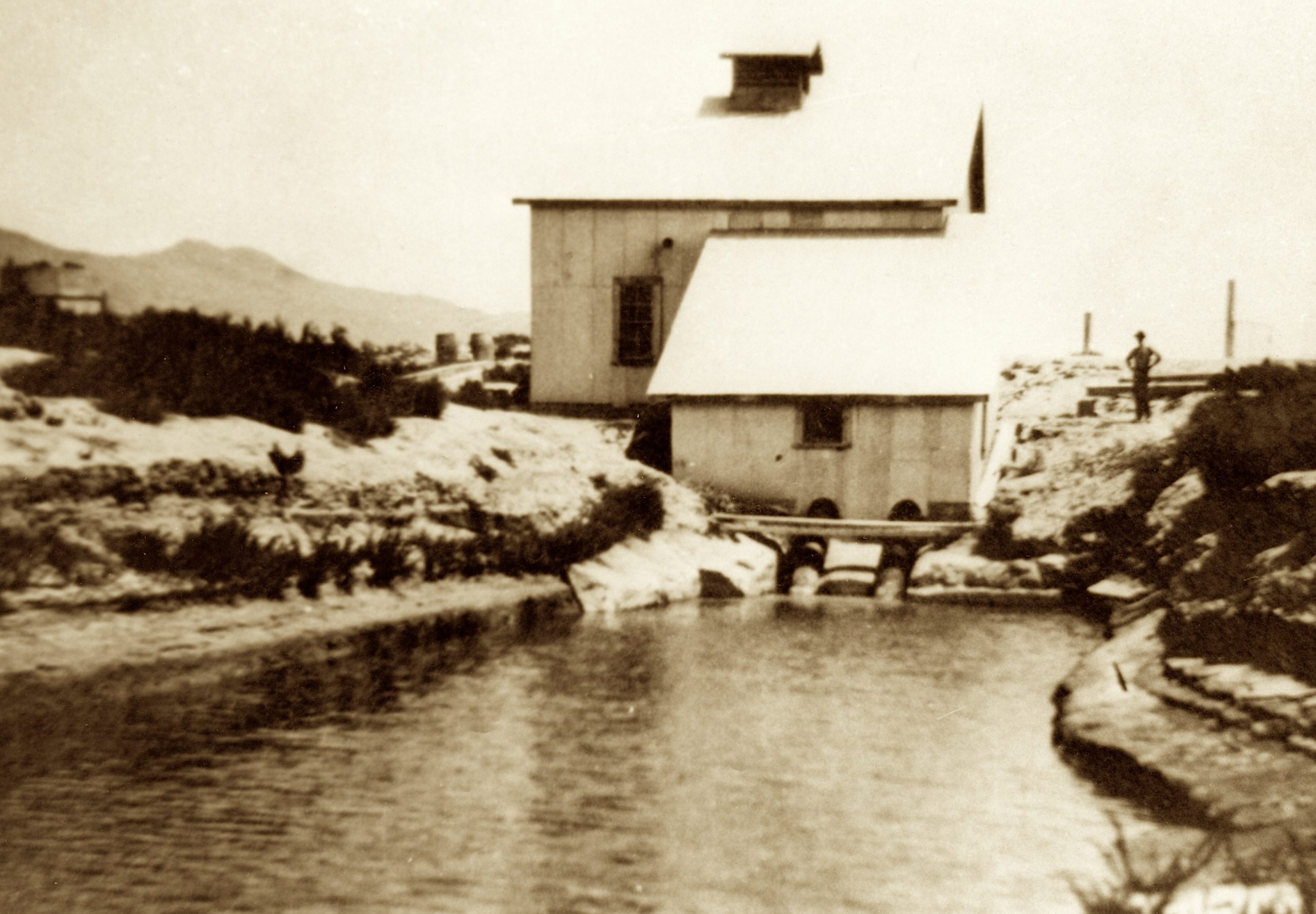
Honey Lake pumping plant, 1911–Prentice Holmes

In 1910, the Standish Water Company built a pumping plant on the east shore of Honey Lake that they believed would transform the region into a major sugar beet production. It went bust. Then, in 1916, the Honey Lake Valley Irrigation District thought that they had a viable plan to tap Eagle Lake that went nowhere. Last, but not least was the Southern Irrigation District that was to transform the region with water from the Little Truckee River. By the 1920s, after so many failed attempts for reclamation the entrepreneurs gave up.

Support

An Interesting Christmas Postcard

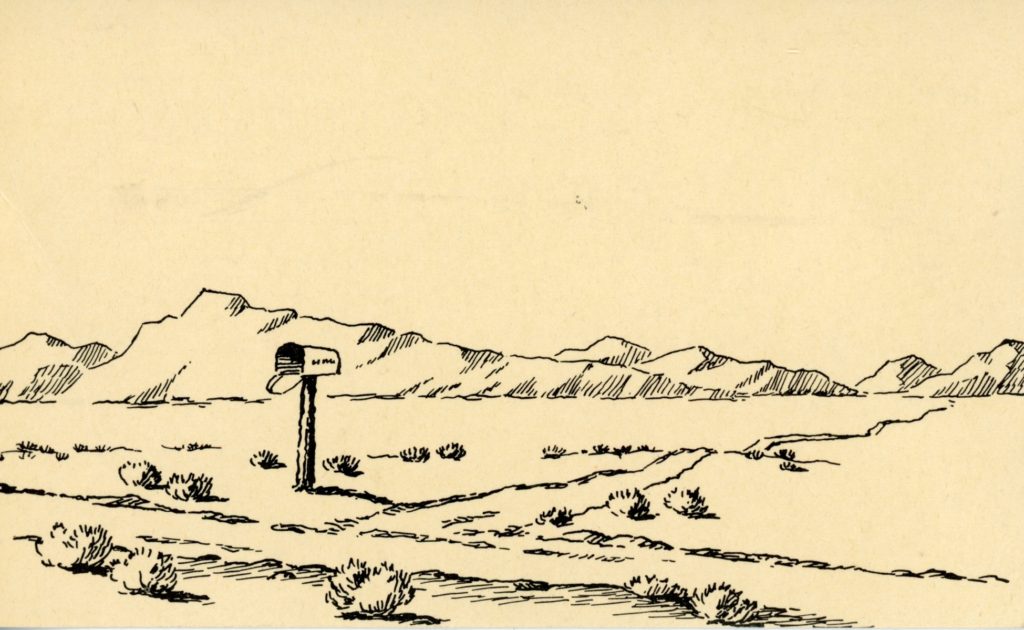
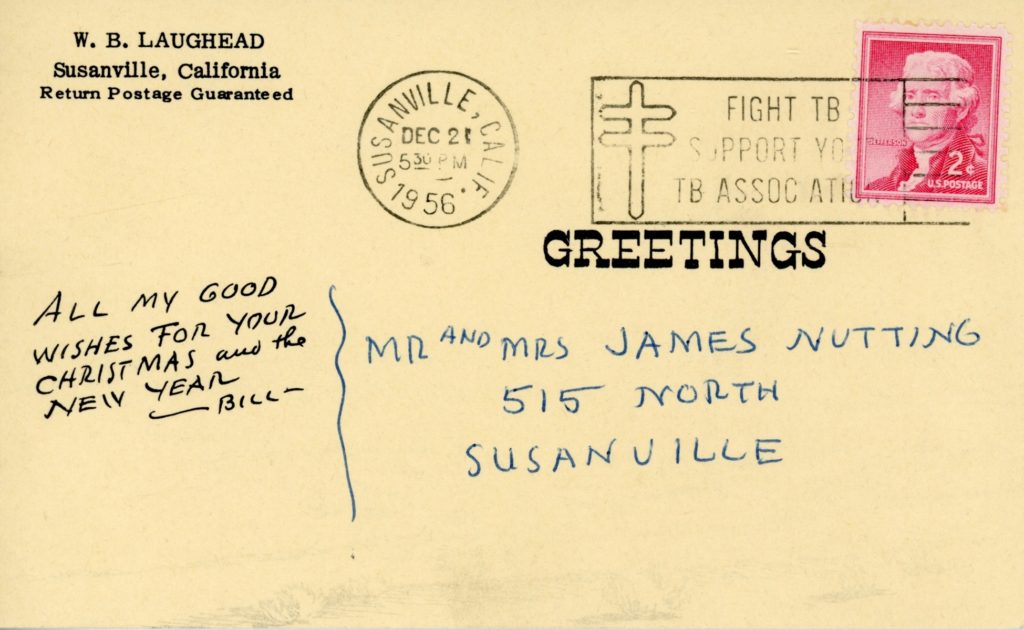
A Laughead Christmas postcard.

One of the interesting characters in the Red River Lumber Company’s family was William Barlow “Bill” Laughead, a cousin to T.B. Walker the founder of the company. Laughead contributed to
Red River’s public image, all by accident.

In 1900, Bill, a high school drop out, left his native Ohio and went to Akeley, Minnesota to work in the woods. His first job was that as a logging camp chore-boy, slowly working his way up the ladder as an assistant bull cook, timekeeper, timber cruiser, surveyor and his last position being a construction engineer. After eight years in the woods, Bill moved to Minneapolis where he worked odd jobs and during the interim tried his skill in free-lance advertising work. In 1914 his cousin Archie Walker, hired him to work on an advertising campaign for the California operations. Laughead conceived the first drawings of the Paul Bunyan character. In 1916, a promotional pamphlet “Introducing Paul Bunyan” failed. The general public never heard of Paul Bunyan, he was just part of logging camp folklore. However, Archie liked the idea. By the mid-1920s the Paul Bunyan campaign flourished and became Red River’s logo.

In 1922, Laughead moved to Westwood and became the company’s  advertising director. He filled in when necessary in other positions, such as the first manager of the Westwood Theater. When Red River sold in 1944, Laughead retired to Susanville. He would do illustrations for various trade publications related to the lumber industry. He also did whimsical Christmas cards for his friends, which is presented today.

Tim


Christian Science Society

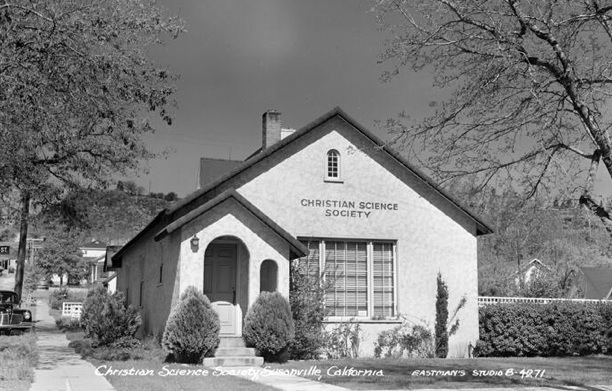
Christian Science Society building, 1946.

In 1920 the Christian Scientists organized locally and held their meetings in the hall of the Knoch building. On August 26, 1931, they purchased property on the corner of Mill and Lassen Streets from Gladys Burroughs and Iva Raker. In the fall of 1937 they announced plans to build a church. The following spring, Enoch Strom began construction of the church. The first services were held in the new church on June 12, 1938. During the Thanksgiving Services of 1938 the building was dedicated. At the same the congregation was pleased to announce that is was debt free. Over the years saw a slow decline in attendance and in 1999, the local church disbanded.

Tim

Chicken Nuggets

Vic Perry’s Store on Wheels, Standish, 1911. Courtesy of Alphozene Terril

This story has nothing to do with the kind of chicken nuggets people purchase at fast food outlets. Early on in my research career, I heard a lot of stories, some were true and others, not, but nonetheless they were good tales.

One particular tale was told to me many times, and that a particular incident occurred more frequently especially in the Gold Run and Richmond area. It was not unusual for a person who while prepping a chicken to eat, during the dressing stage, would find a small gold nugget stuck in the chicken’s craw. To add credence to this story, I came across the following tidbit:  Lassen Advocate,  March 25, 1897 – Vic Perry, the rustling poultry and egg denier, so reports say, recently killed and dressed a chicken for market, in the craw of which he found two dollars and seventeen cents worth of gold. We do not mention the matter as one that is particularly noticeable in this section, however remarkable it might be in other localities but simply present it as an ordinary every day sort of a fact.

Yet, here is another published account from Westwood’s Sugar Pine Press of January 26, 1928: “Gold is where you find it. Wendell Durkee bought a chicken at the store one day last week which he thinks is a bargain as in cleaning it he found a small gold nugget in the gizzard. Upon investigating where the chicken came from, it was found that a Susanville  man raised it and thinks that the nugget was brought to the chicken yard in a load of gravel from the Susan River.”

Subscribe!

Roosevelt Pool Condemned

Roosevelt Pool, 2002

On December 22, 2004, the  City of Susanville condemned  the Roosevelt Pool citing structural defects. This became a long and some times not pleasant saga as to what direction to take. It would take a decade before any action was undertaken in February 2015 the old pool was demolished.

Roosevelt Pool
Remnants of Roosevelt Pool, February 21, 2015

Slowly, but surely there would be a new pool, built adjacent to the old site. Getting all the parties to agree and move forward was another matter. In the end in 2017 a new outdoor community pool became a reality.

Tim


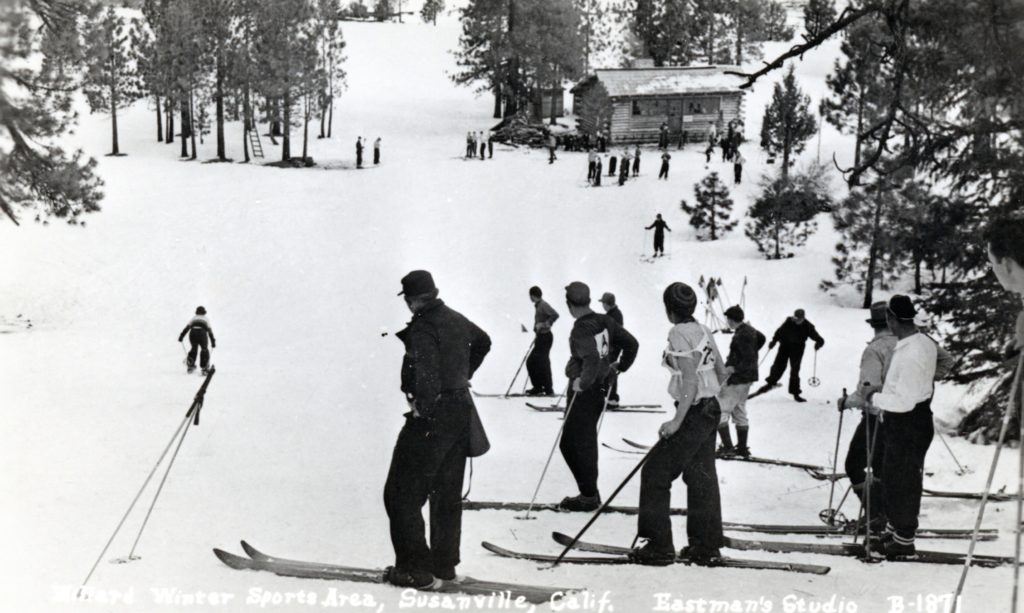
Willard Hill, Lassen County

Willard Hill, 1940. Courtesy of Margaret A. Purdy

Willard Hill located some six miles west of Susanville was a popular winter sports venue. Its initial development came about through Lassen College’s Forestry Program inconjunction with the National Youth Administration. The latter provided each forestry student with not only academic training but to work in related forestry jobs. For their part-time work the students were paid $30 a month, however $20 a month was deducted for room and board in the converted Alpine Hotel dormitory. Continue reading Willard Hill, Lassen County